
FF Duration
Louis Joyner, 183 Civitas St., Mt. Pleasant SC 29464
GEARING DOWN:
Engines like it fast, propellers like it big. The modern short-stroke, two-stroke engine, such as the Nelson .15, produces maximum power at a very high rpm.
The 2.5cc (cubic centimeters or .15-cubic-inch) Nelson turns more than 30,000 rpm on the ground, gaining several thousand more rpm as it unloads in the air. But to get that high an rpm, you have to use a small propeller—typically something close to a seven-inch diameter and three-inch pitch.
With propellers for any type of model, the efficiency increases as the prop gets bigger in diameter. One reason is the increased disc area: the area swept by the blades.
A seven-inch-diameter prop will have a disc area of 38.5 square inches; a 12-inch prop will have a disc area of 113.1 square inches—roughly three times that of the smaller prop. And on a smaller-diameter prop, the fuselage will block proportionally more of the area than on a larger prop.
Assuming a fuselage diameter of 1.6 inches (2.5 square inches), a seven-inch prop will have a useful disc area of 36 square inches, compared to 110.6 square inches for the bigger 12-inch prop.
Factor in the area of the cylinder sticking up from the fuselage, and the area difference is even more.
Propellers work by increasing the speed of the air going through them. Surprisingly, the more efficient the prop, the less the velocity increase. A small prop must move a small amount of air (remember the small disc area) very fast. A larger prop moves a larger amount of air at a slower speed.
A 24-inch-diameter Wakefield prop produces a much slower slipstream than does a typical Gas model with a small prop.
The typical Wakefield Rubber-model prop has an efficiency of approximately 80%—far higher than the small props used on high-revving gas models. One estimate puts the small props at roughly 40% efficiency.
However, putting a big prop on a modern gas engine would only overload it. The solution is simple: gears.
By gearing the crankshaft speed down, the available torque is increased, allowing the use of a larger, more efficient prop while keeping the engine rpm in the range of maximum power.
A few people have tried gears throughout the years. Michael Gaster, 1955 Power World Champion, experimented with 2:1 reduction gears on a follow-on model to his Gastove. The late Tom McLaughlan had a geared model at the World Championships a quarter-century ago.
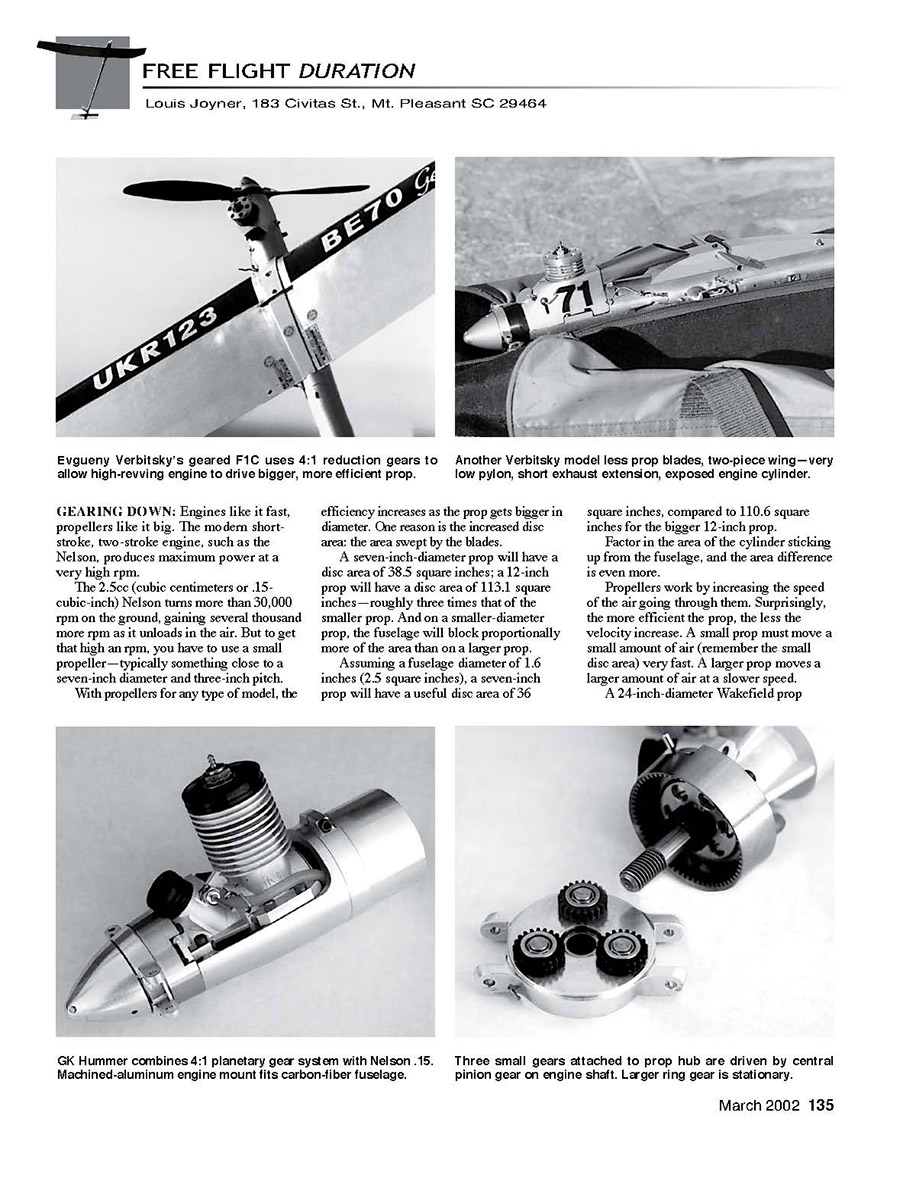
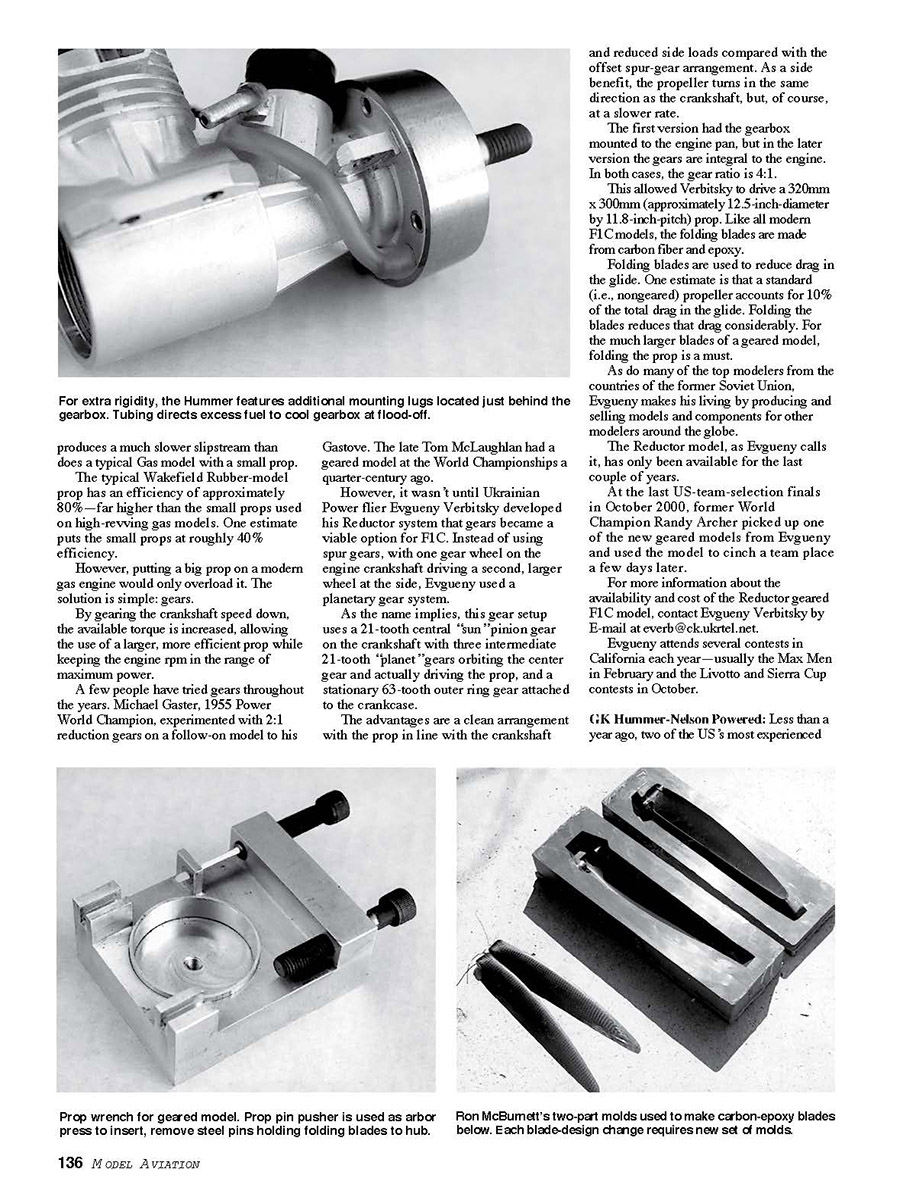
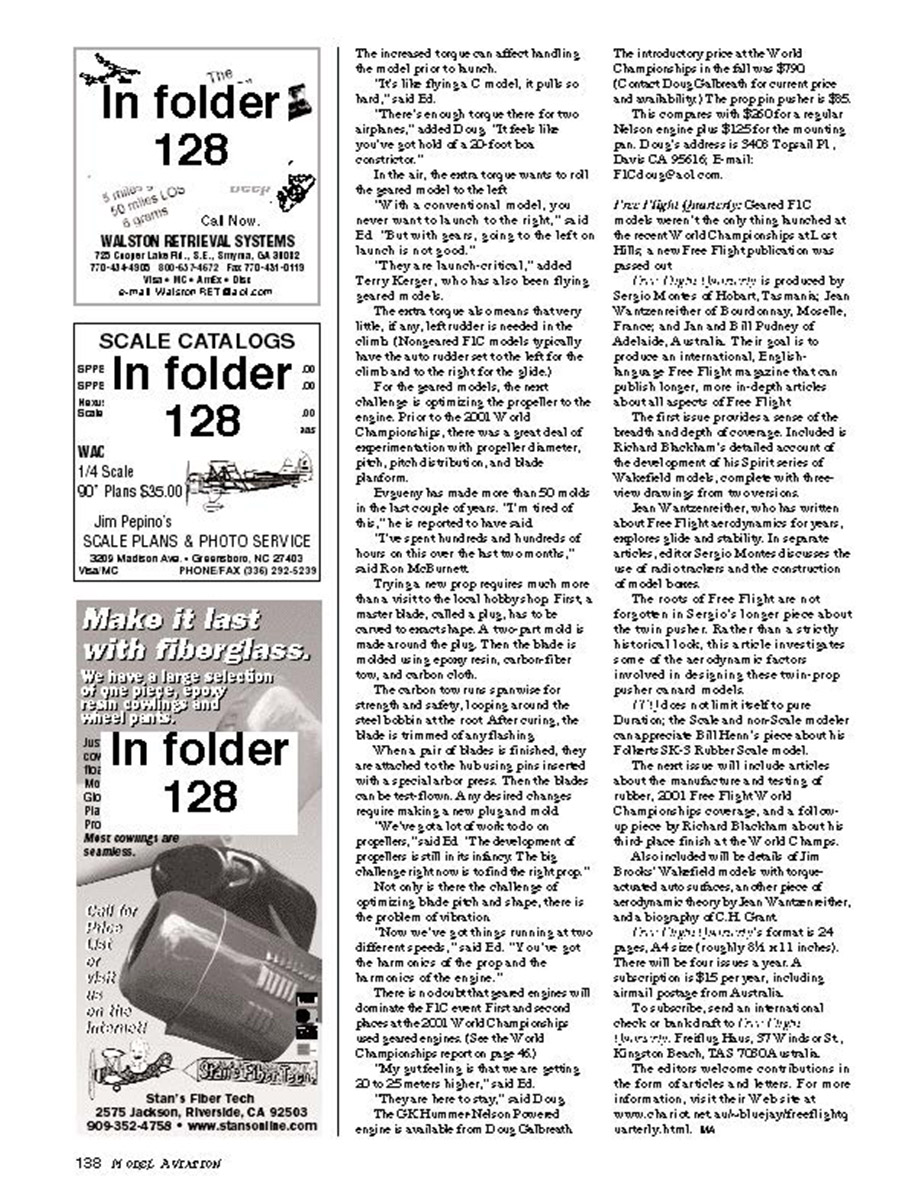
However, it wasn't until Ukrainian Power flier Evgeny Verbitsky developed his Reductor system that gears became a viable option for F1C. Instead of using spur gears, with one gear wheel on the engine crankshaft driving a second, larger wheel at the side, Evgeny used a planetary gear system.
As the name implies, this gear setup uses a 21-tooth central "sun" pinion meshing on the crankshaft with three intermediate 21-tooth "planet" gears orbiting the center gear and actually driving the prop, and a stationary 63-tooth outer ring gear attached to the crankcase.
The advantages are a clean arrangement with the prop in line with the crankshaft and reduced side loads compared with the offset spur-gear arrangement. As a side benefit, the propeller turns in the same direction as the crankshaft, but, of course, at a slower rate.
The first version had the gearbox mounted to the engine pan, but in the later version the gears are integral to the engine. In both cases, the gear ratio is 4:1.
This allowed Verbitsky to drive a 320mm x 300mm (approximately 12.5-inch-diameter by 11.8-inch-pitch) prop. Like all modern F1C models, the folding blades are made from carbon fiber and epoxy.
Folding blades are used to reduce drag in the glide. One estimate is that a standard (i.e., nongeared) propeller accounts for 10% of the total drag in the glide. Folding the blades reduces that drag considerably. For the much larger blades of a geared model, folding the prop is a must.
As do many of the top modelers from the countries of the former Soviet Union, Evgeny makes his living by producing and selling models and components for other modelers around the globe.
The Reductor model, as Evgeny calls it, has only been available for the last couple of years.
At the last US-team-selection finals in October 2000, former World Champion Randy Archer picked up one of the new geared models from Evgeny and used the model to cinch a team place a few days later.
For more information about the availability and cost of the Reductor model, contact Evgeny Verbitsky by E-mail at [email protected].
Evgeny attends several contests in California each year—usually the Max Men in February and the Livotto and Sierra Cup contests in October.
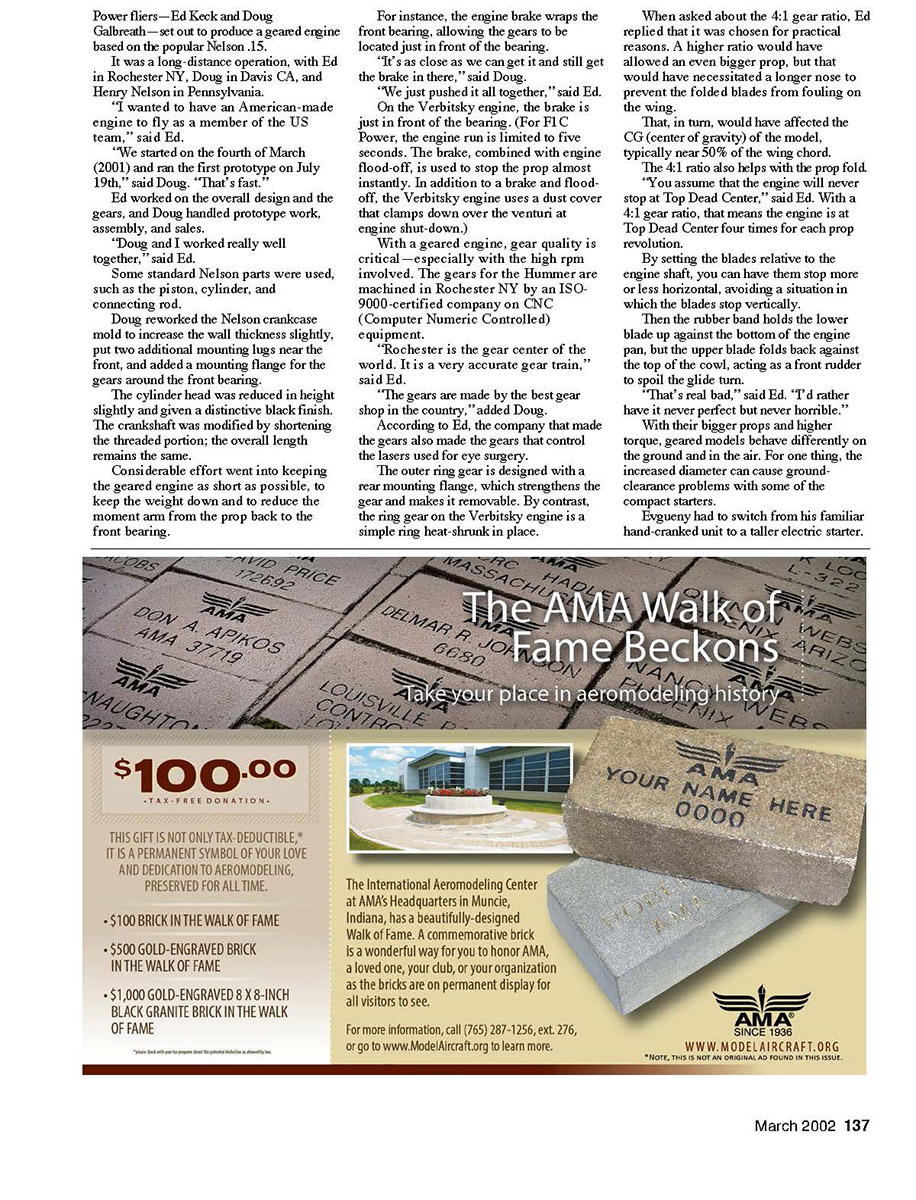
Power fliers—Ed Keck and Doug Galbreath—set out to produce a geared engine based on the popular Nelson .15.
It was a long-distance operation, with Ed in Rochester NY, Doug in Davis CA, and Henry Nelson in Pennsylvania.
"I wanted to have an American-made engine to fly as a member of the US team," said Ed.
"We started on the fourth of March (2001) and ran the first prototype on July 19th," said Doug. "That's fast."
Ed worked on the overall design and the gears, and Doug handled prototype work, assembly, and sales.
"Doug and I worked really well together," said Ed.
Some standard Nelson parts were used, such as the piston, cylinder, and connecting rod.
Doug reworked the Nelson crankcase mold to increase the wall thickness slightly, put two additional mounting lugs near the front, and added a mounting flange for the gears around the front bearing.
The cylinder head was reduced in height slightly and given a distinctive black finish. The crankshaft was modified by shortening the threaded portion; the overall length remains the same.
Considerable effort went into keeping the geared engine as short as possible, to keep the weight down and to reduce the moment arm from the prop back to the front bearing.
For instance, the engine brake wraps the front bearing, allowing the gears to be located just in front of the bearing.
"It's as close as we can get it and still get the brake in there," said Doug.
"We just pushed it all together," said Ed.
On the Verbitsky engine, the brake is just in front of the bearing. (For F1C Power, the engine run is limited to five seconds. The brake, combined with engine flood-off, is used to stop the prop almost instantly. In addition to a brake and flood-off, the Verbitsky engine uses a dust cover that clamps down over the venturi at engine shut-down.)
With a geared engine, gear quality is critical—especially with the high rpm involved. The gears for the Hummer are machined in Rochester NY by an ISO-9000-certified company on CNC (Computer Numeric Controlled) equipment.
"Rochester is the gear center of the world. It is a very accurate gear train," said Ed.
"The gears are made by the best gear shop in the country," added Doug.
According to Ed, the company that made the gears also made the gears that control the lasers used for eye surgery.
The outer ring gear is designed with a rear mounting flange, which strengthens the gear and makes it removable. By contrast, the ring gear on the Verbitsky engine is a simple ring heat-shrunk in place.
When asked about the 4:1 gear ratio, Ed replied that it was chosen for practical reasons. A higher ratio would have allowed an even bigger prop, but that would have necessitated a longer nose to prevent the folded blades from fouling on the wing.
That, in turn, would have affected the CG (center of gravity) of the model, typically near 50% of the wing chord.
The 4:1 ratio also helps with the prop fold. "You assume that the engine will never stop at Top Dead Center," said Ed. With a 4:1 gear ratio, that means the engine is at Top Dead Center four times for each prop revolution.
By setting the blades relative to the engine shaft, you can have them stop more or less horizontal, avoiding a situation in which the blades stop vertically.
Then the rubber band holds the lower blade up against the bottom of the engine pan, but the upper blade folds back against the top of the cowl, acting as a front rudder to spoil the glide turn.
"That's real bad," said Ed. "I'd rather have it never perfect but never horrible."
With their bigger props and higher torque, geared models behave differently on the ground and in the air. For one thing, the increased diameter can cause ground-clearance problems with some of the compact starters.
Evgeny had to switch from his familiar hand-cranked unit to a taller electric starter.
The increased torque can affect handling of the model prior to launch.
"It's like flying a C model, it pulls so hard," said Ed.
"There's enough torque there for two airplanes," added Doug. "It feels like you've got hold of a 20-foot box construction."
In the air, the extra torque wants to roll the geared model to the left.
"With a conventional model, you never want to launch to the right," said Ed. "But with gears, going to the left on launch is not so good."
"They're launch-critical," added Terry Kerger, who has also been flying geared models.
The extra torque also means that very little, if any, left rudder is needed in the climb (nongeared F1C models typically have the auto rudder set to the left for the climb and to the right for the glide).
For the geared models, the next challenge is optimizing the propeller to the engine. Prior to the 2001 World Championship, there was a great deal of experimentation with propeller diameter, pitch, pitch distribution, and blade platform.
Evgeny has made more than 50 molds in the last couple of years. "I'm tired of this," he is reported to have said.
"I've spent hundreds and hundreds of hours on this over the last two months," said Ron McBurnett.
Trying a new prop requires much more than a visit to the local hobbyshop. First, a master blade, called a plug, has to be carved to exact shape. A two-part mold is made around the plug. Then the blade is molded using epoxy resin, carbon fiber tow, and carbon cloth.
The carbon tow runs spanwise for strength and safety, looping around the steel bobbin at the root. After curing, the blade is trimmed of any flashing.
When a pair of blades is finished, they are attached to the hub using pins inserted with a special arbor press. Then the blades can be test-flown. Any desired changes require making a new plug and mold.
"We've got a lot of work to do on propellers," said Ed. "The development of propellers is still in its infancy. The big challenge right now is to find the right prop."
Not only is there the challenge of optimizing blade pitch and shape, there is the problem of vibration.
"Now we've got things running at two different speeds," said Ed. "You've got the harmonics of the prop and the harmonics of the engine."
There is no doubt that geared engines will dominate the F1C event. First- and second-place at the 2001 World Championship used geared engines. (See the World Championship report on page 46.)
"My feeling is that we are getting 20 to 25 meters higher," said Ed.
"They are here to stay," said Doug of the CIK Hummer/Nelson powered engines available from Doug Galbreath.
The introductory price at the World Championships in the fall was $790 (contact Doug Galbreath for current price and availability). The prop pin pusher is $85. This compares with $250 for a regular Nelson engine plus $125 for the mounting pan. Doug's address is 3408 Topail Pl., Davis CA 95616, E-mail: [email protected].
Free Flight Quarterly: Geared F1C models like the one only photoed at the recent World Championship at Lez Huma are new. The flight publication was passed out.
Free Flight Quarterly is produced by Sergio Montes of Hobart, Tasmania; Jean Wantzenreither of Bourdouamy, Moselle, France; and Jan and Bill Pudney of Adelaide, Australia. Their goal is to produce an international, English-language Free Flight magazine that can publish longer, more in-depth articles about all aspects of Free Flight.
The first issue provides a sense of the breadth and depth of coverage. Included is Richard Blackham's detailed account of the development of his Spirit series of Wakefield models, complete with three-view drawing from two versions.
Jan Wantzenreither, who has written about Free Flight aerodynamics for years, explores ride and stability. In separate articles, editor Sergio Montes discusses the use of radiocontrol and the construction of model boxes.
The roots of Free Flight are not forgotten in Sergio's longer piece about the wing pusher. Rather than a strictly historical book, this article investigates some of the aerodynamic factors involved in designing these twin-prop pusher machines.
If this does not intimate to you the possibilities, the Scale and Non-Scale modeler can appreciate Bill Henn's piece about his Fokker SK-5 Rubber Scale model.
The next issue will include articles about the manufacture and testing of rubber, 2001 Free Flight World Championship coverage, and a follow-up piece by Richard Blackham about his third place finish at the World Champs.
Also included will be details of Jim Brokaw's Wakefield model with tongue-stabilized two surfaces, another piece on aerodynamics theory by Jan Wantzenreither, and a biography of C.H. Grant.
Free Flight Quarterly's format is 24 pages, A4 size (roughly 8 1/2 x 11 inches). There will be four issues a year. A subscription is $15 per year including airmail postage from Australia.
To subscribe, send an international check or bankdraft to Free Flight Quarterly, Fruitls Haus, 57 Windsor St., Kingston Beach, TAS 7050 Australia.
The editors welcome contributions in the form of articles and letters. For more information, visit their Website at www.chariot.net.au/~bluejay/freeflightquarterly.html.
Transcribed from original scans by AI. Minor OCR errors may remain.

