
FREE FLIGHT DURATION
CHATTAHOOCHEE CHALLENGE: Cheap, quick, and fun are the basic requirements for a club event. Keeping the cost low allows everybody to participate without having to purchase a new engine or other specialized item. Fast, easy construction eliminates all the excuses about lack of building time. Most importantly, keeping the event fun encourages participation.
And, for many clubs, limiting the performance allows flying at close-in sites instead of trekking all the way out to some big field miles from town. From the standpoint of generating interest in Free Flight, this last point is the most important.
How often have you run into a nonmodeler, or even a modeler, who is not familiar with Free Flight? After all the explanations about Free Flight ("no, they are not radio-controlled" and "yes, they fly all by themselves"), the person is interested in watching a model fly.
If your invitation to visit the flying field involves a two-hour drive each way, the chances of getting that individual out to the field are slim. But if you can suggest that he or she comes to a local field for the monthly club contest, that person just might show up.
And if you can suggest that he or she can buy an inexpensive, ready-to-fly model, such as the Gullow's Sleek Streak, at the local hobby shop or dime store, bring it along, and fly in the contest, you just might set the hook and introduce someone to the hobby/sport of Free Flight.
The Thermal Thumbers of Metro Atlanta is an active model club faced with the challenge of limited, close-in flying sites. A few years back, Delta Airlines pilot Dobman Crawford, then the club president, proposed a simple Outdoor Rubber event for the club's annual event of the year.
The rules are simple. Models must have a maximum projected wingspan of 20 inches, with no limit on rubber weight or fuselage length. Any type or size of propeller can be used. The fuselage must be stick-type with exposed motor.
FF Duration
With interest and competition in a club with some very good Rubber fliers, the models may be getting a little too good. "Our designs have evolved to the point where our better models will easily outfly a typical soccer field or Little League complex," said David.
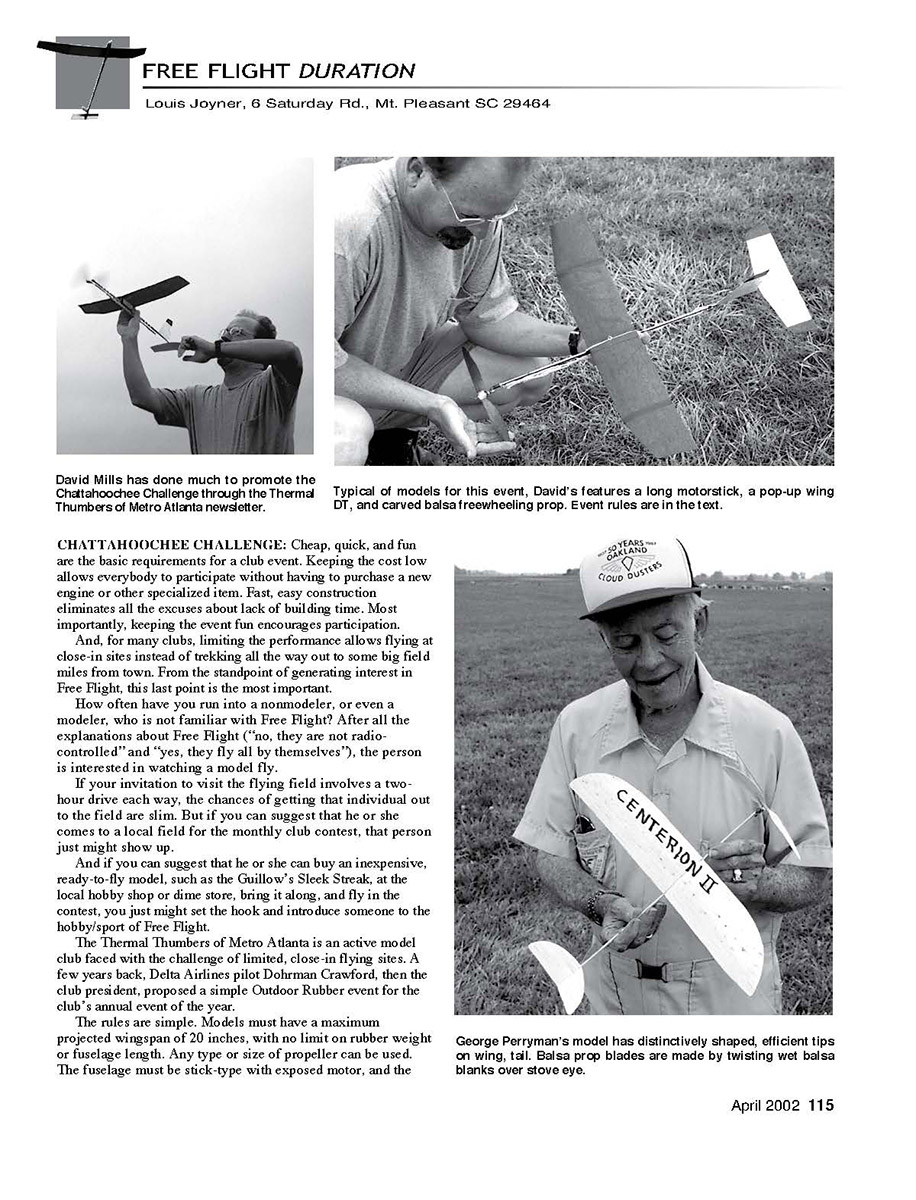
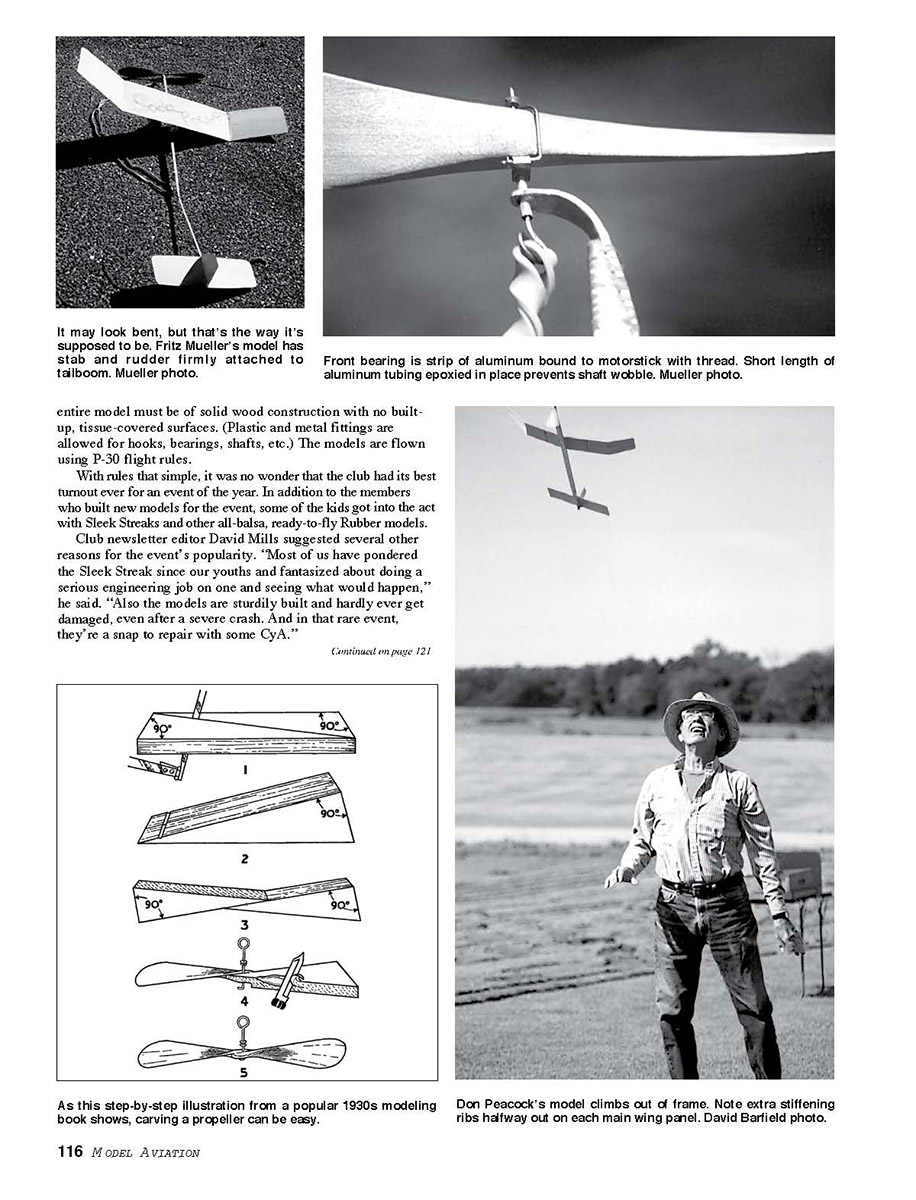
David's own design uses a 10 gram motor consisting of six strands of 3/32 rubber that can take more than 2,000 turns. The airframe weight is 28 grams. The propeller is a hand-carved balsa freewheeler.
But with such simple rules, there are many possible variations. Fritz Mueller's design is 10 grams lighter, weighing in at only 18 grams plus six grams of rubber (a 24-inch-long loop of 7/16-inch-wide strip). The wing is 2 1/2 sheet with a 7% camber. The wing came from one of Fritz's many CO2 models. (That's where the "Soda Power" name on the wing came from.) The 18-inch-long motorstick is a piece of 1/8 x 3/16-inch balsa; the 11-inch-long tailboom is 1/8 square balsa.
All the trimming is done by adjusting the tailboom-motorstick joint. The boom angles up approximately 3.5° for decalage. (The wing is stabilizer relative to the motorstick.) Right rudder and right stabilizer tilt are built in.
The original propeller was a nine-inch Peck Polymers that weighed 7.5 grams. On 850 turns, this gave a flight time of roughly one minute in dead air. Substituting a three gram wood prop from Fritz's friend Otto Kuhn doubled the flight time.
Checking the plastic prop, Fritz discovered that the pitch/diameter ratio was less than 1. Rubber models normally fly best with a pitch/diameter ratio of 1-1.2 or more. It pays to check pitch on both blades of any commercial prop; they are not perfect.
The Chattahoochee Challenge event allows any type of prop and allows it to be modified in any way. (This is different from the P-30 rules, which forbid any modification of the commercially made prop.)
For his next model, Fritz will increase the wing camber, reduce the size of the stabilizer and rudder, and go to a higher-pitch prop. And he will add a dethermalizer, after making three flights exceeding seven minutes in two contests. "None of them in flyoffs, as destiny prescribes," he laments.
The rules for the Chattahoochee Challenge allow a variety of approaches. As quick and inexpensive as the models are to build, you can experiment. Following are a few suggestions to get started.
With the wingspan limited to 20 inches, it makes sense to keep the wing chord wide to pack in as much area as possible. A center chord of four inches seems close to being right. This is not the place for elegantly tapered, high-aspect-ratio wings.
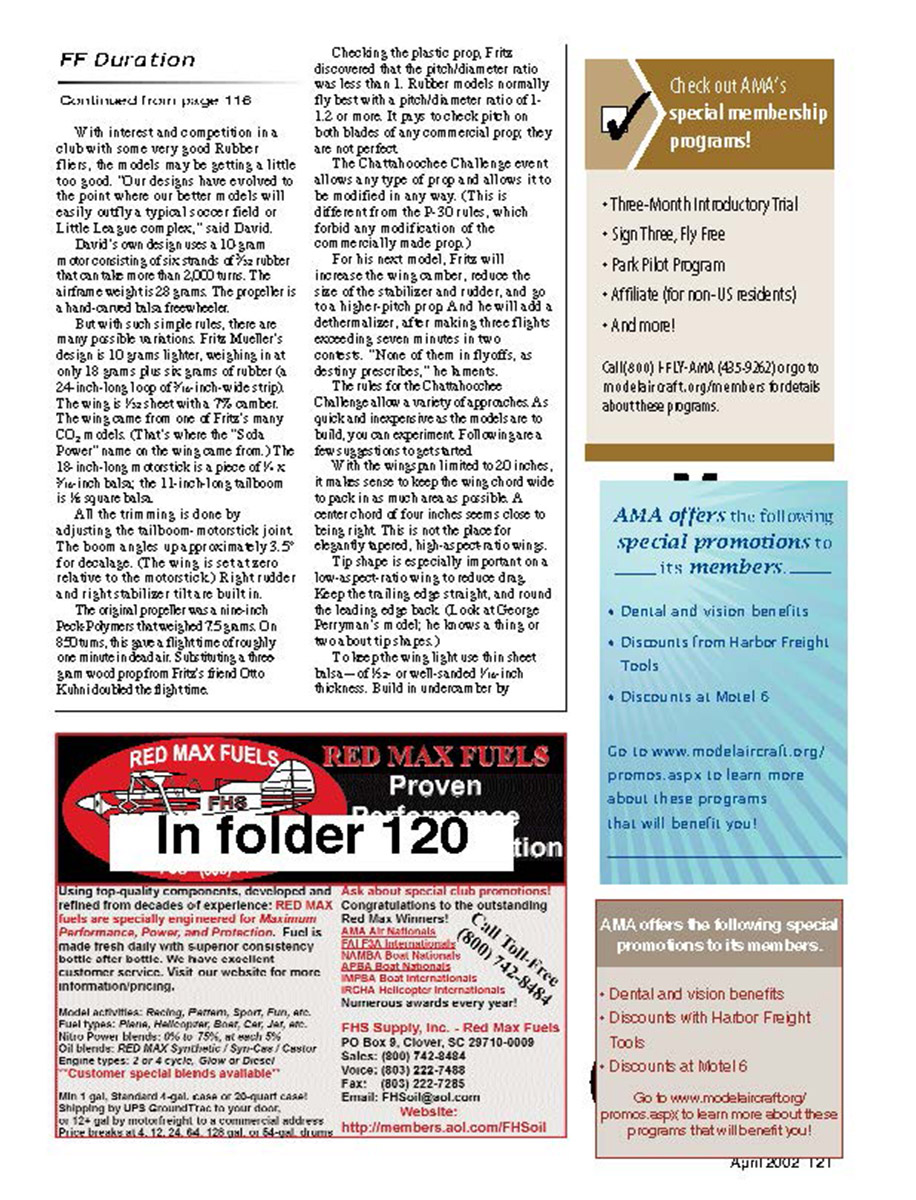
Tip shape is especially important on a low-aspect-ratio wing to reduce drag. Keep the trailing edge straight, and round the leading edge back (Look at George Perryman's model; he knows a thing or two about tip shapes).
To keep the wing light use thin sheet balsa—of 3/32 or well-sanded 1/8-inch thickness. Build in undercamber by removing wood under the trailing edge. Add a strip of 1/32-inch medium-hard surface balsa under the leading edge as shown in many commercial models. This adds leading-edge stiffness while keeping weight down.
Keep the tail surfaces light and thin. Use 1/32-inch balsa for the fin and stab, and sand to 1/64-inch thickness where possible. Use a low-friction hinge; thin plastic film hinges work well. Balance the model carefully; center of gravity is typically about 35% of chord back from the leading edge.
With the model trimmed, practice launches are important. Use a moderate torque—too much will cause the motor to kink and lose energy. A smooth, steady launch of 60 to 70% of maximum turns gives the best results for altitude without excessive spiraling.
When repairs are needed they're a snap to repair with some CyA.
Offers the greatest area for experimentation.
Theoretically, the rubber weight should be at least equal to the airframe weight for maximum duration. But with an all-balsa model, the wing loading will be fairly high anyway. Matching that with 20 or 30 grams of rubber will result in a model that is difficult to control under power and has the glide of a brick.
(Remember that 10 grams of rubber is used for a 30-inch-span P-30 or a 70-gram Coupe. Wakefields, which weigh more than eight ounces, use only 30 grams of rubber now.)
Besides, a thicker, heavier motor will require a thicker, heavier motorstick to support it.
Although a ready-to-use plastic prop would speed construction, a carved wood propeller will be lighter and more easily custom-tuned to match the model and the rubber. Something close to nine to 10 inches in diameter would be a good starting place. Pitch should be in the 11- to 13-inch range. A higher-pitched prop will give a longer motor run, with everything else being equal.
If you have never carved a Rubber-model prop, this is a great time to learn. The X-type block layout is simple and uses minimum wood. A block measuring 1/2-inch thick by 1-inch wide, approximately 5-1/2 inches long, would be a good starting point.
Cut the block diagonally, carefully notch for the prop shaft, then glue the blocks together. Carve the back side of each blade first, sand in undercamber, then carve the top surface. Trim the tips and finish sanding. Balance, finish with a few coats of dope, and rebalance.
The accompanying sketch from the 1938 edition of Edwin T. Hamilton’s Complete Model Aircraft Manual shows how it used to be done. Some things just don’t change.
Although the Chattahoochee Challenge was intended to be a local event, it could easily be adopted by any club that needs an easy, inexpensive, and fun event to pull people out to a small field.
If performance gets too good, the easiest way to limit performance is to use partial motors. Indoor fliers often use this technique to allow shorter test flights.
A wood spacer stick is made with hooks at each end. The overall length is exactly half the length of the hook-to-hook distance on the model. A shorter rubber motor is made using the same number of strands as are normally used. Then the spacer stick is weighted until it weighs the same as the partial motor.
Processing at a contest only requires a simple beam balance to check that the motor is no heavier than the stick. The model is flown with the rubber motor attached to the prop and one end of the spacer stick; the other end of the spacer attaches to the model’s rear hook.
If you are like most modelers, there’s enough balsa in the scrap bin to make a half dozen Chattahoochee Challengers, so start building.
If you are interested in subscribing to the Thermal Thumbers of Metro Atlanta’s bimonthly newsletter, The Thumb Print, contact club treasurer E.D. “Don” Brown, 477 Safari Cir., Stone Mountain GA 30083-4419, or check out the club’s Web site at www.thermalthumbers.com. A subscription is $8 for six issues.
Free Flight Quarterly is a new international English-language magazine
Transcribed from original scans by AI. Minor OCR errors may remain.

