
FF Duration
OR 97002; Tel.: (503) 663-4081; Website: www.laarcotech.com) has introduced another model to its popular line of "foam and tape" built kits. In addition to the P-51, the FAC Corsair, the A6M Zero, the FW 190, and the MGs already in production, the Republic P-47 Thunderbolt is now available.
Using the same pop-up type cover foam with Corrugated™ tail feathers as the company's other designs, the P-47 can be built in one of three versions: the early Razorback, the bubbletop, or the late-war, long-span version with the tall "spine."
Another option is to order the P-47 with silver Mylar™ tape that will allow you to have a sharp-looking chrome finish on your model. With a microreceiver and battery pack, a microservo on the throttle, two standard servos, and a .25-size engine, the P-47 weighs in at 29 pounds.
As do other LaarcoTech designs, the P-47 uses the proven E-28 airfoil and is supported by the company's excellent Web site that offers step-by-step, photo-illustrated construction support for all of its kits.
With all the changes in the rules, it's not surprising to see manufacturers feel out the possible future directions in Combat One kitbuilding. Warbirds Ltd (11111 E. 67th St., Tulsa OK 74133; (918) 740-1284; Website: www.warbirds1d.com), has been prototyping kits for a possible World War I Scale Combat event.
Rod Bauer at Warbirds Ltd. was kind enough to show me his prototype Albatros fighter. At roughly 1/8 scale, the model is powered by an O.S. .26 four-stroke engine. All those curves that make it so difficult to build with a crutch design without a vacuum-formed shell to form the outer fuselage. Even the wing uses vacuum-forming to keep construction simple and building time down.
With a wide 48-inch span wing and a weight of 3.5 pounds, the Albatros is maneuverable yet capable of slow enough flight that it hovers in the wind (in all fairness, Ron lives in Oklahoma, like I do, where on the right day a P-51 can almost be made to hover in the wind!)
Warbirds Ltd is also developing a companion model, to allow fliers to pick from an Allied or Central Powers design for some "World War I Slow Combat."
With the friendship and camaraderie that comes with RC Combat also comes feelings of deep personal loss when tragedy strikes. The Combat community lost a friend when Texas Combat flier Ethan Allen was killed in a work-related accident. Although I did not know Ethan personally, we shared many common friends within the Combat community, and we all feel the loss.
A fund has been set up to aid his family. Donations can be sent to the Ethan Allen Fund, c/o First State Bank of Texas, P.O. Box 1000, Grapevine TX 76051.
Until next time, fly safe, fly Combat, and be sure to checkout our site! MA
FF Duration
Fernando Ramos, 19361 Mesa Dr., Villa Park CA 92861; E-mail: [email protected]
ONCE IN AWHILE it is good to review items introduced in previous columns. If you are like me, you think reviewing is a good thing. When you are as busy as I am, and I know that I am certainly no exception, you tend to forget topics you wanted to pursue because you are going in so many different directions at the same time!
I want to introduce you to another way to cover with Japanese tissue and the doping that follows. Sometime back I was in San Diego CA visiting Tom Arnold. We were in his shop where I was admiring the myriad projects going on, including the construction of a full-scale Cal-Air airplane’s wing.
On a shelf was a Spitfire’s wing that was covered on one side only—one of those get-to-it-later projects. What caught my eye was that the wing was covered on the top, and it was as straight as a die! It had been watershrunk, yet there was no elliptical dihedral. Naturally, I wanted to know how Tom accomplished this wizardry. After a brief explanation, I was armed and ready to try it on a project at home.
I am from the very old school, and I prepare my structures using 50/50 nitrate dope mixed with Super Seam or Fab-Tac (glues used on full-scale airplanes for attaching fabric) also at 50%. Then I add nitrate thinner or lacquer thinner; that is, if I can find lacquer thinner that is any good so that the mixture is at brushing consistency. I put a minimum of three coats on the periphery of the structures. Some of you younger modelers use some kind of glue stick—whatever works!
Here is the Arnold twist. After measuring a piece of tissue the size you need, crumble it into the tightest little ball you can. Yes, you read it right. Now open it up, and wet it with water. Sandwich it between towels to get the excess water out, keeping track of where the glossy side is.
Place the tissue on the structure, and pull carefully until it is fairly smooth. Disregard the fact that it doesn’t look like uncrushed tissue. Activate the dope/glue mixture using acetone or Methyl Ethyl Ketone, or MEK (use with adequate ventilation). When the water has evaporated completely, you will have a smooth, taut covering job. Repeat for the other side if it is a wing or tail.
What is the purpose of mistreating a perfectly good piece of tissue? The tissue pulls just tight enough for a smooth surface without warping the surface. I still weight down the structures until the water has evaporated.
Doping: Many modelers prefer a slick surface, which requires several coats of nitrate dope, and others get by with maybe a single coat. I prefer a smooth finish on a model. One of the points of review is that I use tautening nitrate dope on the bottom of the wings and tail to help prevent the usual elliptical dihedral.
On full-scale aircraft, if cotton or linen is used, the only way it shrinks is with the use of tautening nitrate dope. Only once in my life have I seen an old antique covered with cotton. After several coats of the tautening dope was applied, it looked as though it would never tighten. Once poor fellow I heard about was so despondent at this stage that he thought he had goofed, so he tore off all the covering and started over. Cotton and linen is very, very expensive!
I will get back to doping, but I want to mention a technique that a friend of mine uses. Otto Kuni is one of the top modelers in the world, and those of you who have seen his models can attest to this. Not only his airplanes look fantastic, but they fly as great as they look. His forte is CO2-powered models.
Some time ago, Otto came to a club meeting and gave a demonstration on how to finish model airplanes. He starts by taping the corners of a sheet of Japanese tissue on a flat surface. Then he sprays Floquil evenly on the tissue. When this has dried, he applies the tissue in the normal manner. He follows this by misting the tissue with water.
The tissue will shrink but without overly doing so. I suspect that the paint on the tissue prevents it from shrinking too much. I can’t remember, but it seems that Otto doesn’t have to dope the tissue after applying it in the manner previously mentioned.
Most of you are probably familiar with nitrate and butyrate dopes, and there are two principal dope manufacturers: Certified and Randolph. I use Certified for all my modeling needs, and I use Randolph for full-scale aircraft. There is nothing wrong with using Certified on full-scale aircraft; I just feel more confident using Randolph.
Nitrate dope is used first, to bond the weave of the fabric and to provide a base for attaching all the rib tapes. Clear butyrate is then used to fill the weave.
If you started with butyrate, it would eventually pull off in sheets. It doesn’t penetrate like nitrate. On all of my old-time Power models, I finish with a couple coats of butyrate to obtain a nice gloss. This also allows the model to be cleaned after flying. If only nitrate is used, you will learn that cleaning a model is nearly impossible; stains will get into the weave of whatever material you used.
Water can be a nemesis when spraying nitrate or butyrate—especially butyrate. Butyrate can turn white if the moisture level in the air is too high. Besides emptying the water in the air compressor, it is essential to have a water trap in the line. Also, a variety of gadgets can be attached to the handle of a spray gun that will absorb any water before it gets on the surface that is being painted.
Filtration of the paint is essential in my opinion as well. Water is the cause of little bubbles that are created by air in the spray line. When they pop, they leave tiny pinholes. This is particularly annoying when finishing a full-scale project.
I know that some of you have an aversion to spraying models. I have heard the reasons why throughout the years, and I don’t agree with too many of them. The biggest complaint is that the overspray makes a mess everywhere. How many of you have heard of a spray outfit called high volume, low pressure (HVLP)?
Using HVLP, the compressor is set for roughly 50 pounds per square inch (psi), and there is set for only 3 psi. This way, there is minimal overspray. When shooting full-scale aircraft, I use a pressure pot that holds slightly more than a quart of paint. I can put down paint as fast as I want to move!
Certainly, you don’t need anything like that, but you can purchase a touch-up gun that is gravity-feed (the cup is on top) for approximately $50 at Harbor Freight; it does a whole lot. Once you get used to using a spray gun, your brushes will become history!
The National Association of Scale Aeromodellers (NASA) is the AMA Scale Special Interest Group. It has been lamenting the fact that participation in Free Flight Scale is way down.
To give the events a shot in the arm, Dave Platt has been working on three new Scale categories. These are non-rule book events designed to bring the fun back into flying Scale. They are:
Full-Scale Scale Free Flight—Mass Launch
1) The model must be built from a commercial design in kit or plan form. Scaling to another size is permissible. 2) The model is to be rubber powered. There is no static judging. Flying is to be in a mass-launch format; the best three down-and-out winners. (Flying will be held during the half-time breaks for Radio Control [RC] and Control Line [CL] Scale events.)
Rubber Scale Free Flight
1) There will be static judging to 100 points as per RC and CL SportScale rules will be used (No combination book required). 2) Flying points: One point per second up to a max of 100 points (one minute, 40 seconds). Three flights are allowed; the best single score counts. 3) The contestant’s contest score will be the lower of the static or flying points.
Power Scale Free Flight
1) The model can be powered by anything except rubber, that is, glow, diesel, CO2, electric, jet, etc. 2) Static judging will be as per Rubber Scale. 3) The model must then fly at least one flight of at least one-minute duration (three attempts allowed) to qualify for the model’s static score. The high score wins. If a model does not make the minimum flight time, it has no score.
The Scale National Championship will be held July 7-9, 2000, in Muncie IN. Anyone who is interested in joining NASA, send $15 to Bonnie Radelke, 128 Dannley Dr., Moon Township PA 15108. You will receive six newsletters per year.
FREE FLIGHT DURATION
Louis Joyner, 6 Saturday Rd., Mt. Pleasant SC 29464
THE JUNIOR TEAM Selection Committee has chosen the team that will represent the United States at the 2002 Junior World Championships August 11-18 in Lucent, Slovakia.
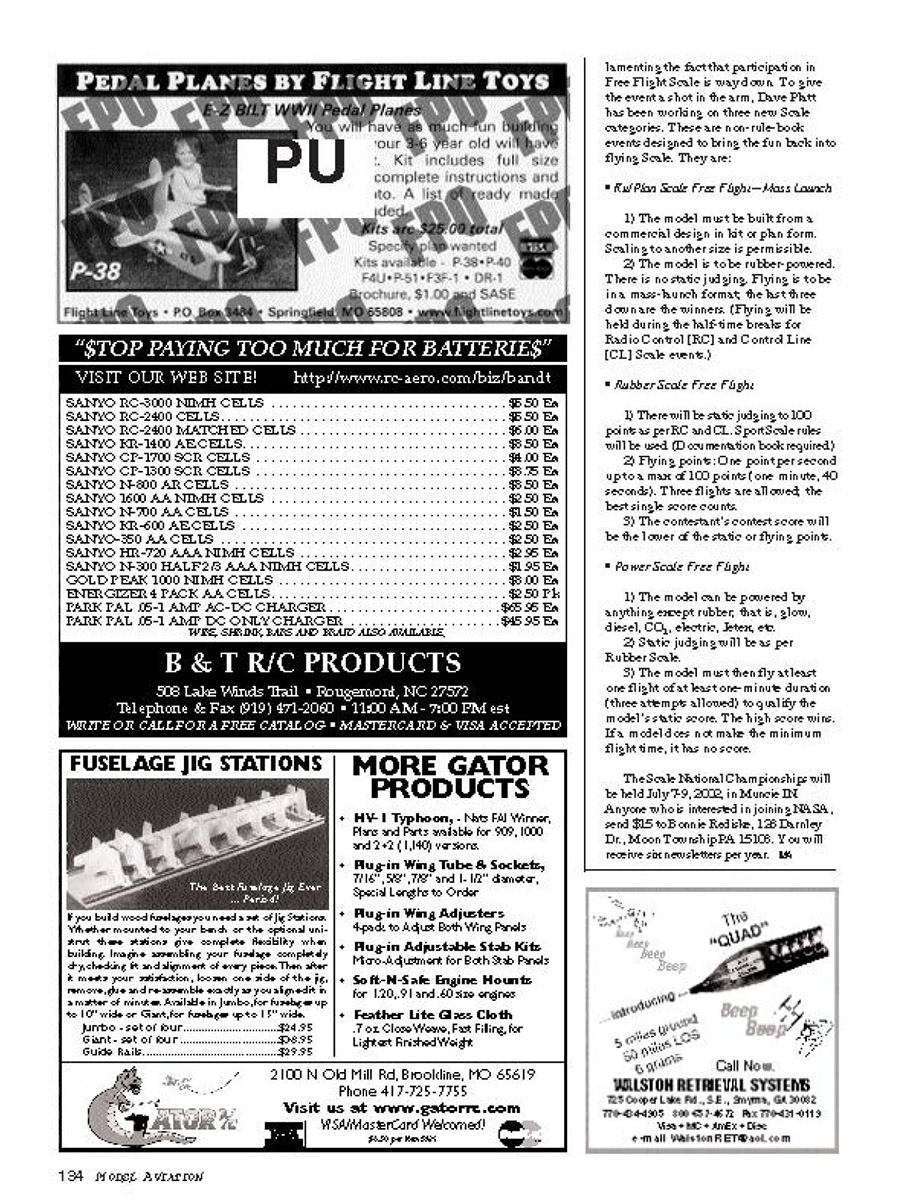
Michael Avallone, Ben Coussens, and Dallas Parker will be flying F1A Nordic Glider. F1B Wakefield Rubber fliers will be Eddie Avallone, Taylor Gunder, and Ryan Jones. Flying F1J Power will be Austin Gunder and John Lorbiecki. Brian VanNest will be team manager. That’s right; there are two sets of brothers on the team.
Here’s a bit more information about each team member:
- Michael Avallone is 15 years old and will be a junior this fall at Catholic Central High School in Grand Rapids MI. In addition to his studies and modeling, Michael runs cross country.
He started flying Radio Control (RC) sailplanes with his father, who then introduced him to Indoor Free Flight (FF). “After a winter of this, my father, brother, and I built simple Outdoor Free Flight models like P-30s and hand-launched gliders,” said Michael. “I finally began flying F1A Towline Gliders at the 2000 Nationals [Nats] with the guidance of other modelers. I really enjoyed it. I enjoy flying F1A models more than any other form of model aviation.” Michael will be using some of his own gliders in Slovakia as well as some by Victor Stamo of Ukraine.
- Ben Coussens is 15 and will enter his sophomore year this fall at Hart High School in Valencia CA.
“I have come to contests since I was a toddler, and flew Towline Gliders for fun since I was nine,” said Ben. “But I didn’t start taking it seriously until the beginning of 2001.” “I fly in every America’s Cup contest I can convince my dad to take me to,” he added. “I have maxed out in both World Cup contests I flew this past year.” Ben holds the Junior national record in F1A. His arsenal of models includes a Buntbone, an M&K long model, and a Lil’ Al. “I have an absolute ball when I am flying Nordic Gliders, and to me towing a glider is the most awesome feeling in the world,” he said.
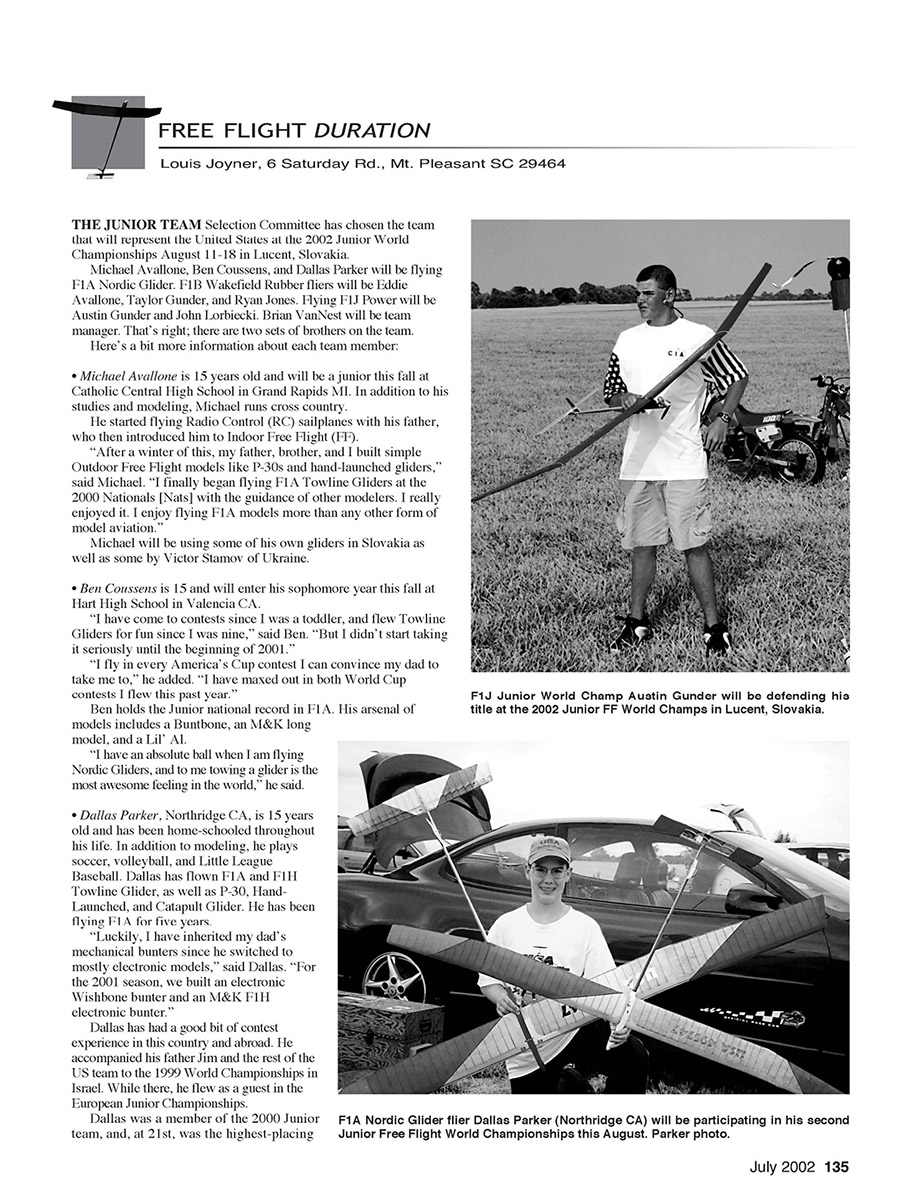
- Dallas Parker, Northridge CA, is 15 years old and has been home-schooled throughout his life. In addition to modeling, he plays soccer, volleyball, and Little League Baseball. Dallas has flown F1A and F1H Towline Glider, as well as P-30, Hand-Launched, and Catapult Glider. He has been flying F1A for five years.
“Luckily, I have inherited my dad’s mechanical buntner since he switched to mostly electronic models,” said Dallas. “For the 2001 season, we built an electronic Wishbone bunter and an M&K F1H electronic bunter.” Dallas has had a good bit of contest experience in this country and abroad. He accompanied his father Jim and the rest of the US team to the 1999 World Championships in Israel. While there, he flew as a guest in the European Junior Championships. Dallas was a member of the 2000 Junior team, and, at 21st, was the highest-placing
F1J Junior World Champ Austin Gunder will be defending his title at the 2002 Junior FF World Champs in Lucent, Slovakia.
F1A Nordic Glider flier Dallas Parker (Northridge CA) will be participating in his second Junior Free Flight World Championships this August. Parker photo.
Transcribed from original scans by AI. Minor OCR errors may remain.

