
FREE FLIGHT DURATION
Louis Joyner, 6 Saturday Rd., Mt. Pleasant SC 29464
NOSTALGIA RUBBER—Another Look:
In the February 2002 Duration column I discussed the two new Nostalgia Rubber events sponsored by the National Free Flight Society (NFFS): Nostalgia Wakefield and Nostalgia Rubber. These events parallel the popular Nostalgia Gas events. Models must have been designed between 1943 and 1956. There are no weight requirements for rubber or model.
There are dozens of Wakefield designs to choose from, as quickly thumbing through Frank Zaic's Year Books from the era shows. At first glance, some of the earlier models seemed to be good choices. They were from the era before the 1954 rules change that limited motor weight to 80 grams. Back then, a three-ounce model with five ounces of rubber was the norm.
To cram all that Pirelli or Dunlap in, modelers resorted to two motors with return gears, effectively doubling the motor base back on itself, or a five-foot-long, single-skein motor. Some of the models from that early period were elegant—or at least as elegant as possible, given the ungainly cross-section requirement.
But almost all those models from the late 1940s to early 1950s had thick airfoils, many had freewheeling or feathering propellers, and the construction was often on the fragile side. Most of the early models also used a nonretracting, two-wheel landing gear.
The long models, such as Hank Cole's Osolong or George Perryman's 1952 design, with their five-foot motor base, stretched the moment of inertia beyond the limit. (By way of comparison, a modern Wakefield has a motor base of 18-20 inches.) Spreading all that rubber along the fuselage resulted in a model with poor stall-recovery characteristics—a quality that plagues many modern Mulvihill designs.
What to build? One can assume that model design was evolving during the time period as modelers tried to increase performance even as the rules-makers were attempting to decrease model performance, so later is better. Along the same lines, the quality of rubber, as measured in the energy output per pound, has also increased.
Luckily, we get to use modern rubber for the Nostalgia events. Typical numbers for the 1950s rubber is well less than 3,000 foot-pounds per pound, compared with more than 4,000 for today's Tan II. Also, the now-almost-universal use of winding tubes has allowed us to wind harder than in the old days, when a blown motor meant a destroyed model.
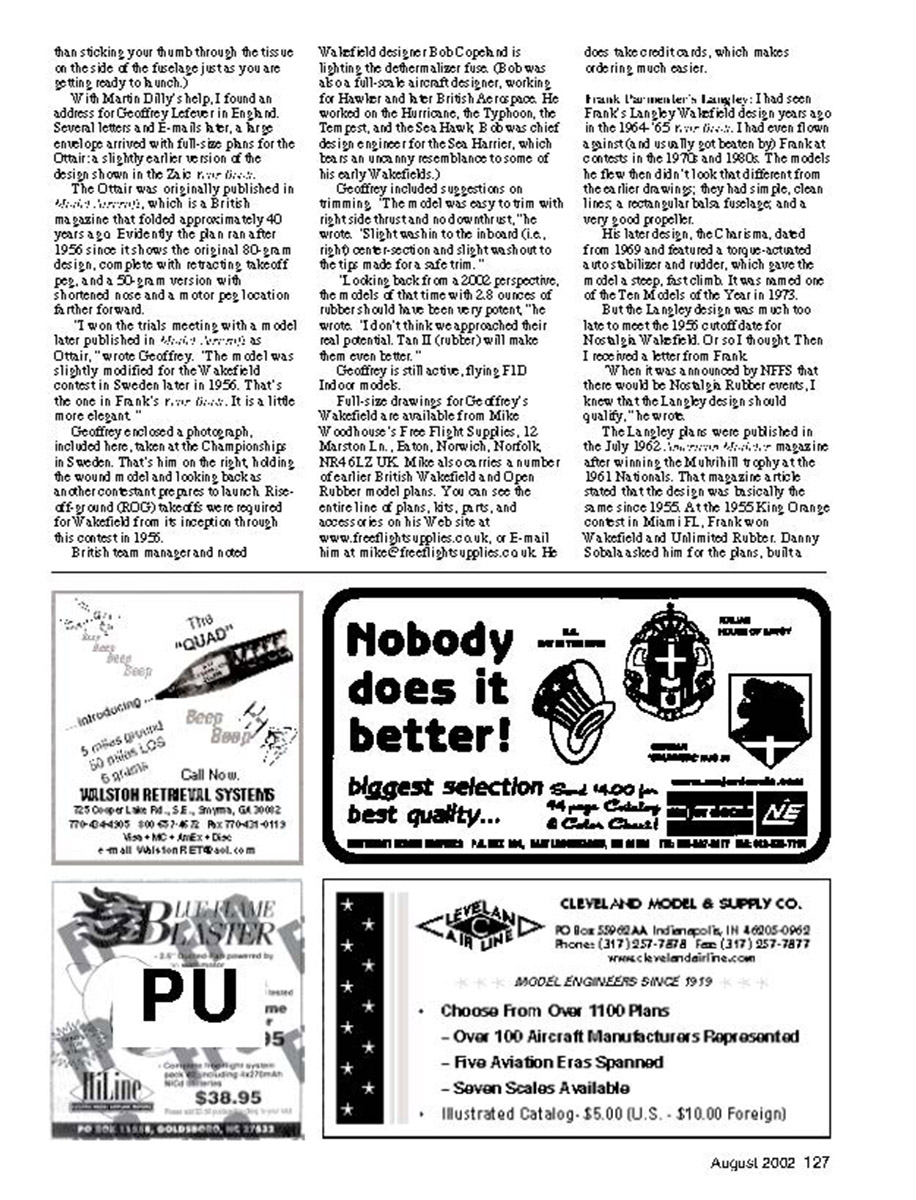
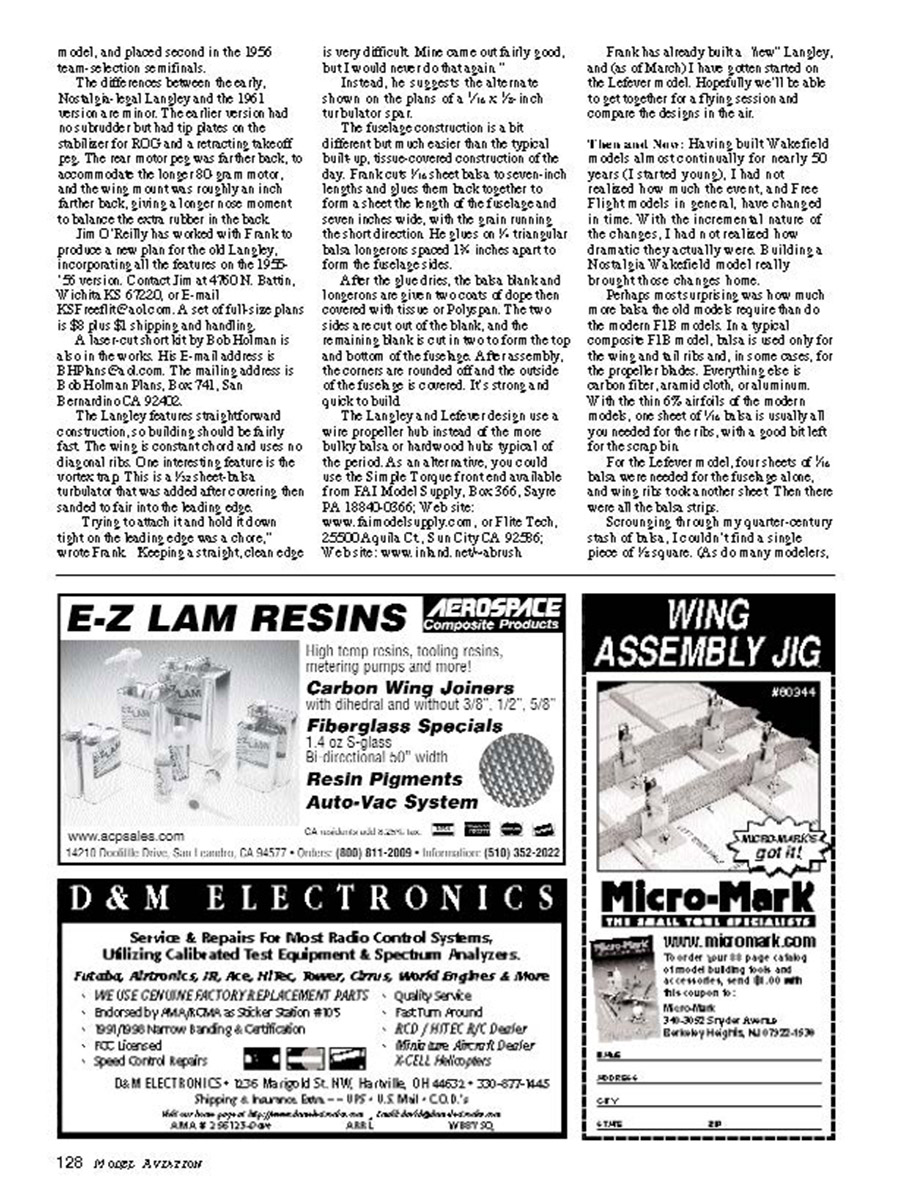
After considerable research, I've come up with the two best choices for the Nostalgia Wakefield event: Geoffrey Lefever's 1956 Wakefield and Frank Parmenter's Langley. Both models are from the last year of eligibility and were designed for the 80-gram rules. Those rules eliminated the cross-section requirement, so both models have reasonably slim fuselages with shorter motor bases of roughly 30-33 inches.
Airfoil design was undergoing a major change in the mid-1950s as wings became thinner. With less rubber to carry, these later designs could beef up the structure to create a more durable model.
(I did find a third aircraft by Soviet modeler Vladimir Matveev that approaches modern F1B proportions, but the too-thin wing airfoil and the intricate construction of balsa, lemon wood, bamboo, and grass seemed to go beyond what most modelers would be willing to undertake. After all, Nostalgia Rubber is supposed to be fun. If you want to take a look, turn to page 101 of the 1957-58 Model Aeronautical Year Book.)
G.F. Lefever's 1956 Wakefield:
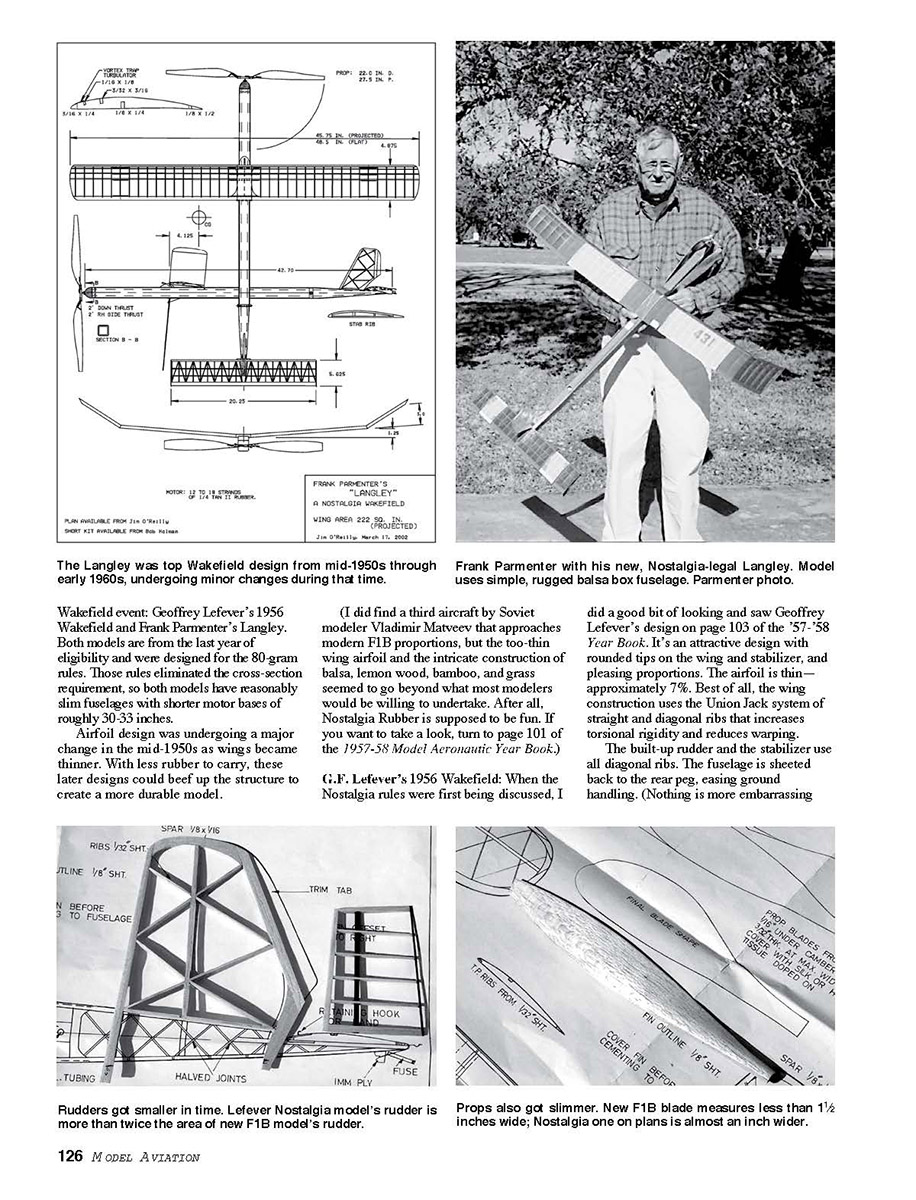
When the Nostalgia rules were first being discussed, I did a good bit of looking and saw Geoffrey Lefever's design on page 103 of the '57-'58 Year Book. It's an attractive design with rounded tips on the wing and stabilizer, and pleasing proportions. The airfoil is thin—approximately 7%. Best of all, the wing construction uses the Union Jack system of straight and diagonal ribs that increases torsional rigidity and reduces warping.
The built-up rudder and the stabilizer use all diagonal ribs. The fuselage is sheeted back to the rear peg, easing ground handling. (Nothing is more embarrassing than losing a model on takeoff.)
"I won the trials meeting with a model later published in the Ottair," wrote Geoffrey. "The model was slightly modified for the Wakefield contest in Sweden in 1956. That's the one in Frank's rear view. It is a little more elegant."
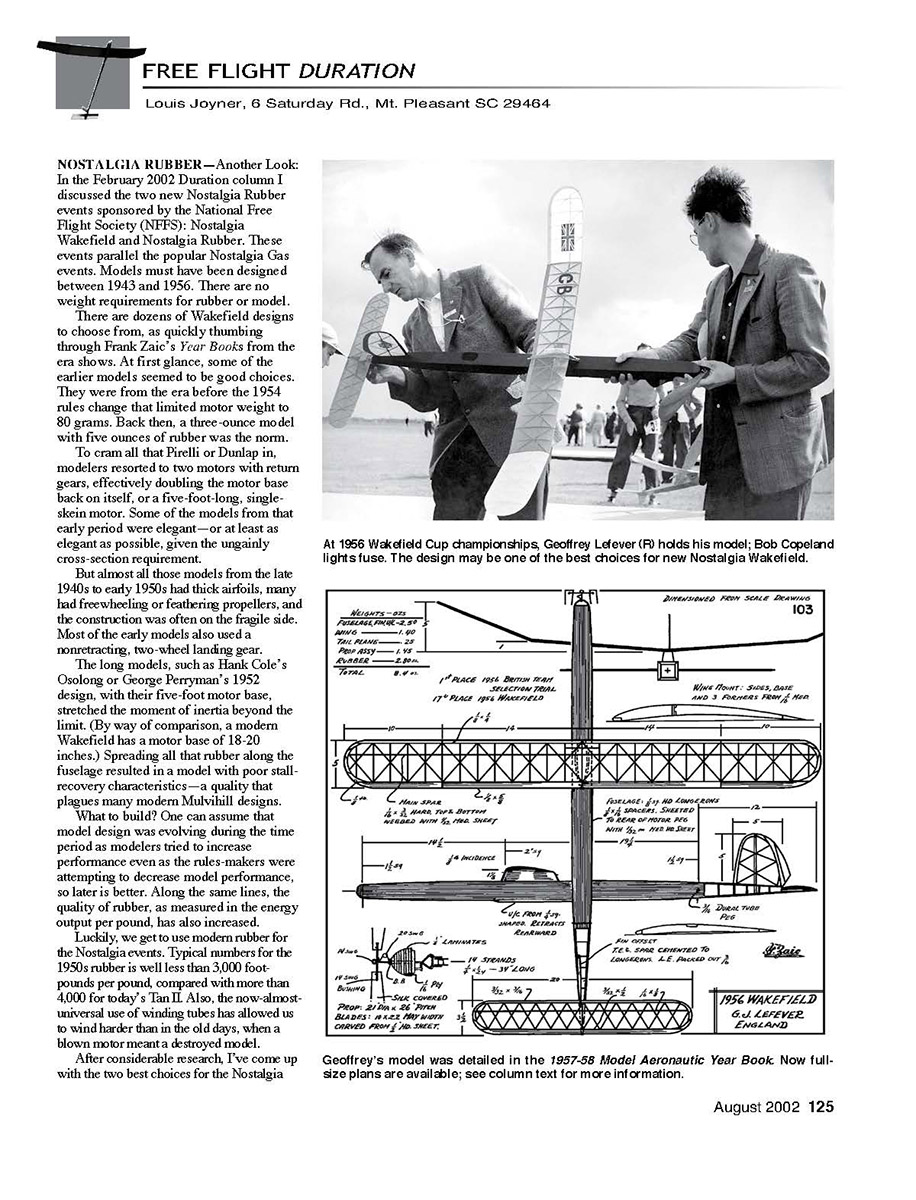
Geoffrey enclosed a photograph, included here, taken at the Championships in Sweden. That's him on the right, holding the wood model and looking back as another contestant prepares to launch R/C off-round (RCO) takeoffs as we required for Wakefield from its inception through this contest in 1956.
British team manager and noted Wakefield designer Bob Coppock is lighting the dethermalizer fuse. (Bob was also a full-scale aircraft designer, working for Hawker and later British Aerospace. He worked on the Hurricane, the Typhoon, the Tempest, and the Sea Hawk. Bob was chief design engineer for the Sea Harrier, which bears an uncanny resemblance to some of his early Wakefields.)
Geoffrey provided suggestions on trimming. "The model was easy to trim with right side thrust and no downthrust," he wrote. "Slight wash-in to the inboard (i.e., right) center-section and slight washout to the tips made for a safe trim."
"Looking back from a 2002 perspective, the models of that time with 2.8 ounces of rubber should have been very potent," he wrote. "I don't think we approached their real potential. Tan I (rubber) will make them even better."
Geoffrey is still active, flying F1D indoor models.
Full-size drawings for Geoffrey's Wakefield are available from Mike Woodhouse's Free Flight Supplies, 12 Marston Lane, Eaton, Norwich, Norfolk, NR4 6LZ UK. Mike also carries a number of earlier British Wakefield and Open Rubber model plans. You can see the entire line of plans, kits, parts, and accessories on his Web site at www.freeflightsupplies.co.uk, or E-mail him at [email protected]. He does take credit cards, which makes ordering much easier.
Frank Pearce-Higgins's Langley:
I had seen Frank's Langley Wakefield design years ago in the 1964-65 "..." I had even flown against and usually got beaten by Frank at contests in the 1970s and 1980s. The models he flew then didn't look that different from the earlier drawings; they had simple, clean lines, a rectangular balsa fuselage and a very good propeller.
His later design, the Charisma, dated from 1969 and featured a torque-actuated autostabilizer and rudder, which gave the model a steep, fast climb. It was named one of the Ten Models of the Year in 1973.
But the Langley design was much too late to meet the 1956 cut-off date for Nostalgia Wakefield. Of course I thought then I recorded the letter from Frank.
"When it was announced by NFFS that there would be Nostalgia Rubber events, I knew that the Langley design should qualify," he wrote.
The Langley plans were published in the July 1962 Aeromodeller magazine after winning the Durham trophy at the 1961 Nationals. That magazine article stated that the design was basically the same since 1955. At the 1956 King Orange contest in Miami FL, Frank won Wakefield and Unlimited Rubber. Danny Sobala asked him for the plans, but a set of full-size plans is $8 plus $1 shipping and handling.
A laser-cut short kit by Bob Holman is also in the works. His E-mail address is [email protected]. The mailing address is Bob Holman Plans, Box 741, San Bernardino CA 92402.
The Langley features straightforward construction, so building should be fairly fast. The wing is constant chord and uses no diagonal ribs. One interesting feature is the vortex tab. This is a “vortex” half-turbulator that was added after covering then sanded to fair into the leading edge.
“Trying to match it and hold it down tight on the leading edge was a chore,” wrote Frank. Keeping a straight, clean edge is very difficult. Mine came out fairly good, but I would never do that again.
Instead, he suggests the alternate shown on the plans of a 7/16 x 1/8 inch turbulator spar.
The fuselage construction is a bit different but much easier than the typical built-up, tissue-covered construction of the day. Frank cuts 1/8 sheet balsa to seven-inch lengths and glues them back together to form a sheet the length of the fuselage and seven wide, with the grain running the short direction. He glues on 1/8 triangular balsa longerons spaced 1 1/2 inches apart to form the fuselage sides.
After the glue dries, the balsa blank and longerons are given two coats of dope then covered with tissue or Polyspan. The two sides are cut out of the blank, and the remaining blank is cut in two to form the top and bottom of the fuselage. After assembly, the corners are rounded off and the outside of the fuselage is covered. It’s strong and quick to build.
The Langley and Lefevre designs use a wire propeller hub instead of the more bulky balsa or hardwood type typical of the period. As an alternative, you could use the Single to Duo front end available from FAI Models Supply, Box 366, Sayre PA 18840-0366; Website: www.faimodelsupply.com, or Flite Tech, 25500 Aqua Ct, Sun City CA 92586; Website: www.inh.dn.net/~abrush
Frank has already built a “new” Langley, and (as of March) I have gotten started on the Lefevre model. Hopefully we’ll be able to get together for a flying session and compare the designs in the air.
Then and Now:
Having built Wakefield models almost continuously for nearly 50 years (I started young), I had not realized how much the event, and Free Flight models in general, have changed in time. With the incremental nature of the changes, I had not realized how dramatic they actually were. Building a Nostalgia Wakefield model really brought those changes home.
Perhaps most surprising was how much more balsa the old models require than do the modern F1B models. In a typical composite F1B model, balsa is used only for the wing tips and rib ends, and in some cases, for the propeller blanks. Everything else is carbon fiber, aramid cloth, or aluminum. With the thin 6% airfoils of the modern models, one sheet of 1/16 balsa is usually all you needed for the ribs, with a good bit left for the scrap bin.
For the Lefevre model, four sheets of 1/16 balsa are needed for the fuses alone, and wing ribs took another sheet. Then there were all the bail strips.
Scrounging through my quarter-century stash of balsa, I couldn’t find a single piece of 3/16 square. (As do many modelers, I check the balsa rack at every hobby shop I visit and hit the local shop at least once a month. If I see a good piece of light quarter-sawn balsa, I buy it knowing that I'll need it sooner or later.)
My private stash was well supplied with light tie sheet, which I had been using for the Modern Wakes. But the square was an anachronism — a reminder of the Galleywods I had built in my youth. I couldn't remember the last time I had bought any or used it in a model.
For the Lefevre model, I needed a couple pieces of 1/8 inch square, a good bit of 1/16 x 1/8, and a few odd-sized strips. When I saw the prices for strip wood, I was struck with sticker shock. Why should a piece of 1/8 square cost 40 cents when a three-inch-wide sheet of balsa cost slightly more than two dollars?
I ended up buying the two pieces of 1/8 square, since that was less trouble than setting up the table saw to strip a couple pieces from a sheet (I have never had much luck stripping anything thicker than 1/8 inch using a knife or a single-edge razor blade. However, a table saw with a thin, fine-tooth blade works fine for thicker material, giving clean, square edges.) The vise was stripped the old-fashioned way, with a straightedge and a blade.
Most of the tricks of building a stick-and-tissue model came right back like riding a bicycle, it's something you never forget.
However, a few things have changed. Instead of the Ambroid cellulose cement of the old days, I used Titebond II: a weatherproof, water-soluble glue. There's no odor, and the resulting joint is strong and slightly flexible. (Cyanoacylate glues tend to be brittle. In addition, Titebond allows a few minutes of open time, allowing parts to be assembled and aligned before the glue sets.)
Building time seems slower than for a modern, high-tech model. Part of that is because many components of the modern models are available prefabricated and only require fitting and gluing.
For instance, on a typical F1B, the fuselage consists of a ready-made aramid motor tube and a rolled carbon fiber-aluminum tailboom. Assembly requires fitting the turned aluminum connectors, the nose ring, and the machined aluminum stabilizer mount and other fittings. For a Nostalgia Wakefield model, there can be more than 100 pieces of balsa that have to be cut, fitted, and glued in place.
Although the overall length and wingspan of a Nostalgia Wakefield are considerably less than for a modern Wake, the older designs seem bigger. A typical F1B has a motor tube approximately 1¼ inches in diameter. The Langley — one of the slim nests of Nostalgia Wakefields — has a 1½-inch square fuselage. The Lefevre fuselage is 2 inches square. Some of the early designs, from the era of required fuselage cross-section, had bodies exceeding 3 inches square. That's fat!
I was also surprised by the size of the rudder for the Lefevre model. Typical of the period, it runs roughly 24 square inches, compared to approximately 10 square inches for a modern F1B. The rudder of a new model has more than twice the movement of a 1950s model, so it can be smaller. Modern propeller blades are also longer, thinner, and narrower than the older models'.
On the Web:
If you have been surfing the Internet instead of spending time at the building board, you will have discovered a wealth of Websites devoted to Free Flight models of all types.
The heart of America Free Flight Association's Website, edited by Ed Wiley, offers two useful items. One is a Free Flight bibliography with a wealth of books about aerodynamics, building, and flying. The other, entitled "Getting Started", offers tips for the beginning modeler. Visit it at www.sunflower.com/~edwiley/.
Ukrainian modeler Vasily Beschasny is a frequent visitor to Lost Hills CA and a well-known supplier of F1A Gliders. Now he has a Web site: www.usacr.com.ua. Offerings include a range of F1A models including the Big Al, the Little Al, and the Dumbo. These are available with electronic or mechanical timing. Prices range from roughly $350 for the electronic version to approximately $650 for the mechanical version, and are available are the Mini Al and Mini Bone F1H Gliders with electronic or mechanical timers.
Vasily carries power props for F1C and F1L. He will also custom-build wings to your design.
Sometimes you find the most unexpected things. I typed in F1B just to see what would turn up. On a Korean Website I found small-scale views of several modern Wakefields and Dave Linstrom's drawing of my Dixie Chicken Wakefield that ran in his "VTO" column roughly 20 years ago.
Transcribed from original scans by AI. Minor OCR errors may remain.

