
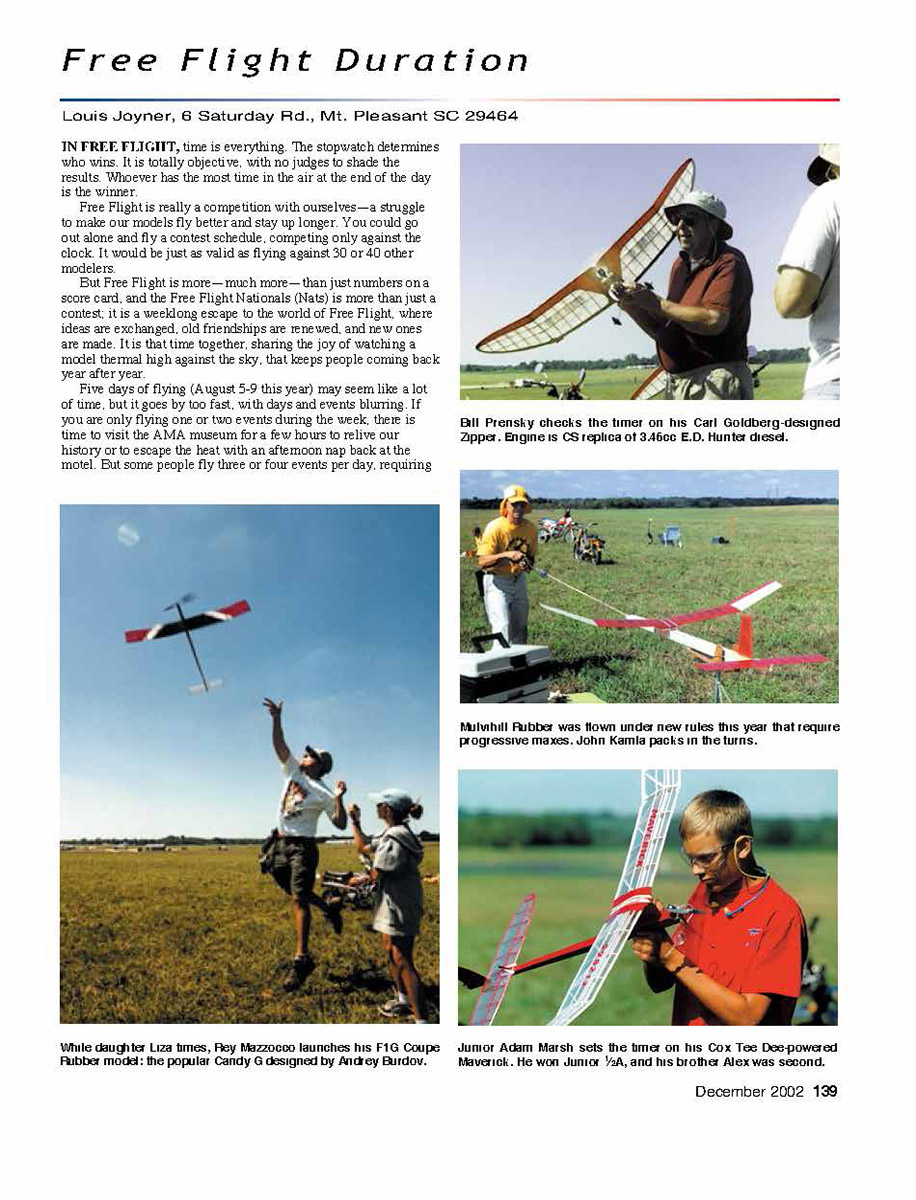
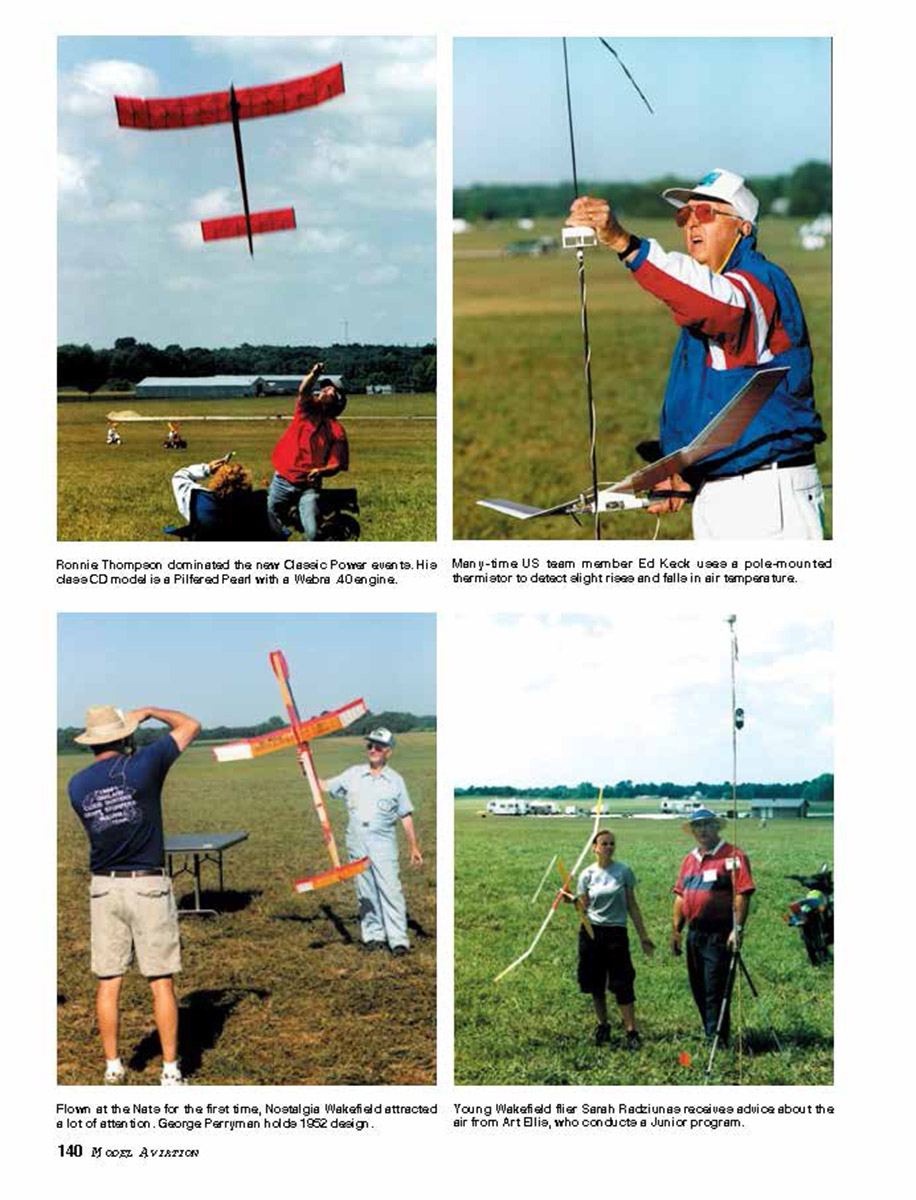
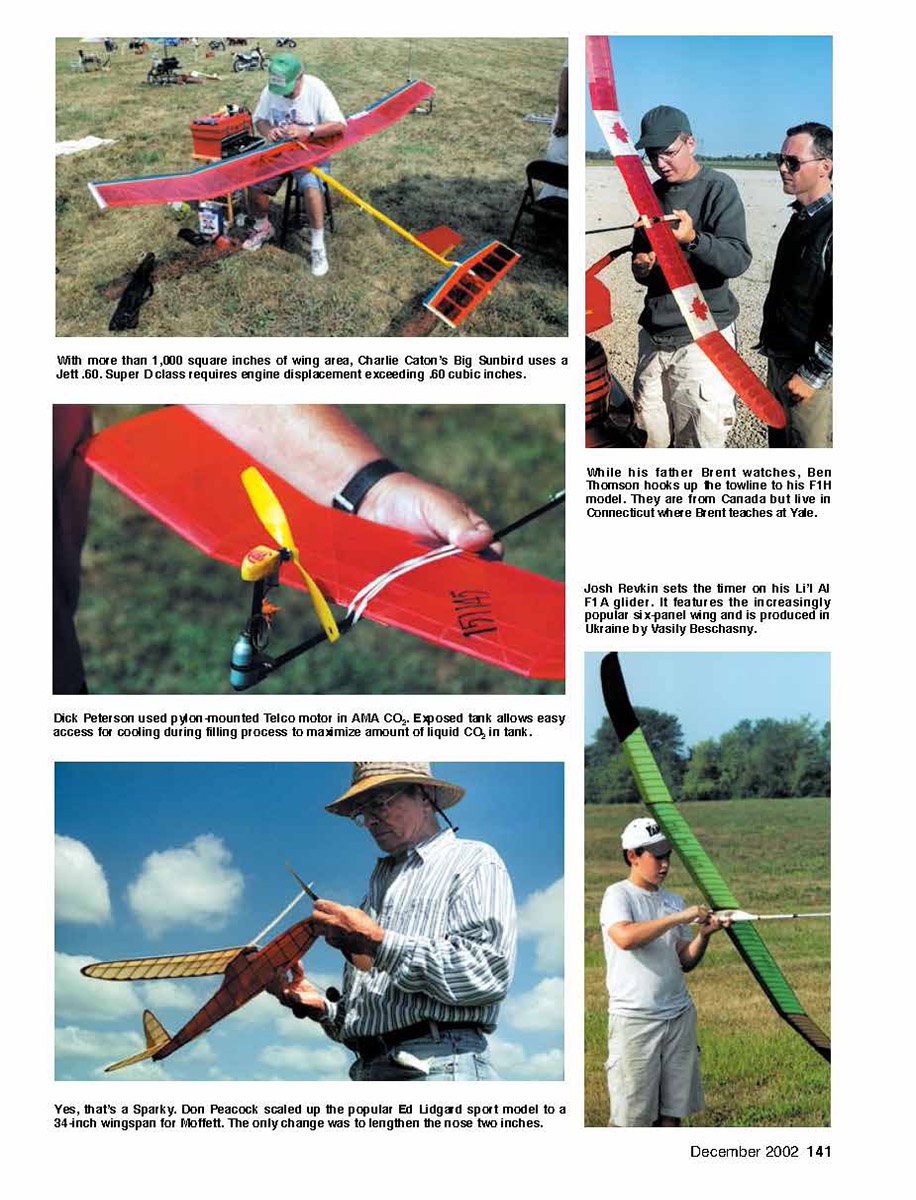
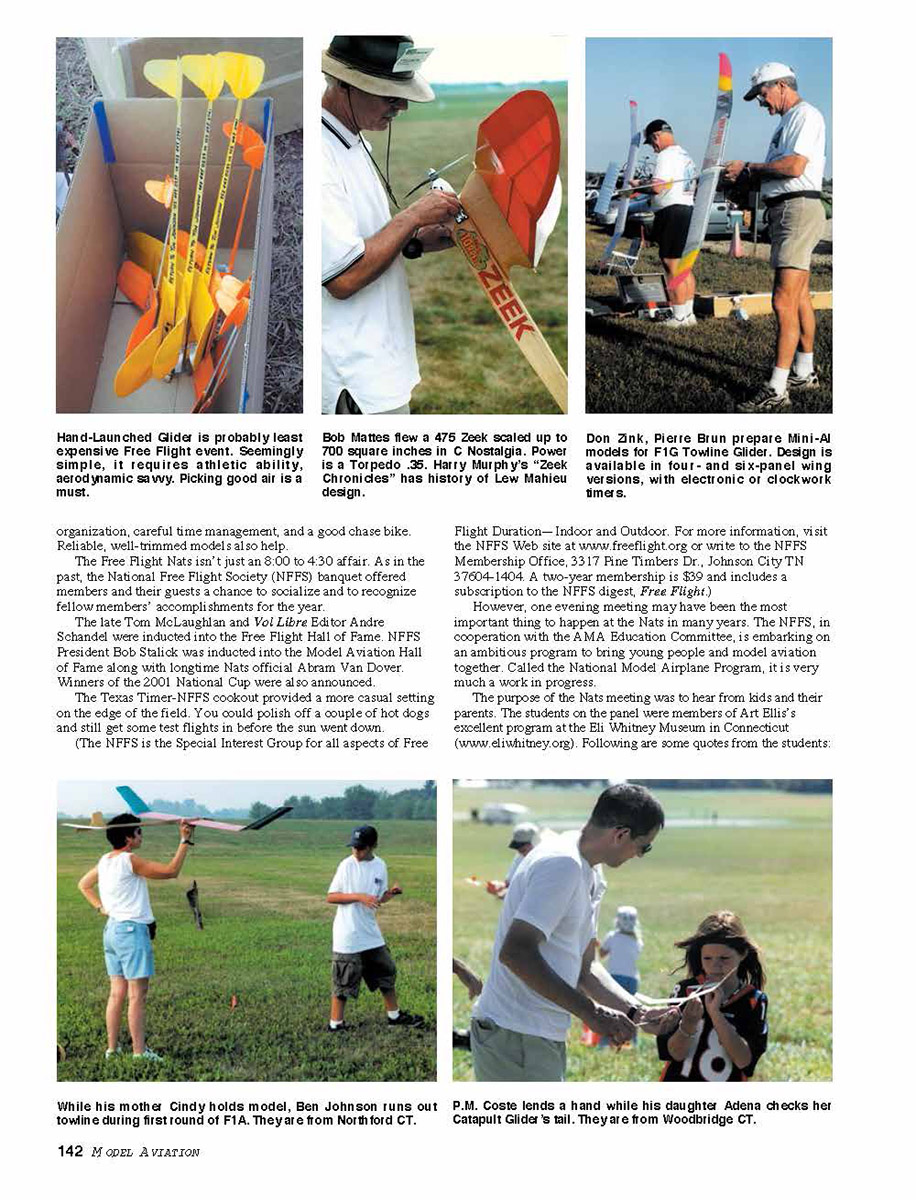
Free Flight Duration
Louis Joyner, 6 Saturday Rd., Mt. Pleasant SC 29464
IN FREE FLIGHT, time is everything. The stopwatch determines who wins. It is totally objective, with no judges to shade the results. Whoever has the most time in the air at the end of the day is the winner.
Free Flight is really a competition with ourselves—a struggle to make our models fly better and stay up longer. You could go out alone and fly a contest schedule, competing only against the clock. It would be just as valid as flying against 30 or 40 other modelers.
But Free Flight is more—much more—than just numbers on a score card, and the Free Flight Nationals (Nats) is more than just a contest; it is a weeklong escape to the world of Free Flight, where ideas are exchanged, old friendships are renewed, and new ones are made. It is that time together, sharing the joy of watching a model thermal high against the sky, that keeps people coming back year after year.
Five days of flying (August 5-9 this year) may seem like a lot of time, but it goes by too fast, with days and events blurring. If you are only flying one or two events during the week, there is time to visit the AMA museum for a few hours to relive our history or to escape the heat with an afternoon nap back at the motel. But some people fly three or four events per day, requiring organization, careful time management, and a good chase bike. Reliable, well-trimmed models also help.
The Free Flight Nats isn't just an 8:00 to 4:30 affair. As in the past, the National Free Flight Society (NFFS) banquet offered members and their guests a chance to socialize and to recognize fellow members' accomplishments for the year.
The late Tom McLaughlan and Vol Libre Editor Andre Schandel were inducted into the Free Flight Hall of Fame. NFFS President Bob Stalick was inducted into the Model Aviation Hall of Fame along with longtime Nats official Abram Van Dover. Winners of the 2001 National Cup were also announced.
The Texas Timer-NFFS cookout provided a more casual setting on the edge of the field. You could polish off a couple of hot dogs and still get some test flights in before the sun went down.
(The NFFS is the Special Interest Group for all aspects of Free Flight. Flight Duration—Indoor and Outdoor. For more information, visit the NFFS Web site at www.freeflight.org or write to the NFFS Membership Office, 3317 Pine Timbers Dr., Johnson City TN 37604-1404. A two-year membership is $39 and includes a subscription to the NFFS digest, Free Flight.)
However, one evening meeting may have been the most important thing to happen at the Nats in many years. The NFFS, in cooperation with the AMA Education Committee, is embarking on an ambitious program to bring young people and model aviation together. Called the National Model Airplane Program, it is very much a work in progress.
The purpose of the Nats meeting was to hear from kids and their parents. The students on the panel were members of Art Ellis's excellent program at the Eli Whitney Museum in Connecticut (www.eliwhitney.org). Following are some quotes from the students: “I finally found something that I enjoy doing.”
“You can find uses for school stuff in aerodynamics.”
“I can tell that I’m attacking problems in different ways.”
“It’s more fun than playing a computer.”
“I love to watch them fly. It’s beautiful.”
Their parents, who also participated on the panel, are all modelers. Following is what they had to say:
“He has fun doing a typical thing.”
“It allows us to interact. You can have a really intelligent conversation.”
“One thing I’m amazed at is how they can deal with problems.”
“It teaches them to get up early.”
The kids' enthusiasm was infectious. It was obvious that they were enjoying the sport of Free Flight; you could see it out on the field. On the first day of the contest, eight Nats judges lined up with 15 Open contestants to fly F1A Glider. Equipment ranged from state-of-the-art carbon-fiber burners to 30-year-old straight-tail models.
The elimination of the Builder of the Model rule in the Fédération Aéronautique Internationale (FAI) events has given these old models, once relegated to the attic, a new lease on life. I saw models flown that were donated by Al Wimer and George Lewis, as well as some of the late Ed Turner’s Nordics donated by Steve Spencer. I think Ed would be pleased knowing that his models are being flown rather than gathering dust.
Juniors flew well in a number of Rubber and Glider events. Top Junior Peter Barron’s (North Haven CT) total of 1,036 seconds in F1A would have placed seventh in Open—approximately 30 seconds ahead of his father, two-time US team member Andrew Barron.
Sarah Radziunas (Northford CT) placed 11th in F1B, flying her 7-year-old model that she had worked all the previous summer to pay for.
John Shalor (Ross Oak MD) won Junior F1HC Coupe, topping five others. His score would have put him in the top 20 in Open.
In Hand-Launched Glider there were 16 Juniors competing and 28 Open fliers. In Catapult Glider there were 18 Junior fliers and 45 Open. In P-30, perhaps the most popular Rubber event, there were 15 Juniors, including six girls; 40 contestants flew in the Open P-30 event. Michelle Badzunas (Northford CT) won Junior with a score of 642. Jim O’Reilly (Wichita KS) won Open with 1,926 seconds.
The high Junior turnout is even more remarkable given that a number of top US Juniors were in Slovakia competing in the Free Flight Junior World Championship. However, the kids weren’t the only ones flying and having fun. Ronnie Thompson (Athens AL) won A/B Classic.
FF Duration
Granger IN finished one-two. Jason Poti was first in Senior.
Ronnie Thompson's domination of the new Classic Power events didn't extend to the small stamps. Tom Kerr and Joe Wagner (a duo from Chesterton IN) paced first and second in Yak Classic, and Ronnie was third.
In addition to the AMA-sponsored events, the NFFS sponsored a number of Nostalgia events — Power and Rubber — and an A-1 Towline Glider event limited to three classes from the day 1960s. Because of the ROG (rise-off-ground) requirement, Nostalgia Wakefields was perhaps the most interesting to watch.
George Perryman (Smyrna GA) flew his 1952 design. His return-period 1951 model he used at the World Championships in Finland is hanging in the AMA museum. George said they wouldn’t let him borrow it back to fly in the Nats. The new 1952 model is well more than six feet long, making ground handling a team effort. George held the model at launch while his son Steve released the propeller. With 4½ ounces of rubber in a four-ounce airframe, the model just kept climbing.
Bud Romak (Orange CA) had two new Nostalgia Wakefields based on designs by his club and Cloud Dusters clubmates Hank Cole and the late Joe Bilgeri. Both models were exquisitely finished.
The time on the watch and the time spent enjoying the flying and fellowship would not be possible without the hundreds of hours put in by volunteers. Contest Director (CD) Chuck Markos and assistant CD Bob Perkins were aided by dozens of modelers who gave up a day, or sometimes an entire week, of flying to run events, record scores, and process models. Without the time they generously donated, and the help from the NFFS and AMA, there would be no Nats. Thanks.
See results in "Focus on Competition".
Transcribed from original scans by AI. Minor OCR errors may remain.

