
FREE FLIGHT DURATION
Louis Joyner, 4221 Old Leeds Rd., Birmingham AL 35213
GOING BACKWARD: The canard or tail-first configuration was popular with model and full-scale aircraft during the early days of aviation. The Wright brothers' aircraft were canards, as were those of Santos Dumont, Curtiss, and others. The tail-first twin pusher was the dominant model layout up to the early 1930s.
But the more conventional layouts, with the stabilizer to the rear, eventually became the norm for full-scale and model aircraft. During the 1950s, there were some efforts to promote the pusher canard for rubber events.
An article by Paul Del Gatto, "Winning the Wakefield" in the February 1952 Air Trails examined conventional and canard configurations. Here's what he said about the canard:
"The Canard—so termed because the tailplane is located forward of the wing—is noted primarily for its superior longitudinal stability with respect to the conventional type of model. If consistency is important in determining a Wakefield winner, we might well consider a Canard configuration solely on the basis of its superior longitudinal stability.
However, there are several other reasons why we should give Canards more serious thought.
"As an example, its adaptability to a pusher arrangement, which if used would result in absolutely no loss in wing efficiency due to the turbulent air from the rotating propeller flowing over the wing surfaces.
"In a Canard the center of gravity (CG) will be located forward of the rear wing, the distance being dependent on the relative lift of the forward wing. For the model we have outlined the center of gravity will be forward of the rear wing approximately 30 percent of the distance between the center of lift (C/L) of both wings. In considering the weight of the model we can readily visualize how the actual center of gravity can easily be located in the desired design position.
"Of lesser importance, though not to be discounted in the design of a Canard, is the fact that the configuration enables us to utilize two high lift airfoil sections, of which the airfoil that stalls sooner is located in the forward wing. By doing this we obtain an increase in the total lifting force acting on the model with respect to that of a conventional design."
In reading this it must be remembered that the rules at the time did not restrict the amount of rubber you could use in a Wakefield—only the minimum all-up weight. Back then, five ounces of rubber in a three-ounce model was the goal. Packing that much rubber into a conventional layout resulted in a very long nose, high moments of inertia, and poor longitudinal stability. (You can still
FF Duration
see this in Mulvihill models.) The other alternative was to use two shorter motors, placed one above the other and a one-to-one return gear at the back. This resulted in a shorter motor base and better stability, but at the expense of a more-complicated model to build and to wind.
But rules change. The maximum allowable amount of rubber was limited—to 80 grams, then 50, 40, and now 35 grams. Beginning in 2002, it will go to 30 grams.
Years ago, Bob Hatschek pointed out that the performance actually increased each time the rubber weight was decreased. He attributed this in large part to the improved longitudinal stability of the model. In other words, keep the tail light, the nose short, and the weight as close to the CG as possible. (For a very detailed and quantified explanation of the importance of light extremities, see Peter King's piece in the November 1995 Aeromodeller.)
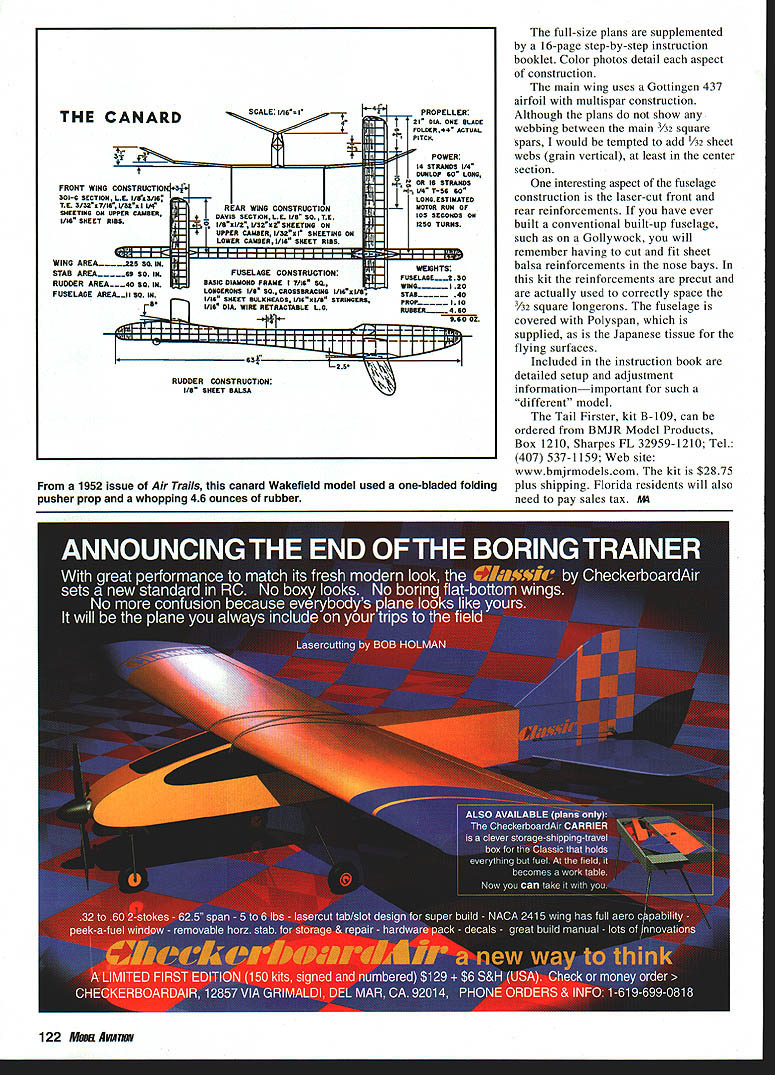
Without the need for the advantages (real or theoretical) of the canard, they basically vanished from the model scene; the one notable exception being the canard F1C power models of Doug Joyce. During the last 40 years, this series has evolved into a very competitive model in Doug's hands. But most modelers are a bit conservative and tend to fly what most other people fly.
A new kit may change that.
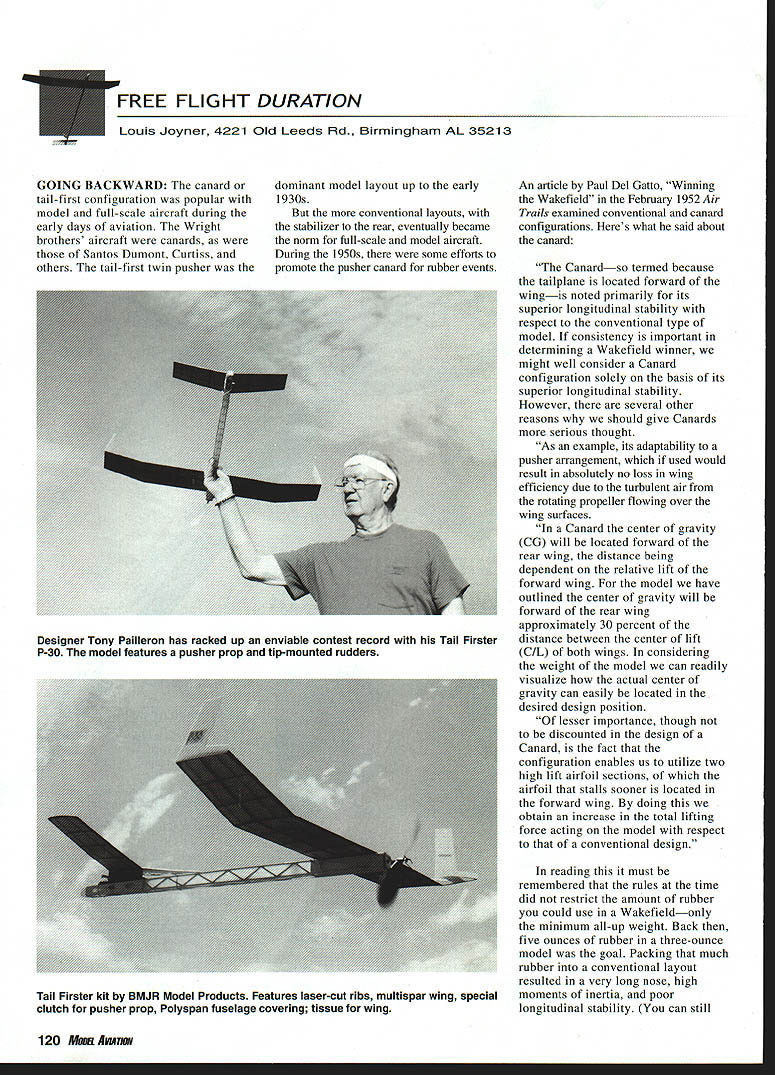
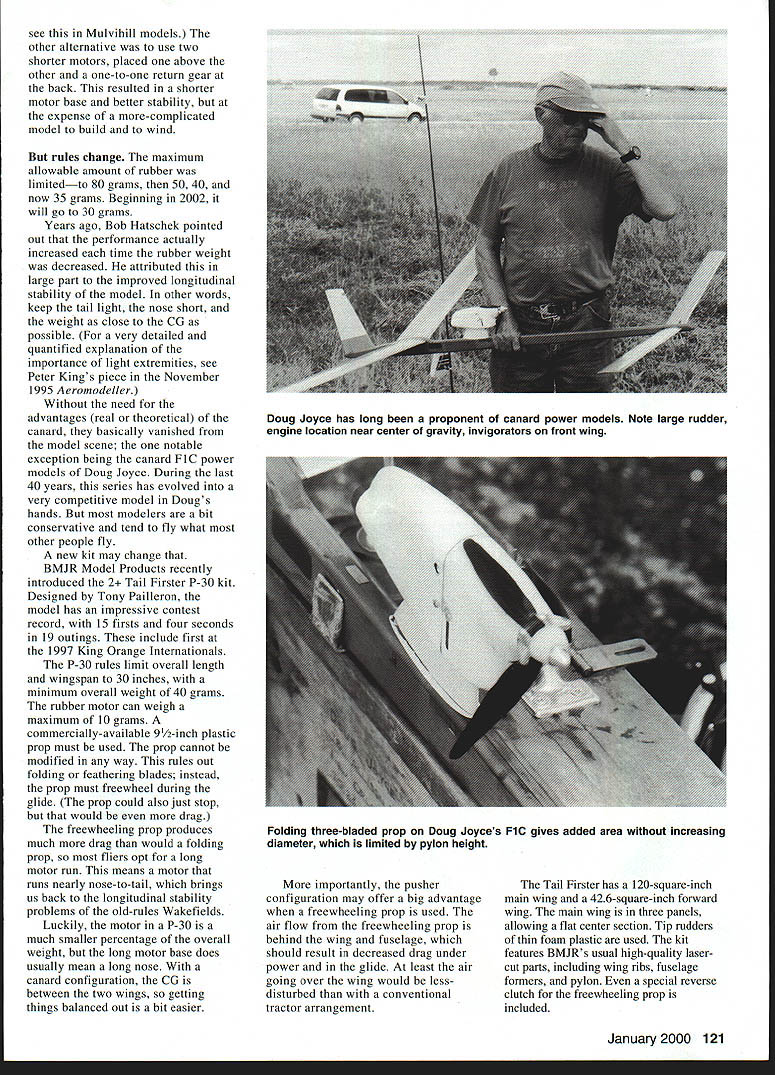
BMJR Model Products recently introduced the 2+ Tail Firster P-30 kit. Designed by Tony Pailleron, the model has an impressive contest record, with 15 firsts and four seconds in 19 outings. These include first at the 1997 King Orange Internationals.
The P-30 rules limit overall length and wingspan to 30 inches, with a minimum overall weight of 40 grams. The rubber motor can weigh a maximum of 10 grams. A commercially-available 9½-inch plastic prop must be used. The prop cannot be modified in any way. This rules out folding or feathering blades; instead, the prop must freewheel during the glide. (The prop could also just stop, but that would even more drag.)
The freewheeling prop produces much more drag than would a folding prop, so most fliers opt for a long motor run. This means a motor that runs nearly nose-to-tail, which brings us back to the longitudinal stability problems of the old-rules Wakefields.
Luckily, the motor in a P-30 is a much smaller percentage of the overall weight, but the long motor base does usually mean a long nose. With a canard configuration, the CG is between the two wings, so getting things balanced out is a bit easier.
More importantly, the pusher configuration may offer a big advantage when a freewheeling prop is used. The air flow from the freewheeling prop is behind the wing and fuselage, which should result in decreased drag under power and in the glide. At least the air going over the wing would be less-disturbed than with a conventional tractor arrangement.
The Tail Firster has a 120-square-inch main wing and a 42.6-square-inch forward wing. The main wing is in three panels, allowing a flat center section. Tip rudders of thin foam plastic are used. The kit features BMJR's usual high-quality lasercut parts, including wing ribs, fuselage formers, and pylon. Even a special reverse clutch for the freewheeling prop is included. The full-size plans are supplemented by a 16-page step-by-step instruction booklet. Color photos detail each aspect of construction.
The main wing uses a Göttingen 437 airfoil with multispar construction. Although the plans do not show any webbing between the main 3/32" square spars, I would be tempted to add 1/32" sheet webs (grain vertical), at least in the center section.
One interesting aspect of the fuselage construction is the laser-cut front and rear reinforcements. If you have ever built a conventional built-up fuselage, such as on a Gollywock, you will remember having to cut and fit sheet balsa reinforcements in the nose bays. In this kit the reinforcements are precut and are actually used to correctly space the 3/32" square longerons. The fuselage is covered with Polyspan, which is supplied, as is the Japanese tissue for the flying surfaces.
Included in the instruction book are detailed setup and adjustment information—important for such a "different" model.
The Tail Firster, kit B-109, can be ordered from BMJR Model Products, Box 1210, Sharps FL 32959-1210. Tel.: (407) 537-1159; Web site: www.bmjrmodels.com. The kit is $28.75 plus shipping. Florida residents will also need to pay sales tax. MA
Transcribed from original scans by AI. Minor OCR errors may remain.

