
FF Duration
Louis Joyner, 6 Saturday Rd., Mt. Pleasant SC 29464
EACH YEAR THE National Free Flight Society (NFFS) produces its annual Symposium Report, better known as the Sympo. This year's is number 38 in the series and was edited by British F1B flier Mike Woodhouse, who operates Free Flight Supplies (www.freeflightsupplies.co.uk)—a mail-order purveyor of all things FF.
For the 2005 Sympo, Mike assembled an international group of volunteer writers who authored papers about the technical and practical aspects of FF. The pieces include Michael Warren's accounts of FF contests around the globe and Ron Pollard's and Art Lonergan's papers about the state of FF and its future.
Vintage and Nostalgia events are amply covered in writings by Martyn Pressnell, Allan Brown, and Rod Audley. Eric Cooper, Charles Williment, and Mike Woodhouse teamed up to present a paper about a lost-and-found Wakefield from the 1940s.
On the theory side, John Barker produced a piece about airfoils with conic camber and Peter King studied the effects of air conditions on model performance. Dutch flier Maarten van Dijk revealed how he makes carbon-fiber pultrusions, and Mike Francis offered practical suggestions for making composite wings.
French modelers Georges Matherat and Jean Wantzenriether discussed the use of single-blade propellers for F1B. American Fritz Mueller wrote about carving propeller blades, and Rainer Lotz and Helmut Werlf added insight on the design of F1Gs. Trevor Payne went into detail about Large Open Power, and Trevor Grey discussed Open electric models.
Ed Mate covered (ROW) rise-off-water models. Allard van Wallene revealed his experiments with flapped-wing F1A Towline Gliders in an effort to gain extra altitude—as much as 30 meters—on the launch. Kurt Krempetz and Peter Lloyd looked at ways to improve Catapult and Hand Launched Gliders.
On the Indoor side, Laurie Barr discussed the EZB event, Bernie Hunt showed how to test balsa stiffness, and Nick Aikman suggested ways to use carbon and boron filaments for reinforcement. For Outdoor Scale, Richard Crossley promoted the Rapier rocket motors as an alternative to the venerable Jetex motors.
One popular feature of the Sympo is the Models of the Year. Headed by Aram Schlosberg, the committee selected a wide range of aircraft. Some offered innovative technology, and others featured stick-and-tissue tradition.
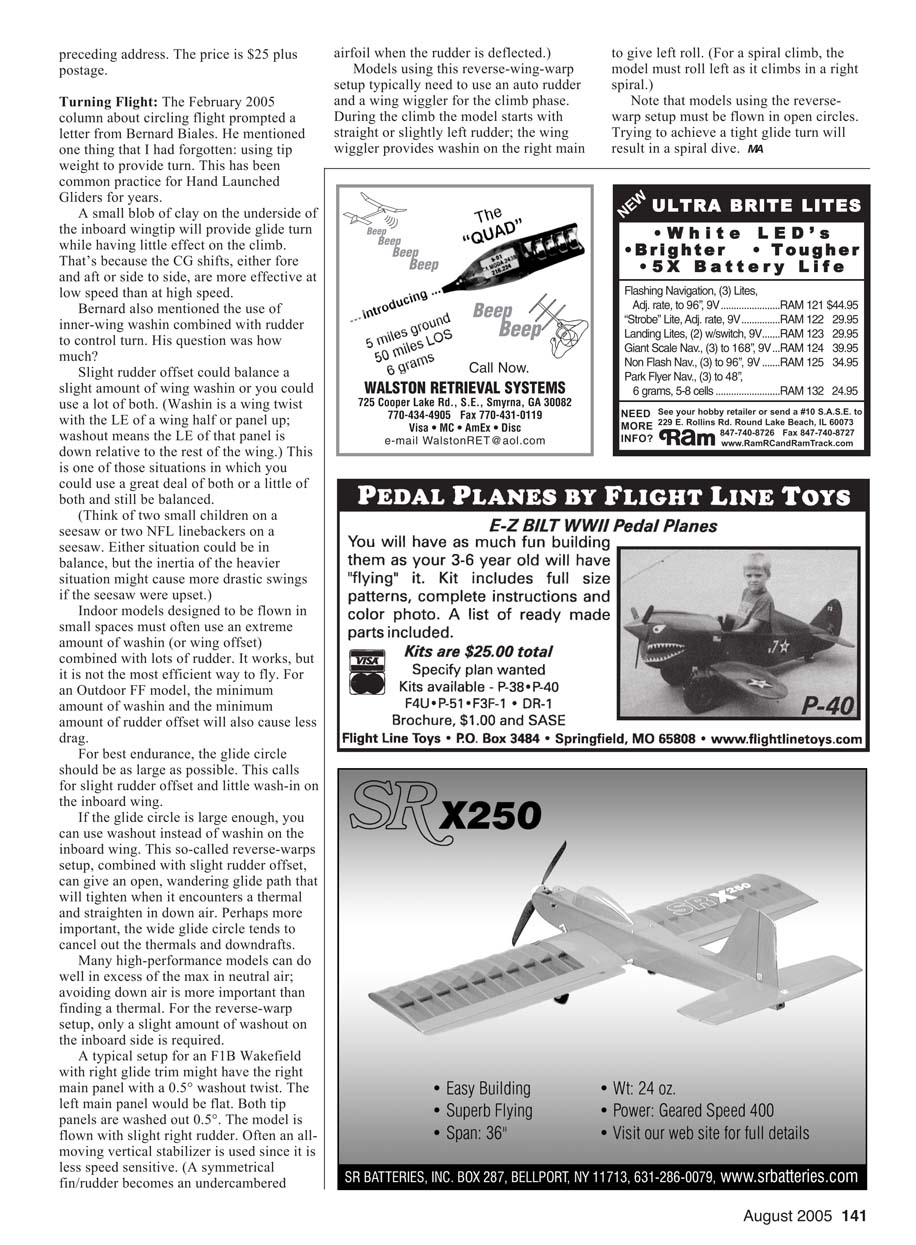
Models chosen included Vic Nippert's Cargo Van .02 Cargo design, the discus-launch developments of Phil Ball and Andrew Hewitt, Anselmo Zeri's Coxy 3 F1B that winds from the rear, Vasily Beschasny's Thermal Floater F1J, Mike Fedor's Texas Cloud Climber F1H—a follow-on to his 1977 Model of the Year L'il Hooker—Ladi Horak's popular Czech Mate F1A, and Chris Starleaf's Indoor electric-powered Scale de Havilland D.H.84 Dragon.
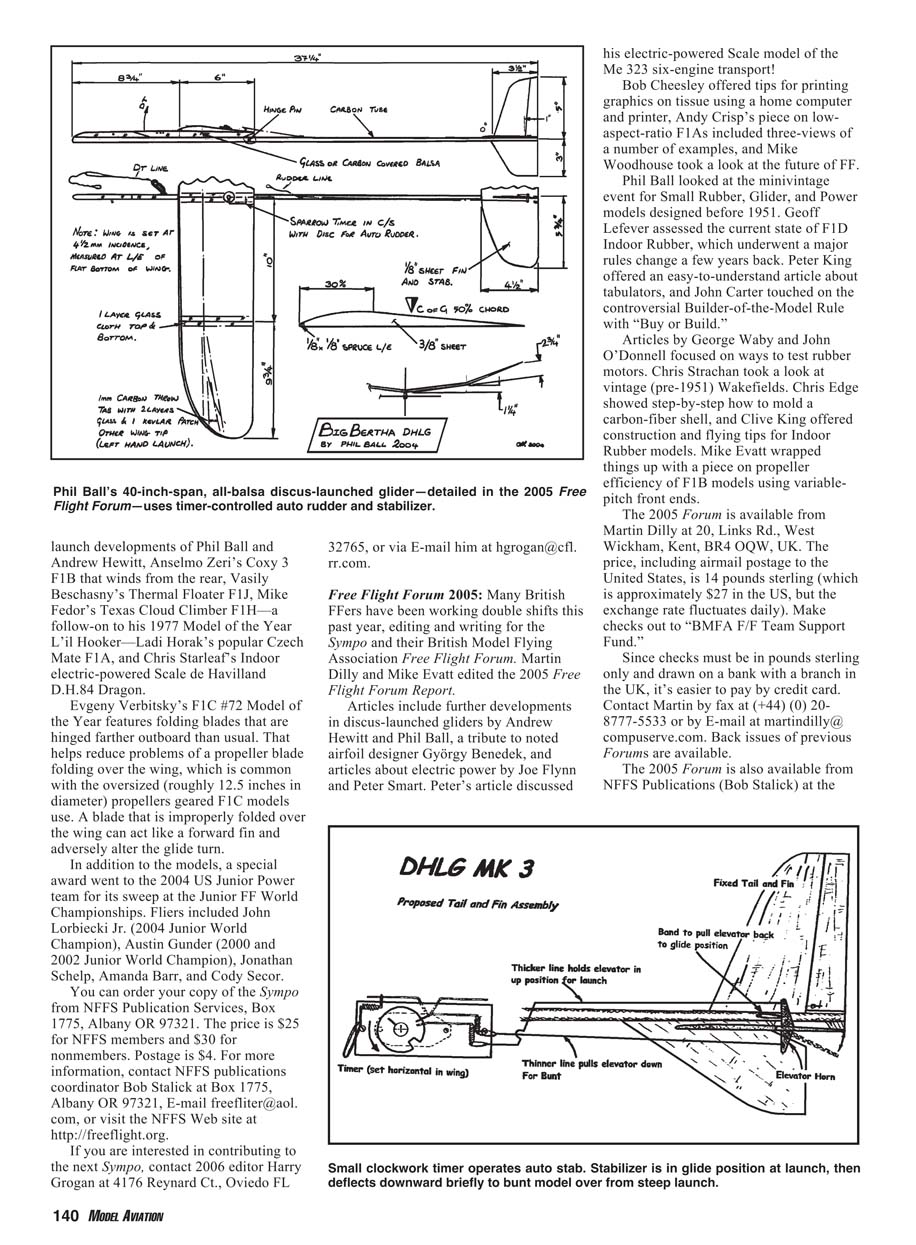
Evgeny Verbitsky's F1C #72 Model of the Year features folding blades that are hinged farther outboard than usual. That helps reduce problems of a propeller blade folding over the wing, which is common with the oversized (roughly 12.5 inches in diameter) propellers geared F1C models use. A blade that is improperly folded over the wing can act like a forward fin and adversely alter the glide turn.
In addition to the models, a special award went to the 2004 US Junior Power team for its sweep at the Junior FF World Championships. Fliers included John Lorbiecki Jr. (2004 Junior World Champion), Austin Gunder (2000 and 2002 Junior World Champion), Jonathan Schelp, Amanda Barr, and Cody Secor.
You can order your copy of the Sympo from NFFS Publication Services, Box 1775, Albany OR 97321. The price is $25 for NFFS members and $30 for nonmembers. Postage is $4. For more information, contact NFFS publications coordinator Bob Stalcik at Box 1775, Albany OR 97321, E-mail [email protected], or visit the NFFS Web site at http://freeflight.org.
If you are interested in contributing to the next Sympo, contact 2006 editor Harry Grogan at 4176 Reynard Ct., Oviedo FL 32765, or via E-mail him at [email protected].
Free Flight Forum 2005: Many British FFers have been working double shifts this past year, editing and writing for the Sympo and their British Model Flying Association Free Flight Forum. Martin Dilly and Mike Evatt edited the 2005 Free Flight Forum Report.
Articles include further developments in discus-launched gliders by Andrew Hewitt and Phil Ball, a tribute to noted airfoil designer Gyorgy Benedek, and articles about electric power by Joe Flynn and Peter Smart. Peter's article discussed his electric-powered Scale model of the Me 323 six-engine transport.
Bob Cheesley offered tips for printing graphics on tissue using a home computer and printer. Andy Crisp's piece on low-aspect-ratio F1As included three-views of a number of examples, and Mike Woodhouse took a look at the future of FF.
Phil Ball looked at the minivintage event for Small Rubber, Glider, and Power models designed before 1951. Geoff Lefever assessed the current state of F1D Indoor Rubber, which underwent a major rules change a few years back. Peter King offered an easy-to-understand article about tabulators, and John Carter touched on the controversial Builder-of-the-Model Rule with "Buy or Build."
Articles by George Waby and John O'Donnell focused on ways to test rubber motors. Chris Strachan took a look at vintage (pre-1951) Wakefields. Chris Edge showed step-by-step how to mold a carbon-fiber shell, and Clive King offered construction and flying tips for Indoor Rubber models. Mike Evatt wrapped things up with a piece on propeller efficiency of F1B models using variable-pitch front ends.
The 2005 Forum is available from Martin Dilly at 20, Links Rd., West Wickham, Kent, BR4 0QW, UK. The price, including airmail postage to the United States, is 14 pounds sterling (which is approximately $27 in the US, but the exchange rate fluctuates daily). Make checks out to "BMFA F/F Team Support Fund."
Since checks must be in pounds sterling only and drawn on a bank with a branch in the UK, it's easier to pay by credit card. Contact Martin by fax at (+44) (0) 20-8777-5533 or by E-mail at [email protected]. Back issues of previous Forums are available.
The 2005 Forum is also available from NFFS Publications (Bob Stalcik) at the
FF Duration
By Louis Joyner
Turning Flight: The February 2005 column about circling flight prompted a letter from Bernard Biales. He mentioned one thing that I had forgotten: using tip weight to provide turn. This has been common practice for Hand Launched Gliders for years.
A small blob of clay on the underside of the inboard wingtip will provide glide turn while having little effect on the climb. That's because the CG shifts, either fore and aft or side to side, are more effective at low speed than at high speed.
Bernard also mentioned the use of inner-wing washin combined with rudder to control turn. His question was how much?
Slight rudder offset could balance a slight amount of wing washin or you could use a lot of both. (Washin is a wing twist with the LE of a wing half or panel up; washout means the LE of that panel is down relative to the rest of the wing.) This is one of those situations in which you could use a great deal of both or a little of both and still be balanced.
(Think of two small children on a seesaw or two NFL linebackers on a seesaw. Either situation could be in balance, but the inertia of the heavier situation might cause more drastic swings if the seesaw were upset.)
Indoor models designed to be flown in small spaces must often use an extreme amount of washin (or wing offset) combined with lots of rudder. It works, but it is not the most efficient way to fly. For an Outdoor FF model, the minimum amount of washin and the minimum amount of rudder offset will also cause less drag.
For best endurance, the glide circle should be as large as possible. This calls for slight rudder offset and little washin on the inboard wing.
If the glide circle is large enough, you can use washin instead of washin on the inboard wing. This so-called reverse-warp setup, combined with slight rudder offset, can give an open, wandering glide path that will tighten when it encounters a thermal and straighten in down air. Perhaps most important, the wide glide circle tends to cancel out the thermals and downdrafts.
Many high-performance models can do well in excess of the max in neutral air; avoiding down air is more important than finding a thermal. For the reverse-warp setup, only a slight amount of washout on the inboard side is required.
A typical setup for an F1B Wakefield with right glide trim might have the right main panel with a 0.5° washin twist. The left main panel would be flat. Both tip panels are washed out 0.5°. The model is flown with slight right rudder. Often an all-moving vertical stabilizer is used since it is less speed sensitive. (A symmetrical fin/rudder becomes an undercambered airfoil when the rudder is deflected.)
Models using this reverse-wing-warp setup typically need to use an auto rudder and a wing wiggler for the climb phase. During the climb the model starts with straight or slightly left rudder; the wing wiggler provides washin on the right main to give left roll. (For a spiral climb, the model must roll left as it climbs in a right spiral.)
Note that models using the reverse-warp setup must be flown in open circles. Trying to achieve a tight glide turn will result in a spiral dive. MA
Transcribed from original scans by AI. Minor OCR errors may remain.

