
The Wee Devil E-36
by Louis Joyner [email protected]
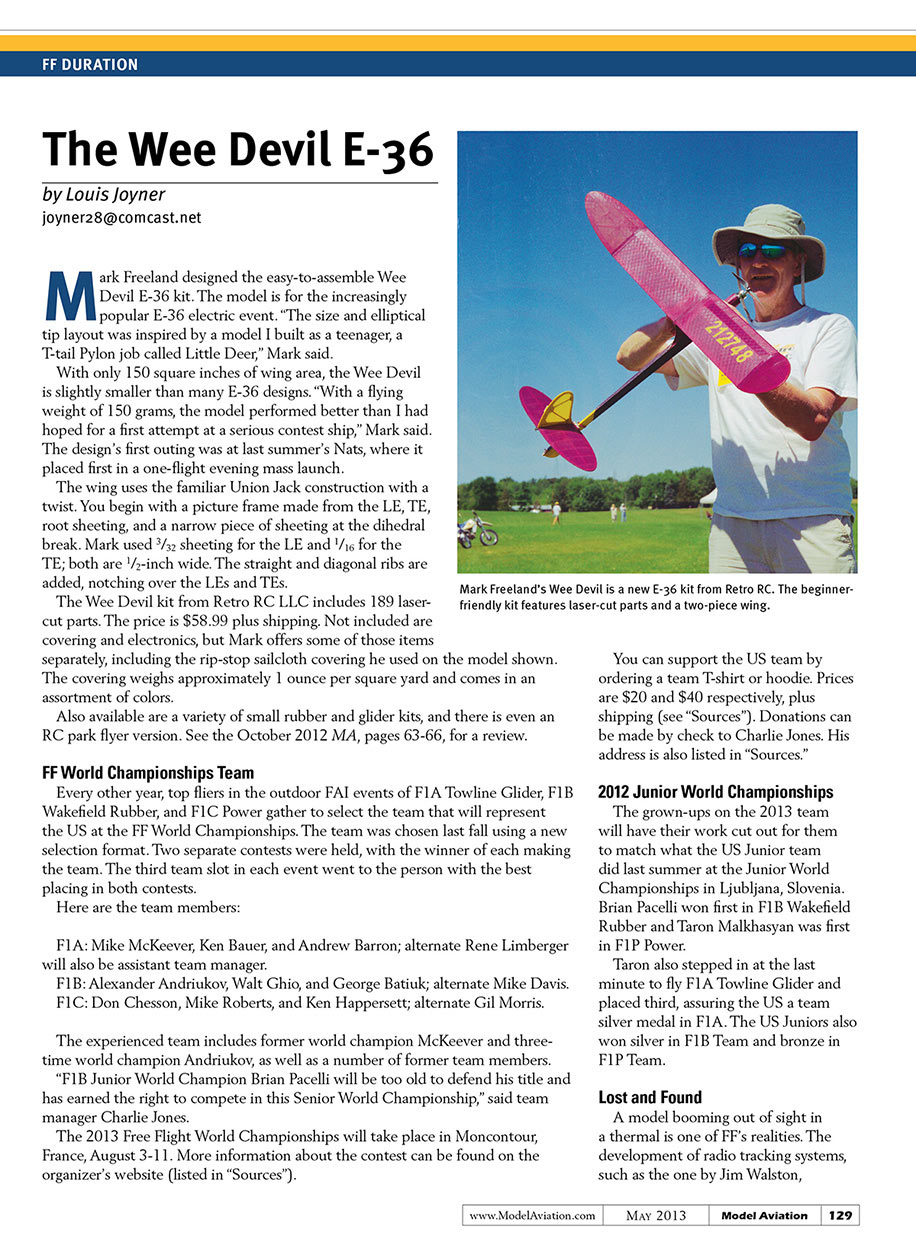
Mark Freeland designed the easy-to-assemble Wee Devil E-36 kit. The model is for the increasingly popular E-36 electric event. “The size and elliptical tip layout was inspired by a model I built as a teenager, a T-tail Pylon job called Little Deer,” Mark said.
With only 150 square inches of wing area, the Wee Devil is slightly smaller than many E-36 designs. “With a flying weight of 150 grams, the model performed better than I had hoped for a first attempt at a serious contest ship,” Mark said. The design’s first outing was at last summer’s Nats, where it placed first in a one-flight evening mass launch.
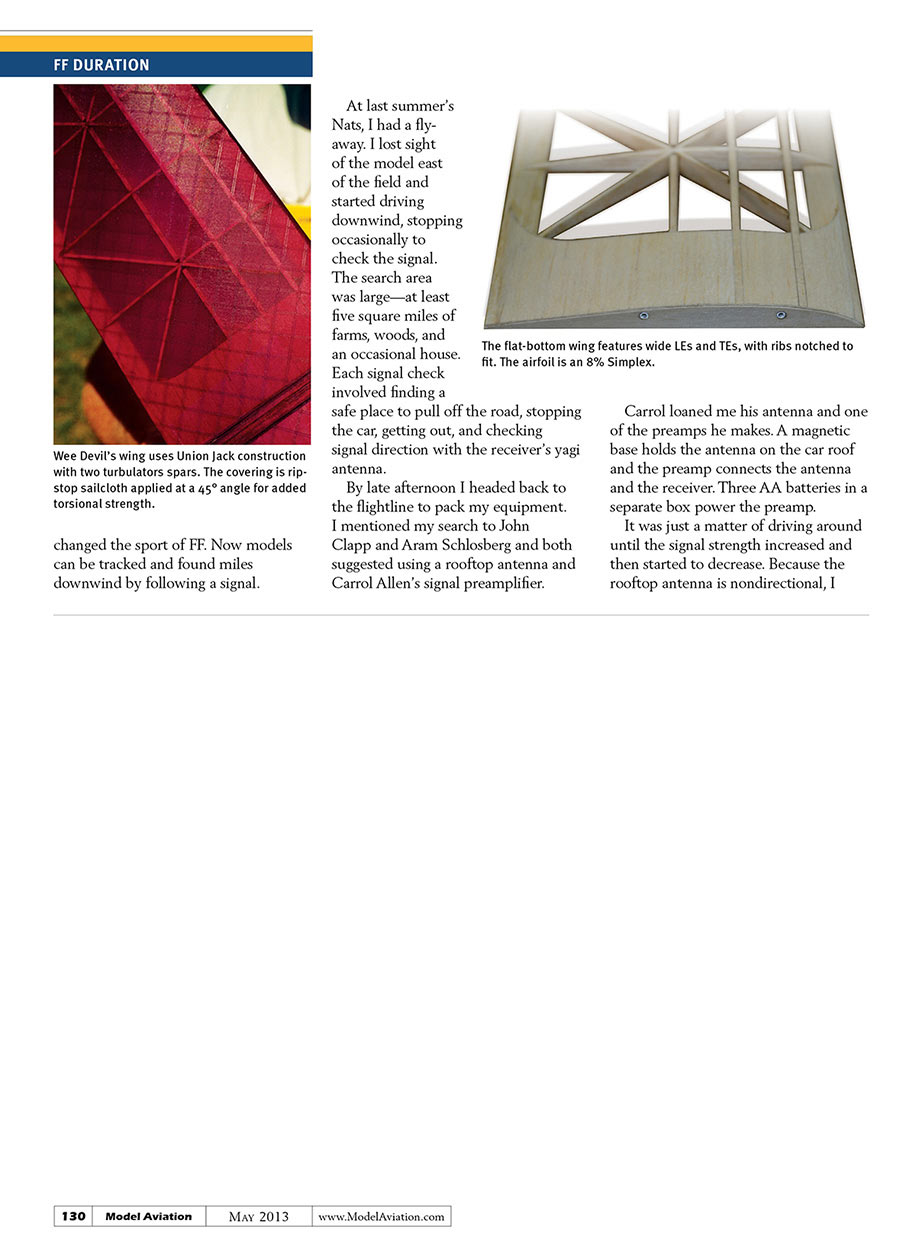
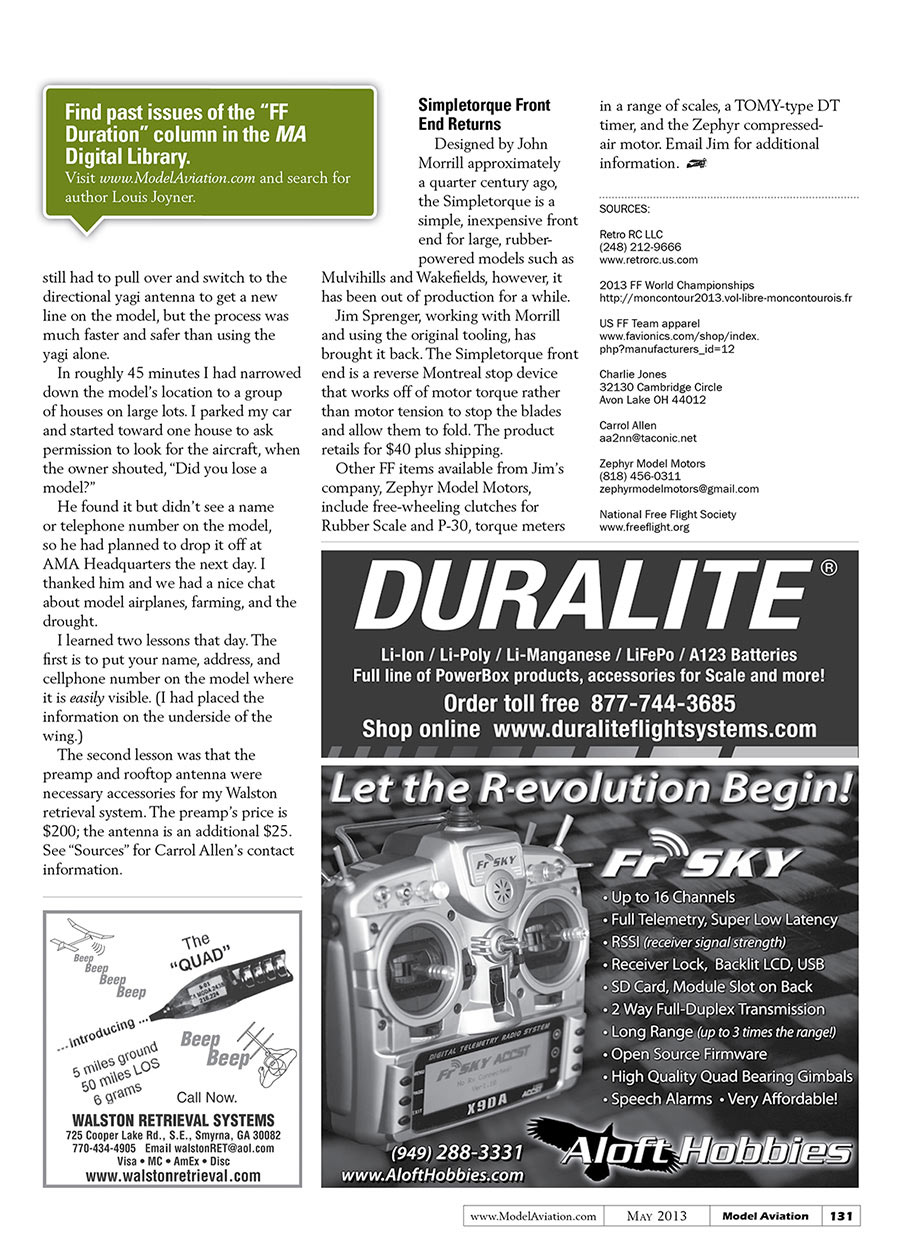
The wing uses the familiar Union Jack construction with a twist. You begin with a picture frame made from the LE, TE, root sheeting, and a narrow piece of sheeting at the dihedral break. Mark used 3/32 sheeting for the LE and 1/16 for the TE; both are 1/2-inch wide. The straight and diagonal ribs are added, notching over the LEs and TEs.
The Wee Devil kit from Retro RC LLC includes 189 laser-cut parts. The price is $58.99 plus shipping. Not included are covering and electronics, but Mark offers some of those items separately, including the rip-stop sailcloth covering he used on the model shown. The covering weighs approximately 1 ounce per square yard and comes in an assortment of colors.
Also available are a variety of small rubber and glider kits, and there is even an RC park flyer version. See the October 2012 MA, pages 63-66, for a review.
At last summer's Nats, I had a fly-away. I lost sight of the model east of the field and started driving downwind, stopping occasionally to check the signal. The search area was large—at least five square miles of farms, woods, and an occasional house. Each signal check involved finding a safe place to pull off the road, stopping the car, getting out, and checking signal direction with the receiver's yagi antenna.
By late afternoon I headed back to the flightline to pack my equipment. I mentioned my search to John Clapp and Aram Schlosberg and both suggested using a rooftop antenna and Carrol Allen's signal preamplifier.
Carrol loaned me his antenna and one of the preamps he makes. A magnetic base holds the antenna on the car roof and the preamp connects the antenna and the receiver. Three AA batteries in a separate box power the preamp.
It was just a matter of driving around until the signal strength increased and then started to decrease. Because the rooftop antenna is nondirectional, I still had to pull over and switch to the directional yagi antenna to get a new line on the model, but the process was much faster and safer than using the yagi alone.
In roughly 45 minutes I had narrowed down the model's location to a group of houses on large lots. I parked my car and started toward one house to ask permission to look for the aircraft, when the owner shouted, "Did you lose a model?"
He found it but didn't see a name or telephone number on the model, so he had planned to drop it off at AMA Headquarters the next day. I thanked him and we had a nice chat about model airplanes, farming, and the drought.
I learned two lessons that day. The first is to put your name, address, and cellphone number on the model where it is easily visible. (I had placed the information on the underside of the wing.)
The second lesson was that the preamp and rooftop antenna were necessary accessories for my Walston retrieval system. The preamp's price is $200; the antenna is an additional $25. See "Sources" for Carrol Allen's contact information.
Transcribed from original scans by AI. Minor OCR errors may remain.

