
NFFS Symposia: 2013
by Louis Joyner <REDACTED>
Edited by Randy Reynolds, the 46th edition of the annual National Free Flight Society (NFFS) Symposia covers a wide variety of topics. Here are the papers:
- "Tips for Winning Power Contests," by MA columnist Gene Smith, offers advice about improving your contest results.
- "The AMA Contest Board," by Jerry Murphy, provides a behind-the-scenes look at the rulemaking organization.
- "Geriatric Free Flight," also by Jerry Murphy, suggests ways to age gracefully on the contest circuit.
- "Photographing the Free Flight Model in Action," by Pat Dailey, shows how he produces the in-flight shots on the DC Maxecuters' website.
- "2012 Geneseo FAC Journal," by Tom Hallman, tells how he prepares for and flies in a major Scale contest.
- "Struts," by Stew Myers, explains how to rig a Scale biplane.
- "Methods of Comparing Gas and Electric Power," by Chris Stoddart, offers suggestions about combining power sources equitably in competition.
- "Methods for Processing F1Q Models," by Dick Ivers, looks at the challenges facing fliers and officials in dealing with the new rules for the FAI Electric event.
- "NFFS Indoor Committee Report," by John Kagan, deals with ways to increase participation on local as well as national levels and build on the interest generated among young modelers by the Science Olympiad.
- "Fund Raising for 'Float'," by Ben Saks, talks about how he used crowd funding on the Internet to finance a feature-length documentary about Indoor flying. (You can view the trailer at www.floatdocumentary.com.)
- "CAD for Model Design/Laser Cutting," by Mike Midkiff and Charlie Bice, shows how CAD drawings and laser-cut parts are done.
- "Dave Wineland—Nobel Laureate; Free Flighter," by Rick Pangell, tells the story of a longtime modeler who received the 2012 Nobel Prize in Physics.
- "NFFS Foundation Report," by Bob Stalcik, offers updates on the organization's philanthropic arm.
- "P-30 Design," by Jean Wantzenriether, explores the parameters of more than 50 P-30 Rubber designs.
- "Roundtable Discussion on Electric Free Flight." Five experts offer their opinions about these developing events.
- "Sal Taibi Memorial," by Kevin Sherman, offers a look back at the noted designer and flier's seven-decade career in FF.
- "Satellite History," by Mike Schwartz, provides a definitive take on the Hunter-designed Power models.
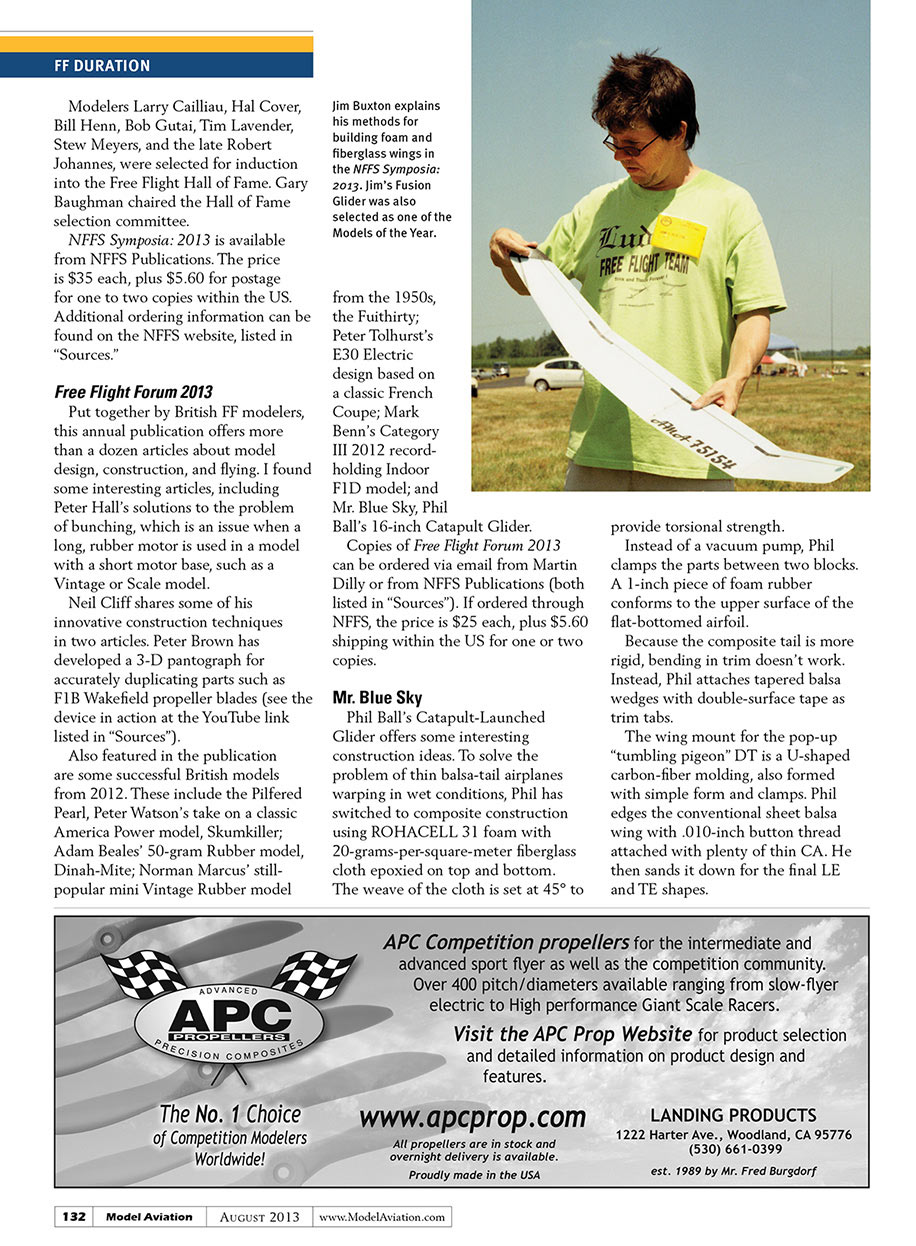
- "Building Foam DLG Wings," by Jim Buxton, shows his methods for making composite-foam wings for Discus Launch Gliders and other models.
- "F1B Propellers," by Sergio Montes, explores the history, development, and evolution of the modern Wakefield Rubber model propeller.
Selected as Models of the Year were the Rubber Scale F4U Corsair by Don DeLoach; the Super Pearl 202-E for E-36 Electric, also by Don; the BS6/DD Easy B Indoor design of Yuan Kang Lee; and Jim Buxton's Fusion Hand-Launch Glider. (The Super Pearl 202-E was reviewed in the July 2012 issue of MA. Full-size plans and construction details for Buxton's Fusion were featured in the November/December issue of Free Flight, aka NFFS Digest.)
Special Recognition Awards went to George White and the Pensacola Free Flight Team for the Online Free Flight Article Index website and to the Hip Pocket Aeronautics Forum. The selection committee was chaired by Dan Berry.
FF DURATION
Lou Joyner
Modelers Larry Cailliau, Hal Cover, Bill Henn, Bob Gutai, Tim Lavender, Stew Meyers, and the late Robert Johannes, were selected for induction into the Free Flight Hall of Fame. Gary Baughman chaired the Hall of Fame selection committee.
NFFS Symposia: 2013 is available from NFFS Publications. The price is $35 each, plus $5.60 for postage for one to two copies within the US. Additional ordering information can be found on the NFFS website, listed in "Sources."
Free Flight Forum 2013
Put together by British FF modelers, this annual publication offers more than a dozen articles about model design, construction, and flying. I found some interesting articles, including Peter Hall's solutions to the problem of bunching, which is an issue when a long, rubber motor is used in a model with a short motor base, such as a Vintage or Scale model.
Neil Cliff shares some of his innovative construction techniques in two articles. Peter Brown has developed a 3-D pantograph for accurately duplicating parts such as F1B Wakefield propeller blades (see the device in action at the YouTube link listed in "Sources").
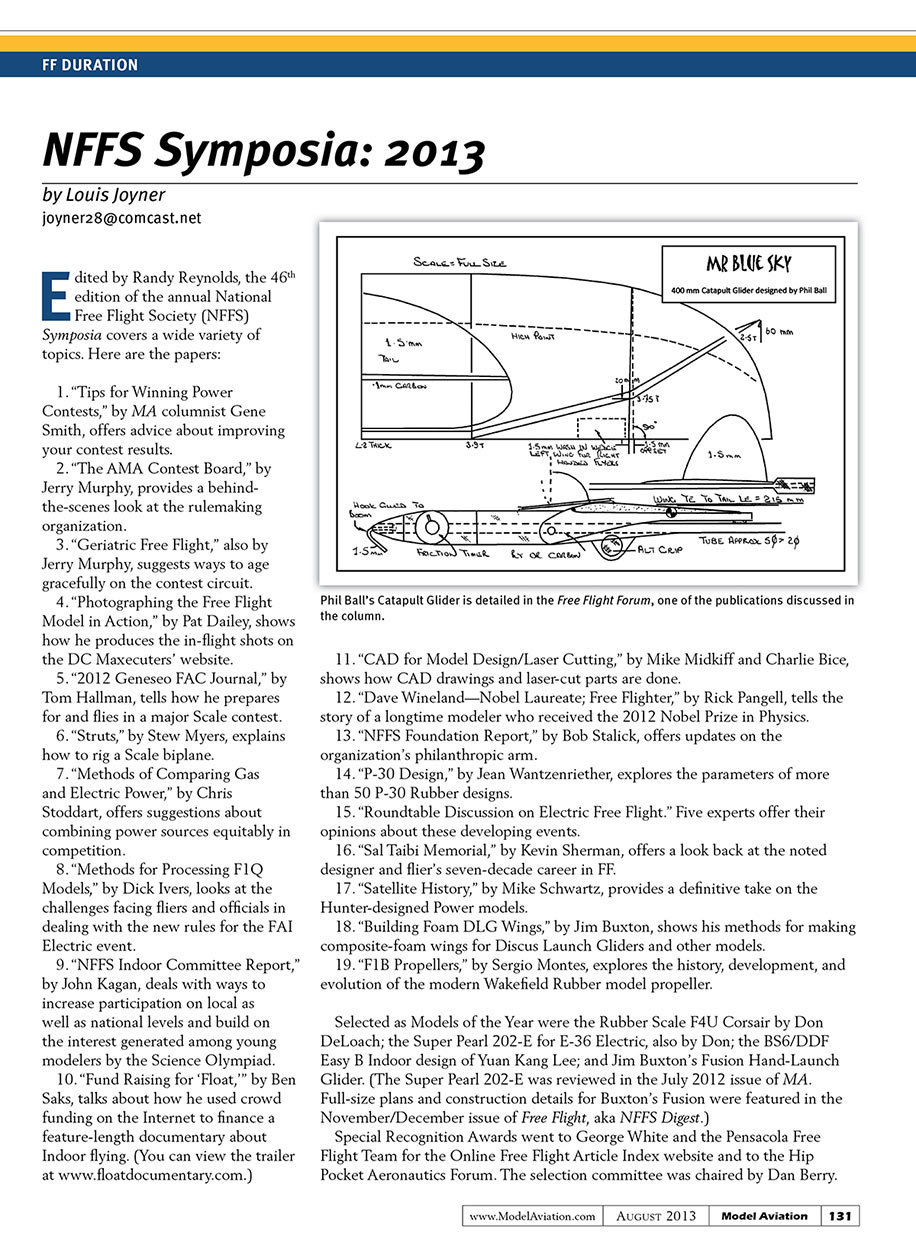
Also featured in the publication are some successful British models from 2012. These include the Pilfered Pearl, Peter Watson's take on a classic America Power model, Skumkiller, Adam Beales' 50-gram Rubber model, Dinah-Mite; Norman Marcus' still-popular mini Vintage Rubber model from the 1950s, the Futirthirty; Peter Tolhurst's E30 Electric design based on a classic French Coupe; Mark Benn's Category III 2012 record-holding Indoor F1D model; and Mr. Blue Sky, Phil Ball's 16-inch Catapult Glider.
Copies of Free Flight Forum 2013 can be ordered via email from Martin Dilly or from NFFS Publications (both listed in "Sources"). If ordered through NFFS, the price is $25 each, plus $5.60 shipping within the US for one or two copies.
Mr. Blue Sky
Phil Ball's Catapult-Launched Glider offers some interesting construction ideas. To solve the problem of thin balsa-tail airplanes warping in wet conditions, Phil has switched to composite construction using ROHACELL 31 foam with 20-grams-per-square-meter fiberglass cloth epoxied on top and bottom. The weave of the cloth is set at 45° to provide torsional strength.
Instead of a vacuum pump, Phil clamps the parts between two blocks. A 1-inch piece of foam rubber conforms to the upper surface of the flat-bottomed airfoil.
Because the composite tail is more rigid, bending in trim doesn't work. Instead, Phil attaches tapered balsa wedges with double-surface tape as trim tabs.
The wing mount for the pop-up "tumbling pigeon" DT is a U-shaped carbon-fiber molding, also formed with simple form and clamps. Phil edges the conventional sheet balsa wing with .010-inch button thread attached with plenty of thin CA. He then sands it down for the final LE and TE shapes.
FF Duration
Lou Joyner
Learning Never Ends
Although FF's basic concept is simple, in execution it can be complex. Aerodynamic design, structural integrity, and construction techniques are challenging for beginners as well as experienced modelers. But much of the fun of FF comes from meeting those challenges, learning new techniques, and embracing new technology.
Publications such as Symposia and Free Flight Forum offer annual updates on the latest thinking in a variety of FF disciplines. Collected and saved, they provide an invaluable reference library.
Specialty FF magazines such as Free Flight and Free Flight Quarterly, help keep us abreast of changes within our hobby and sport, as do the FF-related columns in MA. Internet sites such as the Pensacola Free Flight Team's Article Index and the Hip Pocket Aeronautics online forum and plans library, offer a wealth of information.
By participating in the forums, you can share your questions, experiences, and knowledge with modelers from around the world.
SOURCES:
NFFS www.freeflight.org
Hip Pocket Aeronautics <REDACTED> http://hippocketaeronautics.com
Pensacola Free Flight Team www.pensacolafreeflight.org
Martin Dilly <REDACTED>
Peter Brown's Propeller Blades Duplicator www.youtube.com/watch?v=UyhA_Lfkc9k
Transcribed from original scans by AI. Minor OCR errors may remain.

