
Add strength with carbon-fiber capstrips
by Louis Joyner [email protected]
Building light is easy, but building light and strong requires slightly more work and perhaps the use of some different materials. Carbon fiber is a material that can greatly increase strength and stiffness of a wing or tail.
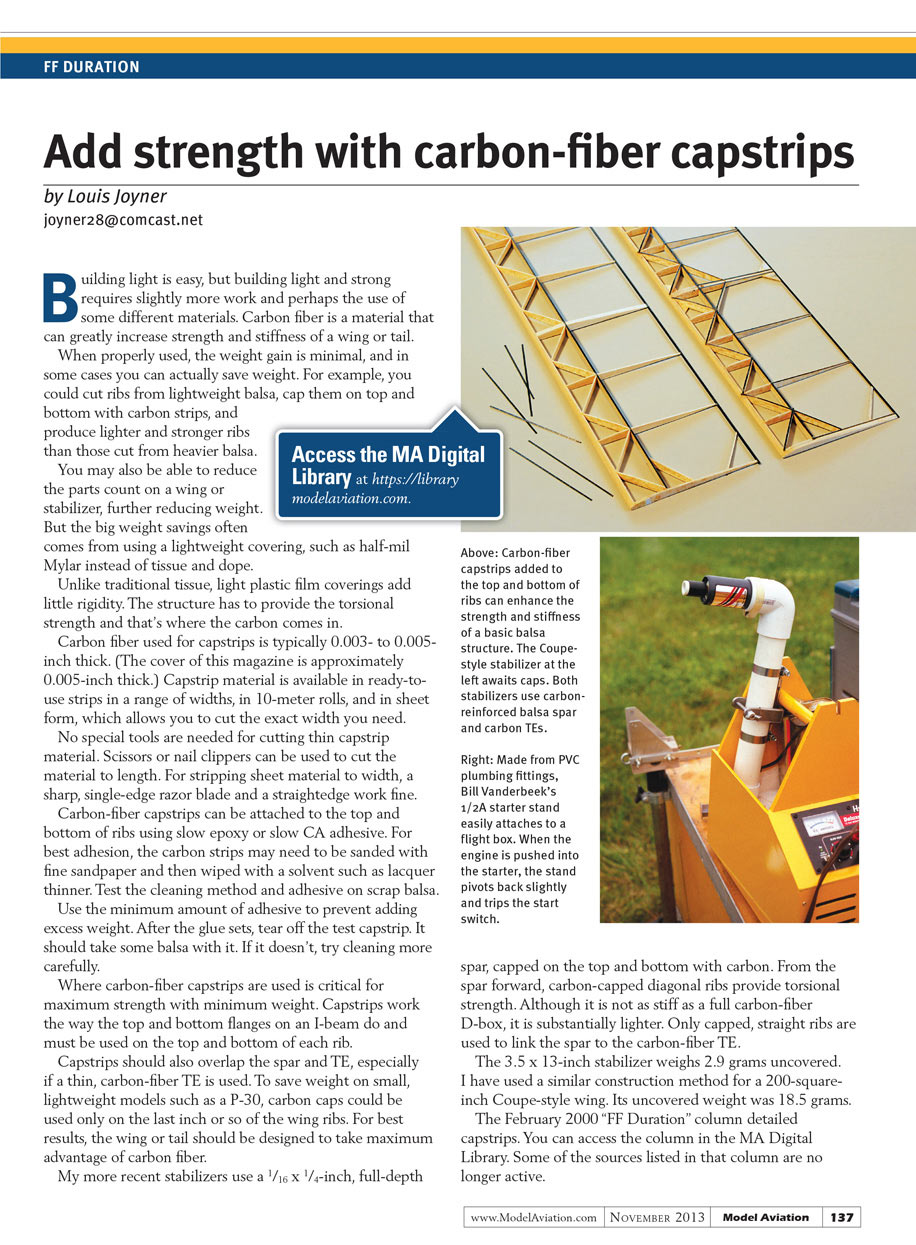
When properly used, the weight gain is minimal, and in some cases you can actually save weight. For example, you could cut ribs from lightweight balsa, cap them on top and bottom with carbon strips, and produce lighter and stronger ribs than those cut from heavier balsa.
You may also be able to reduce the parts count on a wing or stabilizer, further reducing weight. But the big weight savings often comes from using a lightweight covering, such as half-mil Mylar instead of tissue and dope.
Unlike traditional tissue, light plastic film coverings add little rigidity. The structure has to provide the torsional strength and that’s where the carbon comes in.
Carbon fiber used for capstrips is typically 0.003- to 0.005-inch thick. (The cover of this magazine is approximately 0.005-inch thick.) Capstrip material is available in ready-to-use strips in a range of widths, in 10-meter rolls, and in sheet form, which allows you to cut the exact width you need.
No special tools are needed for cutting thin capstrip material. Scissors or nail clippers can be used to cut the material to length. For stripping sheet material to width, a sharp, single-edge razor blade and a straightedge work fine.
Carbon-fiber capstrips can be attached to the top and bottom of ribs using slow epoxy or slow CA adhesive. For best adhesion, the carbon strips may need to be sanded with fine sandpaper and then wiped with a solvent such as lacquer thinner. Test the cleaning method and adhesive on scrap balsa.
Use the minimum amount of adhesive to prevent adding excess weight. After the glue sets, tear off the test capstrip. It should take some balsa with it. If it doesn’t, try cleaning more carefully.
Where carbon-fiber capstrips are used is critical for maximum strength with minimum weight. Capstrips work the way the top and bottom flanges on an I-beam do and must be used on the top and bottom of each rib.
Capstrips should also overlap the spar and TE, especially if a thin, carbon-fiber TE is used. To save weight on small, lightweight models such as a P-30, carbon caps could be used only on the last inch or so of the wing ribs. For best results, the wing or tail should be designed to take maximum advantage of carbon fiber.
My more recent stabilizers use a 1/16 x 1/4-inch, full-depth spar, capped on the top and bottom with carbon. From the spar forward, carbon-capped diagonal ribs provide torsional strength. Although it is not as stiff as a full carbon-fiber D-box, it is substantially lighter. Only capped, straight ribs are used to link the spar to the carbon-fiber TE.
The 3.5 x 13-inch stabilizer weighs 2.9 grams uncovered. I have used a similar construction method for a 200-square-inch Coupe-style wing. Its uncovered weight was 18.5 grams.
The February 2000 "FF Duration" column detailed capstrips. You can access the column in the MA Digital Library. Some of the sources listed in that column are no longer active.
FF Duration
Louis Joyner
1/2A Starter Stand
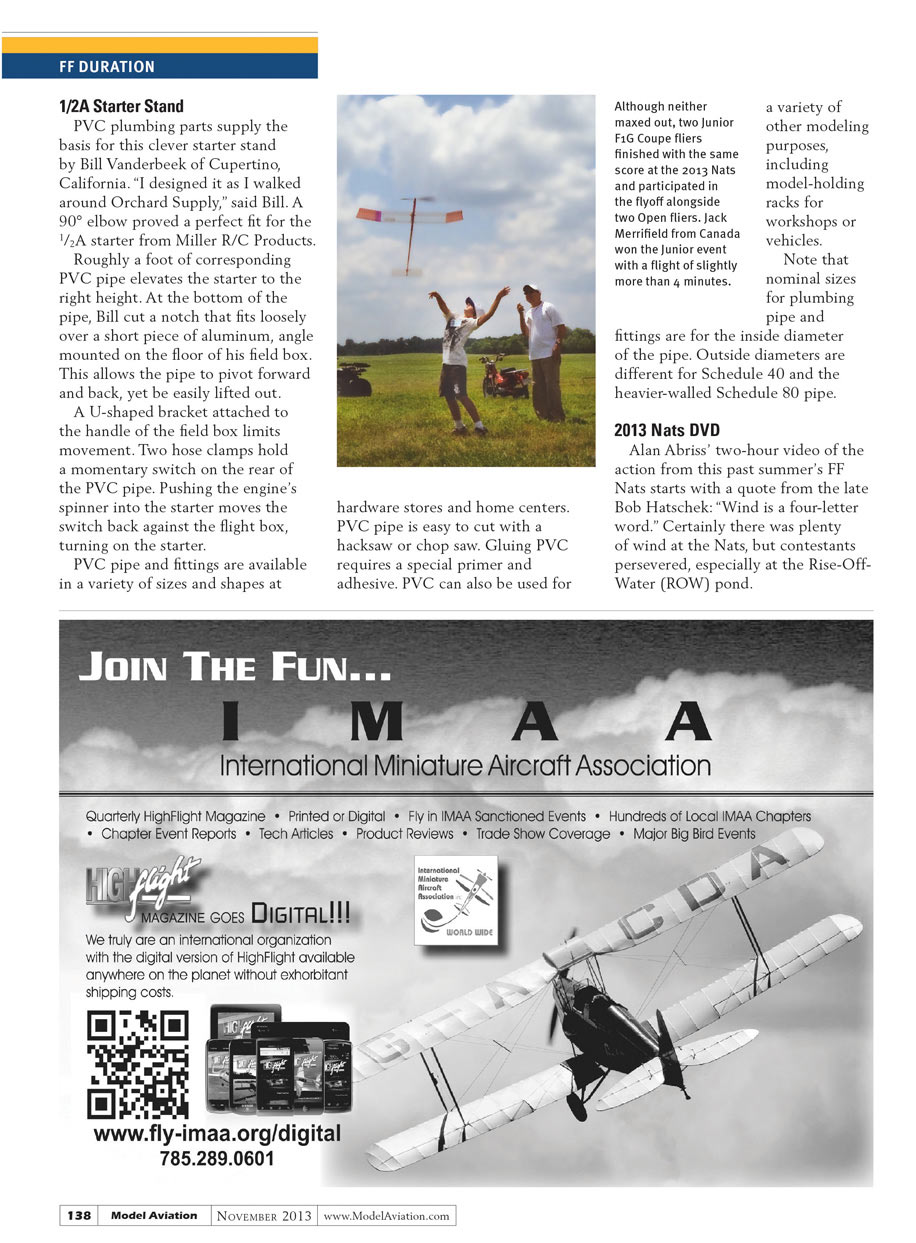
PVC plumbing parts supply the basis for this clever starter stand by Bill Vanderbeek of Cupertino, California. "I designed it as I walked around Orchard Supply," said Bill. A 90° elbow proved a perfect fit for the 1/2A starter from Miller R/C Products.
Roughly a foot of corresponding PVC pipe elevates the starter to the right height. At the bottom of the pipe, Bill cut a notch that fits loosely over a short piece of aluminum, angle mounted on the floor of his field box. This allows the pipe to pivot forward and back, yet be easily lifted out.
A U-shaped bracket attached to the handle of the field box limits movement. Two hose clamps hold a momentary switch on the rear of the PVC pipe. Pushing the engine's spinner into the starter moves the switch back against the flight box, turning on the starter.
PVC pipe and fittings are available in a variety of sizes and shapes at hardware stores and home centers. PVC pipe is easy to cut with a hacksaw or chop saw. Gluing PVC requires a special primer and adhesive. PVC can also be used for a variety of other modeling purposes, including model-holding racks for workshops or vehicles.
Note that nominal sizes for plumbing pipe and fittings are for the inside diameter of the pipe. Outside diameters are different for Schedule 40 and the heavier-walled Schedule 80 pipe.
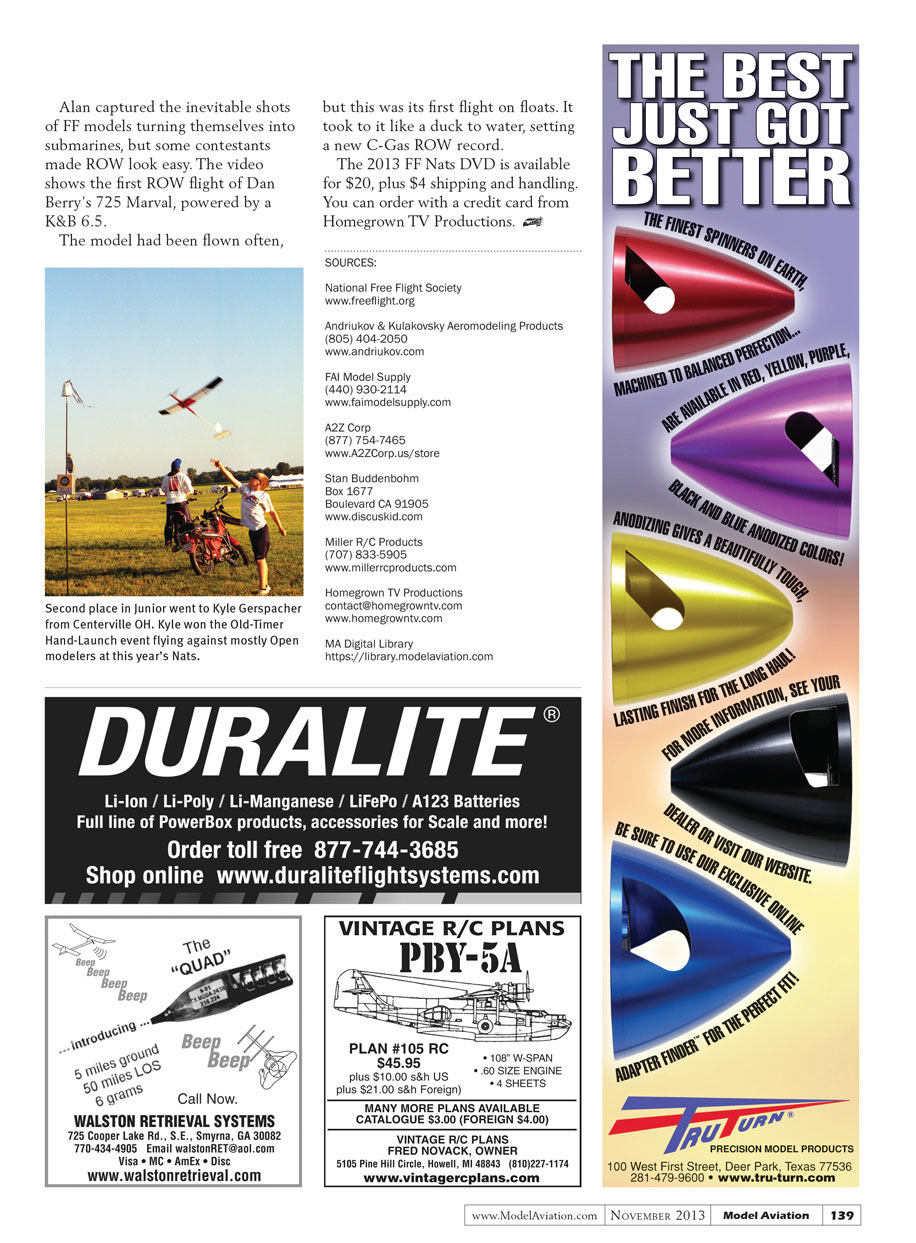
Although neither maxed out, two Junior F1G Coupe fliers finished with the same score at the 2013 Nats and participated in the flyoff alongside two Open fliers. Jack Merrifield from Canada won the Junior event with a flight of slightly more than 4 minutes.
2013 Nats DVD
Alan Abriss' two-hour video of the action from this past summer's FF Nats starts with a quote from the late Bob Hatschek: "Wind is a four-letter word." Certainly there was plenty of wind at the Nats, but contestants persevered, especially at the Rise-Off-Water (ROW) pond.
FF Duration
Louis Joyner
Alan captured the inevitable shots of FF models turning themselves into submarines, but some contestants made ROW look easy. The video shows the first ROW flight of Dan Berry's 725 Marval, powered by a K&B 6.5.
The model had been flown often, but this was its first flight on floats. It took to it like a duck to water, setting a new C-Gas ROW record.
The 2013 FF Nats DVD is available for $20, plus $4 shipping and handling. You can order with a credit card from Homegrown TV Productions.
SOURCES:
- National Free Flight Society
- Andriukov & Kulakovsky Aeromodeling Products
(805) 404-2050 www.andriukov.com
- FAI Model Supply
(440) 930-2114 www.faimodelsupply.com
- A2Z Corp
(877) 754-7465 www.A2ZCorp.us/store
- Stan Buddenbohm
Box 1677 Boulevard CA 91905 www.discuskid.com
- Miller R/C Products
(707) 833-5905 www.millerrcproducts.com
- Homegrown TV Productions
[email protected] www.homegrowntv.com
- MA Digital Library
https://library.modelaviation.com
Transcribed from original scans by AI. Minor OCR errors may remain.

