
FREE FLIGHT DURATION
Louis Joyner, 4221 Old Leeds Rd., Birmingham AL 35213
Editor's note: As this issue was being assembled, we received word that former "FF Duration" columnist Harry Murphy died Christmas Day following a stroke.
Murphy was a founder of the Central Indiana Aeromodellers; was a key figure in the development of the National Free Flight Society's Nostalgia movement; and designed the Pay-Triot, Lunar-Tic, Sunliner, and many other successful models.
CARBON TUBES, PART TWO
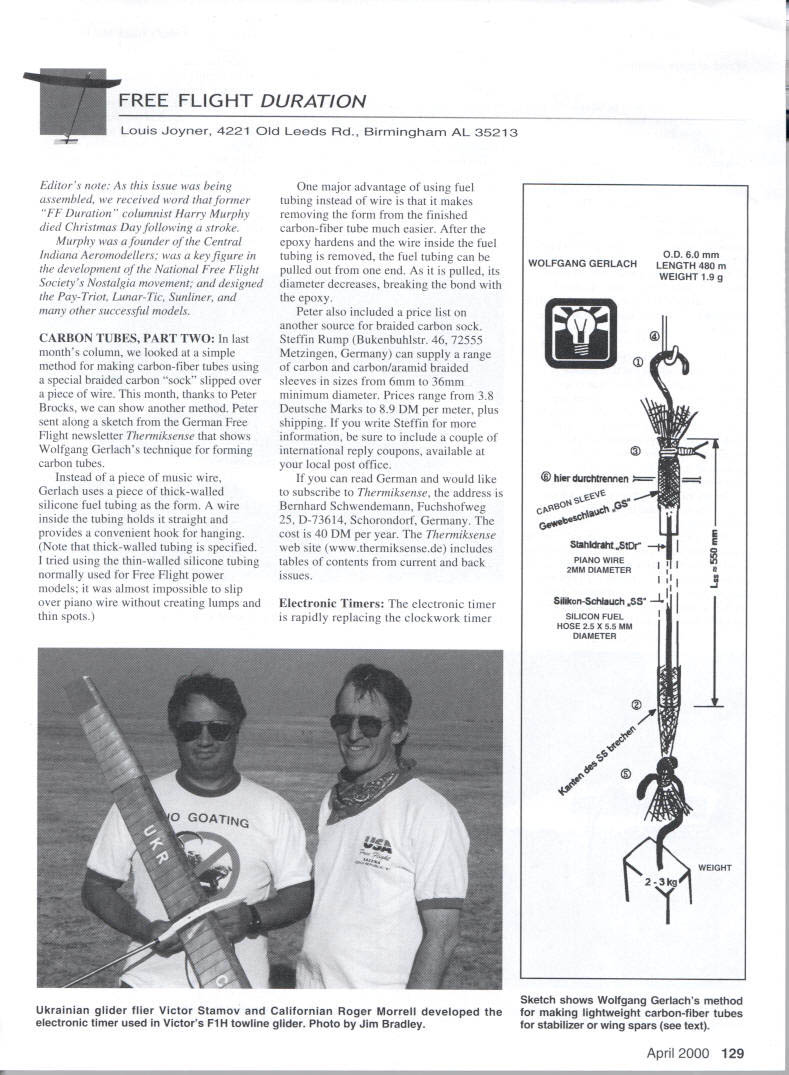
In last month's column, we looked at a simple method for making carbon-fiber tubes using a special braided carbon "sock" slipped over a piece of wire. This month, thanks to Peter Brocks, we can show another method. Peter sent along a sketch from the German Free Flight newsletter Thermikmesse that shows Wolfgang Gerlach's technique for forming carbon tubes.
Instead of a piece of music wire, Gerlach uses a piece of thick-walled silicone fuel tubing as the form. A wire inside the tubing holds it straight and provides a convenient hook for hanging. (Note that thick-walled tubing is specified. I tried using the thin-walled silicone tubing normally used for Free Flight power models; it was almost impossible to slip over piano wire without creating lumps and thin spots.)
One major advantage of using fuel tubing instead of wire is that it makes removing the form from the finished carbon-fiber tube much easier. After the epoxy hardens and the wire inside the fuel tubing is removed, the fuel tubing can be pulled out from one end. As it is pulled, its diameter decreases, breaking the bond with the epoxy.
Peter also included a price list on another source for braided carbon sock. Steffin Rump (Bukenhuhlerstr. 46, 72555 Metzingen, Germany) can supply a range of carbon and carbon/aramid braided sleeves in sizes from 6 mm to 36 mm minimum diameter. Prices range from 3.8 Deutsche Marks to 8.9 DM per meter, plus shipping. If you write Steffin for more information, be sure to include a couple of international reply coupons, available at your local post office.
If you can read German and would like to subscribe to Thermikmesse, the address is Bernhard Schwendenmann, Fuchshofweg 25, D-73614 Schorndorf, Germany. The cost is 40 DM per year. The Thermikmesse web site (www.thermikmesse.de) includes tables of contents from current and back issues.
ELECTRONIC TIMERS
The electronic timer is rapidly replacing the clockwork timer.
With a conventional model with mechanical stops, you have to turn the adjustment screws. Often this is more a matter of a guess. And after the flight, you have to remember to reset the screws to the all-weather setting. With an electronic timer controlling a servo, you can easily change the setting and then change it back.
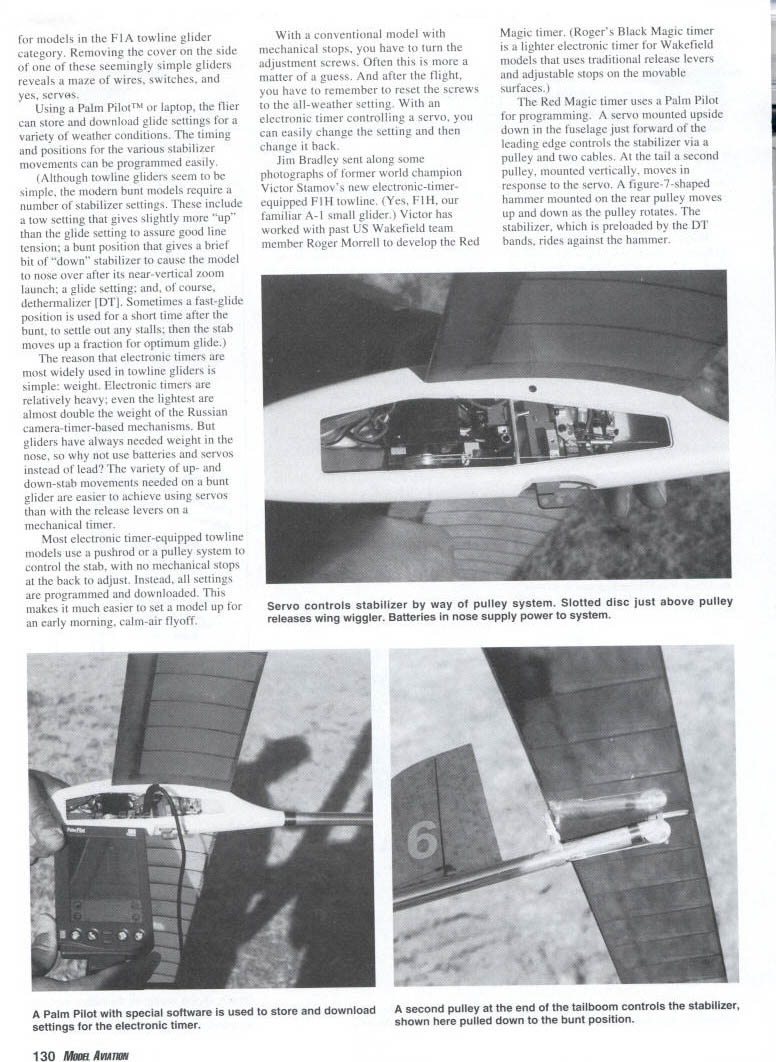
Jim Bradley sent along some photographs of former world champion Victor Stamov's new electronic-timer-equipped F1H towline. (Yes, F1H, our familiar A-1 small glider.) Victor has worked with past US Wakefield team member Roger Morrell to develop the Red Magic timer. (Roger's Black Magic timer is a lighter electronic timer for Wakefield models that has traditional release levers and adjustable stops on the movable surfaces.)
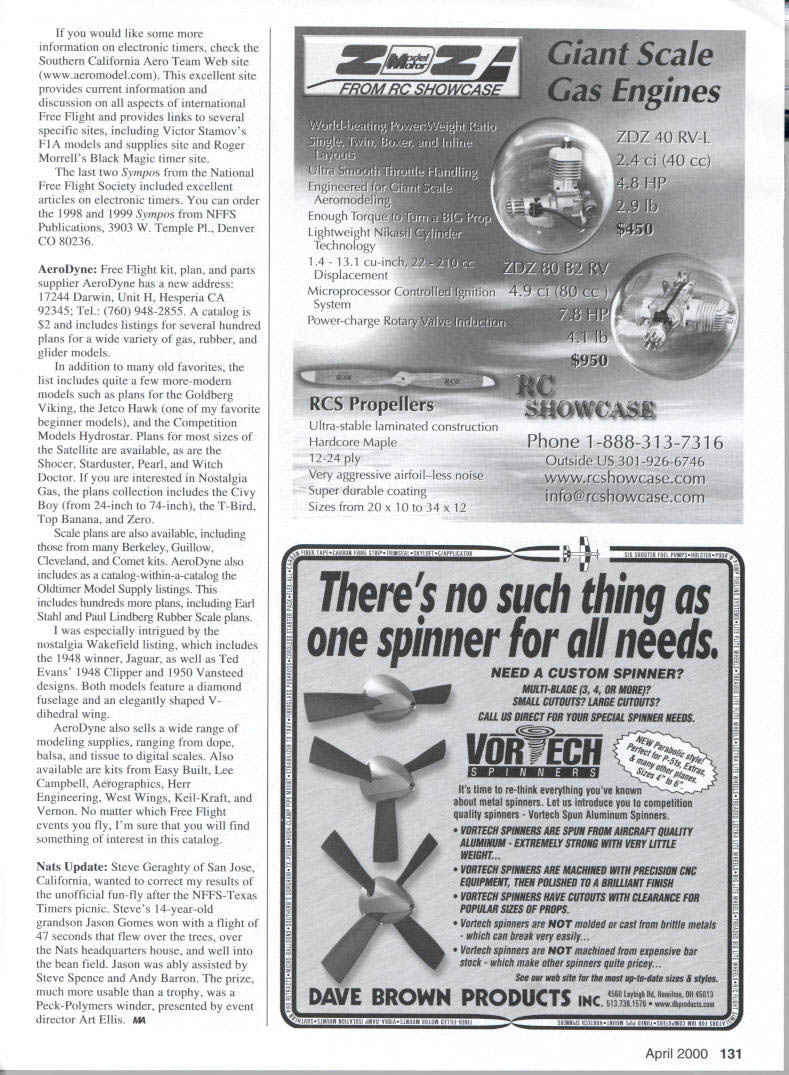
The Red Magic timer uses a Palm Pilot for programming. A servo mounted upside down in the fuselage just forward of the leading edge controls the stabilizer via a pulley and two cables. At the tail a second pulley, mounted vertically, moves in response to the servo. A figure-7-shaped hammer mounted on the rear pulley moves up and down as the pulley rotates. The stabilizer, which is preloaded by the DT, rides against the hammer.
If you would like some more information on electronic timers, check the Southern California Aero Team web site (www.aeromodel.com). This excellent site provides current information and discussion on all aspects of International Free Flight and provides links to several specific sites, including Victor Stamov's F1A models and supplies site and Roger Morrell's Black Magic timer site.
The last two Sympos from the National Free Flight Society included excellent articles on electronic timers. You can order the 1998 and 1999 Sympos from NFFS Publications, 3903 W. Temple Pl., Denver CO 80236.
AERODYNE
Free Flight kit, plan, and parts supplier AeroDyne has a new address: 17244 Darwin, Unit H, Hesperia CA 92345; Tel.: (760) 948-2855. A catalog is $2 and includes listings for several hundred plans for a wide variety of gas, rubber, and glider models.
In addition to many old favorites, the list includes quite a few more-modern models such as plans for the Goldberg Viking, the Jecco Hawk (one of my favorite beginner models), and the Competition Models Hydrostar. Plans for most sizes of the Satellite are available, as are the Schoer, Starduster, Pearl, and Witch Doctor. If you are interested in Nostalgia Gas, the plans collection includes the Clevy Boy (from 24-inch to 74-inch), the T-Bird, Top Banana, and Zero.
Scale plans are also available, including those from many Berkeley, Guillows, Cleveland, and Comet kits. AeroDyne also includes as a catalog-within-a-catalog the Oldtimer Model Supply listings. This includes hundreds more plans, including Earl Stahl and Paul Lindberg rubber scale plans.
I was especially intrigued by the nostalgia Wakefield listing, which includes the 1948 winner, Jaguar, as well as Ted Evans' 1948 Clipper and 1950 Vansteed designs. Both models feature a diamond fuselage and an elegantly shaped V-dihedral wing.
AeroDyne also sells a wide range of modeling supplies, ranging from dope, balsa, and tissue to digital scales. Also available are kits from Easy Built, Lee Campbell, Aerographics, Herr Engineering, West Wings, Keil-Kraft, and Vernon. No matter which Free Flight events you fly, I'm sure that you will find something of interest in this catalog.
NATS UPDATE
Steve Geraghty of San Jose, California, wanted to correct my results of the unofficial fun-fly after the NFFS–Texas Timers picnic. Steve's 14-year-old grandson Jason Gomes won with a flight of 47 seconds that flew over the trees, over the Nats headquarters area house, and well into the bean field. Jason was ably assisted by Steve Spence and Andy Barron. The prize, much more usable than a trophy, was a Peck-Polymers winder, presented by event director Art Ellis.
Transcribed from original scans by AI. Minor OCR errors may remain.

