
FREE FLIGHT DURATION
Louis Joyner, 4221 Old Leeds Rd., Birmingham AL 35213
CARBON TUBE STAB
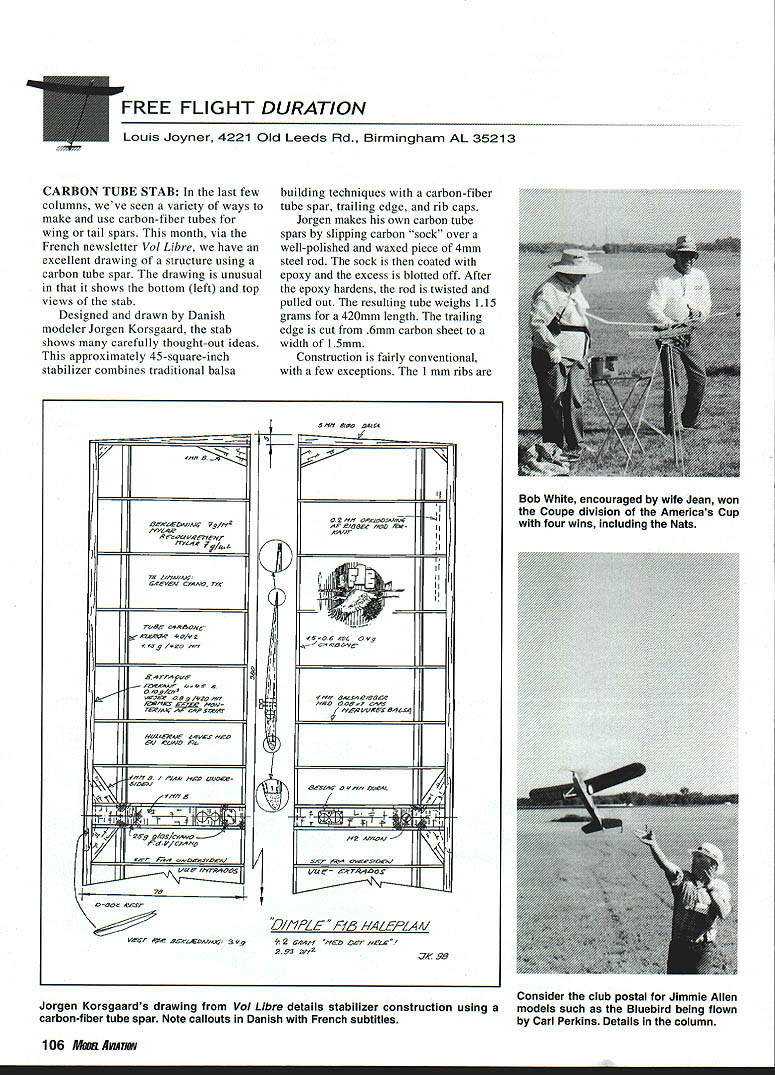
In the last few columns, we've seen a variety of ways to make and use carbon-fiber tubes for wing or tail spars. This month, via the French newsletter Vol Libre, we have an excellent drawing of a structure using a carbon-tube spar. The drawing is unusual in that it shows the bottom (left) and top views of the stab.
Designed and drawn by Danish modeler Jorgen Korsgaard, the stab shows many carefully thought-out ideas. This approximately 45-square-inch stabilizer combines traditional balsa building techniques with a carbon-fiber tube spar, trailing edge, and rib caps.
Jorgen makes his own carbon tube spars by slipping carbon "sock" over a well-polished and waxed piece of 4 mm steel rod. The sock is then coated with epoxy and the excess is blotted off. After the epoxy hardens, the rod is twisted and pulled out. The resulting tube weighs 1.15 grams for a 420 mm length. The trailing edge is cut from 0.6 mm carbon sheet to a width of 1.5 mm.
Construction is fairly conventional, with a few exceptions. The 1 mm ribs are cut individually, drilled for the spar, then threaded onto the tubular spar. The front of each rib is shimmed up 0.08 mm using scrap carbon cap material. The leading edge and trailing edge are then attached. A drop of CyA at each spar‑rib location locks everything in place.
The 0.08 mm carbon caps are added to the top and bottom of each rib. Note that the caps butt up against the back of the leading edge, rather than overlap it. That was the purpose of shimming the front of each rib slightly.
The balsa leading edge is sanded to shape after the capstrips are installed. This eliminates the slight ridges that would occur if the capstrips overlapped the leading edge. Since the rib-to-leading-edge joint is fairly wide (approximately 4 mm) and lightly loaded, there's no reason for the extra strength gained by running the caps over the leading edge.
Of interest is Jorgen's use of gussets—the triangular balsa reinforcements at the tip and center.
- In the center, the gussets provide local strengthening to a high-stress area. This is further reinforced by a scrap piece of carbon-fiber D-box material. This should do a good job of keeping the rubber bands from cutting into the soft balsa leading edge.
- At the tips, the gussets help prevent the end rib from bowing inward after covering. (The carbon caps strengthen the ribs in the vertical plane, but don't help that much from side-to-side.) The soft balsa tip is also tapered to provide extra bending strength toward the rear of the rib.
Another good feature is the use of a nylon screw as an anchor for the stabilizer hold-down rubber bands. Unlike a bent music wire or plywood hook, the screw is removable. This comes in handy when the stab needs to be recovered. (The 1/4-mil Mylar® that has become the standard for tail covering is light and waterproof, but it does puncture.) The screw threads into a balsa block that is drilled and tapped. Lightweight glass cloth on the top and bottom of the block adds strength. CyA is used to attach the glass cloth, and also to harden the threads after tapping.
Ready-Made Tubular Spars
In case the idea of making your own carbon-fiber tube spars sounds daunting, seven sizes of ready-to-use spars are now available from Mike Woodhouse.
Lightweight spars suitable for stabilizer spars:
- 3.5 mm x 400 mm (1.5 g)
- 4.0 mm x 450 mm (2.0 g)
- 4.5 mm x 550 mm (2.5 g)
- 5.0 mm x 550 mm (3.0 g)
These have a 0.25 mm wall thickness and will telescope into the next-size tube. Price is 5 pounds sterling (about $8) each, plus postage.
Larger tubes intended for wing spars on medium-size models:
- 8.0 mm x 700 mm (10.5 g)
- 10.0 mm x 700 mm (15.0 g)
- 12.0 mm x 800 mm (25.0 g)
These each have a 1.0 mm wall thickness and also telescope. Price per tube is 8 pounds (about $13) plus postage.
For more information you can write Michael J. Woodhouse, 12 Marston Ln., Eaton, Norwich, Norfolk, NR4 6LZ, UK. His E-mail is [email protected]. Mike's Web site catalog lists a wide variety of Free Flight parts, plans, and accessories: http://members.aol.com/mjwffs/M_Woodhouse_FFS.htm. Credit cards are accepted, which makes ordering by E-mail very easy.
National Cup Committee
Last month we talked about the new National Cup series of contests for AMA and Nostalgia events.
Although the 2000 season is well underway, there are still plenty of contests left in the year. Check with the committee member in your area about contests. They are:
- Bob Reecroft (west)
- Charles Caton (southeast)
- Bob Johannes (central)
- Bob Sifleet (northeast)
For information on the rules, contact National Cup chairman Bob Perkins, 2285 Pinebrook Rd., Columbus OH 43220. The rules are also posted on the National Free Flight Society Web site: http://www.freeflight.org.
America's Cup
The inspiration for the National Cup is, of course, the America's Cup series that was developed by members of the Southern California Aero Team. Contestants can compete in more than two dozen contests across North America, with the best four contests counting toward the Cup.
Divisions:
- Three "large" FAI events: F1A Nordic glider, F1B Wakefield rubber, and F1C power.
- Three "mini" events: F1G Coupe, F1H towline, and F1J power.
To give you an idea of the level of competition, four first-places were needed to win four of the six Cup events. Winners for 1999 are:
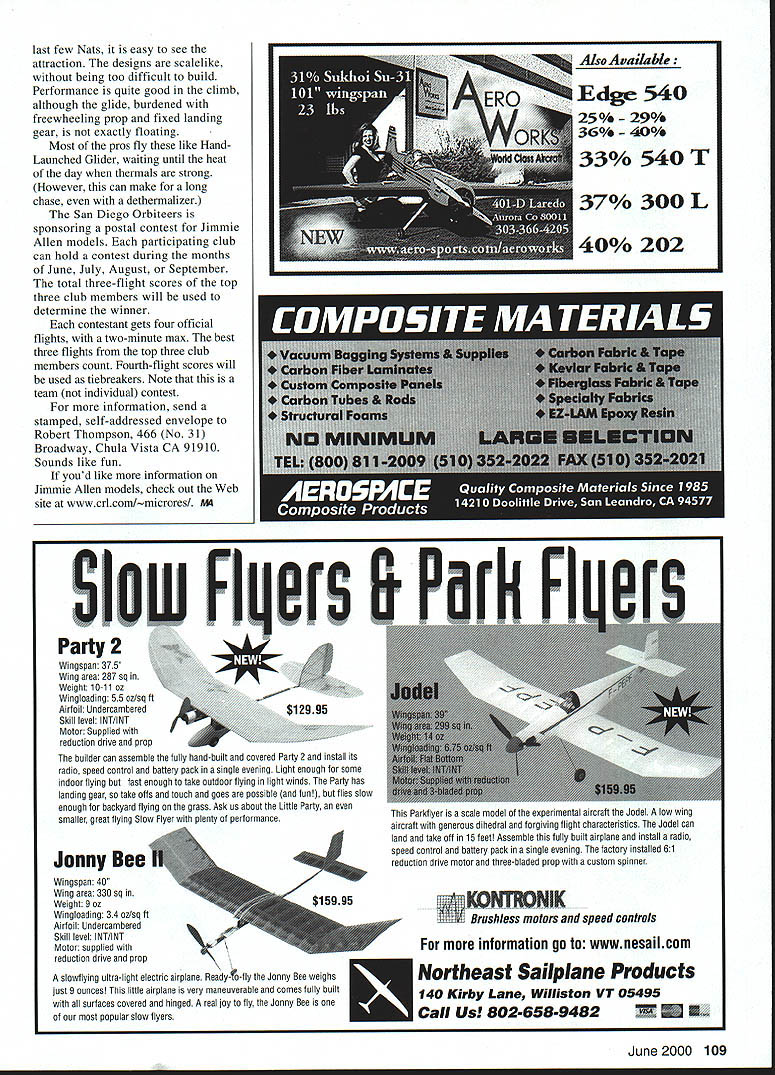
- Lee Hines, F1A
- Paul Crowley, F1B
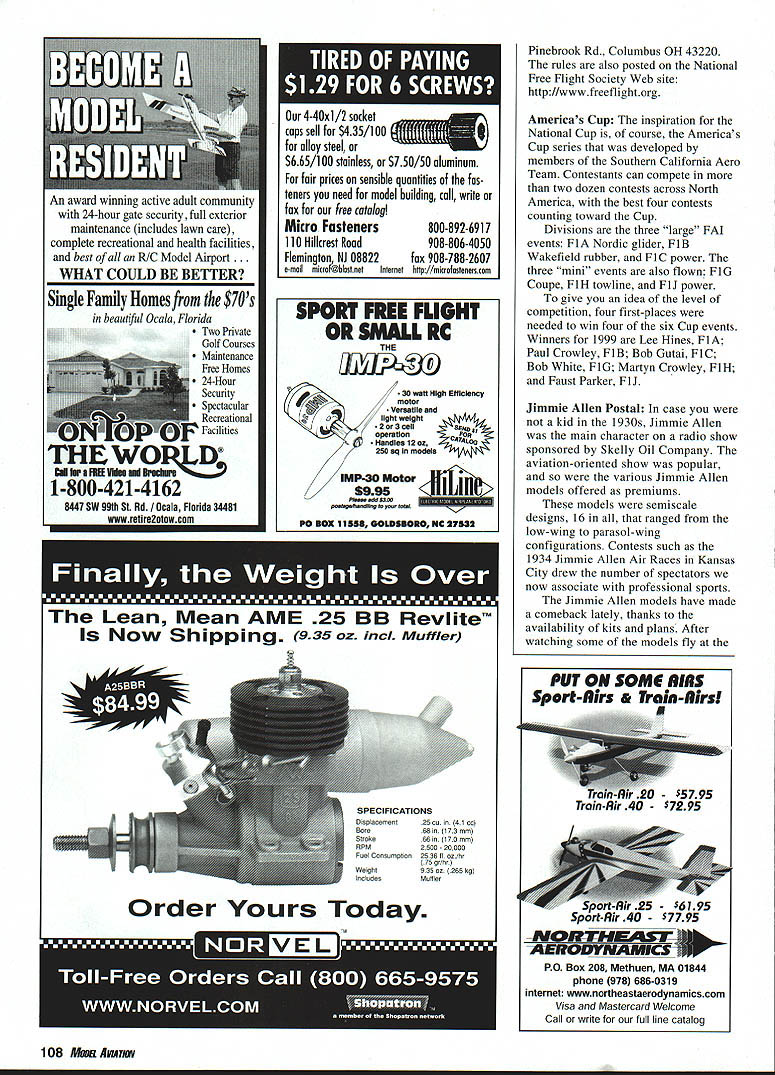
- Bob Guait, F1C
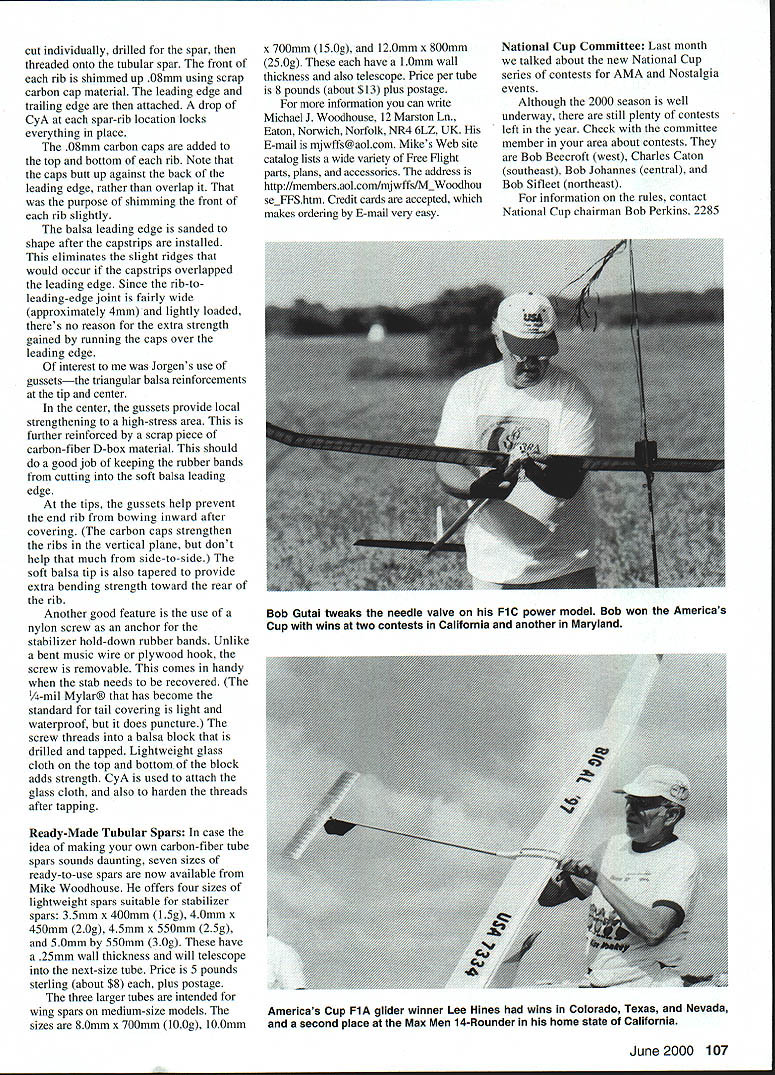
- Bob White, F1G
- Martyn Crowley, F1H
- Faust Parker, F1J
Jimmie Allen Postal
In case you were not a kid in the 1930s, Jimmie Allen was the main character on a radio show sponsored by Skelly Oil Company. The aviation-oriented show was popular, and so were the various Jimmie Allen models offered as premiums.
These models were semiscale designs, 16 in all, that ranged from low-wing to parasol-wing configurations. Contests such as the 1934 Jimmie Allen Air Races in Kansas City drew the number of spectators we now associate with professional sports.
The Jimmie Allen models have made a comeback lately, thanks to the availability of kits and plans. After watching some of the models fly at the last few Nats, it is easy to see the attraction. The designs are scalelike without being too difficult to build. Performance is quite good in the climb, although the glide, burdened with a freewheeling prop and fixed landing gear, is not exactly floating.
Most of the pros fly these like Hand-Launched Gliders, waiting until the heat of the day when thermals are strong. (However, this can make for a long chase, even with a dethermalizer.)
The San Diego Orbiteers are sponsoring a postal contest for Jimmie Allen models. Each participating club can hold a contest during the months of June, July, August, or September. The total three-flight scores of the top three club members will be used to determine the winner.
Contest rules summary:
- Each contestant gets four official flights, with a two-minute max.
- The best three flights from the top three club members count.
- Fourth-flight scores will be used as tiebreakers.
- This is a team (not individual) contest.
For more information, send a stamped, self-addressed envelope to Robert Thompson, 466 (No. 31) Broadway, Chula Vista CA 91910.
If you'd like more information on Jimmie Allen models, check out the Web site at www.crl.com/~microres/.
Transcribed from original scans by AI. Minor OCR errors may remain.

