
FREE FLIGHT DURATION
Louis Joyner, 4221 Old Leeds Rd., Birmingham AL 35213
GETTING A HANDLE, Part One
Lightweight fiberglass cloth is a popular material for reinforcing balsa parts such as sheeted wings, carved props, pylons, and fuselages.
The usual instructions state that you should place the dry cloth over the area to be covered and squeeze on the thin epoxy resin, spreading it evenly.
Sounds easy. Well, it isn't.
Just getting .75-ounce glass cloth out of the package without wrinkles and snags is difficult for me, and just about everyone I've talked to. Here's a better way, based on some ideas from Rex Hinson:
- Before you open a new package of lightweight glass cloth, get a large sheet of corrugated cardboard. Carefully spread the glass cloth out on the cardboard, making sure the threads are straight.
- Spray with a light coat of nitrate dope. This will lock the threads together, stiffen the cloth slightly, and make it much easier to cut and handle.
- Dope the part you are covering, again using nitrate. A couple of thin coats, sanding with 220 or 320 paper between coats, should do it.
- Lay the cloth over the part and brush on lacquer thinner. Even on compound curves, the glass cloth will mold to the shape with very little effort.
- Dope around the edge with nitrate, allow to dry, and trim with fine sandpaper.
- Allow the dope to dry thoroughly for several days, then brush on a coat of epoxy laminating resin, such as West Systems. I use a fine-textured sponge that's made for applying makeup. Don't get too heavy-handed with the epoxy, or it can run.
- Sand smooth after the epoxy hardens.
Star Link
Noted California modeler Allen Brush and Russian Wakefield flier Andrey Burdov have teamed up in an international joint venture to bring high-quality rubber kits to the American market. Their collaboration, called Star Link, offers FIB Wakefield, F1G Coupe, and P-30 kits, parts, and finished models.
The Burdov name should be familiar to many in the Free Flight community; his popular Sweet G Coupe has been available for several years. Star Link will continue to offer the Sweet G, as well as several other Coupes:
Coupes and Pricing
- The Candy G is a simple, entry-level model with a carbon-tube wing structure and a Montreal front end. Cost for the kit is $99; a ready-to-fly version is $149. (Shipping is not included in all prices shown.)
- The Sweet G features VIT (Variable Incidence Tailplane) and auto rudder. It lists for $399 ready-to-fly or $333 for a kit with the flying surfaces built. It is also available as a kit requiring wing assembly for $299.
- The Honey G and Sugar G use a time-operated wing wiggler to control the power pattern. (The wing wiggler holds the left wing at a couple of degrees negative angle relative to the right wing, to introduce a slight left roll to reduce the familiar tendency of a rubber model to drop its right wing at the end of the power burst.)
- The Honey G uses a carbon-fiber tube wing structure; the Sugar G uses a carbon-fiber D-box wing. Both are available with optional DPR (Delayed Prop Release) front end in place of the standard Montreal-type front end.
- The Honey G sells for $477 ready to fly with Montreal front end ($499 with DPR front end). A kit is in the works.
- The Sugar G kit, with Montreal front end, sells for $399. The ready-to-fly version is $499.
Star Link also stocks an extensive line of Coupe parts and components, ranging from a set of carbon-fiber D-box wings, ready to cover ($93) to a special case for your models ($110).
F1B Wakefield Models
Two F1B Wakefield models are offered: the entry-level STARter and the advanced WIN STAR.
- The STARter uses a carbon tube wing spar, a Montreal-stop front end, and a two-position rudder. The ready-to-fly version of the STARter is $222.
- The WIN STAR is a full-house Wakefield with wing wiggler, three-position rudder, DPR, and carbon-fiber D-box wing.
Alan has been flying these models for several years to great effect, including winning the America's Cup. All of the components for the WIN STAR are available separately. I can speak from experience about the high quality of the DPR front end and Andrey's excellent prop blades.
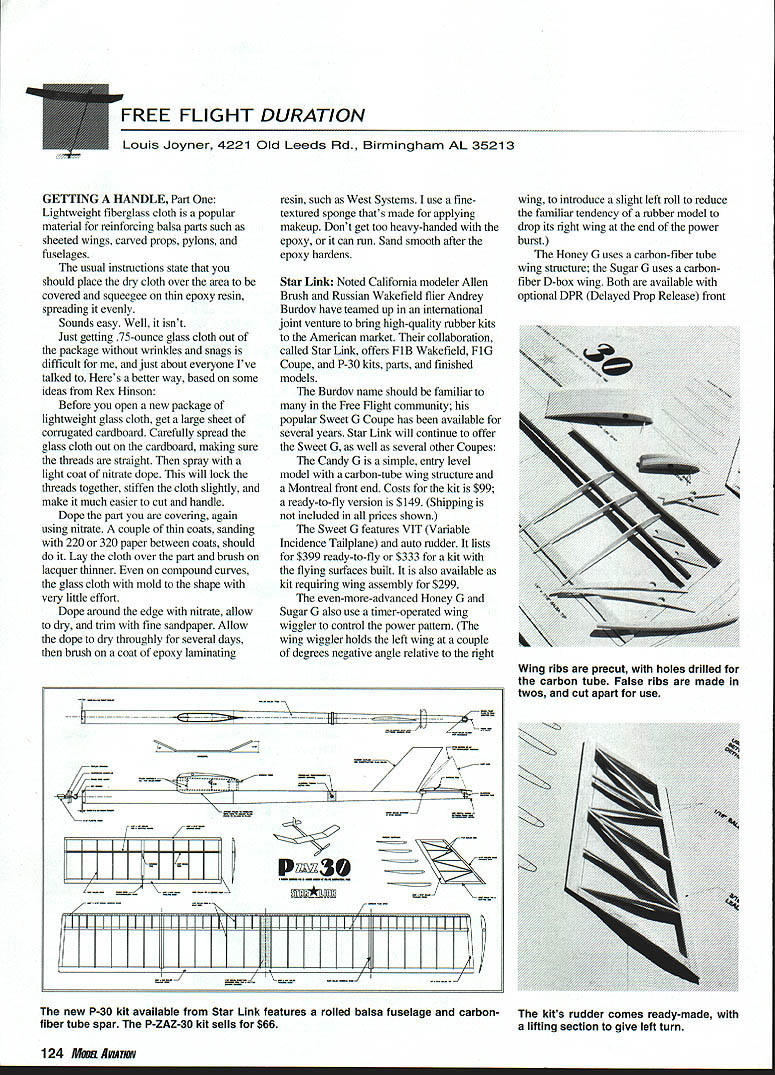
P-ZAZ-30 (P-30 Kit)
Of particular interest to AMA rubber fliers will be the P-ZAZ-30 kit. This is a very well-thought-out kit to fit our popular P-30 event.
- The event is not flown in Russia, so it is interesting to see how Andrey has designed and detailed this model. What he has come up with is a small, all-weather P-30. (Small relates only to the wing chord; P-30 rules restrict overall length and span to 30 inches maximum.)
- The P-ZAZ-30 has a wing chord slightly less than 4.5 inches, giving an area of approximately 130 square inches. The motor base is roughly 19 inches; that's shorter than many P-30s.
- The kit, which lists for $66, is very complete, with extensive prefabrication.
Features of the kit:
- The fuselage is a rolled balsa tube, covered inside and out with white tissue. An aluminum nose ring is already in place, with the correct amount of right thrust and downthrust sanded in.
- The rear peg location is reinforced with fiberglass tape and the holes neatly predrilled. Interestingly, the fuselage taper starts well in front of the rear peg.
- The pylon is also already assembled and sanded to fit over the round fuselage.
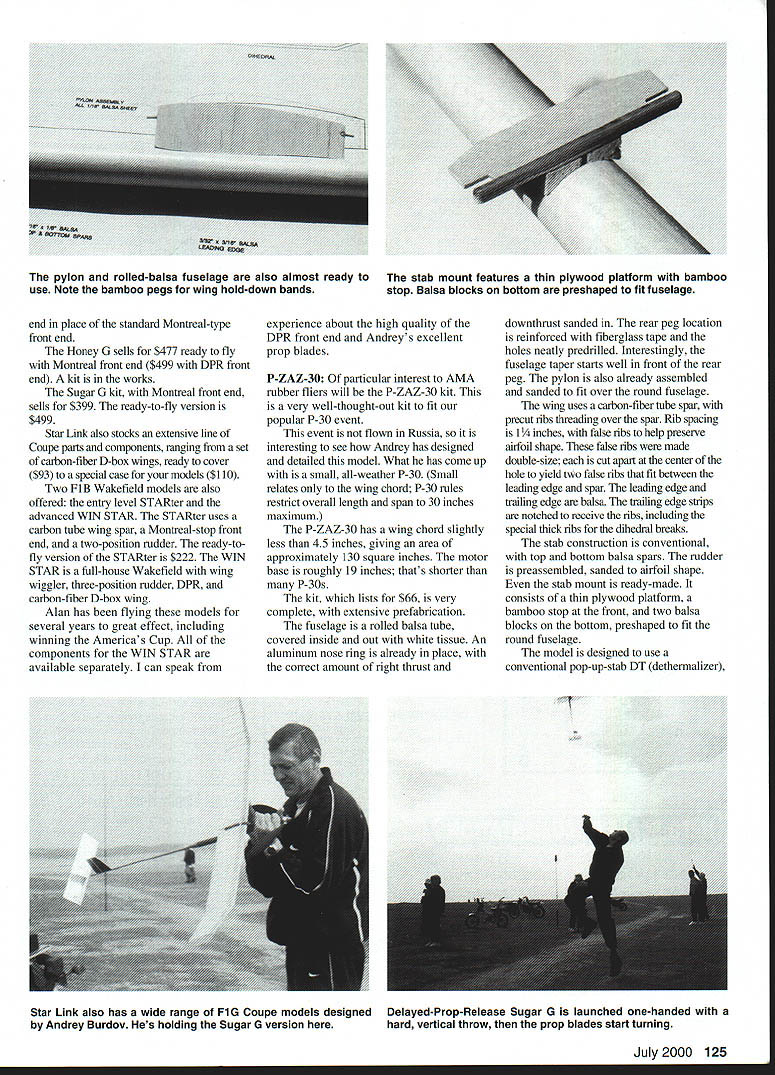
- The wing uses a carbon-fiber tube spar, with precut ribs threading over the spar. Rib spacing is 1¼ inches, with false ribs to help preserve airfoil shape. These false ribs have one made double-size; each is cut apart at the center of the hole to yield two false ribs that fit between the leading edge and spar.
- The leading edge and trailing edge are balsa. The trailing edge strips are notched to receive the ribs, including the special thick ribs for the dihedral breaks.
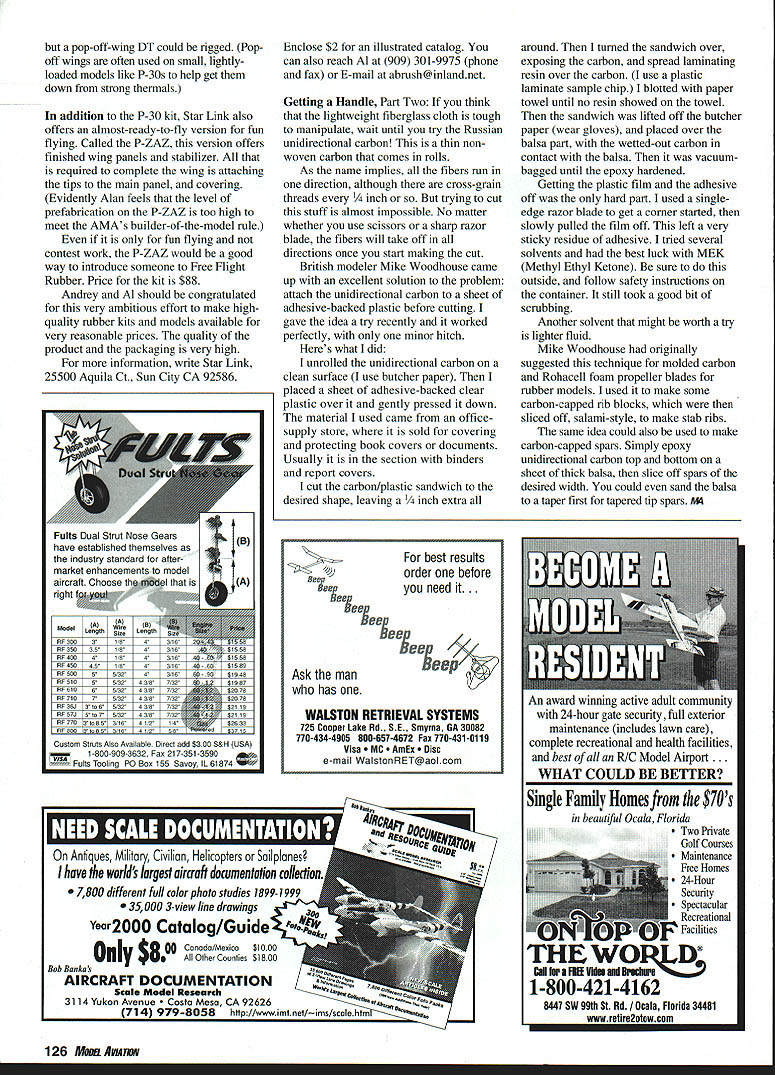
- The stab construction is conventional, with top and bottom balsa spars. The rudder is preassembled, sanded to airfoil shape.
- Even the stab mount is ready-made. It consists of a thin plywood platform, a bamboo stop at the front, and two balsa blocks on the bottom, preshaped to fit the round fuselage.
- The model is designed to use a conventional pop-up-stab DT (dethermalizer), downthrust sanded in.
Star Link also offers an almost-ready-to-fly version called the P-ZAZ, which includes finished wing panels and stabilizer. All that is required to complete the wing is attaching the tips to the main panel, and covering. (Evidently Alan feels that the level of prefabrication on the P-ZAZ is too high to meet the AMA’s builder-of-the-model rule.)
Even if it is only for fun flying and not contest work, the P-ZAZ would be a good way to introduce someone to Free Flight Rubber. Price for the almost-ready-to-fly version is $88.
Andrey and Al should be congratulated for this very ambitious effort to make high-quality rubber kits and models available for very reasonable prices. The quality of the product and the packaging is very high.
For more information, write Star Link, 25500 Aquila Ct., Sun City CA 92586. Enclose $2 for an illustrated catalog. You can also reach Al at (909) 301-9975 (phone and fax) or E-mail at [email protected].
Getting a Handle, Part Two
If you think that the lightweight fiberglass cloth is tough to manipulate, wait until you try the Russian unidirectional carbon! This is a thin non-woven carbon that comes in rolls.
As the name implies, all the fibers run in one direction, although there are cross-grain threads every 1/4 inch or so. But trying to cut this stuff is almost impossible. No matter whether you use scissors or a sharp razor blade, the fibers will take off in all directions once you start making the cut.
British modeler Mike Woodhouse came up with an excellent solution to the problem: attach the unidirectional carbon to a sheet of adhesive-backed plastic before cutting. I gave the idea a try recently and it worked perfectly, with only one minor hitch.
Here’s what I did:
- Unroll the unidirectional carbon on a clean surface (I use butcher paper).
- Place a sheet of adhesive-backed clear plastic over it and gently press it down. The material I used came from an office-supply store, where it is sold for covering and protecting book covers or documents. Usually it is in the section with binders and report covers.
- Cut the carbon/plastic sandwich to the desired shape, leaving a 1/4 inch extra all around.
- Turn the sandwich over, exposing the carbon, and spread laminating resin over the carbon. (I use a plastic laminate sample chip.)
- Blot with paper towel until no resin shows on the towel.
- Lift the sandwich off the butcher paper (wear gloves), and place it over the balsa part, with the wetted-out carbon in contact with the balsa.
- Vacuum-bag until the epoxy hardens.
Getting the plastic film and the adhesive off was the only hard part. I used a single-edge razor blade to get a corner started, then slowly pulled the film off. This left a very sticky residue of adhesive. I tried several solvents and had the best luck with MEK (Methyl Ethyl Ketone). Be sure to do this outside, and follow safety instructions on the container. It still took a good bit of scrubbing.
Another solvent that might be worth a try is lighter fluid.
Mike Woodhouse had originally suggested this technique for molded carbon and Rohacell foam propeller blades for rubber models. He used it to make some carbon-capped rib blocks, which were then sliced off, salami-style, to make stab ribs.
The same idea could also be used to make carbon-capped spars. Simply epoxy unidirectional carbon top and bottom on a sheet of thick balsa, then slice off spars of the desired width. You could even sand the balsa to a taper first for tapered tip spars.
NOTES ON DELAYED-PROP-RELEASE SUGAR G
The Delayed-Prop-Release Sugar G is launched one-handed with a hard, vertical throw; then the prop blades start turning. A pop-off-wing DT could be rigged. (Pop-off wings are often used on small, lightly-loaded models like P-30s to help get them down from strong thermals.)
Transcribed from original scans by AI. Minor OCR errors may remain.

