
FREE FLIGHT DURATION
Louis Joyner, 4221 Old Leeds Rd., Birmingham AL 35213
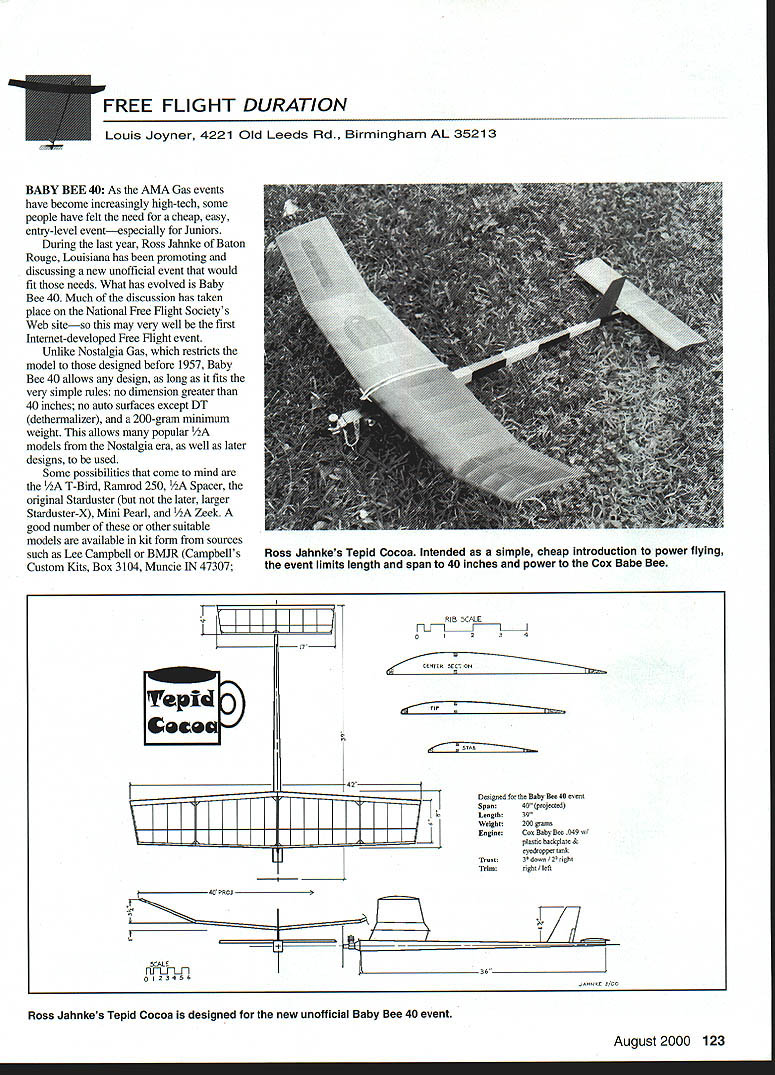
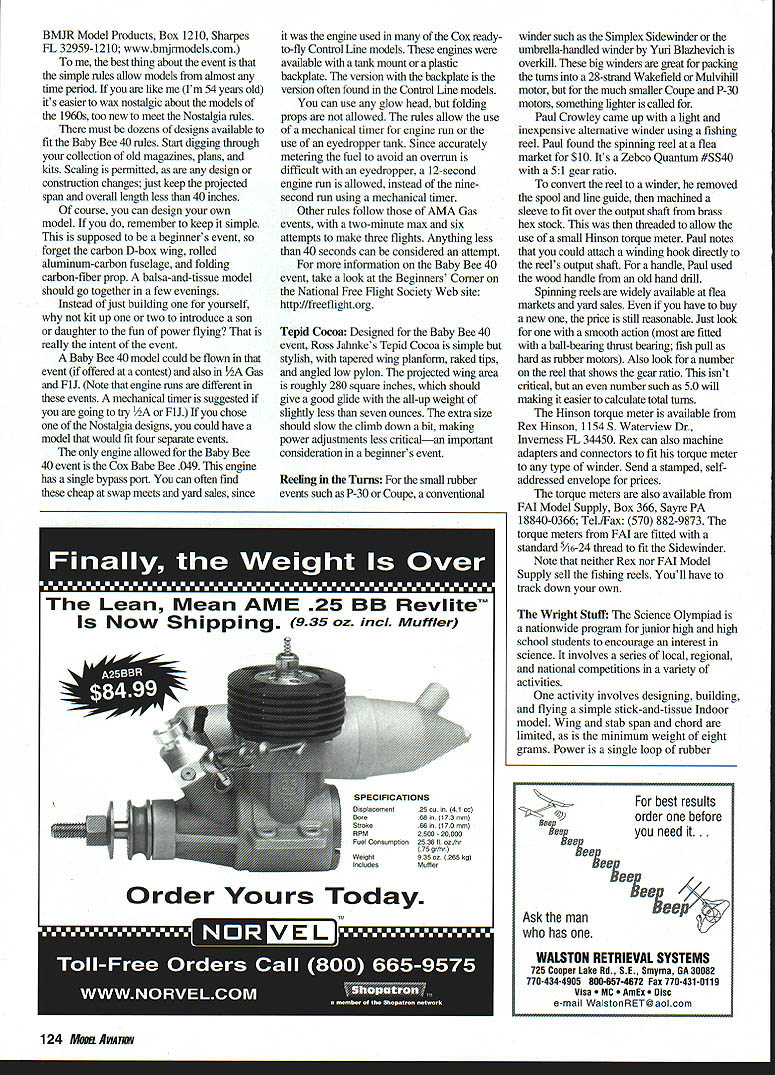
BABY BEE 40
As the AMA Gas events have become increasingly high-tech, some people have felt the need for a cheap, easy, entry-level event—especially for Juniors.
During the last year, Ross Jahnke of Baton Rouge, Louisiana has been promoting and discussing a new unofficial event that would fit those needs. What has evolved is Baby Bee 40. Much of the discussion has taken place on the National Free Flight Society's Web site—so this may very well be the first Internet-developed Free Flight event.
Unlike Nostalgia Gas, which restricts the model to those designed before 1957, Baby Bee 40 allows any design, as long as it fits the very simple rules:
- No dimension greater than 40 inches.
- No auto surfaces except DT (dethermalizer).
- 200-gram minimum weight.
This allows many popular ½A models from the Nostalgia era, as well as later designs, to be used. Some possibilities that come to mind are the ½A T-Bird, Ramrod 250, ½A Spacer, the original Starduster (but not the later, larger Starduster-X), Mini Pearl, and ½A Zeek.
A good number of these or other suitable models are available in kit form from sources such as Lee Campbell or BMJR:
- Campbell's Custom Kits, Box 3104, Muncie IN 47307
- BMJR Model Products, Box 1210, Sharpsburg PA 15236-1210; www.bmjrmolds.com
To me, the best thing about the event is that the simple rules allow models from almost any time period. If you are like me (I'm 54 years old) it's easier to wax nostalgic about the models of the 1960s, too new to meet the Nostalgia rules.
There must be dozens of designs available to fit the Baby Bee 40 rules. Start digging through your collection of old magazines, plans and kits. Scaling is permitted, as are any design or construction changes; just keep the projected span and overall length less than 40 inches.
Of course, you can design your own model. If you do, remember to keep it simple. This is supposed to be a beginner's event, so forget the carbon D-box wing, rolled aluminum-carbon fuselage, and folding carbon-fiber prop. A balsa-and-tissue model should go together in a few evenings.
Instead of just building one for yourself, why not kit up one or two to introduce a son or daughter to the fun of power flying? That is really the intent of the event.
A Baby Bee 40 model could be flown in the event (if offered at a contest) and also in 1/2A Gas and F1J. (Note that engine runs are different in these events. A mechanical timer is suggested if you are going to try 1/2A or F1J.) If you choose one of the Nostalgia designs, you could have a model that would fit four separate events.
The only engine allowed for the Baby Bee 40 event is the Cox Babe Bee .049. This engine has a single bypass port. You can often find these cheap at swap meets and yard sales, since it was the engine used in many of the Cox ready-to-fly Control Line models. These engines were available with a tank mount or a plastic backpack. The version with the backpack is the version often found in the Control Line models.
You can use any glow head, but folding props are not allowed. The rules allow the use of a mechanical timer for engine run or the use of an eydropper tank. Since accurately metering the fuel to avoid an overrun is difficult with an eydropper, a 12-second engine run is allowed, instead of the nine-second run using a mechanical timer.
Other rules follow those of AMA Gas events, with a two-minute max and six attempts to make three flights. Anything less than 40 seconds can be considered an attempt.
For more information on the Baby Bee 40 event, take a look at the Beginners' Corner on the National Free Flight Society Web site: http://freeflight.org
SCIENCE OLYMPIAD AND JUNIOR PROGRAMS
According to long-time Free Flighter Gary Baughman of Atlanta, interest in the Science Olympiad program has grown by leaps and bounds, with some 37,000 youngsters participating. Try to remember the last time you saw more than a dozen juniors at a Free Flight contest.
"I have been involved with this program for two years as a mentor, in person and via the Internet," says Gary. "My experience has found that there is tremendous interest but very little skill. The science teachers are not able to build models, and most of the kids have no experience with models or with sharp instruments used in constructing models.
"In response to this void, and to give teachers and students direction, I wrote a handbook describing how to build and trim a basic Science Olympiad model. I have gotten a warm response from many teachers and students who utilized this information source to successfully compete. A student from Dalton, Georgia won the Atlanta regional competition with flights of 2:23 and 2:05 flying the Spartan, his first balsa model airplane.
"To help beginning modelers and their teachers, Gary has put together a 26-page booklet with plans, drawings, and detailed instructions for building a Science Olympiad model. The booklet, titled 'The Wright Stuff,' is $10 postpaid. Order from Gary Baughman, 470 Hardage Farm Dr., Marietta GA 30064."
Gary's booklet offers a wealth of useful information on design, construction, and trimming. Numerous sketches are used to explain the details of construction and rigging. Especially useful is a list of sources for modeling supplies.
This is a must-have book for anyone who is working with a young modeler. For more information about the Science Olympiad, visit the NFFS Web site.
MORE POLYSPAN TRICKS
A few months back, we discussed a few techniques for using the popular Polyspan polyester covering. British reader Martin Gregorie emailed a few additional suggestions:
"I was taught a trick by John Williams, who may well have gotten it from Victor Stanov. It works well on carbon structures where there really isn't enough trailing-edge area to serve a decent bond with the covering, especially where you consider the bumps where the capstrips overlap the trailing edge. The trick is to cover each panel with a single piece of tissue. I find I can leave the tissue edge straight on the inner panel's outer edge and the underside of the tip. I usually mark out an approximate centre line on the covering for the dihedral joint on the tip upper surface.
"Start on the top surface above the main spar. (If you have a turbulator, then the covering should start under it.) You could also start on the undersurface, sticking the tissue to the lower spar. Work back to the trailing edge, adhering the tissue to the ribs and trailing edge with dope. When the dope has dried, pull the covering around the trailing edge and work back along the other surface, adhering it to the ribs and spar, keeping it tight to avoid undue bagging at the trailing edge. Overlap the joint by 2 to 3 mm. Now use a heat gun or iron to pull out any bagging or wrinkles at the trailing edge before doping as usual."
"I cheat a little. I won't worry about getting an overlap or even a butt joint at the dihedral break. That's because I use 6 mm dihedral ribs and also use a 10 mm-wide black tissue trim strip along the joint. This works for me because my panels are different colours (black inner panels underside, scarlet or yellow top on the inner panels, and fluorescent orange on both top and bottom surface of the tip). Note that Polyspan is only available in white. I add the colour by using dye in the clear dope used to seal the tissue."
"Other tricks: As you know, a carbon D-box should really be a light color to shed heat. I've found that a good way to do this is to cover the D-box with 5-micron (i.e., 9- to 10-mil) aluminumized Mylar stuck down with 3M Spraymount before covering the wing. By using a fairly low-tack adhesive you have a better chance of getting the Mylar down without wrinkles. You can lift and reposition it as necessary before smoothing it down in its final position. This adds about one gram to each wing on an off-F1A glider. Its appearance under Solariz tissue (Polyspan in the US) coloured with dye dissolved in thinned dope is really nice."
MA
Transcribed from original scans by AI. Minor OCR errors may remain.

