
FREE FLIGHT DURATION
Louis Joyner, 4221 Old Leeds Rd., Birmingham AL 35213
JUNIOR WORLD CHAMPIONSHIPS
The 2000 World Junior Aeromodelling Championships for Free Flight will be held August 14–19 in Vsechvy, Czech Republic. The United States will be represented by three fliers in F1A towline glider, three in F1B Wakefield rubber, and one in F1J power.
F1A team members:
- Dallas Parker — Sepulveda, California. 13 years old; flying two years.
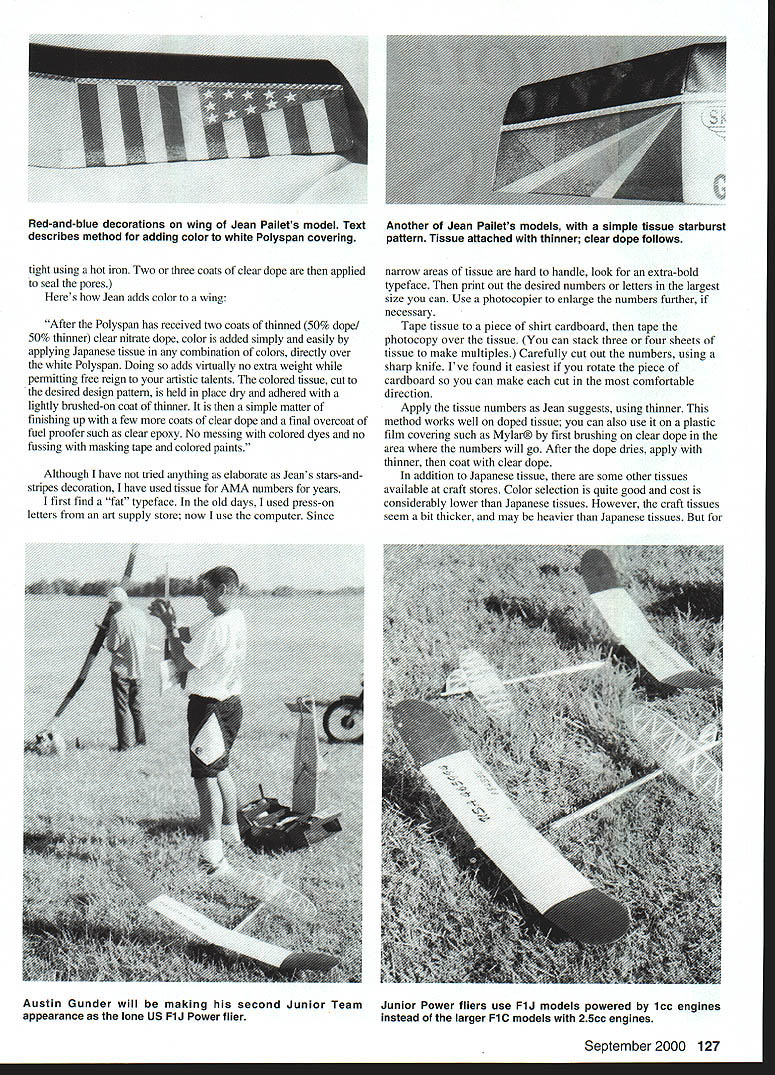
- John Barron — North Haven, Connecticut. 15 years old; flying Free Flight since age 10.
- David Ellis — Guilford, Connecticut. 16 years old; flying towline six years. This is David's third time on the glider team.
F1B team members:
- Aaron Arzmand — Denton, Texas. 16 years old; flying two years.
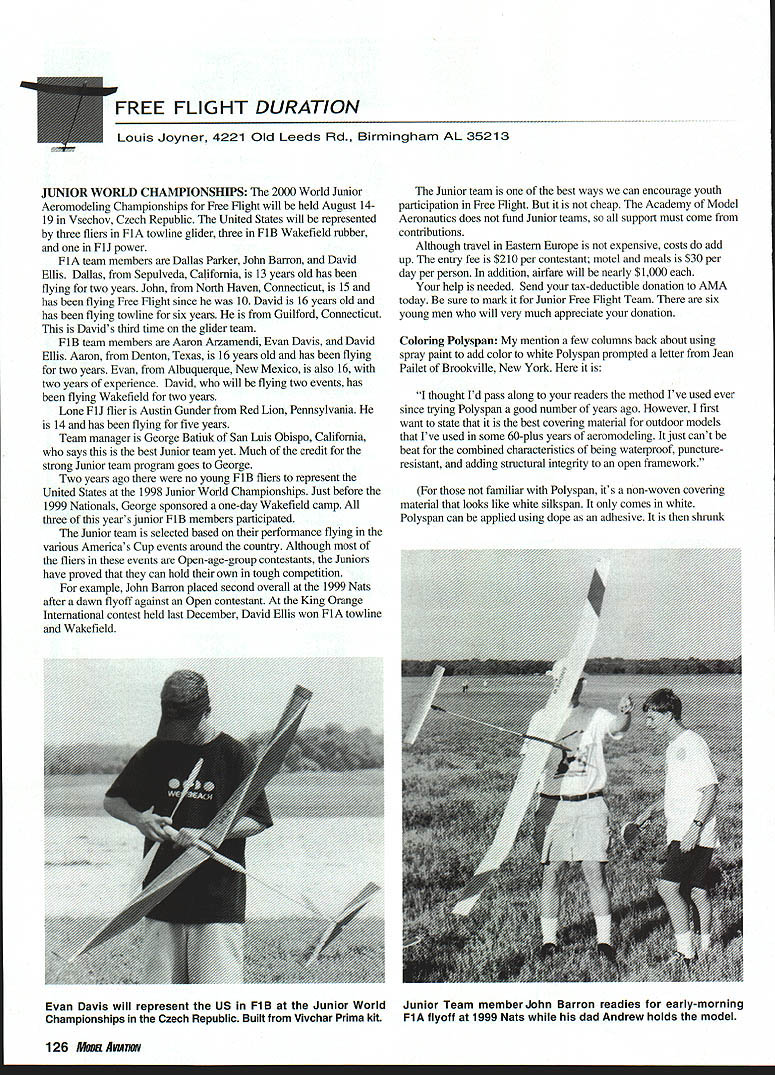
- Evan Davis — Albuquerque, New Mexico. 16 years old; flying two years.
- David Ellis — (also on F1A) has been flying Wakefield for two years.
Lone F1J flier:
- Austin Gunder — Red Lion, Pennsylvania. 14 years old; flying five years.
Team manager is George Batiuk of San Luis Obispo, California, who says this is the best Junior team yet. Much of the credit for the strong Junior team program goes to George.
Two years ago there were no young F1B fliers to represent the United States at the 1998 Junior World Championships. Just before the 1999 Nationals, George sponsored a one-day Wakefield camp. All three of this year's junior F1B members participated.
The Junior team is selected based on performance in the various America's Cup events around the country. Although most of the fliers in these events are open-age-group contestants, the Juniors have proved that they can hold their own in tough competition.
For example, John Barron placed second overall at the 1999 Nats after a dawn flyoff against an open contestant. At the King Orange International contest held last December, David Ellis won F1A towline and Wakefield.
The Junior team is one of the best ways we can encourage youth participation in Free Flight. It is not cheap. The Academy of Model Aeronautics does not fund Junior teams, so all support must come from contributions.
Although travel in Eastern Europe is not expensive, costs do add up. The entry fee is $210 per contestant; motel and meals are $30 per day per person. In addition, airfare will be nearly $1,000 apiece today. Your help is needed. Send your tax-deductible donation to AMA to the address below for Junior Free Flight Team. There are six young men who will very much appreciate your donation.
Coloring Polyspan
My mention a few columns back about using spray paint to add color to white Polyspan prompted a letter from Jean Paillet of Brookville, New York. Here it is:
"I thought I'd pass along to your readers the method I've used ever since trying Polyspan a good number of years ago. However, I first want to state that it is the best covering material for outdoor models that I've used in some 60-plus years of aeromodeling. It just can't be beat for the combined characteristics of being waterproof, puncture-resistant, and adding structural integrity to an open framework."
(For those not familiar with Polyspan, it's a non-woven covering material that looks like white silkspan. It only comes in white. Polyspan can be applied using dope as an adhesive. It is then shrunk tight using a hot iron. Two or three coats of clear dope are then applied to seal the pores.)
Here's how Jean adds color to a wing:
"After the Polyspan has received two coats of thinned (50% dope/50% thinner) clear nitrate dope, color is added simply and easily by applying Japanese tissue in any combination of colors, directly over the white Polyspan. Doing so adds virtually no extra weight while permitting free reign to your artistic talents. The colored tissue, cut to the desired design pattern, is held in place dry and adhered with a lightly brushed-on coat of thinner. It is then a simple matter of finishing up with a few more coats of clear dope and a final overcoat of fuel proofer such as clear epoxy. No messing with colored dyes and no fussing with masking tape and colored paints."
Although I have not tried anything as elaborate as Jean's stars-and-stripes decoration, I have used tissue for AMA numbers for years. I first find a "fat" typeface. In the old days, I used press-on letters from an art supply store; now I use the computer. Since narrow areas of tissue are hard to handle, look for an extra-bold typeface. Then print out the desired numbers or letters in the largest size you can. Use a photocopier to enlarge the numbers further, if necessary.
Tape tissue to a piece of shirt cardboard, then tape the photocopy over the tissue. (You can stack three or four sheets of tissue to make multiples.) Carefully cut out the numbers, using a sharp knife. I've found it easiest if you rotate the piece of cardboard so you can make each cut in the most comfortable direction.
Apply the tissue numbers as Jean suggests, using thinner. This method works well on doped tissue; you can also use it on a plastic film covering such as Mylar® by first brushing on clear dope in the area where the numbers will go. After the dope dries, apply with thinner, then coat with clear dope.
In addition to Japanese tissue, there are some other tissues available at craft stores. Color selection is quite good and cost is considerably lower than Japanese tissues. However, the craft tissues seem a bit thicker, and may be heavier than Japanese tissues. But for small areas of decoration, the weight difference would be insignificant.
Jimmie Allen Kits and Plans
A mention of Jimmie Allen models in the June "Duration" column sparked a reply from Charlie Reich of St. Augustine, Florida.
"Being a SAM member, I was pleased to see your Jimmie Allen Postal information. You mentioned the availability of Jimmie Allen Kits and plans; however, I wonder if the readers know where to obtain these jewels?
"Jim O'Reilly has redrawn all of the original Jimmie Allen plans into a modern CAD (computer aided drafting) version. These are exquisite in that Jim has corrected a lot of errors and added a lot of small parts details that were missing in the original plans. They are truly the work of an artist."
"In turn, these new CAD plans were then turned over to Bob Holman, who now offers laser-cut semikits for all the Jimmie Allen designs."
A semikit includes the ribs, tips, and other curved pieces. You supply the stripwood, wire, wheels, prop, etc. Typical price for a Jimmie Allen model is $8 for the plans and $8 to $18 for the laser-cut parts.
In addition to the Jimmie Allen semiscale rubber models from the 1930s, Bob also offers laser-cut parts and plans for a wide range of Old-Timer gas and rubber models. For more information, contact:
- Bob Holman, Box 741, San Bernardino CA 92402; Tel.: (909) 888-3959; Fax: (909) 889-9307; E-mail: [email protected].
Plans are available directly from:
- Jim O'Reilly, 4760 N. Battin, Wichita KS 67220. Send $2 for an illustrated catalog of more than 90 plans.
Charlie made reference in his letter to SAM. That stands for the Society of Antique Modelers. (That's one of those names that you can take two ways. All of the models, but not all of the modelers, are antiques, dating to the Golden Age of Free Flight before World War II.) Membership, which includes the excellent Sam Speaks magazine, is $18 for residents of the United States and Canada. Make checks payable to the Society of Antique Modelers. Send to Larry Clark, Box 528, Lucerne Valley CA 92356.
MA
Transcribed from original scans by AI. Minor OCR errors may remain.

