
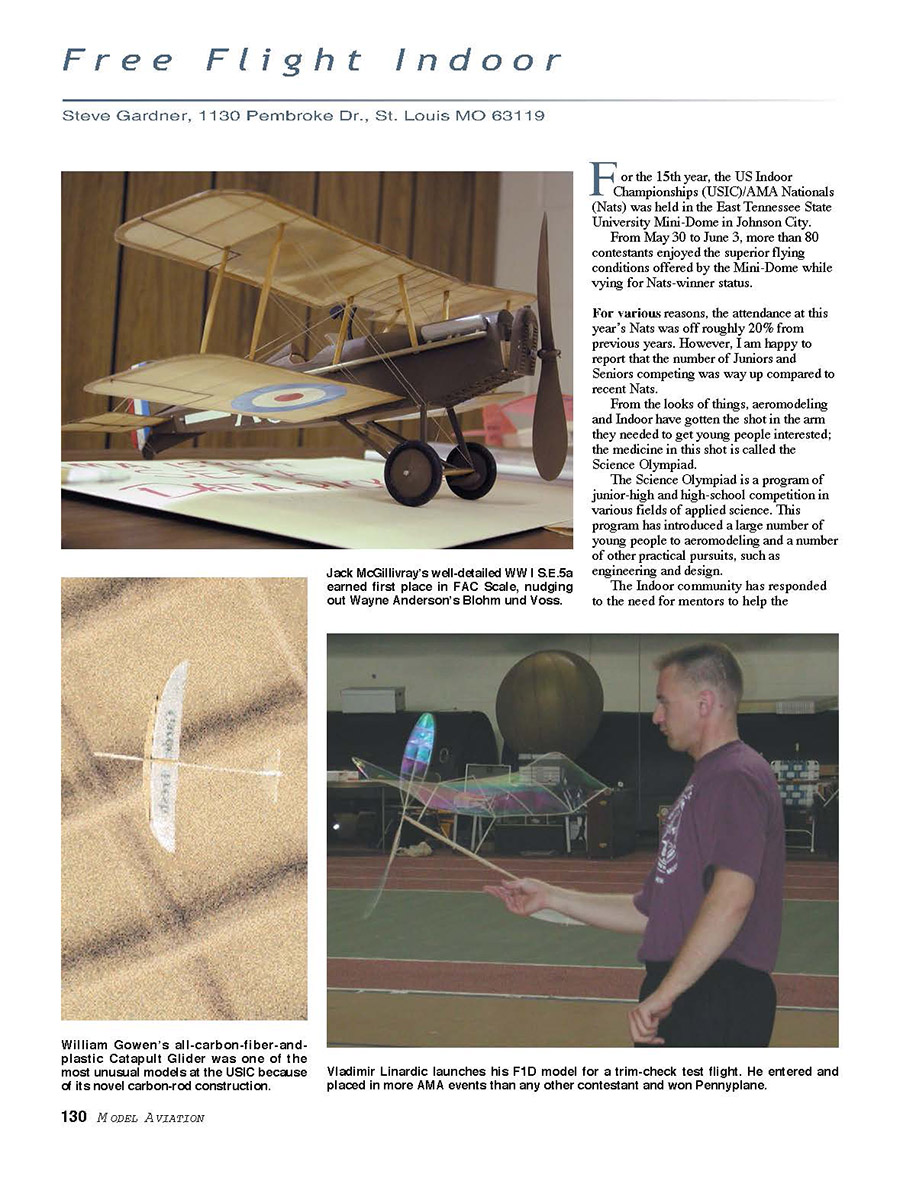
FF Indoor
Steve Gardner, 1130 Pembroke Dr., St. Louis MO 63119
For the 15th year, the US Indoor Championships (USIC)/AMA Nationals (Nats) was held in the East Tennessee State University Mini-Dome in Johnson City. From May 30 to June 3, more than 80 contestants enjoyed the superior flying conditions offered by the Mini-Dome while vying for Nats-winner status.
For various reasons, the attendance at this year's Nats was off roughly 20% from previous years. However, I am happy to report that the number of Juniors and Seniors competing was way up compared to recent Nats.
From the looks of things, aeromodeling and Indoor have gotten the shot in the arm they needed to get young people interested; the medicine in this shot is called the Science Olympiad.
The Science Olympiad is a program of junior-high and high-school competition in various fields of applied science. This program has introduced a large number of young people to aeromodeling and a number of other practical pursuits, such as engineering and design.
The Indoor community has responded to the need for mentors to help the students develop and refine their modeling and flying skills.
Countless Indoor fliers have contributed their time, materials, and encouragement to the Science Olympiad competitors, and the results spoke very loudly at this year's Nats.
Not only were several Science Olympiad events run alongside the USIC categories, but a fair number of new Junior and Senior Science Olympiad fliers participated in the various USIC events.
With eight Juniors and Seniors in Limited Pennyplane, eight in Pennyplane, seven in EZB, and six in F1D (27% beginners!), this year's contest was like no other in recent history.
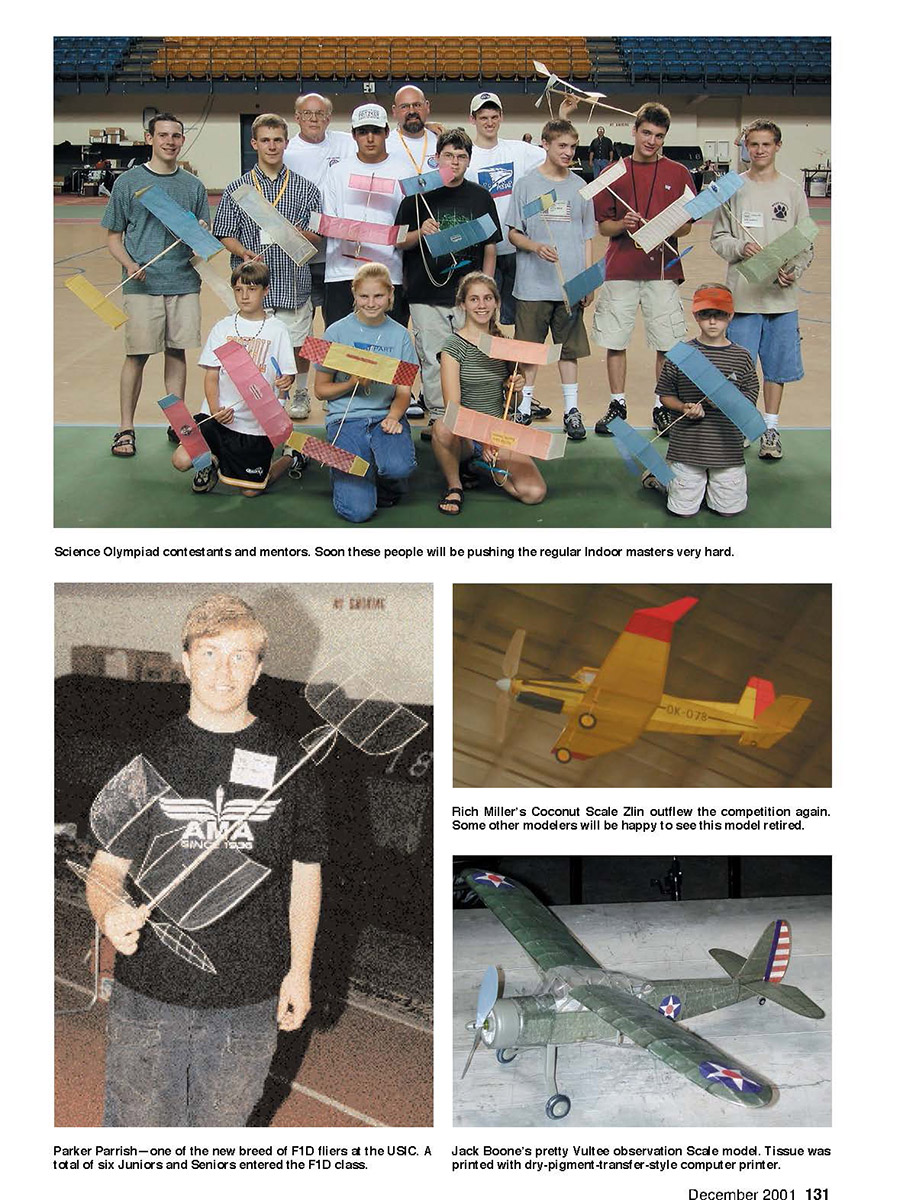
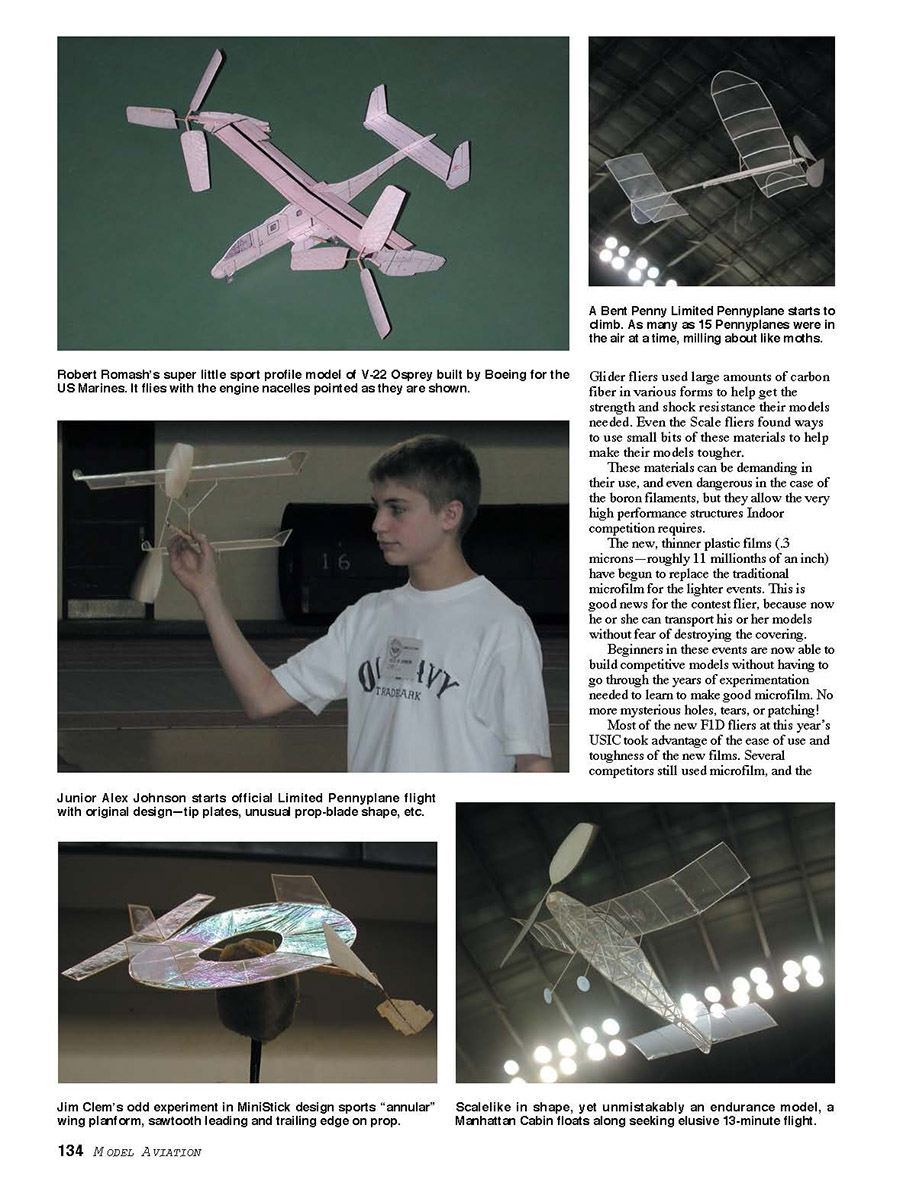
In addition to the wonderful influx of new fliers, novice and seasoned modelers demonstrated new ideas and techniques at this Nats. Most prominent of these innovations were the incredible Catapult Gliders William Gowen built.
These fascinating models' wings and stabilizers were constructed entirely from carbon-fiber rods and polycarbonate plastic covering. This construction method promises very light and strong airframes, with an extraordinary degree of temperature and humidity tolerance.
Really nice wood for glider wings is getting very hard to find, and balsa is subject to warps from almost any atmospheric change. This new construction method, or a mix of new and old, may provide the best glider wings yet.
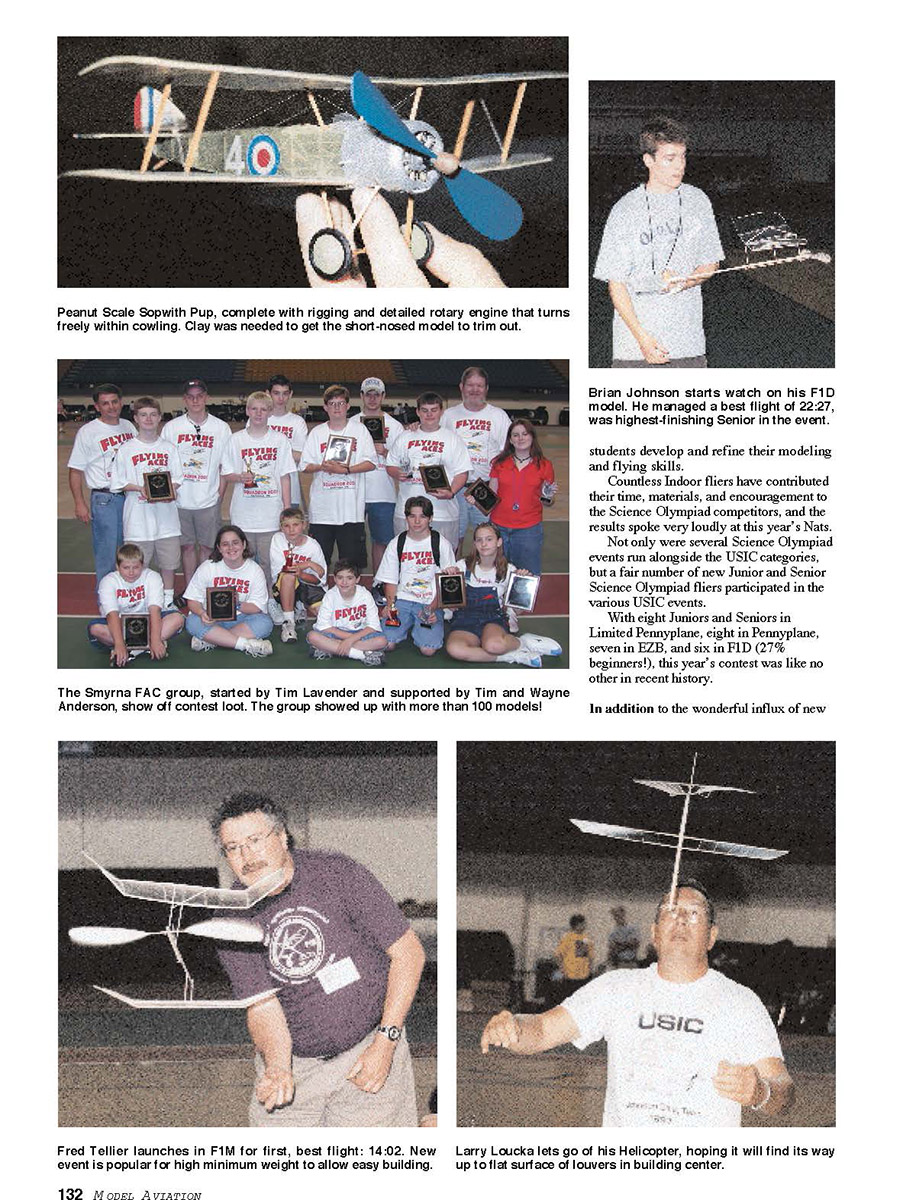
Variable-pitch propellers were in evidence in several events. These props change pitch in reaction to the motor torque to extend the usable motor run.
This is becoming a mature technology, and the basic methods are being well-established.
Better materials and more-consistent mechanisms are the focus of new ideas in this area. Actual stainless-steel tube and wire bearings are replacing the tissue hinges for the prop-blade attachment.
Several types of torsion springs were used other than the usual coiled load spring.
With the variable-pitch props showing obvious performance gains and the new materials making them easier and lighter to build, you can look for them in most of the model classes where the rules do not expressly forbid them.
Indoor modeling has always been the leader in the use of exotic materials such as carbon fibers, boron filaments, aramid fibers, polyplastic films, and high-tensile metal filaments.
Most fliers in the endurance events were using the new films, boron filaments, and tungsten or nichrome wire in their models' construction.
The Catapult and Hand-Launched Glider fliers used large amounts of carbon fiber in various forms to help get the strength and shock resistance their models needed. Even the Scale fliers found ways to use small bits of these materials to help make their models tougher.
These materials can be demanding in their use, and even dangerous in the case of the boron filaments, but they allow the very high performance structures Indoor competition requires.
The new, thinner plastic films (.3 microns—roughly 11 millionths of an inch) have begun to replace the traditional microfilm for the lighter events. This is good news for the contest flier, because now he or she can transport his or her models without fear of destroying the covering.
Beginners in these events are now able to build competitive models without having to go through the years of experimentation needed to learn to make good microfilm. No more mysterious holes, tears, or patching!
Most of the new F1D fliers at this year's USIC took advantage of the ease of use and toughness of the new films. Several competitors still used microfilm, and the models covered with it were very easily noticed; the material is famous for its beautiful rainbow colors.
Although the new films are so thin that they also exhibit a fair amount of color, it is not the same. When the last of the microfilm is gone, it will be missed.
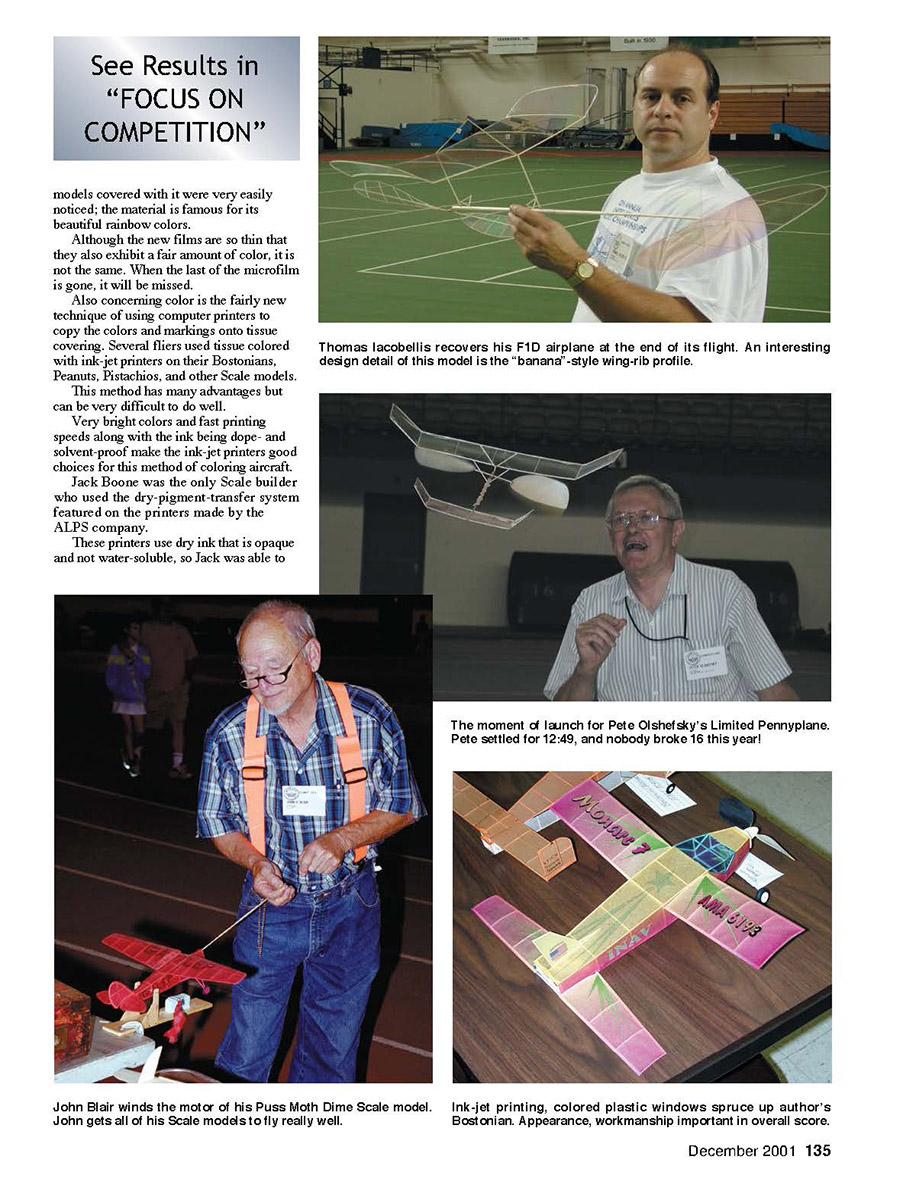
Also concerning color is the fairly new technique of using computer printers to copy the colors and markings onto tissue covering. Several fliers used tissue colored with ink-jet printers on their Bostonians, Peanuts, Pistachios, and other Scale models.
This method has many advantages but can be very difficult to do well.
Very bright colors and fast printing speeds along with the ink being dope- and solvent-proof make the ink-jet printers good choices for this method of coloring aircraft.
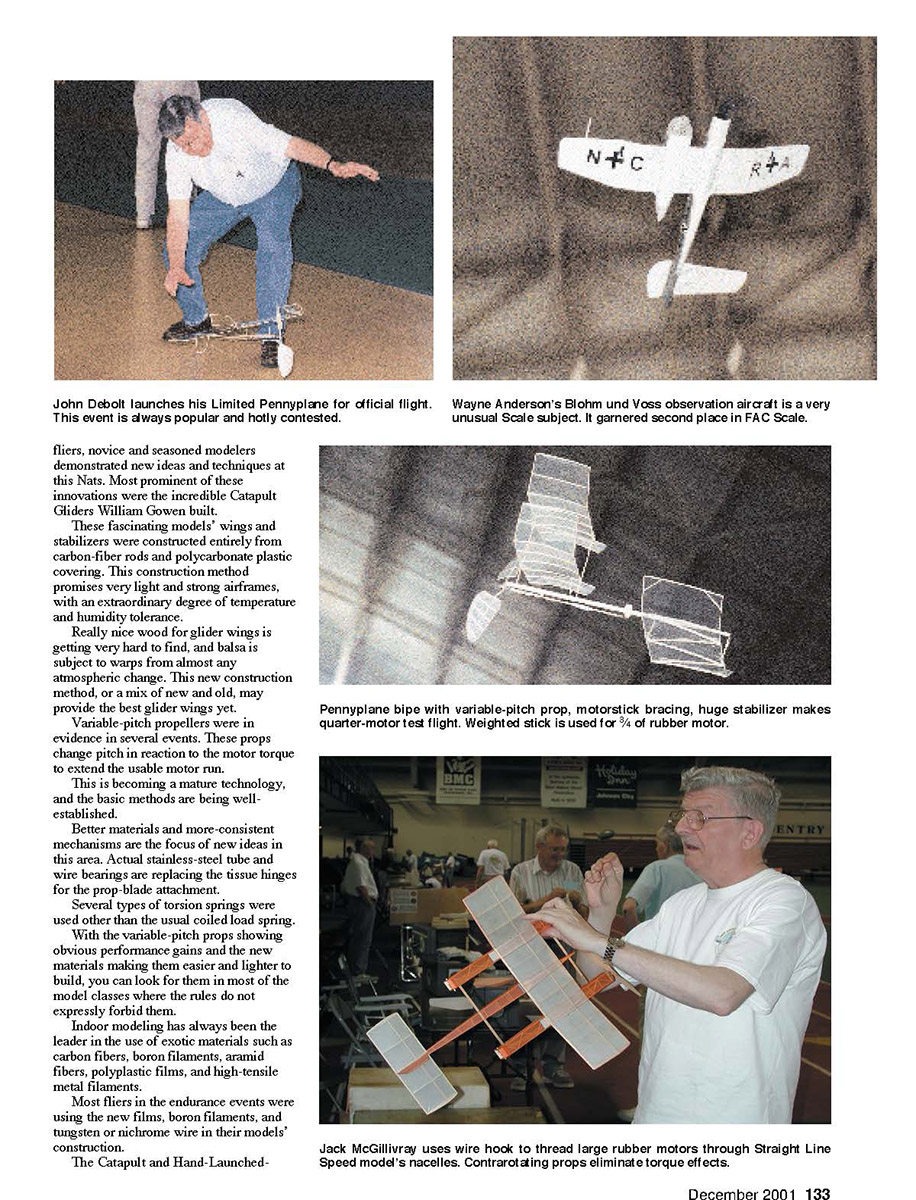
Jack Boone was the only Scale builder who used the dry-pigment-transfer system featured on the printers made by the ALPS company.
These printers use dry ink that is opaque and not water-soluble, so Jack was able to produce deep, vibrant colors that didn't run or fade during finishing.
The ink-jet printers, on the other hand, permit far more subtle shading and detail, but the inks must be protected from solvents and abrasion.
Print/white markings on dark tissue and use water to shrink the tissue on the model. His little observation model colored this way was very impressive.
Another newer technique is the use of very light wood and foam combinations to conserve weight while retaining necessary strength. Many fliers are combining balsa, basswood, and foam cores with thin sheeting or laminates of carbon fiber to get the best of both worlds.
Finally, experience still counts. New materials and techniques help, but careful construction, trimming, and an understanding of indoor aerodynamics are what win contests. The field at the USIC is more competitive than ever, and those who continue to experiment responsibly with materials and methods will keep pushing the sport forward.
A subject of much discussion at the USIC this year was the rubber-supply situation. Of all the competition shapes that use rubber for power, the Indoor endurance events are by far the most seriously affected by the quality of the rubber.
Good rubber was not in too short a supply this year, but the trouble with the last few batches and the conflicting reports about the quality of the April batch were on many fliers' minds.
The April batch was initially reported as being really good. Tests indicated that the rubber would deliver very high energy return, so people scrambled to get some of it.
Later reports by other fliers indicated that the rubber was flawed and very brittle. It was a good performer when you could get it wound, but very often it broke while winding.
The April batch was variable and unreliable, so practically nobody flew with it. The May 1999 batch was the last really great one, and perhaps 70% of the contestants used it.
The July 1999 batch was also well represented. This batch was known to be good, but it was easily broken if used in too much heat. Four years of age has apparently helped this batch, and people using it have reported that it is tougher than it was when new.
I used it for my Limited Pennyplane flights last year and several flights per motor.
These good batches are helping the Indoor community through the problem with rubber quality control, but this note of reassurance is only relative.
This year many of the regular fliers were very generous with their stash of good rubber, as most beginners were able to fly with quality material.
Hopefully this problem will straighten itself out before too much longer.
The covering material, rubber, coloring, and rules are changing in Indoor flying. New fliers and young people are finally coming into the sport.
The Science Olympiad and other scholastic events are bringing a freshness into Indoor competition that was evident at this USIC. FAI and the other very difficult events that have been falling off in entries were well-attended and contested.
The very intense events are being enhanced by the new events, such as the mass-launch, speed events, and the Racer to the Roof.
The new events, materials, techniques, and especially the new faces, made this year's USIC/NASA Nats a pleasure and a success.
Transcribed from original scans by AI. Minor OCR errors may remain.

