
FF Indoor
Bud Tenny, Box 830545, Richardson TX 75083
RICHARD DOIG passed away late in May. He was an accomplished F1D flier, and he headed up the team-selection program for several years. Richard made contributions in so many areas of indoor and international competition, and he was a member of the Indoor Contest Board from the beginning.
Richard was laid to rest June 1, 2002, in Lake Orion, Michigan. In his immediate family he left his wife Melody and an eight-year-old son. Melody has requested that memorial contributions (tax-deductible) be sent to the National Free Flight Society Indoor Fund at 2317 Clawson, Royal Oak MI 48073.
Last fall Jim Richmond made a Cat. IV F1D flight of 34:54, which qualified for a national record and a world record. The national record has been homologated, but because of a procedural delay the National Aeronautic Association would not process the world record because it was submitted too late.
Silver Dome: A piece in the Dallas Morning News reported that the Detroit Lions football team had moved from the dome in Pontiac, Michigan. This piqued my interest, so I queried some fliers who live nearby about whether anyone had explored the possibility of flying models there. Rich Doig replied:
"I got a chance to fly there several years ago. Extremely turbulent down low, because the heat was on. Very windy in the top of the dome. My Pennyplane tumbled end over end as it went up. I suspect it would be pretty good in the summer, when the heat is off.
"The dome is 203+ feet high with a floor the same size as Johnson City [TN]. There are some speakers on cables that hang down to 147 feet and other cables for advertising, and nets that prevent the ball from flying into the stands during point kicks."
"Of course, you're right," said Hardy Broderson. "Why notify them? I'll bet some RC guys will think of that first."
New Sites: Hardy Broderson ([email protected]) passed along the following information: Tom Jerger (pronounced Jer-ger) lives in Columbia, Maryland, and actively flies Wakefield. He is a buddy of Bob Siler. He is vice president of Pecon, a company that builds and operates balloons that fly around the world (don't ask me).
Pecon owns and operates a large World War II hangar in (near) Elizabeth City, North Carolina, which is 800 feet long, 280 feet wide, and 165 feet high. Tom is talking with Bob, and he indicates some willingness to try to make the facility available for indoor flying. The subject came up with him expressing an interest in conducting glide tests indoors for F1B and other model classes.
The hangar has regular activity with the balloons the company manufactures (which are large, long shapes with fins). There is also traffic with commercial blimps (advertising types — MetLife, Budweiser, etc.) that visit from time to time.
He says that the weekends normally have no activity. A portion of the floor has structures (12 feet high) for shops and offices, where the balloons are built. We talked about a Nationals site, a World Championships site, etc., and he was not negative about that. I suggested that one of the indoor guys could come to make a survey and test flights. He was totally open to that.
Quarter Moto: For a long time I didn't remember where I first heard of partial-motor testing. Recently I reviewed some very early (mid 1960s) issues of Air Trails and found a flying tip reported by Carl Redlin; a half-motor setup was shown. Now experienced indoor fliers use the technique frequently, regardless of how high the site is.
Clarence Mather used quarter-motor testing while preparing for the 1968 World Championships in Rome. With only a Cat I site available for testing, Clarence was able to prepare for competition in the World Championship site that was higher than 100 feet. The fractional motor concept works as follows.
- Make a motor of the presumed correct cross-section (weight/length), but one-quarter as long as the final motor will be.
- Make a spacer bar with hooks on each end. The spacer must be three-quarters the distance between the propeller hook and rear hook on the model.
- Add enough weight to the spacer to make it exactly three times as heavy as a short motor.
- Fly the model with this combination. If you are accurate in all the associated weight and length measurements, a test flight's peak altitude reached and the flight time will be almost exactly one-quarter as long as flights with a full motor made from the same batch of rubber and using rubber with the same weight/unit length.
- Adjust loop length and cross-section of the short motor as needed to zero in on the correct motor size and weight. You can then change the weight of the spacer to reach the adjusted motor.
Partial-motor flight testing is useful in any site, but quick tests in high-ceiling sites give useful information even if the motor preparation is inaccurate. You can still check the model's response to full torque, and the test flights save critical contest time. Just don't expect to predict flight times and altitude with accuracy better than the motor preparation.
Warning: Low-ceiling partial-motor tests will not give accurate data if the model touches the ceiling longer than briefly. Part of the information the test shows includes altitude gained. If the ceiling limits the climb, altitude and duration predictions will be inaccurate.
Steering: Steering has become an important tactic in almost all contests. For F1D flying, especially at World Championships, steering is often crucial. As far back as 1966, shortly after steering was first allowed, an incomplete steering maneuver made the difference between first place and second place for one team.
Steering can only be mastered by regular and intensive practice. This requires regular and frequent access to a site. It doesn't require a high-ceilinging site — at least until your skill level improves enough for you to feel confident in your ability.
Balloon-style steering requires the balloon to have a very strong pull so that it will follow your movements quickly. A slack balloon can be used for retrieval; it may be better because it won't over-react.
A steering drone? Do you have a sturdy model that doesn't quite do as well as you'd like? Take off the big propeller, lighten it and rebalance it to fly "low and slow" on smaller rubber and propeller. Now you have a model with which you can practice steering.
Since you're not going all out for first place or a record, you can use a site with odd ceiling height, rafters that have an attitude, and a drift problem. You can also practice retrieval if the model hangs up. A bonus is that you will be more relaxed without the pressure to win — an excellent training environment.
Working With Boron: Boron filaments are used as reinforcement in many phases on indoor models to give lighter and stiffer structures. As outlined in the following, there are hazards associated with handling boron. This discussion is the best I've seen. It's from the December 1995 Boeing Hawks newsletter. Gene Stubbs was the editor.
"Gil Coughlin described to me some useful tips for using boron fiber.
For those like me who have not experienced it, the material Gil uses is a .004 in. fiber consisting of a tungsten core with vapor-deposited coating of boron. It comes on a roll, and has tensile strength and stiffness similar to .003 in. piano wire. The typical use is to add stiffness to a motor stick or stabilizer framework by cementing a fiber to the structure.
To cement the fiber Gil first coats it with Duco cement by drawing it through a drop of cement between his fingers. Then with the coated fiber positioned on the structure, he activates the cement with a swipe of acetone.
Anyone using boron fiber should be aware of its danger and appropriate disposal methods. The chief danger with boron fiber is that if a small piece punctures the skin like a splinter, it tends to migrate through the body causing discomfort and damage. Therefore, extreme care must be used to contain any scraps or fragments of the fiber.
A good way to keep track of the material is to handle it attached to masking tape until it is ready for installation. For disposal, Gil collects any scraps in a plastic bowl and coats them into a block of Portland cement."
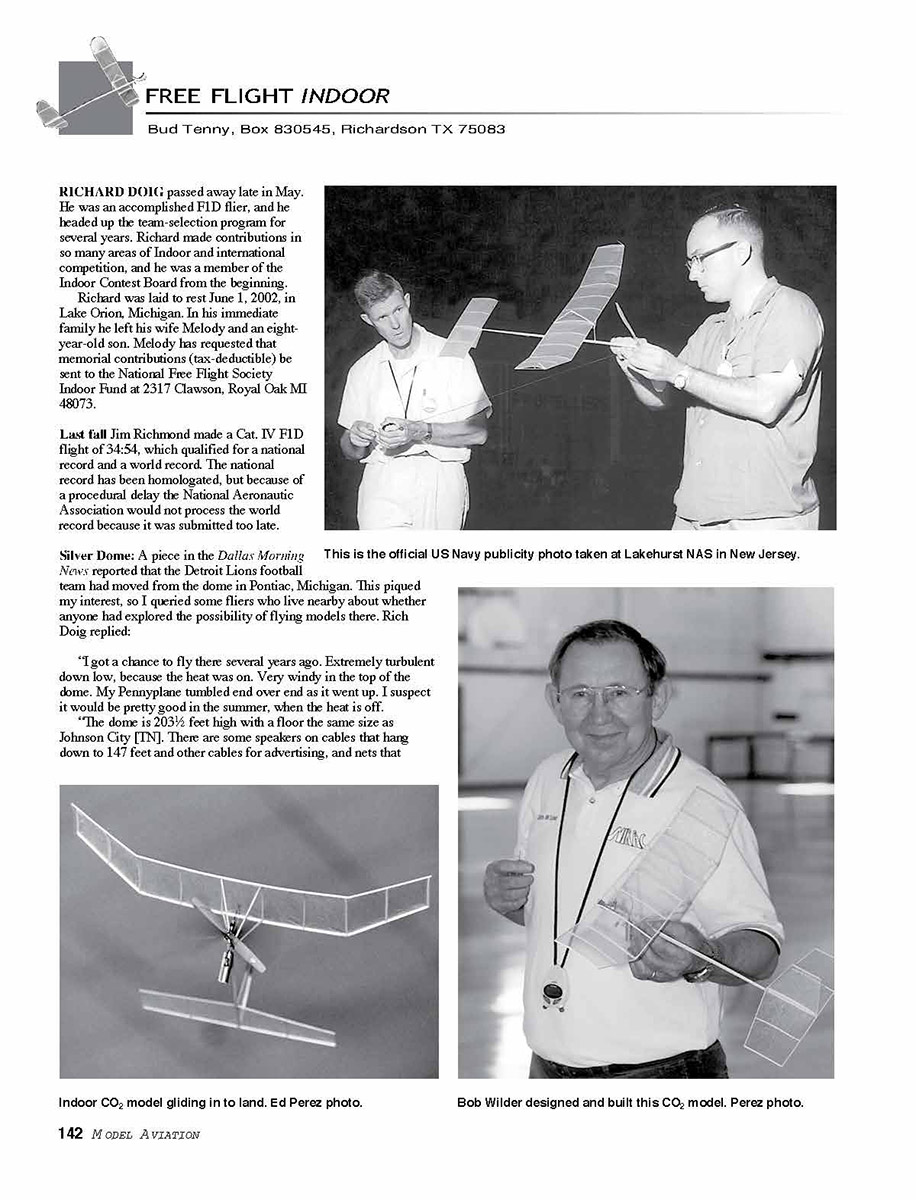
With a "T" fillet? A photo I've included this month was taken in Hangar 5 of the Lakehurst Naval Air Station in the 1960s. Identify the two people and the model class, which no longer exists in the same form. An official US Navy photographer took the picture as part of the Navy's public relations activity.
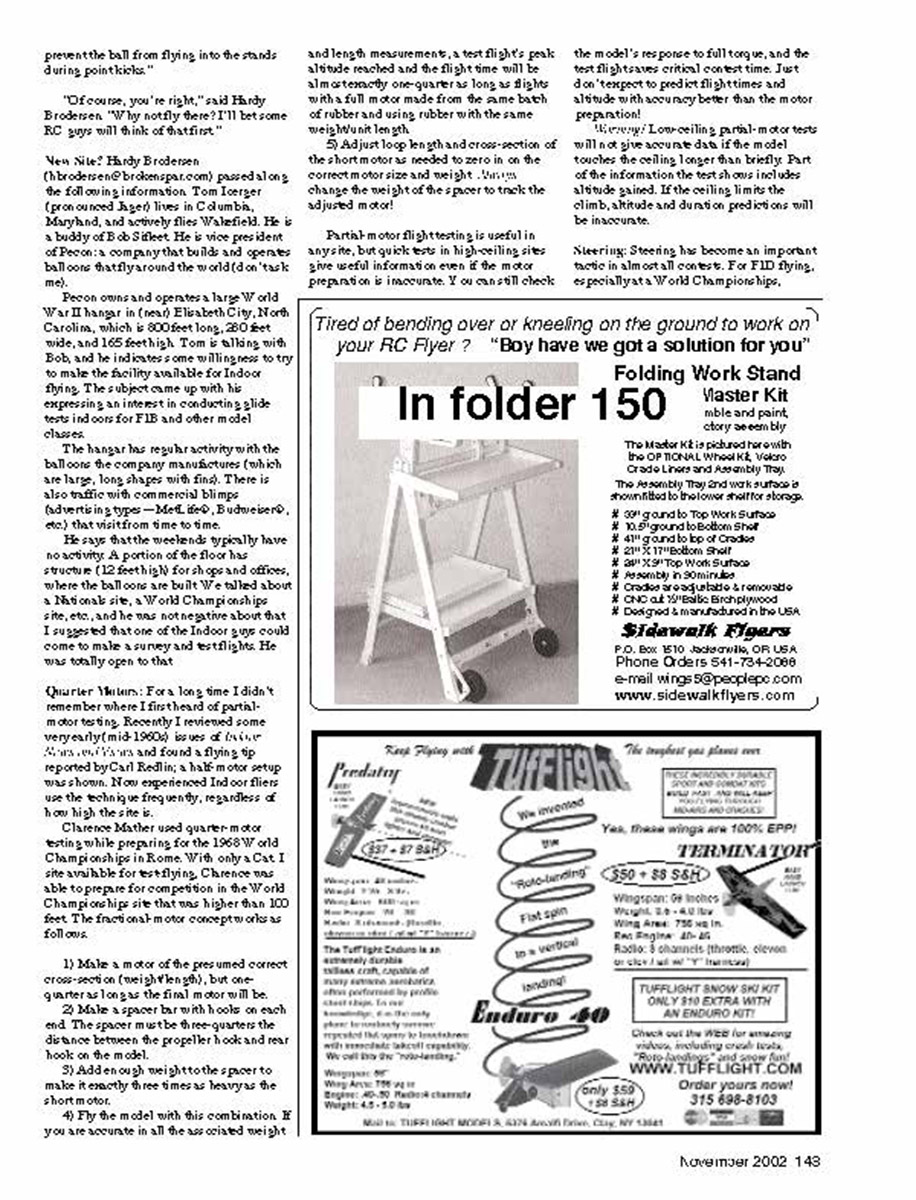
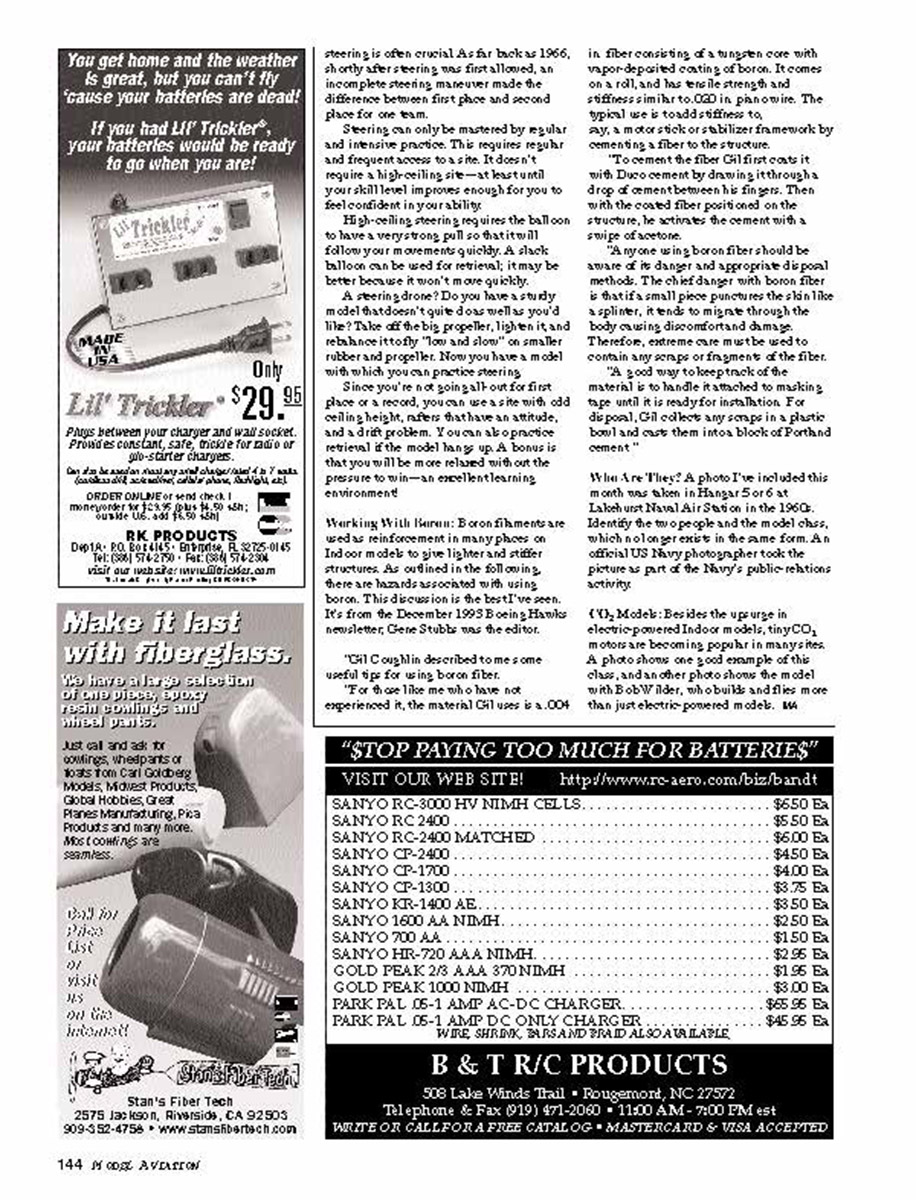
(1/2) Models: Besides the upsurge in electric-powered indoor models, tiny CO2 motors are becoming popular in many sites. A photo shows one good example of this class, and another photo shows the model with Bob Wilder, who builds and flies more than just electric-powered models. W.W.
Transcribed from original scans by AI. Minor OCR errors may remain.

