
Free Flight Indoor
Steve Gardner, 1130 Pembroke Dr., Saint Louis MO 63119
THE 2002 AMA Indoor Nationals (Nats)/US Indoor Championships (USIC) was held in the incredible Mini-Dome athletic building. This was the 16th Nats in this nearly perfect flying site located on the campus of East Tennessee State University in Johnson City. From May 29 to June 2, approximately 100 competitors filled that huge building with Indoor models flying in more than 30 events.
This year's attendance seemed to have improved compared to the past few years. New faces, young and not so young, were everywhere. These fliers—first-time competitors along with the "new regulars"—are the people who determine the new directions in Indoor competition. The experienced fliers set the goals and provide the wealth of advice that these inexperienced fliers use to advance their abilities.
The Science Olympiad (SO) and Wright Stuff programs were again showing tremendous results as an introduction to Indoor competition. Several fliers who had won their wings with SO competition models were flying in F1D and other sophisticated events. Some of the "new regulars" were SO fliers from last year's USIC.
We need to do everything we can to keep the SO program working and well supported with materials and instruction. There are several kits and special tooling available, as well as a wonderful CD about constructing SO models. With these tools and all the volunteers, the SO programs will continue to be a boon to the Indoor community.
The first time an Indoor flier attends the USIC at the Mini-Dome, he or she is surprised by the marathon nature of the contest. Official flights start at approximately 8 a.m. and go through to as late as 10 p.m. for five consecutive days.
The air is still and more than a bit humid, but the temperature is actually comfortable. Because of the large floor area, you need to move around a great deal to make sure you don't miss anything. There are often dozens of models in flight at any one time, with test-flying at each end of the building. The natural pace of Indoor flying gives you time to watch others fly, and even pick the experts' brains a bit.
One of the problems with the rubber supply was the reorganization of the manufacturer's network of making the specialty rubber needed for model flying. After reassessing the cost of making the rubber and increasing the price, the manufacturer began making model rubber again.
The rubber supplier began working with the manufacturer to help tune the process to get the best product. Many mediocre batches were made before the newest batch of promising rubber came out. The March 2002 batch tested above the 4,000 feet/pound/pound point, at which rubber starts to get famous. Everybody scrambled to get a pound or two of this batch, and many people had some to use at this year's USIC.
This newest hot batch may turn out to be too variable to be of much use. Several fliers, myself included, had trouble getting any performance from this batch. Those of us with May 1999 or July 1997 rubber used that instead for most of the contest. The March 2002 batch may not be any good in the long run, but it is a step in the right direction, and everyone is hoping it is an indication that the maker will soon be making good rubber again.
As in past years, the contest began with the glider events. These models are heavier and faster than other Indoor models, so they are flown strictly in their own time slot. Gliders lend themselves to experimentation; they are very quick to build and modify.
Bill Gowen's and Jim Lewis's built-up gliders were among the most innovative models flying this year. Bill started the ball rolling a few years ago with his all-carbon-structured built-up gliders, then Jim took the idea and melded the carbon with balsa to arrive at the beautiful gliders he flew this year. His second-place finish in Unlimited Catapult was the highest place ever for a built-up glider—just seven seconds less than Kurt Krempetz's winning time.
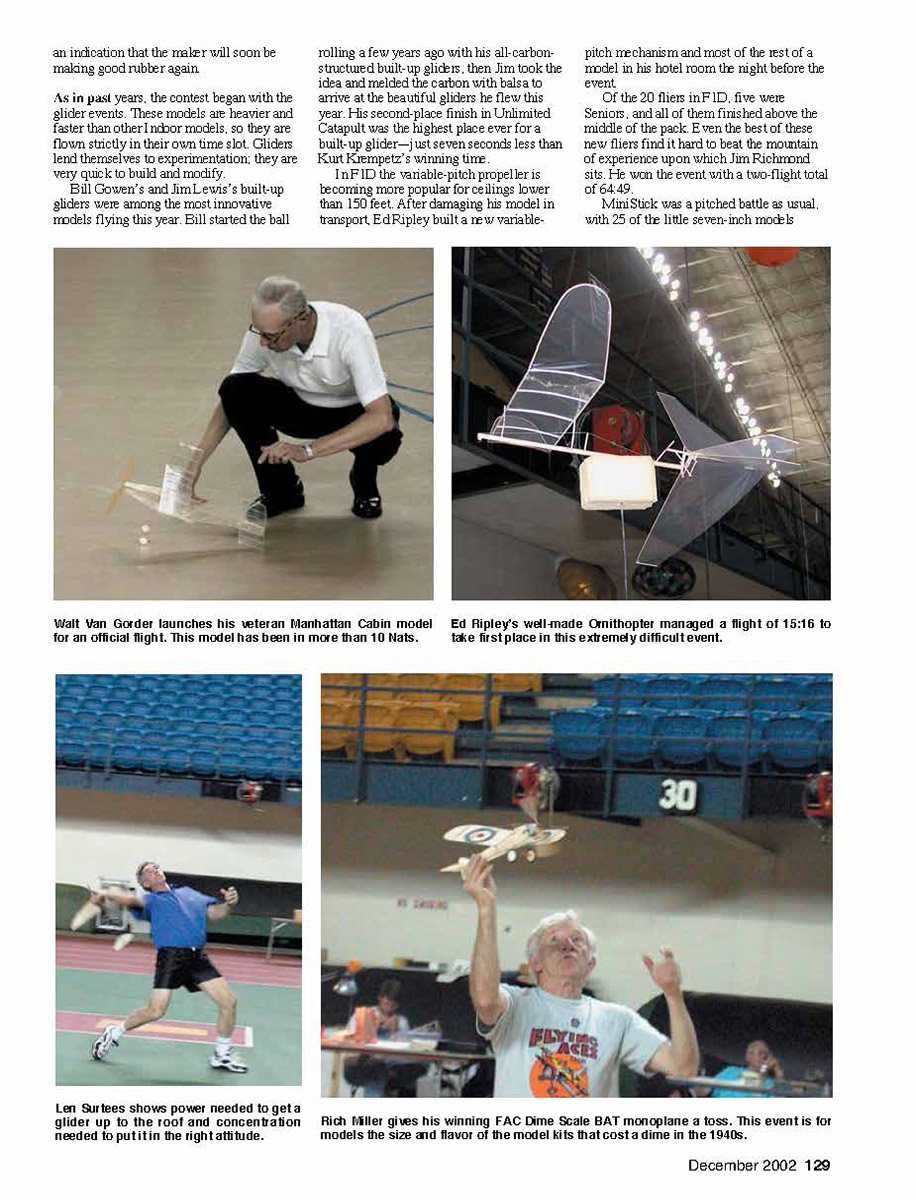
In F1D the variable-pitch propeller is becoming more popular for ceilings lower than 150 feet. After damaging his model in transport, Ed Ripley built a new variable-pitch mechanism and most of the rest of a model in his hotel room the night before the event.
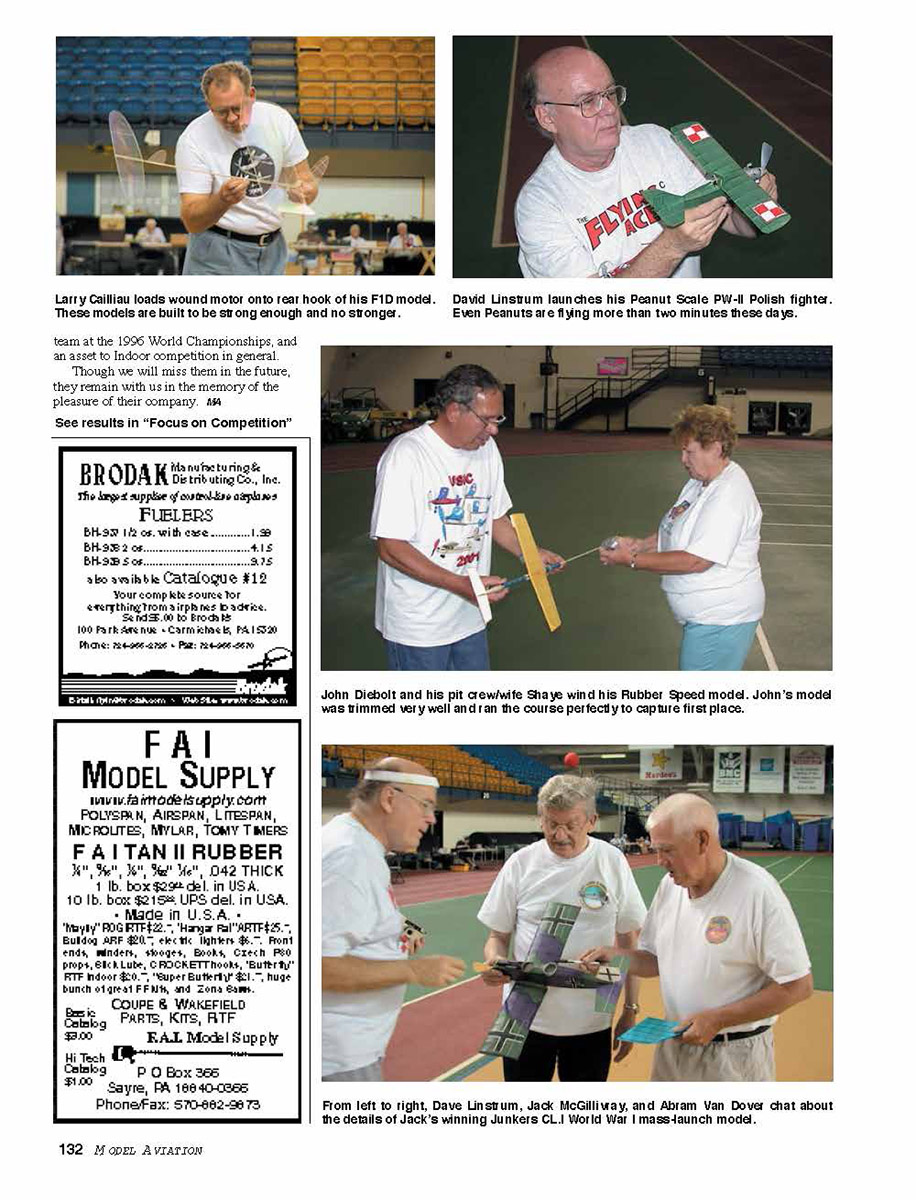
Of the 20 fliers in F1D, five were Seniors, and all of the men finished above the middle of the pack. Even the best of these new fliers find it hard to beat the mountain of experience upon which Jim Richmond sits. He won the event with a two-flight total of 64:49.
MiniStick was a pitched battle as usual, with 25 of the little seven-inch models entered. Only three models finished both flights with times over five minutes.
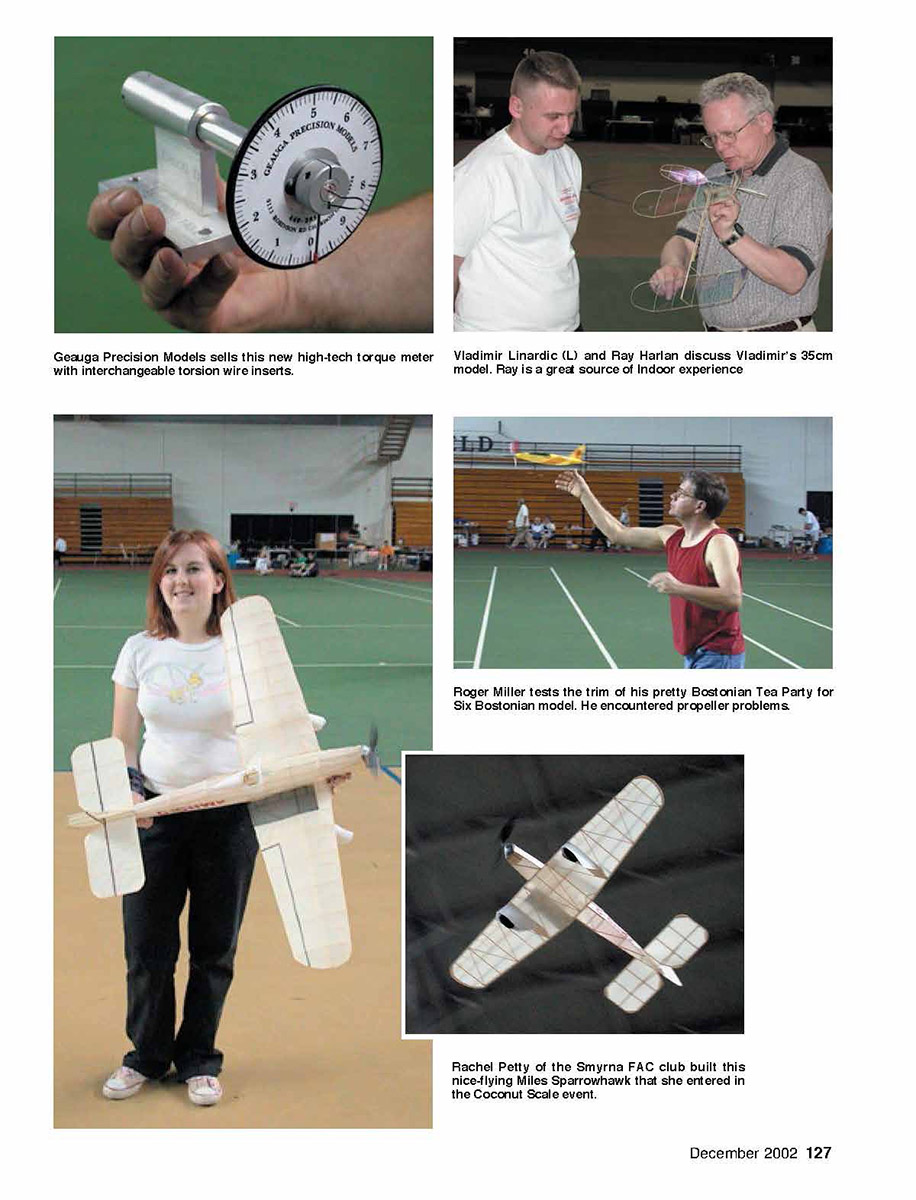
Rich Miller won the FAC Dime Scale BAT monoplane toss. This event is for models the size and flavor of the model kits that cost a dime in the 1940s.
Zipping around. With propeller diameters just an inch less than the wingspan and rubber weight often higher than the airframe weight these models are very tricky to trim well. The torque at launch often causes stalling and rolling, which may take the model down. If the model remains in the air until the torque drops off a bit, it usually stabilizes and goes on up.
Rob Romash, who brings the most interesting, fun-flying models each year, won MiniStick with a flight of 12:47.
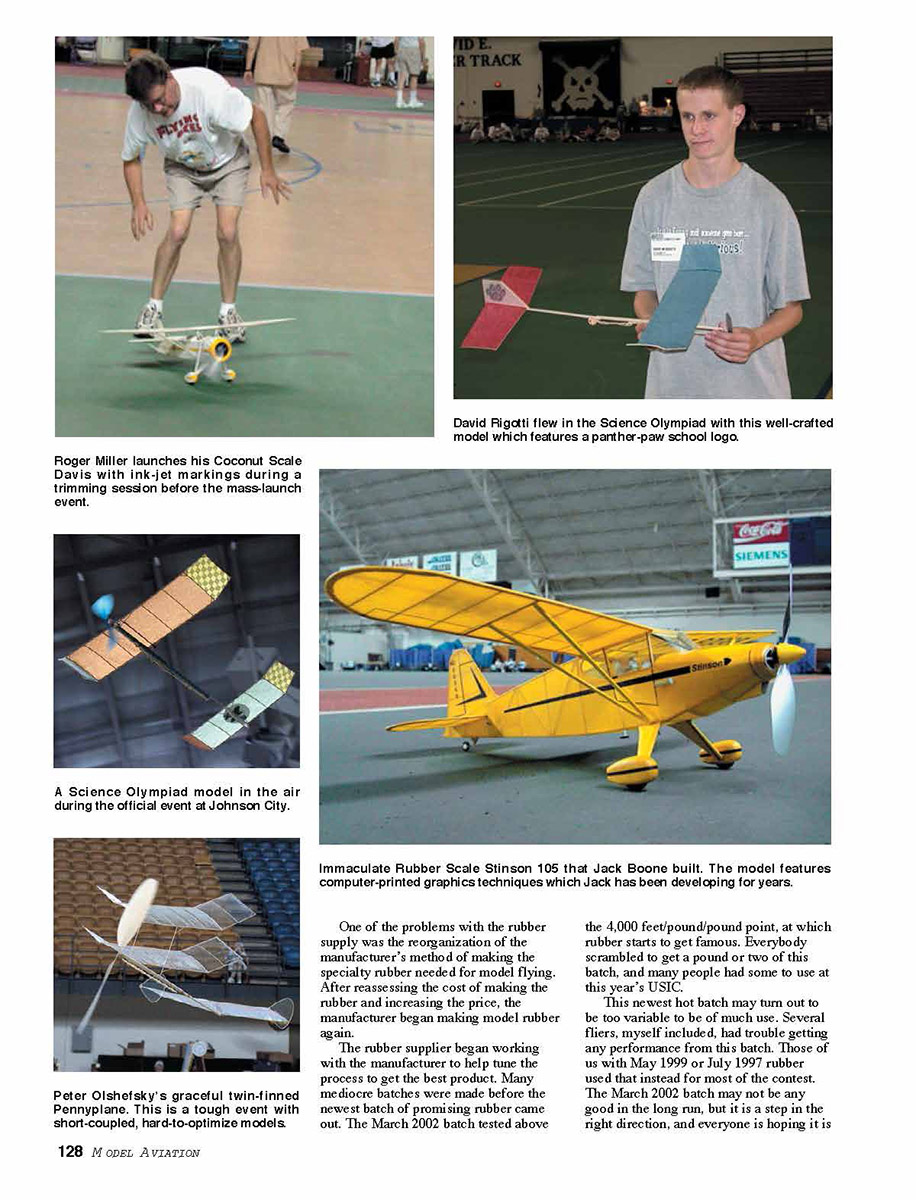
Limited Pennyplane was the most popular event, with 38 entries. The rigid rules make the models nearly identical to each other. Most Limited Pennyplanes can be fairly easily trimmed to fly well. To win this event the flier must be very good at making propellers and choosing the best motors. A change of an inch of propeller pitch or shortening a motor by a half inch can make a two-minute difference in the flight time.
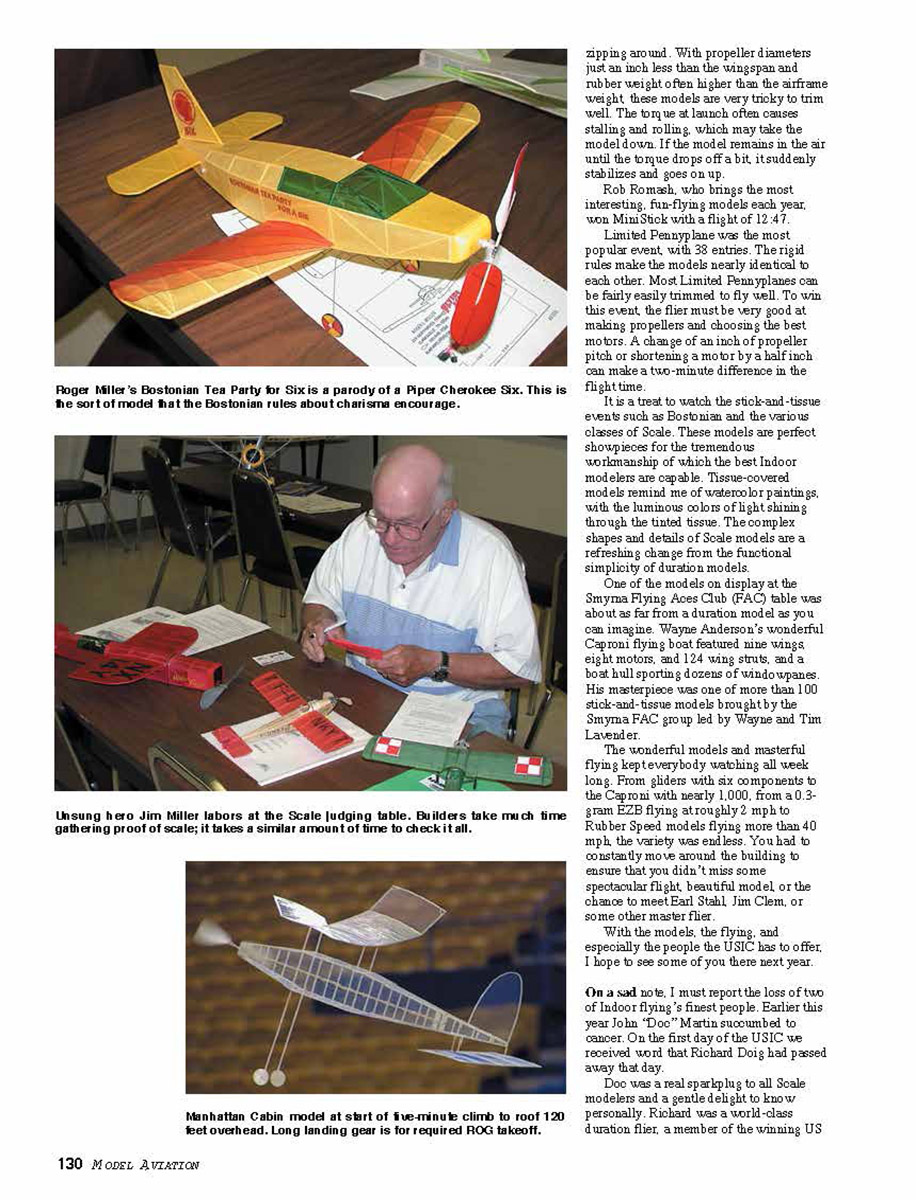
It is a treat to watch the stick-and-tissue events such as Bostonians and the various classes of Scale. These models are perfect showpieces for the tremendous workmanship of which the best Indoor modelers are capable. Tissue-covered models remind me of watercolor paintings, with the luminous colors of light shining through the tinted tissue. The complex shapes and details of Scale models are a refreshing change from the functional simplicity of duration models.
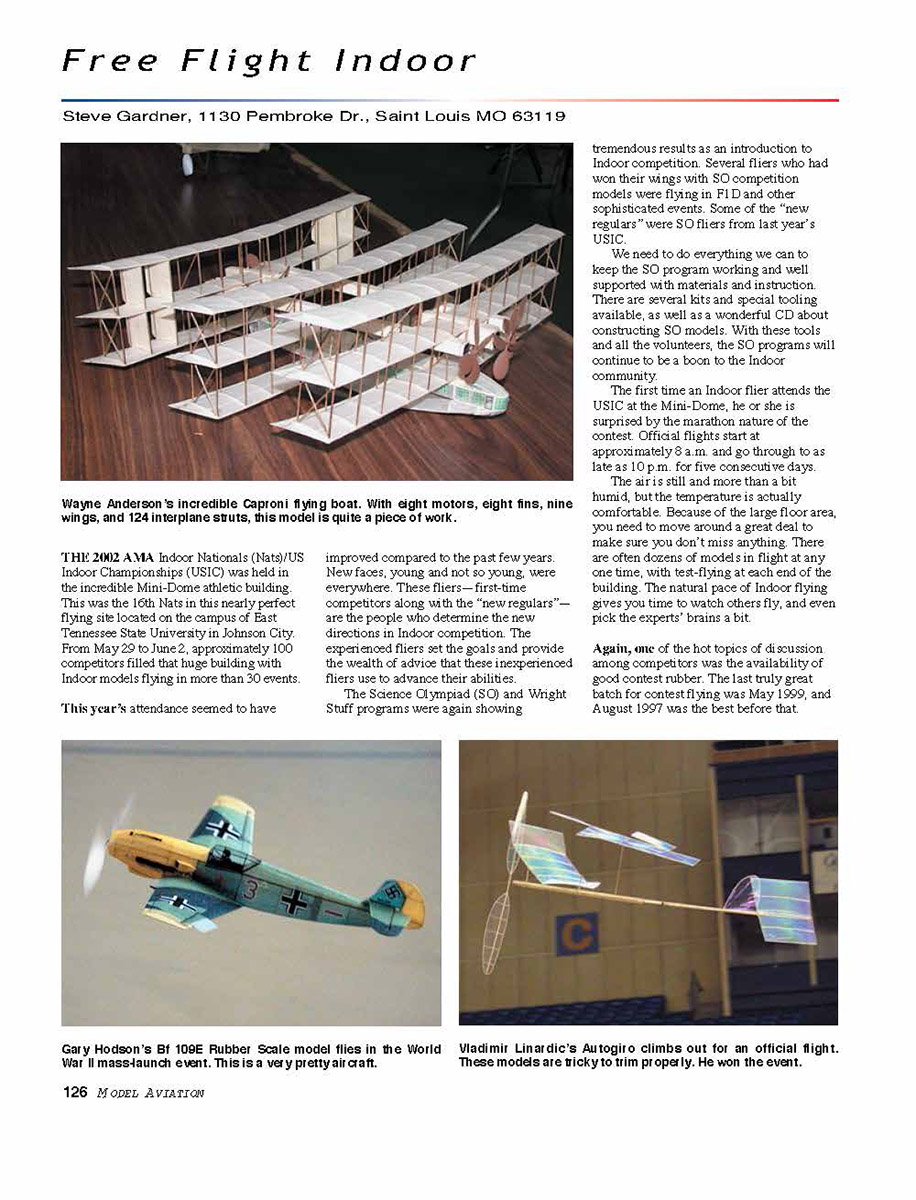
One of the models on display at the Smyrna Flying Aces Club (FAC) table was about as far from a duration model as you can imagine. Wayne Anderson's wonderful Caproni flying boat featured nine wings, eight motors, and 124 wing struts, and a boat hull sporting dozens of windowpanes. His miniature was one of more than 100 stick-and-tissue models brought by the Smyrna FAC group led by Wayne and Tim Lavender.
The wonderful models and masterful flying kept everybody watching all week long. From gliders with six components to the Caproni with nearly 1,000, from a 0.3-gram EZB flying at roughly 2 mph to Rubber Speed models flying more than 40 mph, the variety was endless. You had to constantly move around the building to ensure that you didn't miss some spectacular flight, beautiful model, or the chance to meet Earl Stahl, Jim Clem, or some other master flier.
With the models, the flying, and especially the people the USIC has to offer, I hope to see some of you there next year.
On a sad note, I must report the loss of two of Indoor flying's finest people. Earlier this year John "Doc" Martin succumbed to cancer. On the first day of the USIC we received word that Richard Doig had passed away that day.
Doc was a real sparkplug to all Scale modelers and a gentle delight to know personally. Richard was a world-class duration flier, a member of the winning US team at the 1996 World Championships, and an asset to Indoor competition in general.
Though we will miss them in the future, they remain with us in the memory of the pleasure of their company.
See results in "Focus on Competition"
Transcribed from original scans by AI. Minor OCR errors may remain.

