
FF Indoor
John Kagan, <REDACTED>
WE INDOOR FF people have a large number of events under our "umbrella." There are 17 official AMA categories (judging by the Nats entry form in my hand and the records page in MA), 20 non-AMA events that we fly at the Nats, and countless others that are in various stages of "officialness."
I used to think that we have far more events than in the other AMA disciplines, but a review of the other Nats forms reveals that we are right on par. I guess modelers love variety!
The computer scientist in me would love to see a nice, small set of events with some unifying thread, such as level of difficulty/complexity or maybe grade by size, such as the A, B, C, D models of old. But, probably for the better, we have a wonderful cornucopia of events with wildly varying rules.
The events all seem to have evolved from local rules that "caught on." For some the goal was to create airplanes with a certain look, such as Bostonian and Manhattan Cabin. Other times it was to define particular challenges, as with ROG [rise-off-ground] Stick and Cabin, Autogiro, and Ornithopter. Often it was to create an easy beginner's category, which was the initial goal of Easy B (EZB), PennypIane, Limited PennypIane, A-6, and others.
Each with its loyal fans, the myriad divisions aren't likely to shrink significantly anytime soon. As evidence, I've received more than a few letters of the form, "I see you talking about [fill in the blank] a lot, but don't forget those of us who fly [fill in the blank]."
So in recognition of all those who love what they fly, and also to share information with the rest of the MA audience, this column will begin a minireview of some of the events. First is big-time favorite EZB.
What is EZB? The product of Wally Miller's imagination in the 1960s, EZB defines a medium-sized airplane of relatively simple construction. The prominent features of the rules include an 18 x 3-inch wing, all-balsa propeller, and solid-balsa motorstick and tailboom. For the rest of the details, refer to section 19 in the AMA Competition Regulations Indoor FF section. You can access this information at www.modelaircraft.org/comp/0506Rulebook/indoorFreeFlight.pdf.
The rules prohibit the use of structurally superior, but more complex, elements such as rolled sticks and booms, built-up propellers, bracing, and composite materials. It seems this would make a good beginner's model, and maybe it did initially. But the absence of a model weight limit has led to minimalist aircraft that are fun to build but challenging to master. An old joke is that they should change the name of EZB to "Son of a B."
Indoor FF legends Larry Coslick and Larry Cailliau redefined the class with models weighing roughly a half gram, pushing times well past 30 minutes. But you don't have to begin with something that light to experience the event; there is much to learn by starting with slightly beefier EZBs.
I do not generally advocate directing newcomers toward heavy models; too often it produces airplanes with un-Indoor-like characteristics that don't get the person much closer to building a proper model. But in this case, an added few tenths of a gram drastically tones down the lighter models' delicate nuances. In fact, you will likely get a more competitive first aircraft if it weighs more than .75 gram than if you try for .50 gram right off.
Larry Coslick notes that the model he used to first break the 30-minute barrier weighed .83 gram. He says that weight is important, but working out the other details, such as the wing-tube fit, thrustline adjustment, and proper flying-surface warps are even more vital. (A 1.2-gram EZB is also an F1L, which is the FAI's international version of the US EZB. It is also a great starter model.)
Approximately eight years ago Larry put together what is now regarded as the bible of EZB: the Hobby Shopper EZB Construction Guide. In it he outlines the testing and grading process he uses to construct his winning models, showing you how to craft a .75-gram EZB from common hobby-shop balsa. It is a great way to learn the ins and outs of selecting the right piece of wood for the task.
You can find this masterpiece in Indoor News and Views issue 90, as part of the archive collection that is available in the INAV section of Tim Goldstein's Web page at www.indooroutdoorair.com. The article is also available separately in the "Articles" section of the site.
Once you try the Hobby Shopper, you will get a taste of the top-level models. Each component must be strong enough to do its job and light enough to keep the overall weight down, while it also flexes properly and in harmony with the rest of the airplane.
A flaring propeller must flex enough to fit the climb into the available ceiling space, but not so much that it stalls the blades and causes the model to flounder. And a motorstick must be strong enough to hold a fully wound motor, but flex and twist enough to generate the right amount of wing wash and negative stabilizer incidence for launch.
On models such as F1Ds, you could control the amount of stick bow by applying boron and adjusting the tension of the bracing wire, but on an EZB airplane you must accomplish the same results by selecting, testing, and tuning a single piece of wood.
Now you know why top-level EZBs aren't so easy! But they are fun. Grab a copy of Larry's Hobby Shopper article and give EZB a try.
Good News From Florida
After several years without a steady flying site, and after low turnout at the last local contest, Dave "VTO" Linstrum sent the following note.
"Indoor is born again in FL! Florida attracts many retiree Free Flighters—even Indoor fliers who avoid the sun.
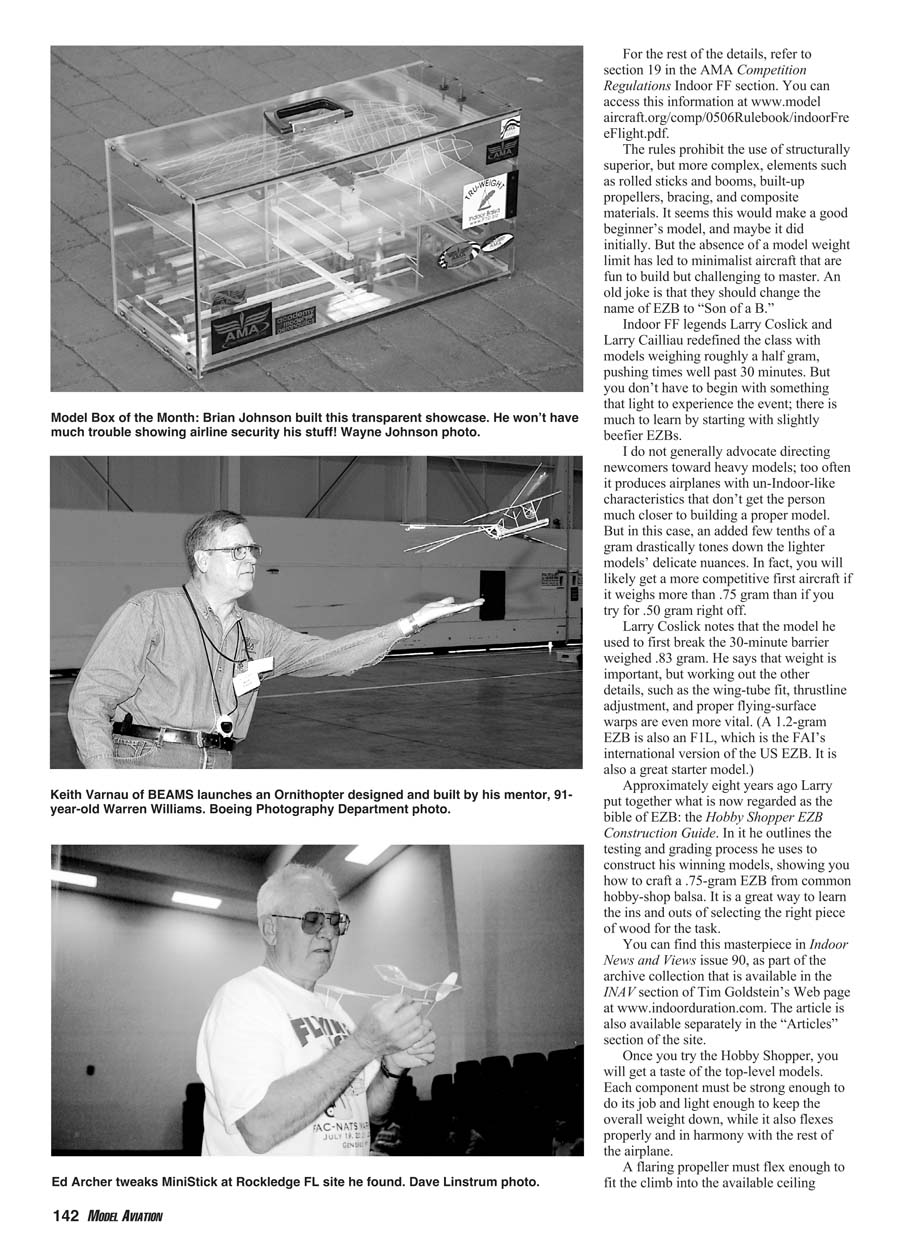
"Ed Archer [see picture] noticed that his new church in Rockledge FL had a multipurpose space with a smooth 24-foot ceiling suited to Indoor models. He arranged for a trial contest with all AMA and FAC [Flying Aces Club] events.
"With a great turnout of 21 fliers and an equal number of spectators, it was run by Indoor activist Bill Carney. Now regular monthly meets are scheduled in this space (no pews, just stacking chairs).
"For more info contact DB Bill Carney <REDACTED>. Come fly or just enjoy and kibitz."
Dave reports that this is currently the only viable flying site in Florida, but Bill Carney isn't one to sit on his hands. Further developments are anticipated.
Seattle, Washington, "Local Scene"
Carl Stokes Jr. sent the following about Seattle's "Local Scene."
"[The Boeing Company] gives us two gyms to fly in: the one in Everett is ours the second Saturday of the month; Oxbow gym located near Boeing Field is ours for four hours the third Saturday of each month. Both have around 25-foot ceilings ... and are about the size of two basketball courts. Each is only 30 minutes from my house and they are free!
"Most of the modelers are strictly fun-flyers. Lately we also include in our flying time to talk over stuff like health ... and modeling ideas—we all look forward to each session."
Carl included a packet of information from the Boeing Employees' Aeromodelling Society (BEAMS), which is a huge Indoor FF club. I learned from the pictures and newsletters that BEAMS has a tremendous amount of modeling activity going on, with regular flying and building sessions and many participants. The club's general purpose is:
"To inspire our next generation of aeromodellers and aviation professionals. A network of adults and youth for an informal community of Northwest modelers who focus on providing opportunities in Indoor Free Flight model aeronautics. Many members also fly Outdoor Free Flight, Electric, and RC models. We meet on a regular basis in Everett and Seattle (Oxbow) Boeing Recreation facilities in the Puget Sound area of Washington State."
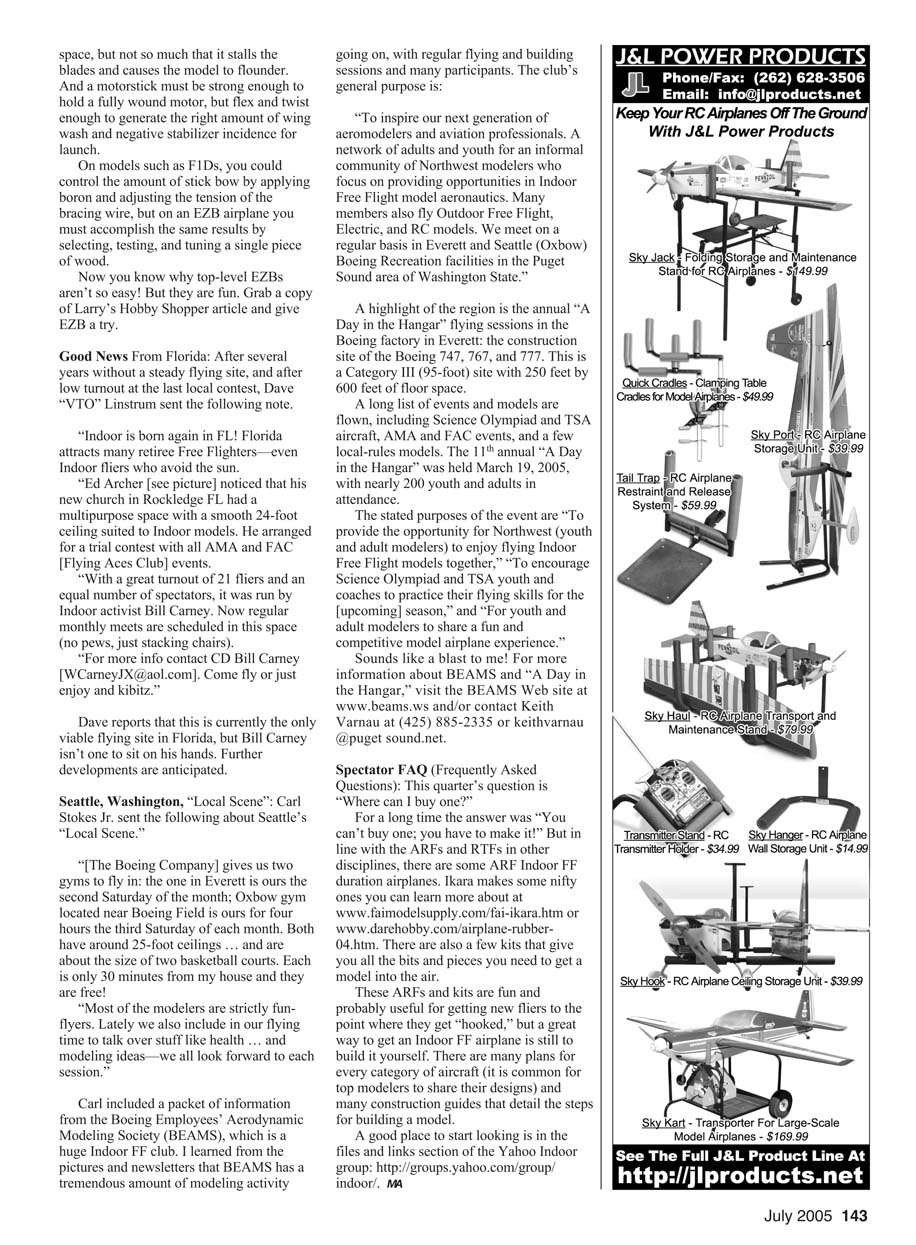
A highlight of the region is the annual "A Day in the Hangar" flying sessions in the Boeing factory in Everett: the construction site of the Boeing 747, 767, and 777. This is a Category III (95-foot) site with 250 feet by 600 feet of floor space.
A long list of events and models are flown, including Science Olympiad and TSA aircraft, AMA and FAC events, and a few local-rules models. The 11th annual "A Day in the Hangar" was held March 19, 2005, with nearly 200 youth and adults in attendance.
The stated purposes of the event are "To provide the opportunity for Northwest (youth and adult modelers) to enjoy flying Indoor Free Flight models together," "To encourage Science Olympiad and TSA youth and coaches to practice their flying skills for the [upcoming] season," and "For youth and adult modelers to share a fun and competitive model airplane experience."
Sounds like a blast to me! For more information about BEAMS and "A Day in the Hangar," visit the BEAMS Web site at www.beams.ws and/or contact Keith Varnau at <REDACTED>.
Spectator FAQ (Frequently Asked Questions)
This quarter's question is "Where can I buy one?"
For a long time the answer was "You can't buy one; you have to make it!" But in line with the ARFs and RTFs in other disciplines, there are some ARF indoor FF duration airplanes. Ikara makes some nifty ones you can learn more about at www.faidomessupply.com/fai-ikara.htm or www.darehobby.com/airplane-rubber-04.htm. There are also a few kits that give you all the bits and pieces you need to get a model into the air.
These ARFs and kits are fun and probably useful for getting new fliers to the point where they get "hooked," but a great way to get an Indoor FF airplane is still to build it yourself. There are many plans for every category of aircraft (it is common for top modelers to share their designs) and many construction guides that detail the steps for building a model.
A good place to start looking is in the files and links section of the Yahoo Indoor group: http://groups.yahoo.com/group/indoor/. MA
Transcribed from original scans by AI. Minor OCR errors may remain.

