
F1D World Championship
by John Kagan <REDACTED>
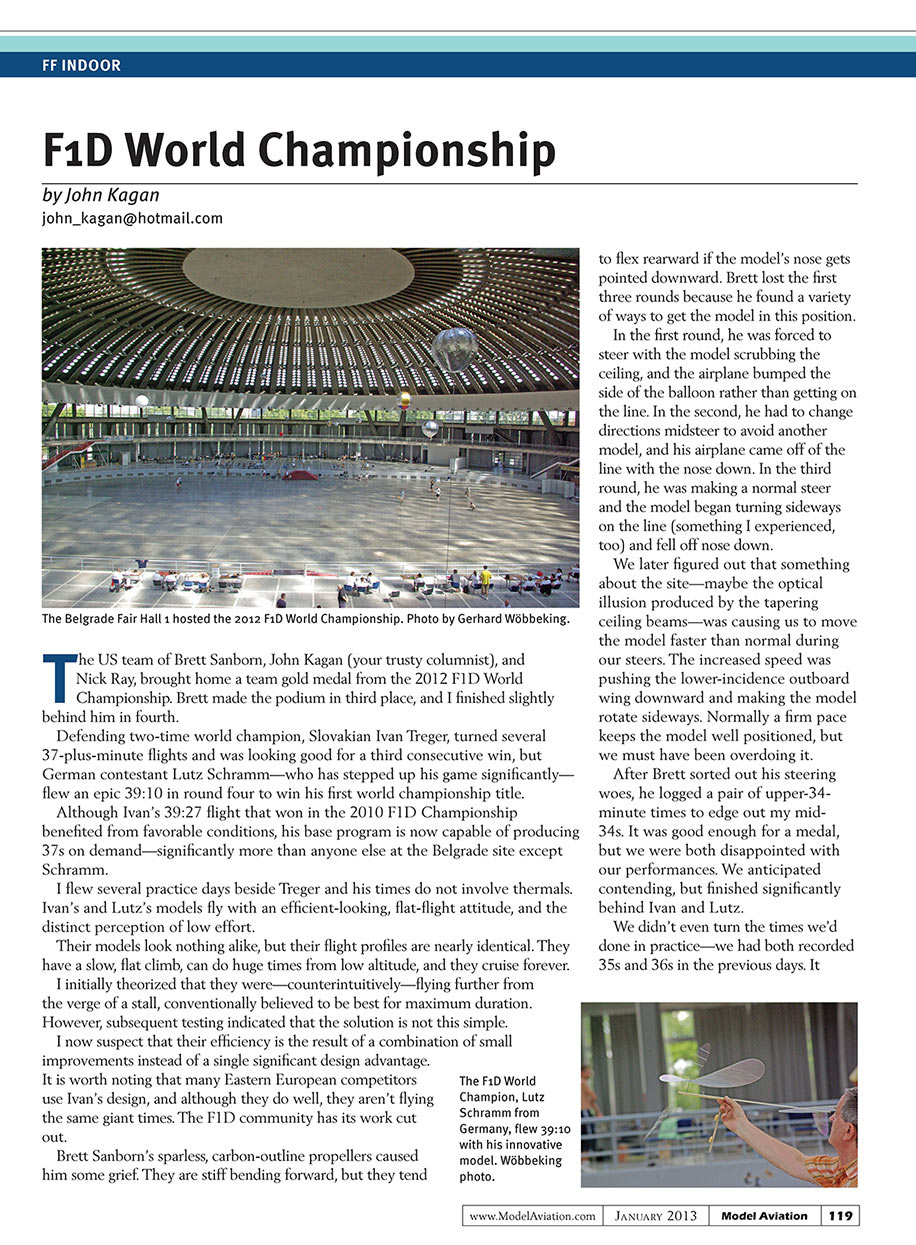
The Belgrade Fair Hall 1 hosted the 2012 F1D World Championship. Photo by Gerhard Wöbbeking.
The US team of Brett Sanborn, John Kagan (your trusty columnist), and Nick Ray, brought home a team gold medal from the 2012 F1D World Championship. Brett made the podium in third place, and I finished slightly behind him in fourth.
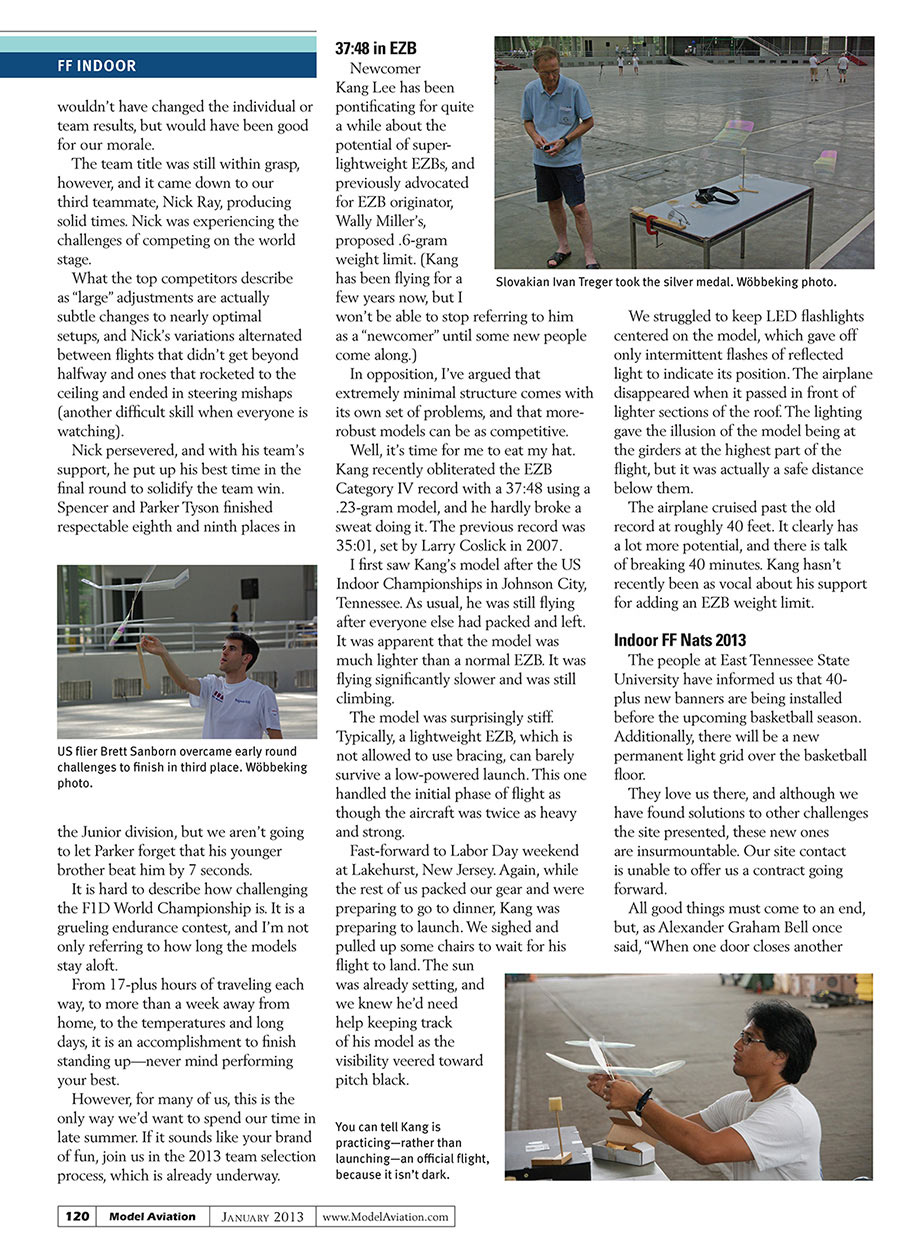
Defending two-time world champion, Slovakian Ivan Treger, turned several 37-plus-minute flights and was looking good for a third consecutive win, but German contestant Lutz Schramm—who has stepped up his game significantly—flew an epic 39:10 in round four to win his first world championship title.
Although Ivan’s 39:27 flight that won in the 2010 F1D Championship benefited from favorable conditions, his base program is now capable of producing 37s on demand—significantly more than anyone else at the Belgrade site except Schramm.
I flew several practice days beside Treger and his times do not involve thermals. Ivan’s and Lutz’s models fly with an efficient-looking, flat-flight attitude, and the distinct perception of low effort.
Their models look nothing alike, but their flight profiles are nearly identical. They have a slow, flat climb, can do huge times from low altitude, and they cruise forever.
I initially theorized that they were—counterintuitively—flying further from the verge of a stall, conventionally believed to be best for maximum duration. However, subsequent testing indicated that the solution is not this simple.
I now suspect that their efficiency is the result of a combination of small improvements instead of a single significant design advantage.
It is worth noting that many Eastern European competitors use Ivan’s design, and although they do well, they aren’t flying the same giant times. The F1D community has its work cut out.
Brett Sanborn’s sparless, carbon-outline propellers caused him some grief. They are stiff bending forward, but they tend to flex rearward if the model’s nose gets pointed downward. Brett lost the first three rounds because he found a variety of ways to get the model in this position.
In the first round, he was forced to steer with the model scrubbing the ceiling, and the airplane bumped the side of the balloon rather than getting on the line. In the second, he had to change directions midsteer to avoid another model, and his airplane came off of the line with the nose down. In the third round, he was making a normal steer and the model began turning sideways on the line (something I experienced, too) and fell off nose down.
We later figured out that something about the site—maybe the optical illusion produced by the tapering ceiling beams—was causing us to move the model faster than normal during our steers. The increased speed was pushing the lower-incidence outboard wing downward and making the model rotate sideways. Normally a firm pace keeps the model well positioned, but we must have been overdoing it.
After Brett sorted out his steering woes, he logged a pair of upper-34-minute times to edge out my mid-34s. It was good enough for a medal, but we were both disappointed with our performances. We anticipated contending, but finished significantly behind Ivan and Lutz.
We didn’t even turn the times we’d done in practice—we had both recorded 35s and 36s in the previous days. the Junior division, but we aren't going to let Parker forget that his younger brother beat him by 7 seconds.
It is hard to describe how challenging the F1D World Championship is. It is a grueling endurance contest, and I'm not only referring to how long the models stay aloft.
From 17-plus hours of traveling each way, to more than a week away from home, to the temperatures and long days, it is an accomplishment to finish standing up—never mind performing your best.
However, for many of us, this is the only way we'd want to spend our time in late summer. If it sounds like your brand of fun, join us in the 2013 team selection process, which is already underway.
37:48 in EZB
Newcomer Kang Lee has been pontificating for quite a while about the potential of super-lightweight EZBs, and previously advocated for EZB originator, Wally Miller's, proposed .6-gram weight limit. (Kang has been flying for a few years now, but I won't be able to stop referring to him as a "newcomer" until some new people come along.)
In opposition, I've argued that extremely minimal structure comes with its own set of problems, and that more-robust models can be as competitive.
Well, it's time for me to eat my hat. Kang recently obliterated the EZB Category IV record with a 37:48 using a .23-gram model, and he hardly broke a sweat doing it. The previous record was 35:01, set by Larry Coslick in 2007.
I first saw Kang's model after the US Indoor Championships in Johnson City, Tennessee. As usual, he was still flying after everyone else had packed and left. It was apparent that the model was much lighter than a normal EZB. It was flying significantly slower and was still climbing.
The model was surprisingly stiff. Typically, a lightweight EZB, which is not allowed to use bracing, can barely survive a low-powered launch. This one handled the initial phase of flight as though the aircraft was twice as heavy and strong.
Fast-forward to Labor Day weekend at Lakehurst, New Jersey. Again, while the rest of us packed our gear and were preparing to go to dinner, Kang was preparing to launch. We sighed and pulled up some chairs to wait for his flight to land. The sun was already setting, and we knew he'd need help keeping track of his model as the visibility veered toward pitch black.
We struggled to keep LED flashlights centered on the model, which gave off only intermittent flashes of reflected light to indicate its position. The airplane disappeared when it passed in front of lighter sections of the roof. The lighting gave the illusion of the model being at the girders at the highest part of the flight, but it was actually a safe distance below them.
The airplane cruised past the old record at roughly 40 feet. It clearly has a lot more potential, and there is talk of breaking 40 minutes. Kang hasn't recently been as vocal about his support for adding an EZB weight limit.
Indoor FF Nats 2013
The people at East Tennessee State University have informed us that 40-plus new banners are being installed before the upcoming basketball season. Additionally, there will be a new permanent light grid over the basketball floor.
They love us there, and although we have found solutions to other challenges the site presented, these new ones are insurmountable. Our site contact is unable to offer us a contract going forward.
All good things must come to an end, but, as Alexander Graham Bell once said, "When one door closes another
FF Indoor
John Kagan
the window opens; but we so often look so long and so regretfully upon the closed door, that we do not see the ones which open for us.
So, let's give the Mini-Dome a respectful period of mourning—it was a fantastic site, and many of us have spent countless Memorial Day weekends under its lights. We enjoyed it for many years, but we now have a compelling reason to find a new location and nothing to regret about leaving the old one.
Your National Free Flight Society (NFFS) Indoor Committee is investigating the Georgia Dome as one potential site. It is big, contains good air, and has a similar driving radius as Johnson City. Keep an eye out for updates as things progress.
Many other sites are feasible as permanent or temporary locations, too. It will be sad to leave Johnson City, but I look forward to finding something fun and new.
A Generous Donation
An anonymous benefactor has donated a large amount of 5/99 rubber to the US F1D program. This vintage has a slight edge over other good Tan II rubber, and will be used to help keep the US program competitive. It will be metered out to Juniors and Seniors on upcoming teams. Speaking for the future team members and the entire program, thank you for your generosity!
On a similar note, I have gotten word from some top-caliber F1B fliers that the latest Super Sport rubber batches have become the weapon of choice for Outdoor events. It is similar in energy capacity to 5/99, but sturdier. In an F1B flyoff round, it is more valuable to have a motor that can be reliably wound to maximum torque than to get the slight performance boost but risk breaking motors and missing the window.
As a result, a considerable amount of 5/99 is suddenly going unused. Calling all F1B pilots and others with a stash of 5/99—one person's trash is another's treasure. Consider putting it on the market; you can buy plenty of Super Sport from the proceeds.
It is worth mentioning that, although 5/99 has proven to be great for Indoor FF, it is not a silver bullet. It won't suddenly transform a poorly built or trimmed model into a contender.
There is a tendency for people to see what the contest winners are using and doing, and then believe that their methods are required to participate in the event. Sparsely carbon propellers, ultralight EZBs, the rarest batch of rubber—these provide a slight advantage, but are only useful if the basics are in place. Trim, winding, and good construction techniques offer much larger gains.
Don't be discouraged if you don't yet have all of the cool tools and supplies, and don't spend all your time obsessing about difficult details when you could instead be flying, learning, and having fun. Indoor FF remains one of the most accessible and enthralling activities you can enjoy!
SOURCES:
NFFS blog http://nffsblog.wordpress.com
NFFS www.freeflight.org
2013 F1D Team Selection Program http://groups.yahoo.com/group/USAF1D
Transcribed from original scans by AI. Minor OCR errors may remain.

