
FREE FLIGHT INDOOR
Bud Tenny, Box 830545, Richardson TX 75083
THREE-VIEW Requirements: Record applications require a three-view of the model. The three-view must include enough detail to allow a reviewer to verify the model's legality. Prop diameter, pitch, and blade outline are required. A plan view of the model should have all major dimensions, including dihedral. There should be enough information for others to duplicate the model or compare their model to yours.
Note: although the Contest Director must process the model, it is the contestant's responsibility to furnish an adequate three-view.
Indoor List: For approximately three years, I have maintained an E-mail list of persons interested in indoor flying. At present, there are 117 fliers who receive news of indoor happenings as soon as I get the word.
Some time back, there were more than 140 names on the list, but the list was compromised by a crashed server. If you were originally on the list and no longer receive mailings, or if you would like to join the list, send an E-mail request to [email protected] and I'll add your name to the distribution list.
Is Your Club Lucky? If your club has a newsletter, you are ahead of clubs that don't! I honor the editors of all the club newsletters I get; they work long hours and don't get nearly enough article contributions to make their job easier. They also don't get many models built!
This is a salute to all those club newsletter editors, no matter how small or large an issue they put out. When the next issue of your club newsletter arrives, think about how you can help the editor with future issues.
A previous column presented a method of laminating balsa, but I had lost track of which newsletter published the article. Dan O'Grady, editor of SAM 86 Speaks, sent word that the piece on laminating wingtips by Jim Anderson was published in that newsletter.
Dan does an exceptional job with SAM 86 Speaks, presenting a good mix of news, humor, and how-to pieces. Thanks, Dan!
Triplets: At the 1999 USIC, Steve Gardner won Limited Pennypane with 16:34—a state record for the class. I asked Steve for some comments about the triplets featured on the model:
"As to the Bent Penny and its wingtips, I have found that the triplets allow the wing to use much less dihedral without any stability problems. It is sort of like a flat wing of max legal area with the stability coming from area not counted in the max area/span rule. I am sure that there are some small benefits from the reduction of the wingtip vortices as well, and your idea of area below the wing surface might bring additional benefits.
"The tips on the Bent Penny were sized by the needed area to give the proper dihedral effect. At the speeds these models fly, I expect that the tips could be smaller and still reduce drag."
Rubber Motor Storage: Several years ago we had a big flap over rubber motors suffering heavy deterioration between seasons, or even between flying sessions. The problem was solved by changing the type of envelope used for storing motors.
Tony Italiano reported the following in an issue of Free Flight, credited to Flightmasters. This came by way of correspondence from Boyd Felstead of Australia.
"There has been concern by rubber modelers, especially indoor ones, of rubber deteriorating when stored in plastic or paper envelopes. The Australians have found that the culprit is polyvinyl chloride (PVC) which is outgassing vinyl chloride (VC) from the plastic bag. VC is bad for rubber, as well as being a carcinogenic element (which may be disputed).
"Some plastic bags are made from PVC and polyethylene. Manufacturers of bags may call their bags, say, polyethylene or polythene or polyolefin, yet there are dozens of variations in the recipe. Bags made from polyester, however, are chemically inert and will not harm rubber. Polyester bags are called 'oven' bags which melt at approximately 280°C or 536°F. It is welded shut. Rubber should be stored in polyester bags, but do not overlap with polythene bags, as the molecules of VC gas will penetrate through the polyester bag and 'chew' up your selected rubber!
"A simple test is that polyethylene smells like a burnt candle when ignited, whereas PVC has an acid smell when burned."
There is an alternative, translucent paper envelopes (called cassine or glassine) used by stamp collectors. They are available from stamp shops and the postal service. So, store your rubber in oven bags or glassine, whichever you prefer.
Steering techniques
Steering an indoor model is either a necessary strategy or an emergency action, depending on the circumstances. Steering is often undertaken with trepidation, usually too little and too late. Any serious indoor flier, regardless of which events are involved, needs to know a lot about steering.
Before steering poles were permitted, steering was done only with balloons.
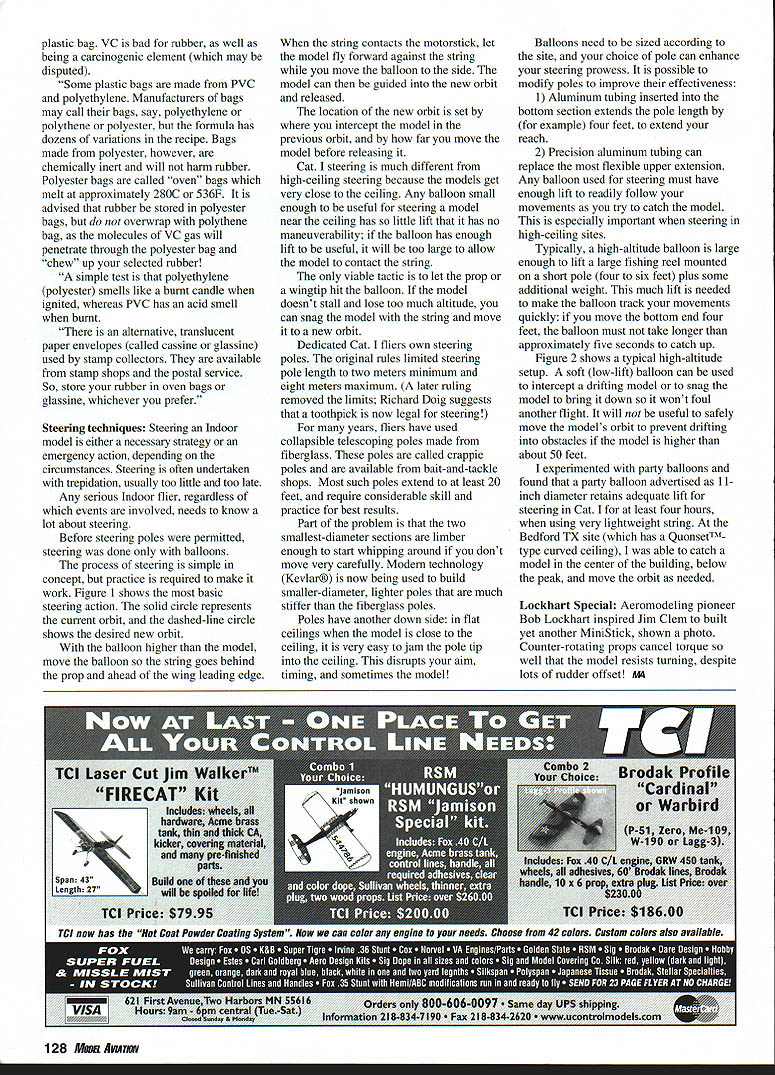
The process of steering is simple in concept, but practice is required to make it work. Figure 1 shows the most basic steering action. The solid circle represents the current orbit, and the dashed line circle shows the desired new orbit.
With the balloon higher than the model, move the balloon so the string goes behind the prop and ahead of the wing leading edge.
When the string contacts the motorstick, let the model fly forward against the string while you move the balloon to the side. The model can then be guided into the new orbit and released.
The location of the new orbit is set by where you intercept the model in the previous orbit, and by how far you move the model before releasing it.
Cat. I steering is much different from high-ceiling steering because the models get very close to the ceiling. Any balloon small enough to be useful for steering a model near the ceiling has so little lift that it has no maneuverability; if the balloon has enough lift to be useful, it will be too large to allow the model to contact the string.
The only viable tactic is to let the prop or a wingtip hit the balloon. If the model doesn't stall and lose too much altitude, you can snag the model with the string and move it to a new orbit.
Dedicated Cat. I fliers own steering poles. The original rules limited steering pole length to two meters minimum and eight meters maximum. (A later ruling removed the limits; Richard Doig suggests that a toothpick is now legal for steering!)
For many years, fliers have used collapsible telescoping poles made from fiberglass. These poles are called crappie poles and are available from bait-and-tackle shops. Most such poles extend to at least 20 feet, and require considerable skill and practice for best results.
Part of the problem is that the two smallest-diameter sections are limber enough to start whipping around if you don't move very carefully. Modern technology (Kevlar®) is now being used to build smaller-diameter, lighter poles that are much stiffer than the fiberglass poles.
Poles have another downside: in flat ceilings when the model is close to the ceiling, it is very easy to jam the pole tip into the ceiling. This disrupts your aim, timing, and sometimes the model!
Balloons need to be sized according to the site, and your choice of pole can enhance your steering prowess. It is possible to modify poles to improve their effectiveness:
- Aluminum tubing inserted into the bottom section extends the pole length by (for example) four feet, to extend your reach.
- Precision aluminum tubing can replace the most flexible upper extension.
Any balloon used for steering must have enough lift to readily follow your movements as you try to catch the model. This is especially important when steering in high-ceiling sites.
Typically, a high-altitude balloon is large enough to lift a large fishing reel mounted on a short pole (four to six ft.) plus some additional weight. This much lift is needed to make the balloon track your movements quickly; if you move the bottom end four feet, the balloon must not take longer than approximately five seconds to catch up.
A soft (low-lift) balloon can be used to intercept a drifting model or to snag the model to bring it down so it won't foul another flight. It will not be useful to safely move the model's orbit to prevent drifting into obstacles if the model is higher than about 50 feet.
I experimented with party balloons and found that a party balloon advertised as 11-inch diameter retains adequate lift for steering in Cat. I for at least four hours when using very lightweight string. At the Bedford, TX site (which has a Quonset/flat-type curved ceiling), I was able to catch a model in the center of the building, below the peak, and move the orbit as needed.
Lockhart Special
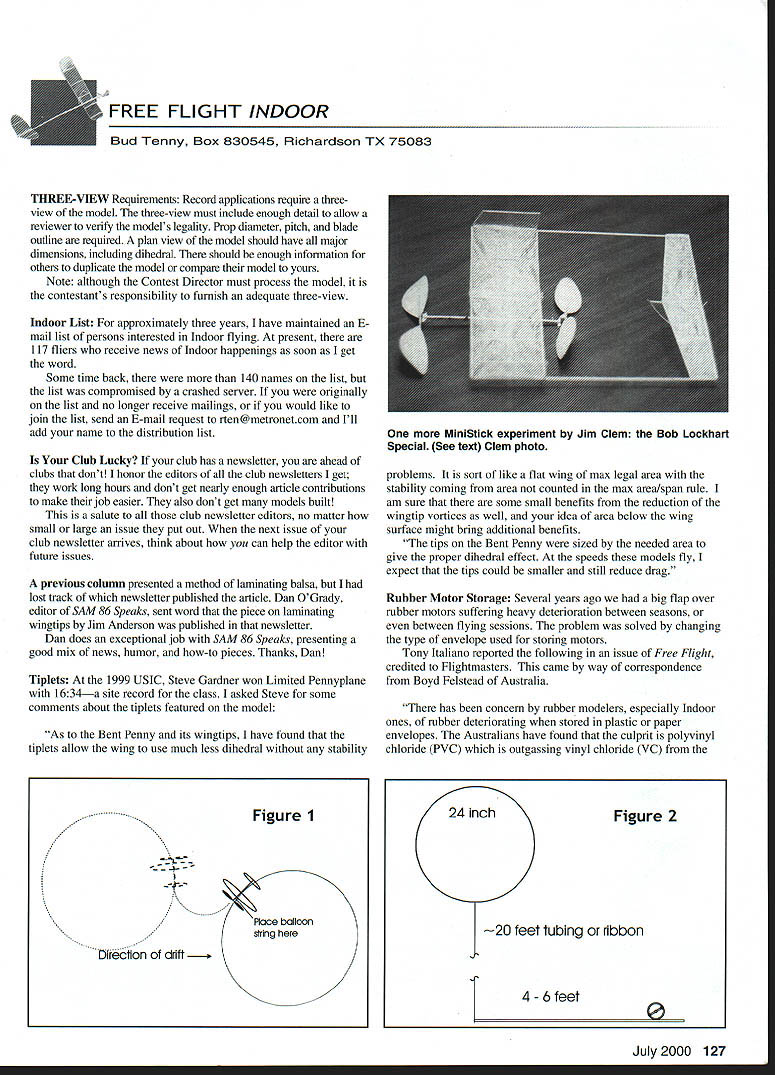
Aeromodelling pioneer Bob Lockhart inspired Jim Clem to build yet another MiniStick, shown in a photo. Counter-rotating props cancel torque so well that the model resists turning, despite lots of rudder offset! MA
Transcribed from original scans by AI. Minor OCR errors may remain.

