
FF Indoor
Bud Tenny, Box 830545, Richardson TX 75083
Book About Balsa
Joseph Maxwell, a modeling pioneer from Scotland, has written a definitive book about balsa: Balsa for Indoor Models.
I have reviewed this book, and I believe it pretty well tells the whole story. The book is softcover, 48 pages, 5.65 x 8.25 inches, and well worth the $15 US (bills, not a check). Lift/Drag Publications, 11 Windsor Pl., Stirling FK8 2HY Scotland; E-mail: [email protected].
Science Olympiad
A science-oriented activity was established in Delaware to improve the science curriculum for elementary schools. An offshoot of that activity, known as Science Olympiad (SO), is becoming an opportunity for indoor fliers everywhere.
The Science Olympiad activity embraces many different science-oriented topics and develops student skills in a variety of contest activities. An indoor model class known as Wright Stuff is the golden opportunity available to indoor fliers (indoor especially, but mentors are coming from many modeling groups). Nationwide, the official total involvement tops 1,000,000 students!
Each team is comprised of 15 students and 1 adult coach. From each team at least two students fly in the Wright Stuff event. Most teams have additional coaches and alternates for each event. This comes to a conservative estimate of 37,000 participants.
Tom Sanders, SO National Supervisor, reports that approximately two million additional students and teachers (not SO members) are using the SO rules as part of their curriculum. It seems that Wright Stuff has been a positive attraction for new schools joining up.
A major stumbling block for these students and teachers is that almost none of them have any experience with any kind of model airplanes, let alone models suitable for flying indoors. This is where we, as mentors, can lend a guiding hand.
The rules for the Wright Stuff "indoor model" specify a relatively heavy 50 cm airplane. Thankfully, model builders (as opposed to ARF fliers) have common skills that help the student build models that are vastly improved over those built by SO teams without experienced mentors.
Tom Sanders says, "My additional comment would be that we need the support of all modelers and not just Free Flighters to become mentors. The more we get, the faster all the teams will be up to speed competing from an equal playing (flying?) field. I can't stress how vast an opportunity this is for all of model aviation, the AMA, and the Special Interest groups."
Tom further noted that at the 2000 Science Olympiad National contest, held May 18, flight times of three minutes or more likely set records.
How Do I Get Involved?
Tom Sanders offers the following suggestions:
- The easiest and most direct route is to call local schools and ask. Don't be afraid to ask if the staff knows of any in their area that are members. Science Olympiad is affiliated with school science departments, and the Technology Student Association (TSA) is affiliated with school technology departments.
- Both organizations have websites. SO: soinc.org; TSA: tsawww.org. Neither lists schools, but contacting the state director should get you noticed by a local member.
- There is also a site run by Thayer Syme that lists teams needing help and a list of willing mentors: http://sirius.com/~thayer/sotsa/assist.html.
- Glenn Davison also has a relevant site at http://people.mediacone.net/indoor/olympiad.htm.
The few mentors we have so far have willingly been assisting many schools. Having more mentors would certainly relieve the loads that some folks are already carrying.
SO Helpers
In the Cleveland, Ohio area the Cleveland Clowns are a group of well-known indoor and FF participants: Vern Hacker, Don Slusarczyk, Chuck Slusarczyk, Larry Loucka, Larry Mizik, Tom Sova, Mike Zand, Vern Neff, Steve Gribling, Marge and Warren Weisenbach.
The Clowns have been quite active in SO, and in addition to mentoring SO participants, at least one of their proteges has progressed into AMA activities. Ben Saks, a senior-age flier, has a Catapult Glider record application in process. Good work, Clowns!
ECIM News
The East Coast Indoor Modelers (ECIM), a very active group based at Lakehurst (NJ) Naval Air Station, continues with their active flying schedule at Hangar #1.
However, Gary and Kit Underwood and Doug Barber have devoted more of their lives to management of the group than could reasonably be expected. In their place, three individuals have agreed to take over the organization: Rob Romash, Sal Cannizzo, and Don Post.
- Rob is an avid indoor enthusiast; his energies are exactly what this club needs to carry them for the next several years.
- Sal's experience with indoor has placed him on the US Indoor FF team in past years.
- Don's current interest is with indoor RC; Sal and Don Post manage the Indoor RC group sponsored by ECIM in Hangar #1.
The East Coast Indoor Modelers club has been in existence since 1926. Members of this group have been, and continue to be, leaders in advancing the state of indoor activity. All of us, not just indoor fliers near the historic Hangar #1, owe the club and its leaders a great debt.
Always, in the back of my mind, I carry the desire to fly at Lakehurst again. Thanks to ECIM, it is there and available when I can make it.
Significant Design
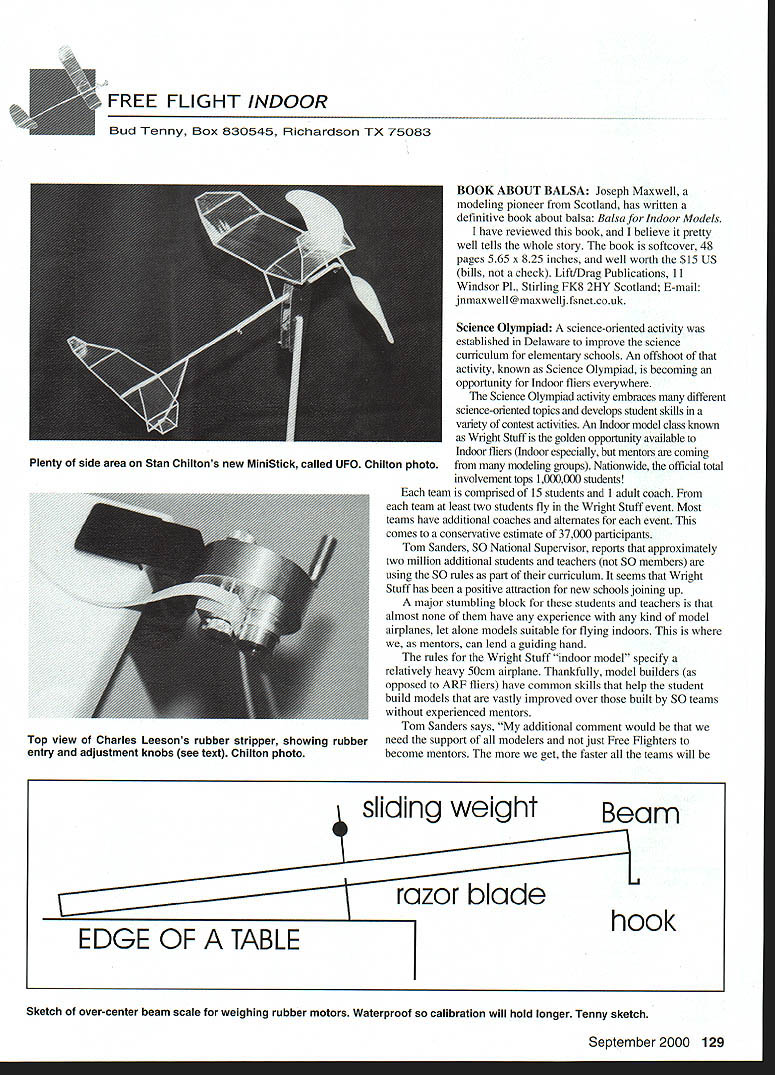
Stan Chilton has designed a very capable MiniStick model that he has named UFO. In flights posted on successive weekends in a 34-foot-high Florida site, Stan posted flights of 10:44 and 11:00. These times are good, but more important is that the model moves out on launch, climbing rapidly with high torque winds.
Part of the success comes from the fact that the model has a lot of side area that contributes to the absence of the "spindizzy" antics of most MiniStick models.
Some fliers simply launch their models into vertical flight; the models helicopter up until torque drops to a level the model can handle. A few fliers have quit flying MiniStick because of these antics; here is the cure!
Weighing .6g F1D Motors
Several fliers have expressed concern about weighing motors for the new-rule F1D models. Here's one reasonable, easy solution.
Make a .6 g standard weight and an evaporation balance. Waterproof the balance so the calibration will hold for several hours, and calibrate it in the morning. The vertical center of gravity (CG) of the balance should be above or below the pivot line just barely to make it go. If the lubed motor tips the beam when you hang it on, but won't tip it back if you push the beam over-center again, you're right there.
Figure 1 (not included) shows a sketch of the beam balance. It pivots on a razor blade, and the sensitivity of the over-center tip is adjusted by moving the sliding weight up or down until the response is just right. With an accurate calibration weight, the accuracy can be very good.
New Rubber Stripper
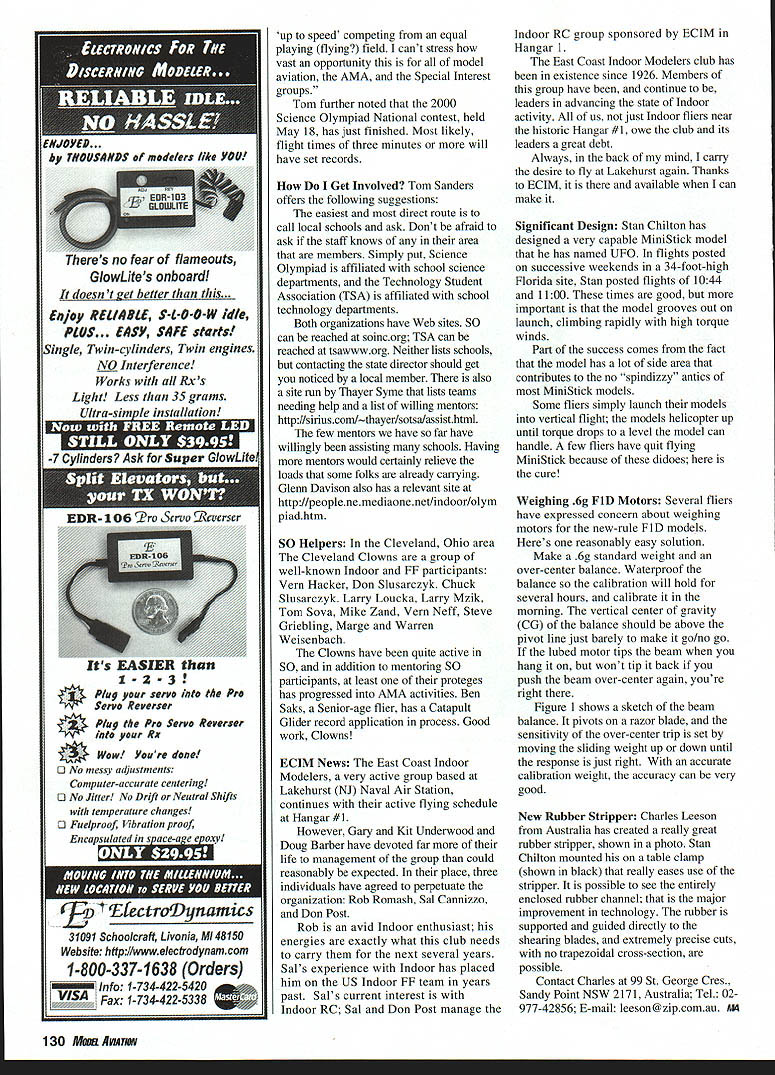
Charles Leeson from Australia has created a very good rubber stripper, shown in a photo. Stan Chilton mounted his on a table clamp that really eases use of the stripper. It is possible to see the entirely enclosed rubber channel: that is the major improvement of the stripper. The rubber is supported and guided directly to the shearing blades, and extremely precise cuts, with a trapezoidal cross-section, are possible.
Contact Charles at 99 St. George Cres., Sandy Point NSW 2711, Australia; Tel.: 02-977-42856; E-mail: [email protected].
Transcribed from original scans by AI. Minor OCR errors may remain.

