
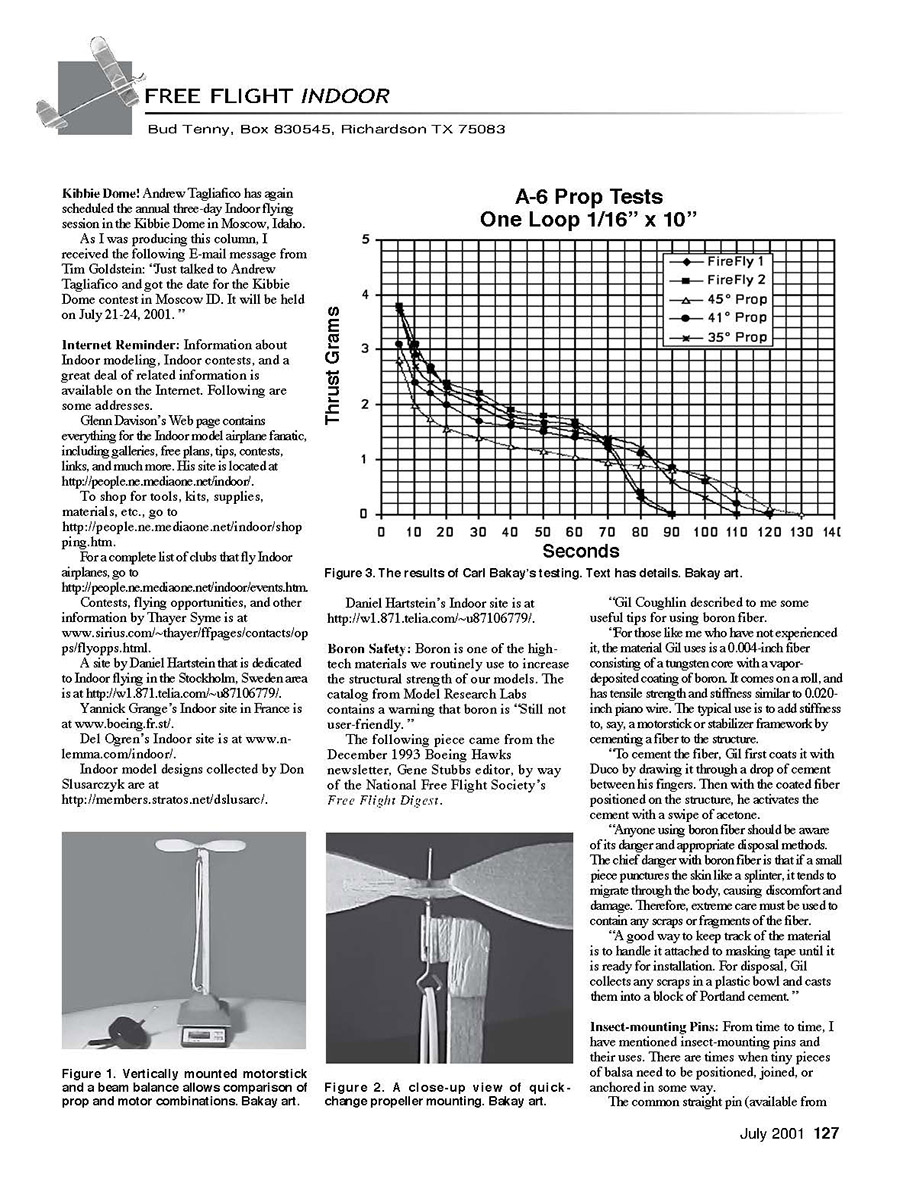
FF Indoor
Bud Tenney, Box 830545, Richardson TX 75083
Kibbie Dome
Andrew Tagliafico has again scheduled the annual three-day indoor flying session in the Kibbie Dome in Moscow, Idaho.
As I was producing this column, I received the following e-mail message from Tim Goldstein: "Just talked to Andrew Tagliafico and got the date for the Kibbie Dome contest in Moscow ID. It will be held on July 21-24, 2001."
Internet Reminder
Information about indoor modeling, indoor contests, and a great deal of related information is available on the Internet. Following are some addresses.
- Glenn Davison's web page contains everything for the indoor model airplane fanatic, including galleries, free plans, tips, contests, links, and much more: http://people.ne.mediaone.net/indoor/
- To shop for tools, kits, supplies, materials, etc.: http://people.ne.mediaone.net/indoor/shopping.htm
- For a complete list of clubs that fly indoor airplanes: http://people.ne.mediaone.net/indoor/events.htm
- Contests, flying opportunities, and other information by Thayer Syme: www.sirius.com/~thayer/fpages/contacts/ops/flyopps.html
- A site by Daniel Hartstein dedicated to indoor flying in the Stockholm, Sweden area: http://w1.871.telia.com/~u87106779/
- Yannick Grange's indoor site in France: www.boeing.fr.st/
- Del Ogren's indoor site: www.n-lemma.com/indoor/
- Indoor model designs collected by Don Slusarczyk: http://members.stratos.net/dslusarcl/
Figures
- Figure 1. Vertically mounted motorstick and a beam balance allows comparison of prop and motor combinations. (Bakay art.)
- Figure 2. A close-up view of quick-change propeller mounting. (Bakay art.)
- Figure 3. The results of Carl Bakay's testing. Text has details. (Bakay art.)
Boron Safety
Boron is one of the high-tech materials we routinely use to increase the structural strength of our models. The catalog from Model Research Labs contains a warning that boron is "still not user-friendly."
The following piece came from the December 1993 Boeing Hawks newsletter, Gene Stubbs editor, by way of the National Free Flight Society's Free Flight Digest.
"Gil Coughlin described to me some useful tips for using boron fiber.
For those like me who have not experienced it, the material Gil uses is a 0.004-inch fiber consisting of a tungsten core with a vapor-deposited coating of boron. It comes on a roll, and has tensile strength and stiffness similar to 0.020-inch piano wire. The typical use is to add stiffness to, say, a motorstick or stabilizer framework by cementing a fiber to the structure.
To cement the fiber, Gil first coats it with Duco by drawing it through a drop of cement between his fingers. Then the coated fiber is positioned on the structure; he activates the cement with a swipe of acetone.
Anyone using boron fiber should be aware of its danger and appropriate disposal methods. The chief danger with boron fiber is if a small piece punctures the skin like a splinter, it tends to migrate through the body, causing discomfort and damage. Therefore, extreme care must be used to contain any scraps or fragments of the fiber.
A good way to keep track of the material is to handle it attached to masking tape until it is ready for installation. For disposal, Gil collects any scraps in a plastic bowl and casts them into a block of Portland cement."
Insect-mounting Pins
From time to time, I have mentioned insect-mounting pins and their uses. There are times when tiny pieces of balsa need to be positioned, joined, or anchored in some way.
The common straight pin (available from hobby suppliers) is useful for these small tasks; it can act as a temporary clamp, alignment post, or anchor while glue dries.
Propeller and Motor Testing Method
Here is a simple way to test all sorts of indoor propeller/rubber combinations before you get to the flying site. Not only is this a good method for comparing different prop designs, but it also gives a good indication of flight duration.
- Test rig:
- For the A-6 model, use a hard balsa motorstick made with a 3/16-inch square front end drilled out to 1/16 inch and fitted with a slot for the prop shaft so different designs can be interchanged quickly.
- Fashion a soft foam pyramid base with a slit from top to bottom to hold the motorstick. Glue this to a 1/8-inch plywood base for weight and apply double-stick tape to the bottom to prevent the assembly from spinning off the scale during a test (see Figure 1).
- Use a quick-change prop mounting so props can be swapped rapidly (see Figure 2).
- Test procedure:
- Install the prop and a 10-inch loop of 1/16-inch rubber.
- Adjust the weight with clay to exactly 20.0 grams.
- Wind the motor to 62 winds with a 16:1 winder to give 1,000 turns.
- Count seconds using a wall clock and record the weight every five seconds as the prop unwinds. The decrease in weight from 20 grams is the thrust.
- Observations:
- The Ikara six-inch plastic prop that comes with the Firefly/Butterfly models was drilled out to 7/32-inch and used as a control. On the Excel graph (see Figure 3), this prop gives repeatable results over a 90-second flight time.
- The flat A-6 balsa props ran for 110 to 130 seconds, depending on pitch.
- When the area under the curves was calculated to find total thrust in gram-seconds, the results were surprisingly uniform, except for the 45-degree pitch (shown on the plan), which was the least efficient.
- Modern thinking on the A-6 suggests 38 degrees is about optimum for combining good climbing thrust with long flight times.
- Test results (Propeller — Total Gram–Seconds — Duration):
- "Firefly" 1 — 145 — 90
- "Firefly" 2 — 152 — 90
- 35-degree A-6 — 157 — 110
- 41-degree A-6 — 151 — 120
- 45-degree A-6 — 128 — 130
Although I have not tried it, this method should also work for Hangar Rat seven-inch flat-bladed props and MiniStick too.
Transcribed from original scans by AI. Minor OCR errors may remain.

