
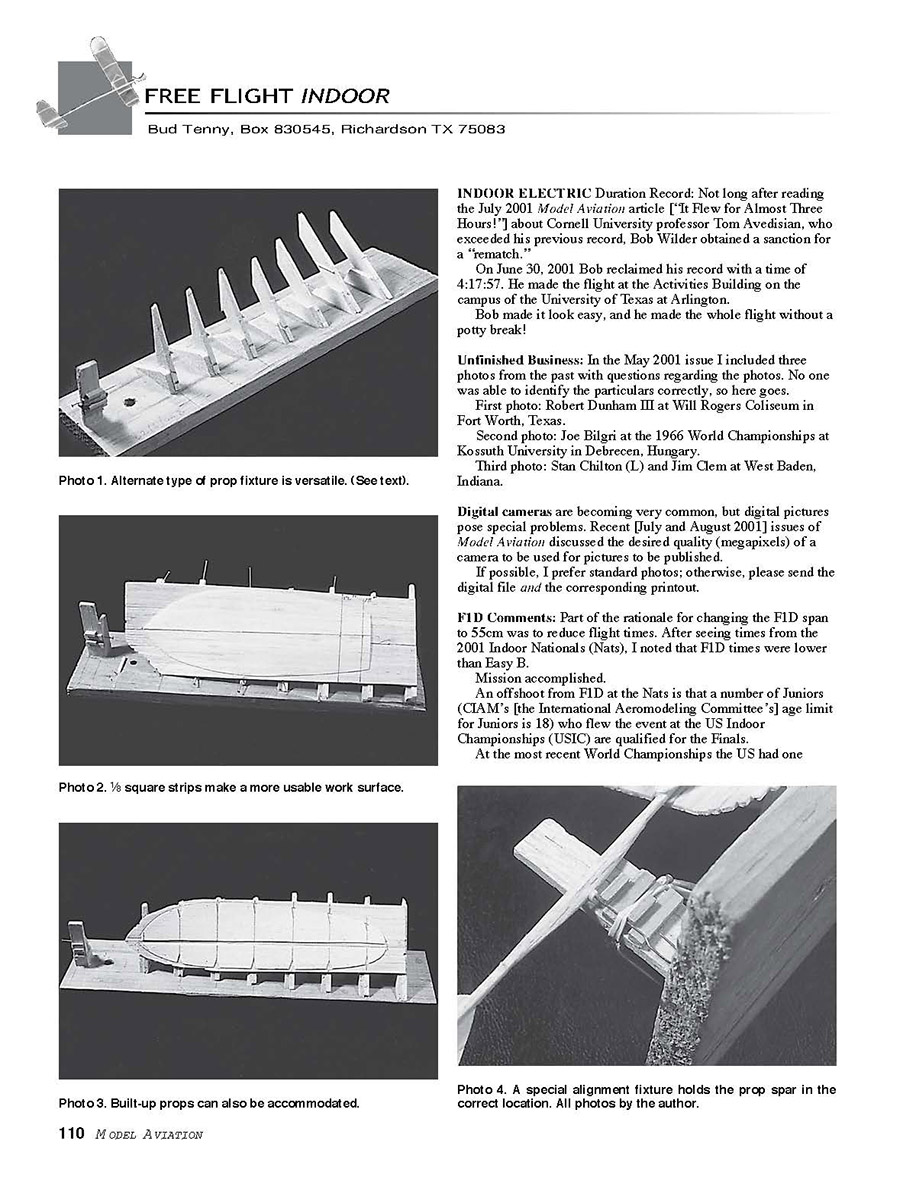
FF Indoor
INDOOR ELECTRIC Duration Record:
Not long after reading the July 2001 Model Aviation article "It Flew for Almost Three Hours" about Cornell University professor Tom Avedisian, who exceeded his previous record, Bob Wilder obtained a sanction for a "rematch."
On June 30, 2001 Bob reclaimed his record with a time of 4:17:57. He made the flight at the Activities Building on the campus of the University of Texas at Arlington.
Bob made it look easy, and he made the whole flight without a potty break!
Unfinished Business:
In the May 2001 issue I included three photos from the past with questions regarding the photos. No one was able to identify the particulars correctly, so here goes.
First photo: Robert Dunham III at Will Rogers Coliseum in Fort Worth, Texas.
Second photo: Joe Bilgri at the 1966 World Championships at Kossuth University in Debrecen, Hungary.
Third photo: Stan Chilton (L) and Jim Clem at West Baden, Indiana.
Digital cameras are becoming very common, but digital pictures pose special problems. Recent [July and August 2001] issues of Model Aviation discussed the desired quality (megapixels) of a camera to be used for pictures to be published.
If possible, I prefer standard photos; otherwise, please send the digital file and the corresponding printout.
F1D Comments:
Part of the rationale for changing the F1D span to 55cm was to reduce flight times. After seeing times from the 2001 Indoor Nationals (Nats), I noted that F1D times were lower than Easy B.
Mission accomplished.
An offshoot from F1D at the Nats is that a number of Juniors (CIAM's [the International Aeromodeling Committee's] age limit for Juniors is 18) who flew the event at the US Indoor Championships (USIC) are qualified for the Finals.
At the most recent World Championships the US had one Junior entrant; now there are plans to hold a separate Junior qualification series.
There will be a new World Championships especially for Juniors, so the US will field a Junior and a Senior team.
Science Olympiad (SO) at the Nats:
The following information was furnished by Vernon Hacker.
"The Science Olympiad was attended by 15 kids who flew in three events.
"SO models must weigh 10 grams and are allowed two grams of rubber for the standard event. For the second event, they were allowed unlimited rubber to fly in the main arena. Finally, there was an unlimited mass launch.
"Juniors sponsored by the Cleveland Clowns did very well. The mass launch was won by Dave Rigotti Jr., who just barely beat Brian Johnson by a couple of seconds. Brian's airplane dead-sticked and the rubber came off the rear hook, causing a drive that lost the contest. Dave also won the middle-school contests."
Hand-Launched Glider (HLG) at the Nats:
Jim Buxton won HLG by a wide margin. Lee Hines congratulated Jim, noting that Jim was approaching the ability to post the "magic" time of 1:30.
Jim had the following comments.
"I left USIC last year with the goal of 1:25 in mind. I built two new gliders and tested at Buffalo, New York in May.
"Buffalo is a tight building, no seats around the edges to push the walls out to give one a safety net. I worked up to 1:24.7, just missing the observation decks there and put them away for Johnson City [TN].
"Johnson City was different this year outside, only in the 60s and raining. Did it change the air? Who knows?
"Bernie was down from 1:14 to 1:07. I was feeling good and got up to 1:22.2, still with a slight little stall at the top, maybe two or three feet. I felt good about that and felt I proved last year was no fluke.
"I started messing with my newer gliders then, which were pretty green. I got my biggest new glider out, and it was way off on the decalage, not sure how. Anyway I finally got it settled in somewhat, but I really needed to remove, shim, and replace the stab.
"By the time I went back to my best glider, the 'snap' in my arm was gone. I did about 12 flights in a row of 1:17-1:18, and I know my altitude had dropped.
"So I won by a wide margin this year (1:22.2 and 1:21.3, I think to Bernie's 1:06 and 1:07), but did not crack the 1:25. I think I was closer this year than last; I just did not get the best rollouts on the same throws with my best altitude. It looks like I will have to wait another year to find out.
"I wish I had access to a good blimp hangar on a regular basis. In the meantime, I must force myself to remember that goal every day and work toward it every day.
"This year I have a new strategy. I feel my gliders are good; I do not have much improvement left in them. I do, however, have altitude left at the ceiling to use. I also have 360-some days to get my arm into shape for five more feet.
"I did not work nearly as hard this past year as I did the four months prior to USIC 2000, when I heard Len Surtees would be here to do 90 seconds. I pushed my best from 1:16 to 1:23 that year.
"I need to focus on improving strength and doing that again. I rarely worked out and exercised this year, which is a bad testimony of work ethic, but perhaps an untapped resource for those extra seconds. I have come too far to fall just a few seconds short.
"In an interesting side note, a man named Jim Lewis showed up from Georgia this year. He is a big-time glider guy from the '70s; one year he won A-2, A-1, and HLG all at the same Nats.
"He built my NXT-3 from plans and said he loves it. He placed third at USIC with flights in the 65-second range. His glider was a bit heavy—around 23 grams. He decided to enter it in Catapult and added a launch hook.
"I saw him launch the second flight (two loops of 3-1/2-inch) and saw it hit a table at 1:22. I think he ended up bouncing it into a speaker and placing fourth, just behind three Buddenbohm-style Sweep Up designs. I firmly believe this glider will do the time now; it just needs a few feet more altitude.
"So to sum up the contest, I won. Am I happy? Not really. If I am happy now at 1:20s, I may as well give up chasing the Holy Grail of Indoor Hand-Launched Glider right now (that is what I have called the 90-second flight for years), but I figure at 28 I still have some more years left to chase it."
Indoor Propellers:
The propeller is almost the most important part of an Indoor model and half of the most important part: the prop/rubber combination.
Any indoor model of competitive weight and in reasonable trim will do well as long as the airframe is stiff enough to hold adjustments. From that point, the prop/rubber combination makes the difference.
Basic prop theory begins with the definition of pitch. The formula—pitch (of any blade element) = 3.1416 x tan (angle) x diameter—can be illustrated by solving it for the blade angle at each diameter.
Pitch = 20 inches Diameter (inches) / Blade Angle (degrees) 2 / 72.6 4 / 57.9 6 / 46.7 8 / 38.5 10 / 32.5 12 / 27.9 14 / 24.4 16 / 21.7
These blade angles are created automatically when the traditional carved block is made to the proper dimensions. Balsa is normally used for the block, but balsa blocks are very expensive, and one is needed for each pitch you need.
Photo 1 shows an alternate prop form. The required blade angle is created for each station, and the use supports are aligned on a block as shown.
The actual work surface is built up using 1/8 square strips, as shown in Photo 2. The block in Photo 2 has a cambered overlay that serves as a pattern to mold all-balsa blades.
Photo 3 shows a form used to assemble built-up blades. This fixture allows the blades to be built in final form, avoiding the structural stresses generated when blades are built flat and re-formed on the prop block.
Photo 4 shows how the prop spar is supported. The location of this support is critical; it must be aligned exactly so the spar contacts the work surface exactly.
The spar can be positioned higher or lower as needed, to match the requirements of the blade outline; this mount ensures that identical blades have proper alignment and length. MA
Transcribed from original scans by AI. Minor OCR errors may remain.

