
Design brilliance: Clive Gamble's Camel
This was a great year for outdoor flying, because the weather from May to October was mostly sunny, dry, and not too windy. It left us with many splendid memories as we shift to what others call winter but we call the "building season."
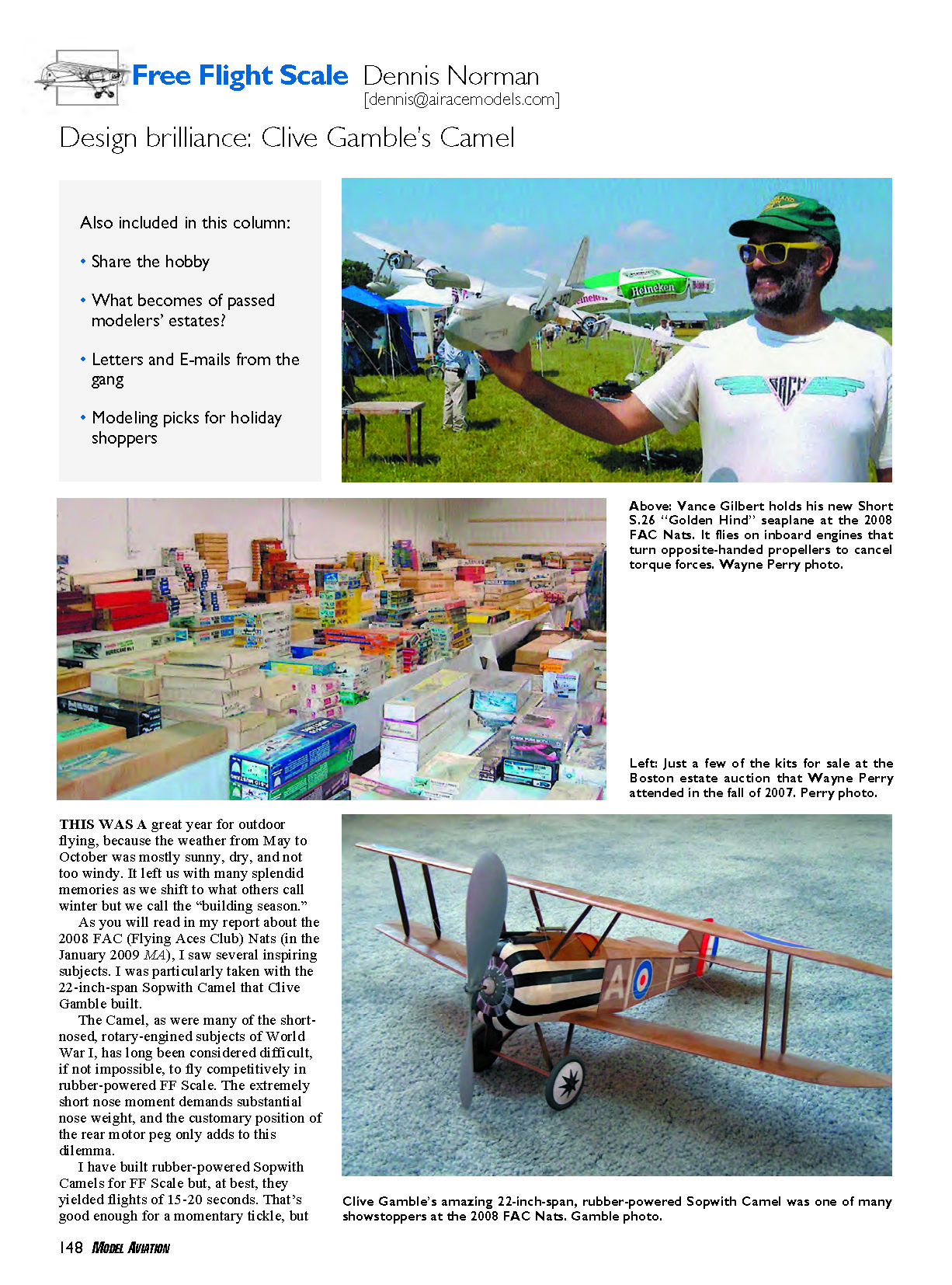
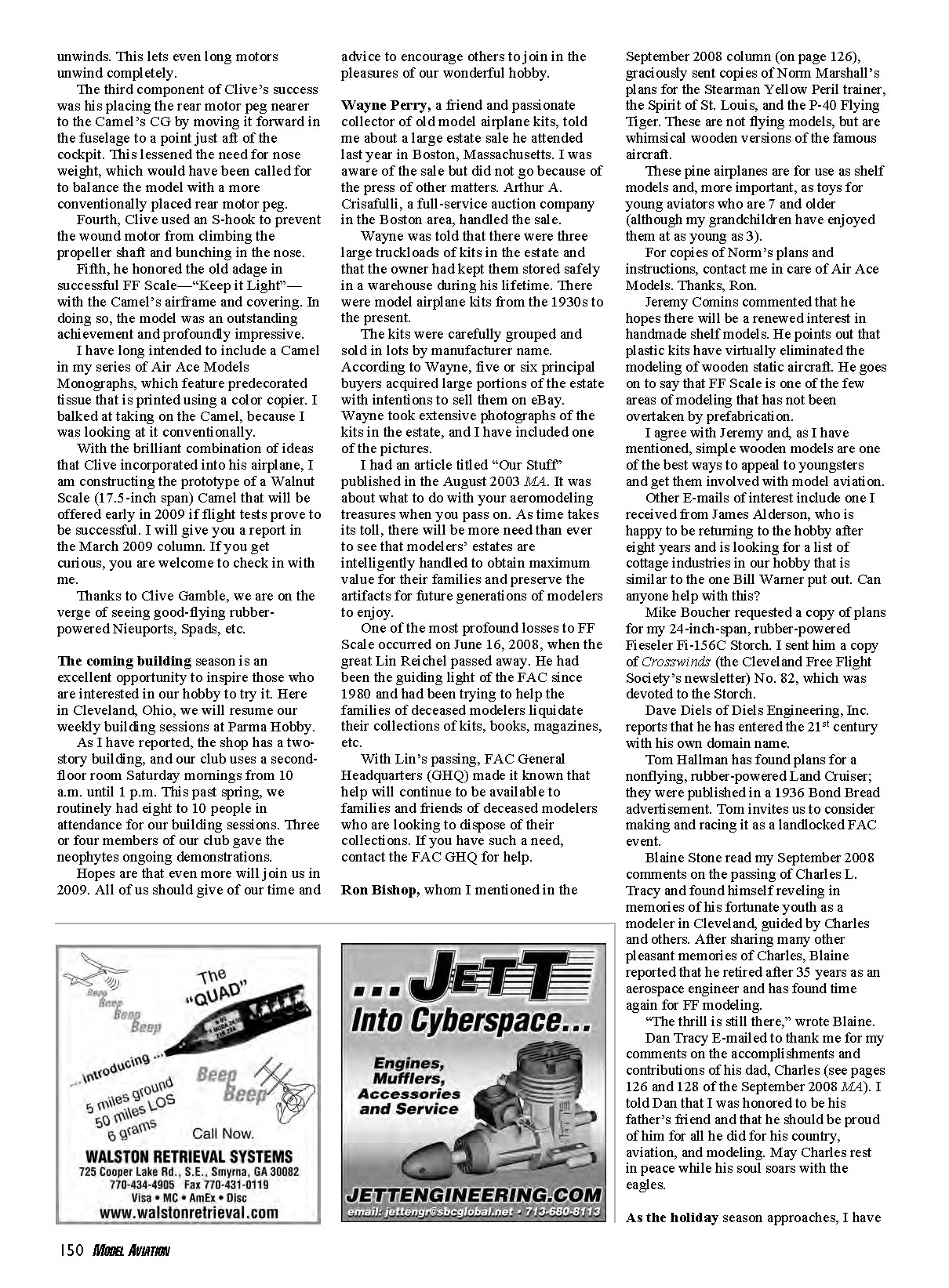
As you will read in my report about the 2008 FAC (Flying Aces Club) Nats (in the January 2009 MA), I saw several inspiring subjects. I was particularly taken with the 22-inch-span Sopwith Camel that Clive Gamble built.
The Camel, as were many of the short-nosed, rotary-engined subjects of World War I, has long been considered difficult, if not impossible, to fly competitively in rubber-powered FF Scale. The extremely short nose moment demands substantial nose weight, and the customary position of the rear motor peg only adds to this dilemma. I have built rubber-powered Sopwith Camels for FF Scale but, at best, they yielded flights of 15–20 seconds. That's good enough for a momentary tickle, but in no way adequate for the duration needed to win a mass launch or other competitive event.
Clive had his new Camel at this year’s FAC Nats and got flights up to a jaw-dropping 1 minute and 45 seconds. He did so despite the fact that the model had only a 4½-inch peg-to-hook length.
How did Clive get such incredible flights with his Camel?
- He used a rubber motor that was four or five times the peg-to-hook length. Using a long motor does not guarantee success; it often wads itself up in either the nose or the tail and becomes ill-placed ballast that throws the model out of trim and causes it to come down after only a short flight.
- He used a “wobbly peg” to help the long motor unwind fully. The wobbly peg is a bit of tubing that is larger in diameter than the rear motor peg. It is slid over the rear motor peg and left free to move about inside the fuselage. The rubber motor is attached to the wobbly peg, which moves without restraint as the motor unwinds. This lets even long motors unwind completely.
- He placed the rear motor peg nearer to the Camel's CG by moving it forward in the fuselage to a point just aft of the cockpit. This lessened the need for nose weight, which would have been called for to balance the model with a more conventionally placed rear motor peg.
- He used an S-hook to prevent the wound motor from climbing the propeller shaft and bunching in the nose.
- He honored the old adage in successful FF Scale—"Keep it Light"—with the Camel's airframe and covering.
In doing so, the model was an outstanding achievement and profoundly impressive.
I have long intended to include a Camel in my series of Air Ace Models Monographs, which feature predecorated tissue that is printed using a color copier. I balked at taking on the Camel because I was looking at it conventionally. With the brilliant combination of ideas that Clive incorporated into his airplane, I am constructing the prototype of a Walnut Scale (17.5-inch span) Camel that will be offered early in 2009 if flight tests prove to be successful. I will give you a report in the March 2009 column. If you get curious, you are welcome to check in with me.
Thanks to Clive Gamble, we are on the verge of seeing good-flying rubber-powered Nieuports, Spads, etc. The coming building season is an excellent opportunity to inspire those who are interested in our hobby to try it.
Here in Cleveland, Ohio, we will resume our weekly building sessions at Parma Hobby. As I have reported, the shop has a two-story building, and our club uses a second-floor room Saturday mornings from 10 a.m. until 1 p.m. This past spring, we routinely had eight to 10 people in attendance for our building sessions. Three or four members of our club gave the neophytes ongoing demonstrations. Hopes are that even more will join us in 2009. All of us should give of our time and advice to encourage others to join in the pleasures of our wonderful hobby.
FF Scale
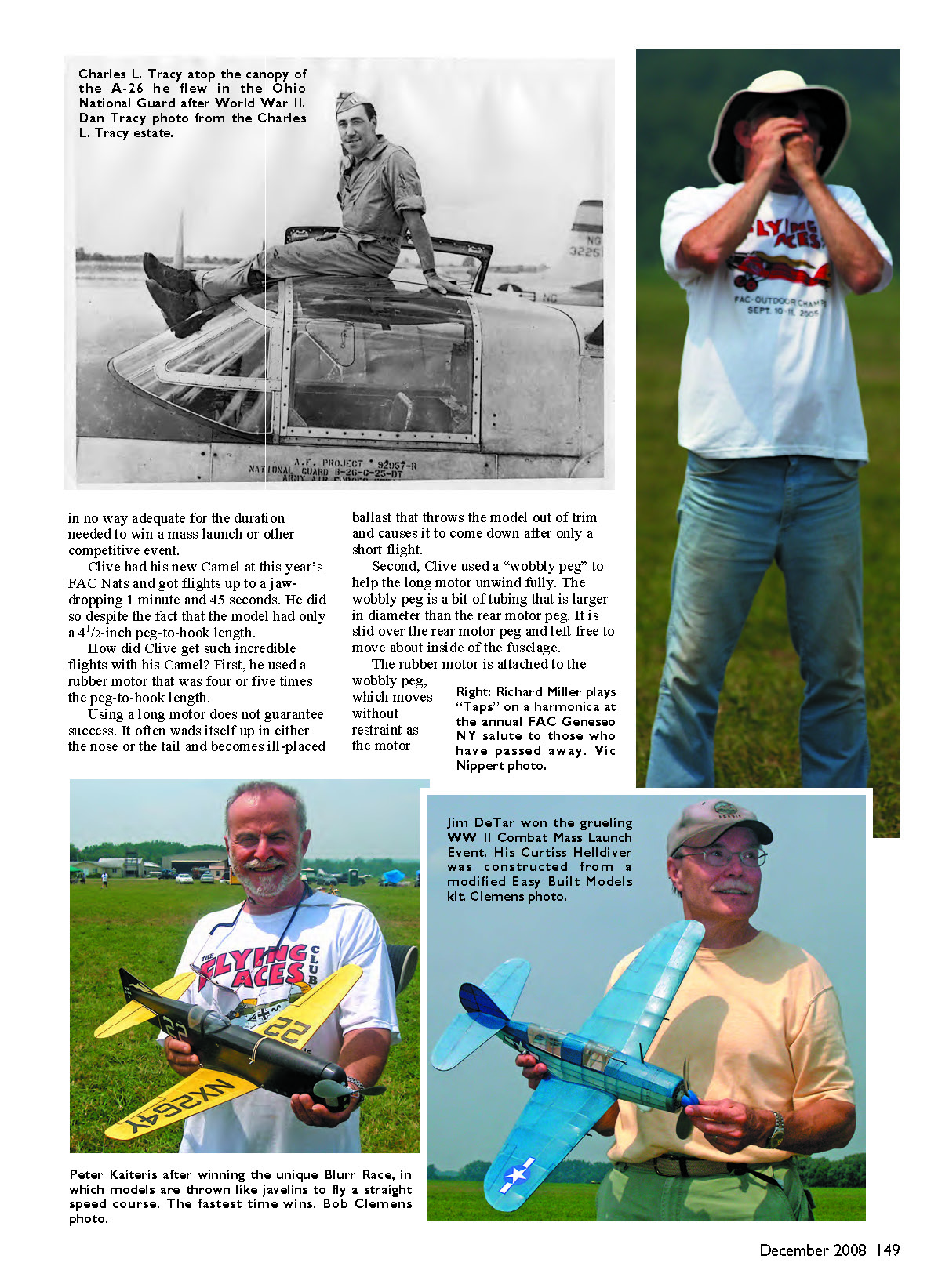
Wayne Perry, a friend and passionate collector of old model airplane kits, told me about a large estate sale he attended last year in Boston, Massachusetts. I was aware of the sale but did not go because of the press of other matters. Arthur A. Crisafulli, a full-service auction company in the Boston area, handled the sale.
Wayne was told that there were three large truckloads of kits in the estate and that the owner had kept them stored safely in a warehouse during his lifetime. There were model airplane kits from the 1930s to the present. The kits were carefully grouped and sold in lots by manufacturer name. According to Wayne, five or six principal buyers acquired large portions of the estate with intentions to sell them on eBay. Wayne took extensive photographs of the kits in the estate, and I have included one of the pictures.
I had an article titled "Our Stuff" published in the August 2003 MA. It was about what to do with your aeromodeling treasures when you pass on. As time takes its toll, there will be more need than ever to see that modelers' estates are intelligently handled to obtain maximum value for their families and preserve the artifacts for future generations of modelers to enjoy.
One of the most profound losses to FF Scale occurred on June 16, 2008, when the great Lin Reichel passed away. He had been the guiding light of the FAC since 1980 and had been trying to help the families of deceased modelers liquidate their collections of kits, books, magazines, etc. With Lin's passing, FAC General Headquarters (GHQ) made it known that help will continue to be available to families and friends of deceased modelers who are looking to dispose of their collections. If you have such a need, contact the FAC GHQ for help.
Ron Bishop, whom I mentioned in the September 2008 column (on page 126), graciously sent copies of Norm Marshall's plans for the Stearman Yellow Peril trainer, the Spirit of St. Louis, and the P-40 Flying Tiger. These are not flying models, but are whimsical wooden versions of the famous aircraft. These pine airplanes are for use as shelf models and, more important, as toys for young aviators who are 7 and older (although my grandchildren have enjoyed them as young as 3).
For copies of Norm's plans and instructions, contact me in care of Air Ace Models. Thanks, Ron.
Jeremy Commins commented that he hopes there will be a renewed interest in handmade shelf models. He points out that plastic kits have virtually eliminated the modeling of wooden static aircraft. He goes on to say that FF Scale is one of the few areas of modeling that has not been overtaken by prefabrication. I agree with Jeremy and, as I have mentioned, simple wooden models are one of the best ways to appeal to youngsters and get them involved with model aviation.
Other e-mails of interest include one I received from James Alderson, who is happy to be returning to the hobby after eight years and is looking for a list of cottage industries in our hobby that is similar to the one Bill Warner put out. Can anyone help with this?
Mike Boucher requested a copy of plans for my 24-inch-span, rubber-powered Fieseler Fi-156C Storch. I sent him a copy of Crosswinds (the Cleveland Free Flight Society's newsletter) No. 82, which was devoted to the Storch.
Dave Diels of Diels Engineering, Inc. reports that he has entered the 21st century with his own domain name.
Tom Hallman has found plans for a nonflying, rubber-powered Land Cruiser; they were published in a 1936 Bond Bread advertisement. Tom invites us to consider making and racing it as a landlocked FAC event.
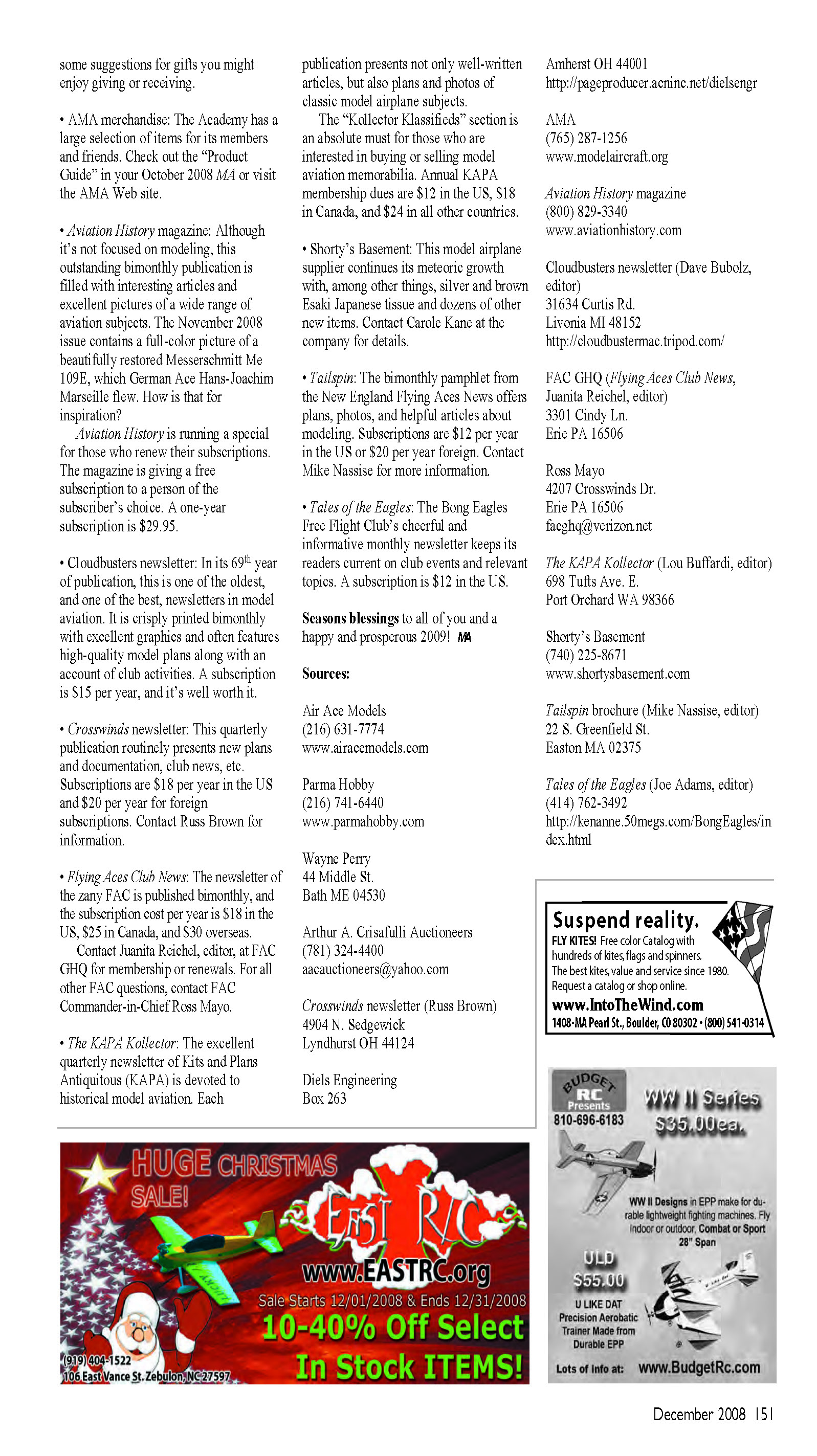
Blaine Stone read my September 2008 comments on the passing of Charles L. Tracy and found himself reveling in memories of his fortunate youth as a modeler in Cleveland, guided by Charles and others. After sharing many other pleasant memories of Charles, Blaine reported that he retired after 35 years as an aerospace engineer and has found time again for FF modeling. "The thrill is still there," wrote Blaine.
Dan Tracy e-mailed to thank me for my comments on the accomplishments and contributions of his dad, Charles (see pages 126 and 128 of the September 2008 MA). I told Dan that I was honored to be his father's friend and that he should be proud of him for all he did for his country, aviation, and modeling. May Charles rest in peace while his soul soars with eagles.
Transcribed from original scans by AI. Minor OCR errors may remain.

