
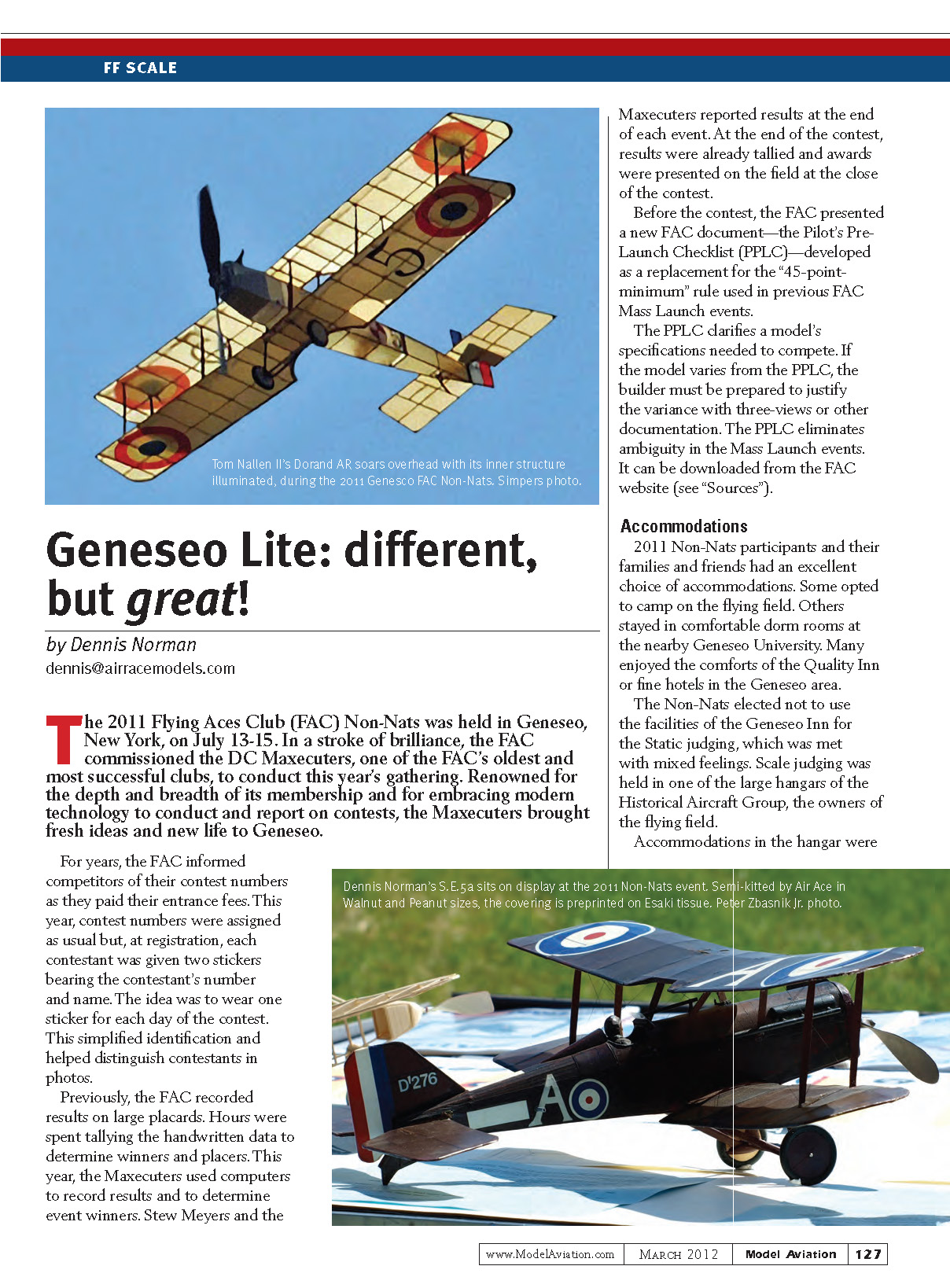
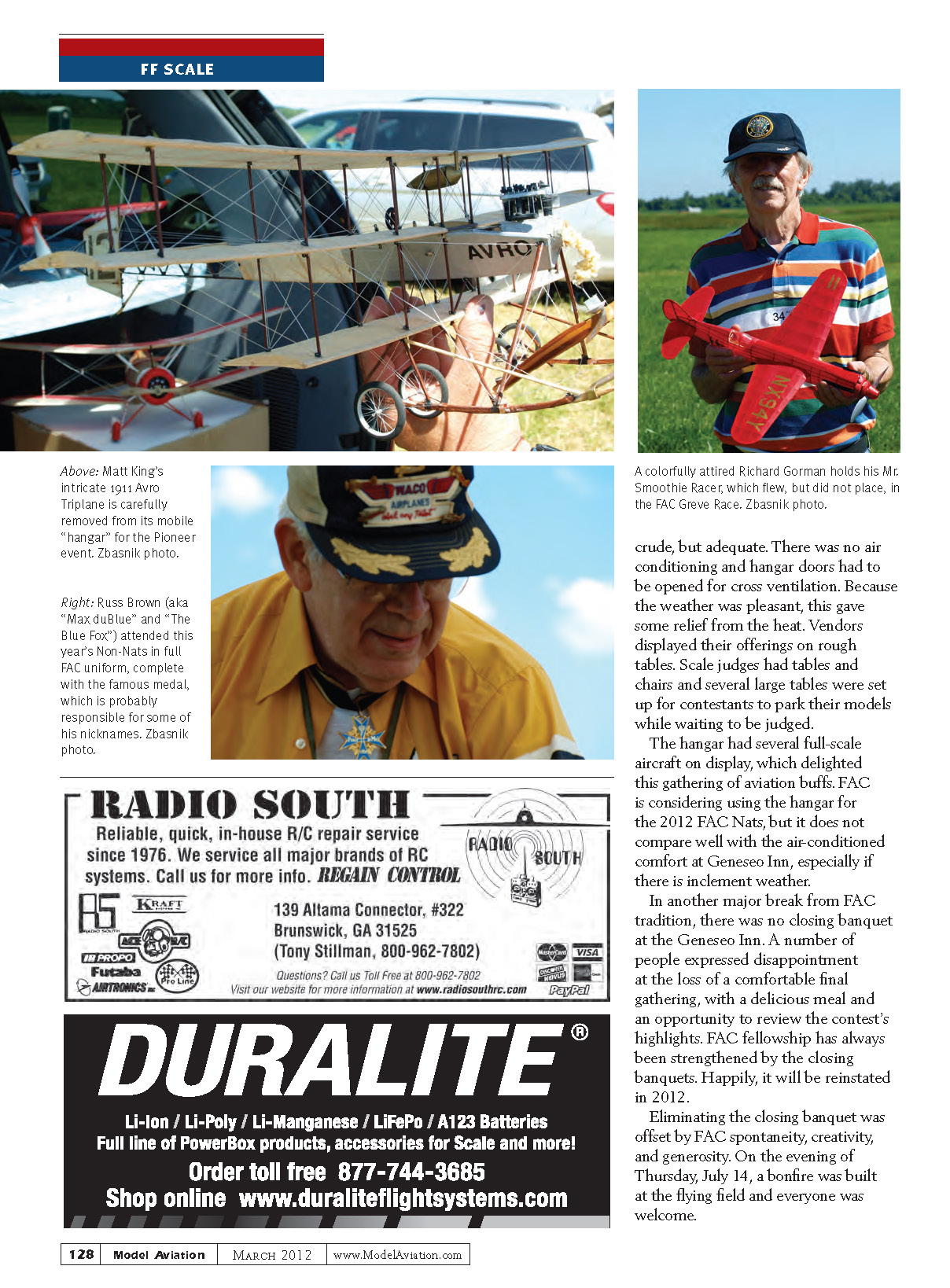

Geneseo Lite: different, but great!
by Dennis Norman [email protected]
The 2011 Flying Aces Club (FAC) Non‑Nats was held in Geneseo, New York, on July 13–15. In a stroke of brilliance, the FAC commissioned the D.C. Maxecuters, one of the FAC’s oldest and most successful clubs, to conduct this year’s gathering. Renowned for the depth and breadth of its membership and for embracing modern technology to conduct and report on contests, the Maxecuters brought fresh ideas and new life to Geneseo.
For years, the FAC informed competitors of their contest numbers as they paid their entrance fees. This year, contest numbers were assigned as usual but, at registration, each contestant was given two stickers bearing the contestant’s number and name. The idea was to wear one sticker for each day of the contest. This simplified identification and helped distinguish contestants in photos.
Previously, the FAC recorded results on large placards. Hours were spent tallying the handwritten data to determine winners and placers. This year, the Maxecuters used computers to record results and to determine event winners. Stew Meyers and the Maxecuters reported results at the end of each event. At the end of the contest, results were already tallied and awards were presented on the field at the close of the contest.
Before the contest, the FAC presented a new FAC document—the Pilot’s Pre‑Launch Checklist (PPLC)—developed as a replacement for the “45‑point‑minimum” rule used in previous FAC Mass Launch events.
The PPLC clarifies a model’s specifications needed to compete. If the model varies from the PPLC, the builder must be prepared to justify the variance with three-views or other documentation. The PPLC eliminates ambiguity in the Mass Launch events. It can be downloaded from the FAC website (see “Sources”).
Accommodations
2011 Non‑Nats participants and their families and friends had an excellent choice of accommodations. Some opted to camp on the flying field. Others stayed in comfortable dorm rooms at the nearby Geneseo University. Many enjoyed the comforts of the Quality Inn or fine hotels in the Geneseo area.
The Non‑Nats elected not to use the facilities of the Geneseo Inn for the Static judging, which was met with mixed feelings. Scale judging was held in one of the large hangars of the 1941 Historical Aircraft Group, the owners of the flying field.
Accommodations in the hangar were crude, but adequate. There was no air conditioning and hangar doors had to be opened for cross ventilation. Because the weather was pleasant, this gave some relief from the heat. Vendors displayed their offerings on rough tables. Scale judges had tables and chairs and several large tables were set up for contestants to park their models while waiting to be judged. The hangar had several full‑scale aircraft on display, which delighted this gathering of aviation buffs. FAC is considering using the hangar for the 2012 FAC Nats, but it does not compare well with the air‑conditioned comfort at Geneseo Inn, especially if there is inclement weather.
In another major break from FAC tradition, there was no closing banquet at the Geneseo Inn. A number of people expressed disappointment at the loss of a comfortable final gathering, with a delicious meal and an opportunity to review the contest’s highlights. FAC fellowship has always been strengthened by the closing banquets. Happily, it will be reinstated in 2012.
Eliminating the closing banquet was offset by FAC spontaneity, creativity, and generosity. On the evening of Thursday, July 14, a bonfire was built at the flying field and everyone was welcome. Beer and wine were shared and brought by many and a spontaneous meal was served.
Great Flying
The flying was magnificent! CD Dave Mitchell, with the help of his bullhorn and loyal crew, orchestrated everything perfectly. Geneseo was sun-drenched and blessed with thermal-filled skies on both days. Some of the thermals lasted for minutes and were so gentle that they deposited the models within a few feet of their launch points.
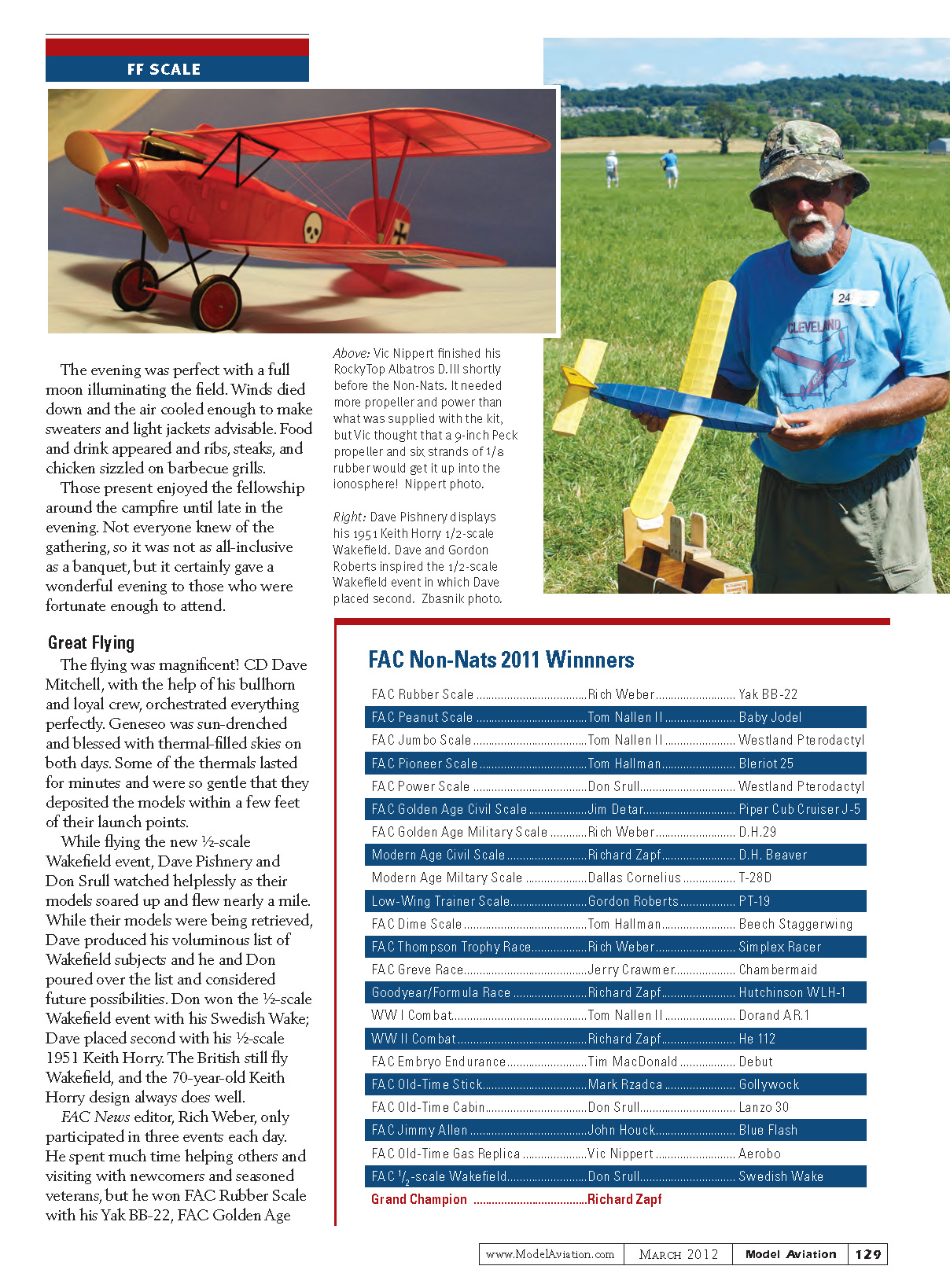
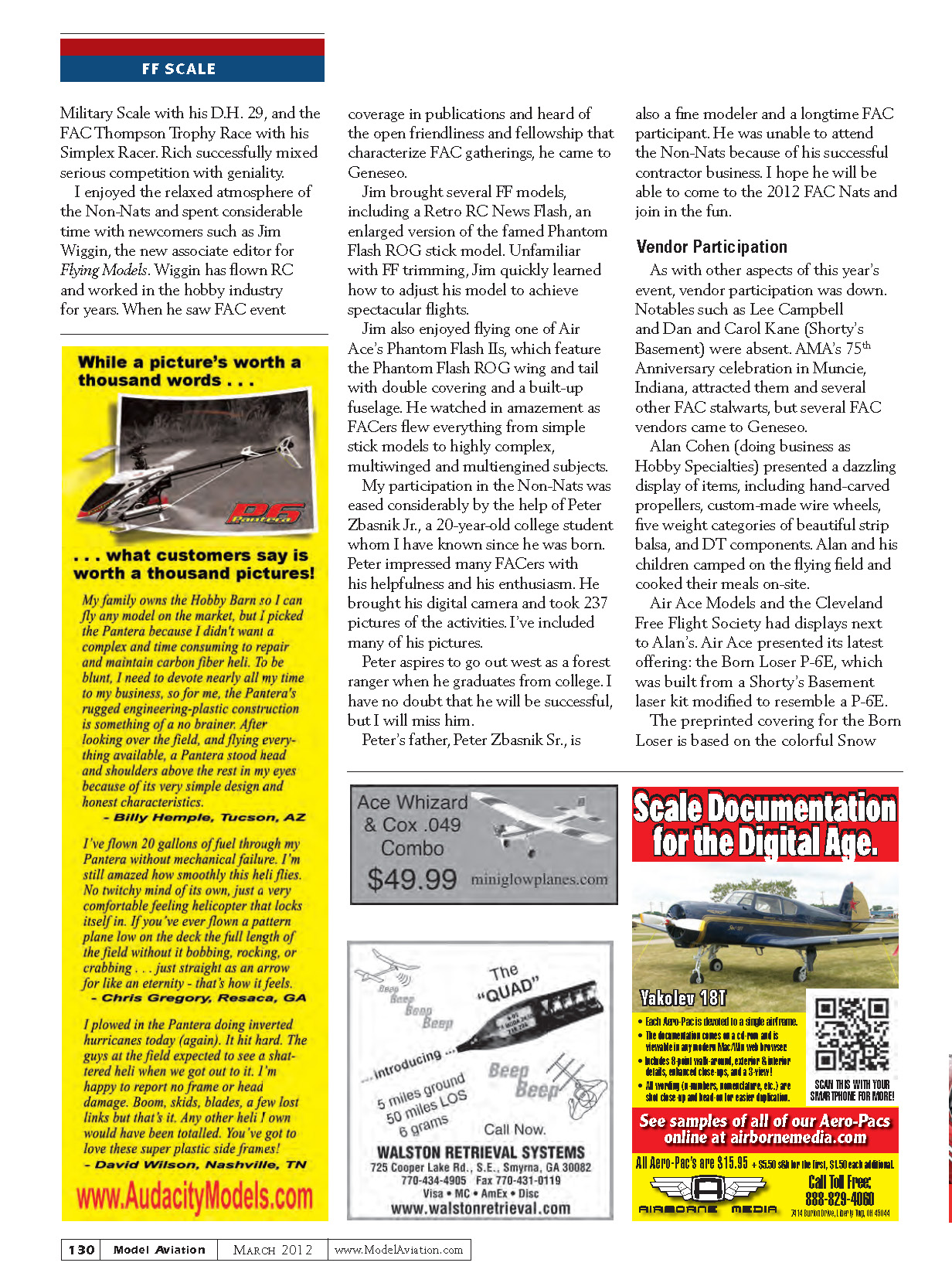
While flying the new 1/2-scale Wakefield event, Dave Pishnery and Don Srull watched helplessly as their models soared up and flew nearly a mile. While their models were being retrieved, Dave produced his voluminous list of Wakefield subjects and he and Don poured over the list and considered future possibilities. Don won the 1/2-scale Wakefield event with his Swedish Wake; Dave placed second with his 1/2-scale 1951 Keith Horry. The British still fly Wakefield, and the 70‑year‑old Keith Horry design always does well.
FAC News editor Rich Weber only participated in three events each day. He spent much time helping others and visiting with newcomers and seasoned veterans, but he won FAC Rubber Scale with his Yak BB-22, FAC Golden Age Military Scale with his D.H. 29, and the FAC Thompson Trophy Race with his Simplex Racer. Rich successfully mixed serious competition with geniality.
I enjoyed the relaxed atmosphere of the Non‑Nats and spent considerable time with newcomers such as Jim Wiggin, the new associate editor for Flying Models. Wiggin has flown RC and worked in the hobby industry for years. When he saw FAC event coverage in publications and heard of the open friendliness and fellowship that characterize FAC gatherings, he came to Geneseo.
Jim brought several FF models, including a Retro RC News Flash, an enlarged version of the famed Phantom Flash ROG stick model. Unfamiliar with FF trimming, Jim quickly learned how to adjust his model to achieve spectacular flights.
Jim also enjoyed flying one of Air Ace’s Phantom Flash IIs, which feature the Phantom Flash ROG wing and tail with double covering and a built-up fuselage. He watched in amazement as FACers flew everything from simple stick models to highly complex, multiwinged and multiengined subjects.
My participation in the Non‑Nats was eased considerably by the help of Peter Zbasnik Jr., a 20‑year‑old college student whom I have known since he was born. Peter impressed many FACers with his helpfulness and his enthusiasm. He brought his digital camera and took 237 pictures of the activities. I’ve included many of his pictures.
Peter aspires to go out west as a forest ranger when he graduates from college. I have no doubt that he will be successful, but I will miss him.
Peter’s father, Peter Zbasnik Sr., is also a fine modeler and a longtime FAC participant. He was unable to attend the Non‑Nats because of his successful contractor business. I hope he will be able to come to the 2012 FAC Nats and join in the fun.
Vendor Participation
As with other aspects of this year’s event, vendor participation was down. Notables such as Lee Campbell and Dan and Carol Kane (Shorty’s Basement) were absent. AMA’s 75th Anniversary celebration in Muncie, Indiana, attracted them and several other FAC stalwarts, but several FAC vendors came to Geneseo.
Alan Cohen (doing business as Hobby Specialties) presented a dazzling display of items, including hand-carved propellers, custom-made wire wheels, five weight categories of beautiful strip balsa, and DT components. Alan and his children camped on the flying field and cooked their meals on-site.
Air Ace Models and the Cleveland Free Flight Society had displays next to Alan’s. Air Ace presented its latest offering: the Born Loser P-6E, which was built from a Shorty’s Basement laser kit modified to resemble a P-6E.
The preprinted covering for the Born Loser is based on the colorful Snow Owl markings of the Curtiss P-6E Hawks of the 17th Pursuit Squadron, 1st Pursuit Group based at Selfridge Field, Michigan, in the 1930s. The prototype Born Loser P-6E was completed after the Non‑Nats and is a handsome eye-catcher.
Russ Brown presented a generous offering of the latest Crosswinds newsletters, featuring new plans, histories, and full-color documentation. Crosswinds is one of the oldest and best newsletters and is getting even better with modern technology.
Dave Diels and John Regalbuto also graced this year’s Non‑Nats with their latest products. Dave and his wife, Anita, relocated to Oregon, Ohio (near Toledo), to be closer to their children and grandchildren. Dave has updated his superb selection of 1:24-scale kits, many of which feature laser-cut parts. Among Dave’s latest is a 20¾‑inch span, laser-cut SBD-3/5. John continues offering his wonderful line of FF specialty products, including an unbelievable new thrust bearing.
Dave Niedzielski, of Easy Built Models (EBM), continues to improve his line of kits with high-quality balsa, well-executed plans, tissue coverings, and markings. EBM’s offerings were on prominent display and measured up well against some of the FAC’s finest, one-of-a-kind originals.
EBM’s latest, a 23½‑inch span version of the Erie Daily Times Junior Pilot (kit #FF-92LC) is capable of ROG takeoffs and flights exceeding 2 minutes. It has CAD-drawn plans, laser-cut balsa, tissue covering, TissueCal logos, and FAI rubber. It sells for $23.24, plus $8 shipping and handling.
Cafe Press
The FAC has announced its new online store at Cafe Press. Quality items sent to your door! All profits go to the FAC and will be used to support FAC activities.
See you at the 2012 FAC Nats!
SOURCES:
- Flying Aces Club
[email protected] http://flyingacesclub.com/
- D.C. Maxecuters
- 1941 Historical Aircraft Group Museum
(585) 243-2100 www.1941hag.org
- Air Ace Models
(216) 631-7774 www.airacemodels.com
- Diels Engineering, Inc.
[email protected] www.dielsengineeringinc.com
- Easy Built Models
(334) 358-5184 www.easybuiltmodels.com
- Cafe Press / FAC Online Store
www.cafepress.com/flyingacesclub
- Hobby Specialties
(908) 638-3636 www.hobbyspecialties.com
- Retro RC
(248) 212-9666 www.retrorc.us.com
- National Free Flight Society
Transcribed from original scans by AI. Minor OCR errors may remain.

