
September Songs
by Dennis Norman [email protected]
September brings a flood of aviation memories, current events, and exciting prospects for the coming year—September songs. Air shows, at least in the northern US, are winding down.
For the first time in recent memory, Cleveland has canceled its annual September air show because of financial constraints. Things are projected to be better in 2014, and if this proves to be true, the Cleveland National Air Show may return.
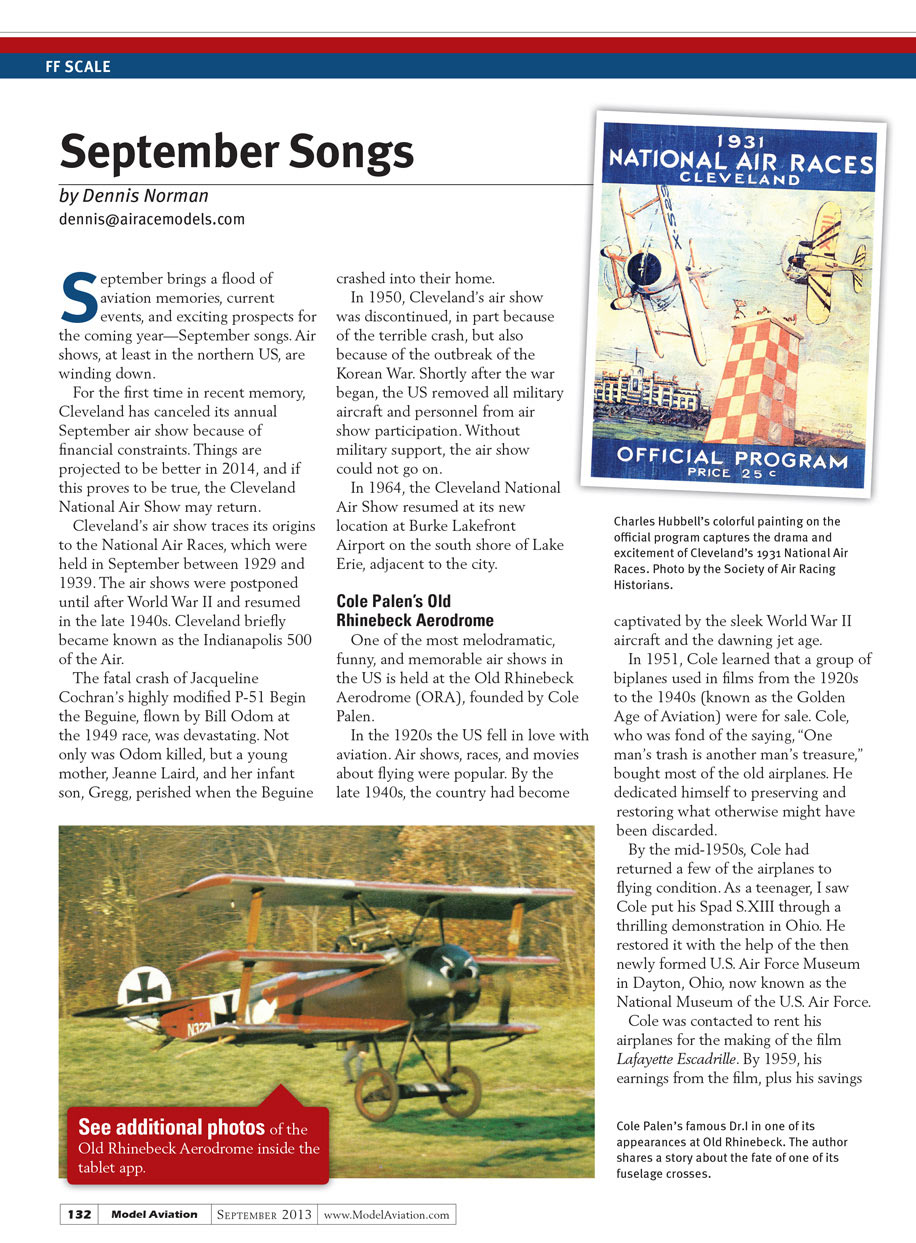
Cleveland's air show traces its origins to the National Air Races, which were held in September between 1929 and 1939. The air shows were postponed until after World War II and resumed in the late 1940s. Cleveland briefly became known as the Indianapolis 500 of the Air.
The fatal crash of Jacqueline Cochran's highly modified P-51 Begin the Beguine, flown by Bill Odom at the 1949 race, was devastating. Not only was Odom killed, but a young mother, Jeanne Laird, and her infant son, Gregg, perished when the Beguine crashed into their home.
In 1950, Cleveland's air show was discontinued, in part because of the terrible crash, but also because of the outbreak of the Korean War. Shortly after the war began, the US removed all military aircraft and personnel from air show participation. Without military support, the air show could not go on.
In 1964, the Cleveland National Air Show resumed at its new location at Burke Lakefront Airport on the south shore of Lake Erie, adjacent to the city.
Cole Palen's Old Rhinebeck Aerodrome
One of the most melodramatic, funny, and memorable air shows in the US is held at the Old Rhinebeck Aerodrome (ORA), founded by Cole Palen.
In the 1920s the US fell in love with aviation. Air shows, races, and movies about flying were popular. By the late 1940s, the country had become captivated by the sleek World War II aircraft and the dawning jet age.
In 1951, Cole learned that a group of biplanes used in films from the 1920s to the 1940s (known as the Golden Age of Aviation) were for sale. Cole, who was fond of the saying, "One man's trash is another man's treasure," bought most of the old airplanes. He dedicated himself to preserving and restoring what otherwise might have been discarded.
By the mid-1950s, Cole had returned a few of the airplanes to flying condition. As a teenager, I saw Cole put his Spad S.XIII through a thrilling demonstration in Ohio. He restored it with the help of the then newly formed U.S. Air Force Museum in Dayton, Ohio, now known as the National Museum of the U.S. Air Force.
Cole was contacted to rent his airplanes for the making of the film Lafayette Escadrille. By 1959, his earnings from the film, plus his savings from his employment as a mechanic at Texaco, enabled him to purchase a small farm located east of the Hudson River, roughly 100 miles north of New York City. This venue became the ORA.
By 1960, Cole's reputation and his fleet of restored aircraft had increased to the point where he began offering air shows. The Aerodrome's runway was a long, narrow, rolling, grass strip with a dog-leg taxi area at one end.
The air shows drew curious spectators from New York and the New England area. A small, dedicated group of highly qualified people joined Cole in his endeavor. They helped him fill ORA's corrugated hangars with parts of old aircraft. From these, new replicas were built and they became part of his summer air shows. During the winter, Cole went to Florida to continue his restorations and build replicas.
My pilgrimages to ORA began in the late 1960s. I initially went with friends to see the World War I RC contests held there in early September. Although I do not build or fly RC, I didn't want to miss the beautiful WW I Scale models.
ORA's zany air show was delightful and the content of its hangars was irresistible. I enjoyed the camaraderie and attended several of ORA's casual Saturday night banquets where Cole and his friends regaled the crowd with stories and reports about their latest projects.
Visitors could purchase rides in a 1929 New Standard D-25 biplane that would fly over the Aerodrome and the nearby Hudson River Valley. The flights were popular and profitable.
On one of my early visits to Old Rhinebeck, I had the pleasure of meeting Vic Nippert and his wife, Tena, from nearby Lake Katrine. Both were school teachers and their children were young and enjoyed the Old Rhinebeck experience.
Vic and Tena have been major participants in FF and FF Scale circles for years. They were honored in 2012 for their many contributions to the growth of the Flying Aces Club (FAC) and both were inducted into the FAC Hall of Fame.
Several times, my family and I had accommodations at the Beekman Arms Hotel when visiting ORA.
As America's oldest, continuously operated hotel, Beekman Arms dates back to Colonial times. It has been beautifully maintained and its facilities have been tastefully expanded. The town of Rhinebeck is surrounded by many historical attractions, including the home of Franklin D. Roosevelt in nearby Hyde Park.
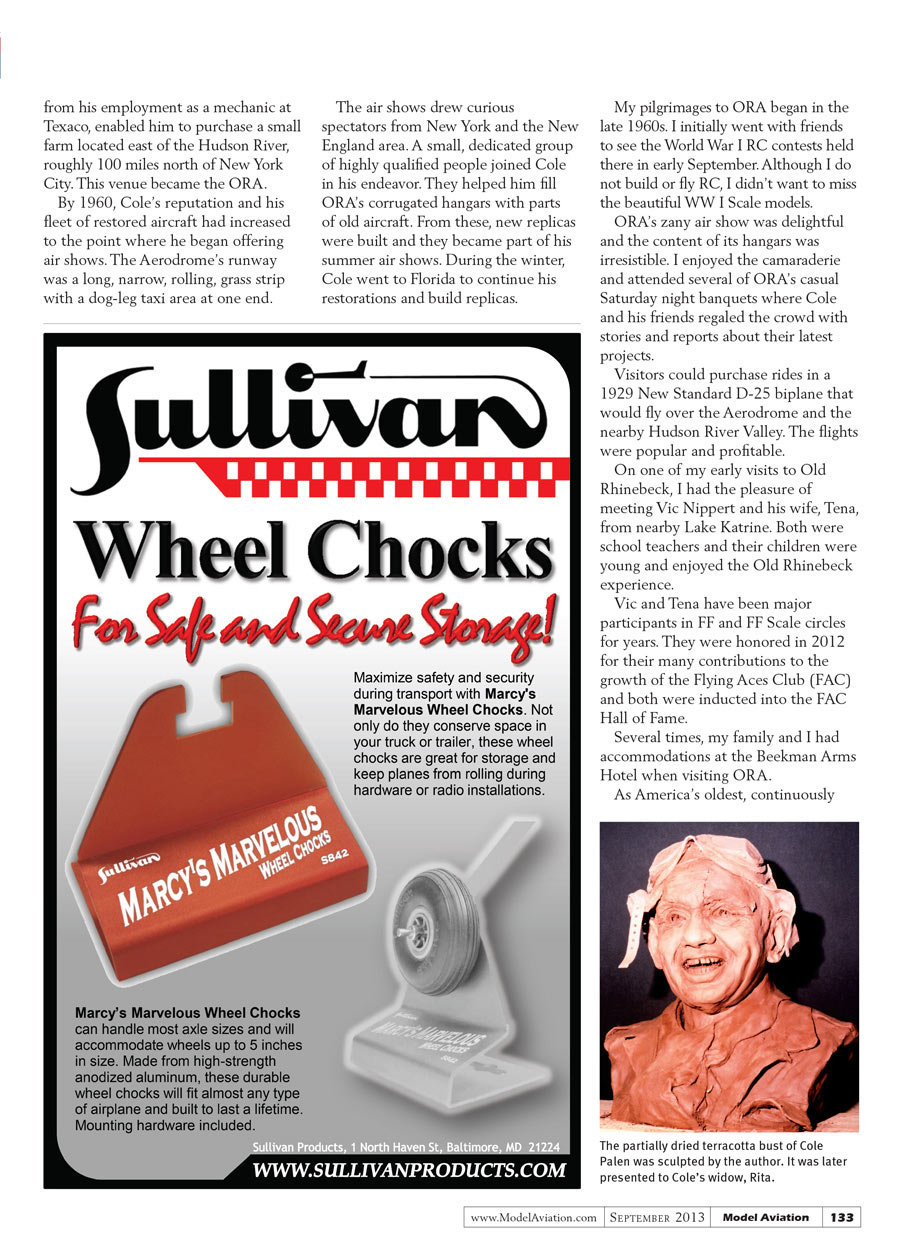
In the early 1980s, Gordon Roberts and I drove to New England to participate in an FAC contest. On our way home, we decided to stop at ORA. It was early in the week and the place was deserted, but Cole was working on his famous Fokker Dr.I.
The airplane was parked on the grass strip near the hangars. There were problems with the tail surfaces and Cole had cut the black crosses from the fuselage and had laid them on the grass.
As Gordon and I chatted with Cole, he noticed my gaze drifting to the crosses. I said nothing, but he saw the gleam in my eye and said, "All right, you can have one of them, but I need the other for a pattern."
I framed that cross and it hangs to this day in a place of honor in my home.
When Dave Fox, one of the air show's cofounders, was killed hours before a September Old Rhinebeck show, I was there to share in the grief. Cole agonized whether or not to cancel the show, but out of respect for Dave, it was held.
A year later I returned to Old Rhinebeck and presented Cole with a terracotta bust that I had sculpted of Dave. He proudly placed it in his museum.
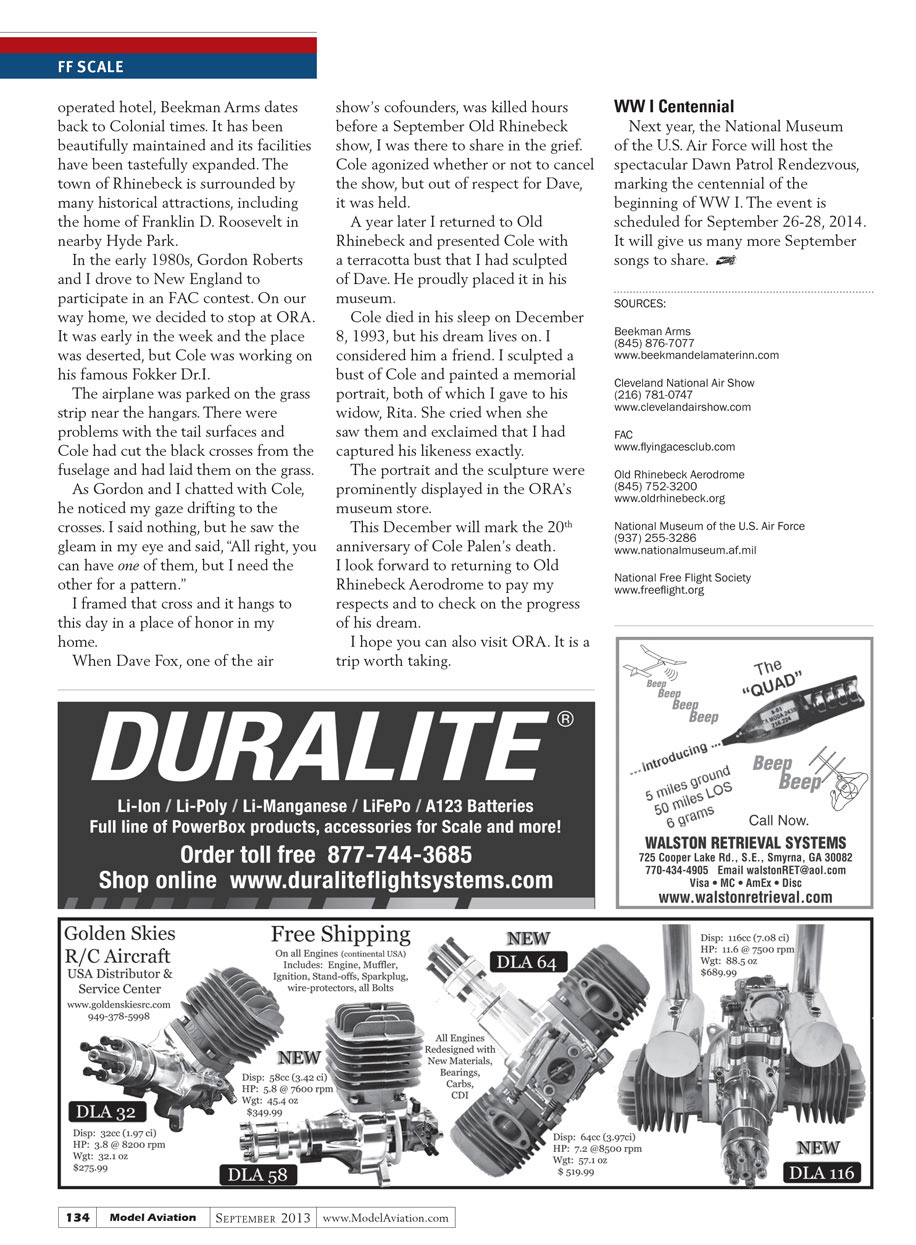
Cole died in his sleep on December 8, 1993, but his dream lives on. I considered him a friend. I sculpted a bust of Cole and painted a memorial portrait, both of which I gave to his widow, Rita. She cried when she saw them and exclaimed that I had captured his likeness exactly.
The portrait and the sculpture were prominently displayed in the ORA's museum store.
This December will mark the 20th anniversary of Cole Palen's death. I look forward to returning to Old Rhinebeck Aerodrome to pay my respects and to check on the progress of his dream.
I hope you can also visit ORA. It is a trip worth taking.
WW I Centennial
Next year, the National Museum of the U.S. Air Force will host the spectacular Dawn Patrol Rendezvous, marking the centennial of the beginning of WW I. The event is scheduled for September 26-28, 2014. It will give us many more September songs to share.
Transcribed from original scans by AI. Minor OCR errors may remain.

