
Geef One-Design gas model for 2012
by Gene Smith [email protected]
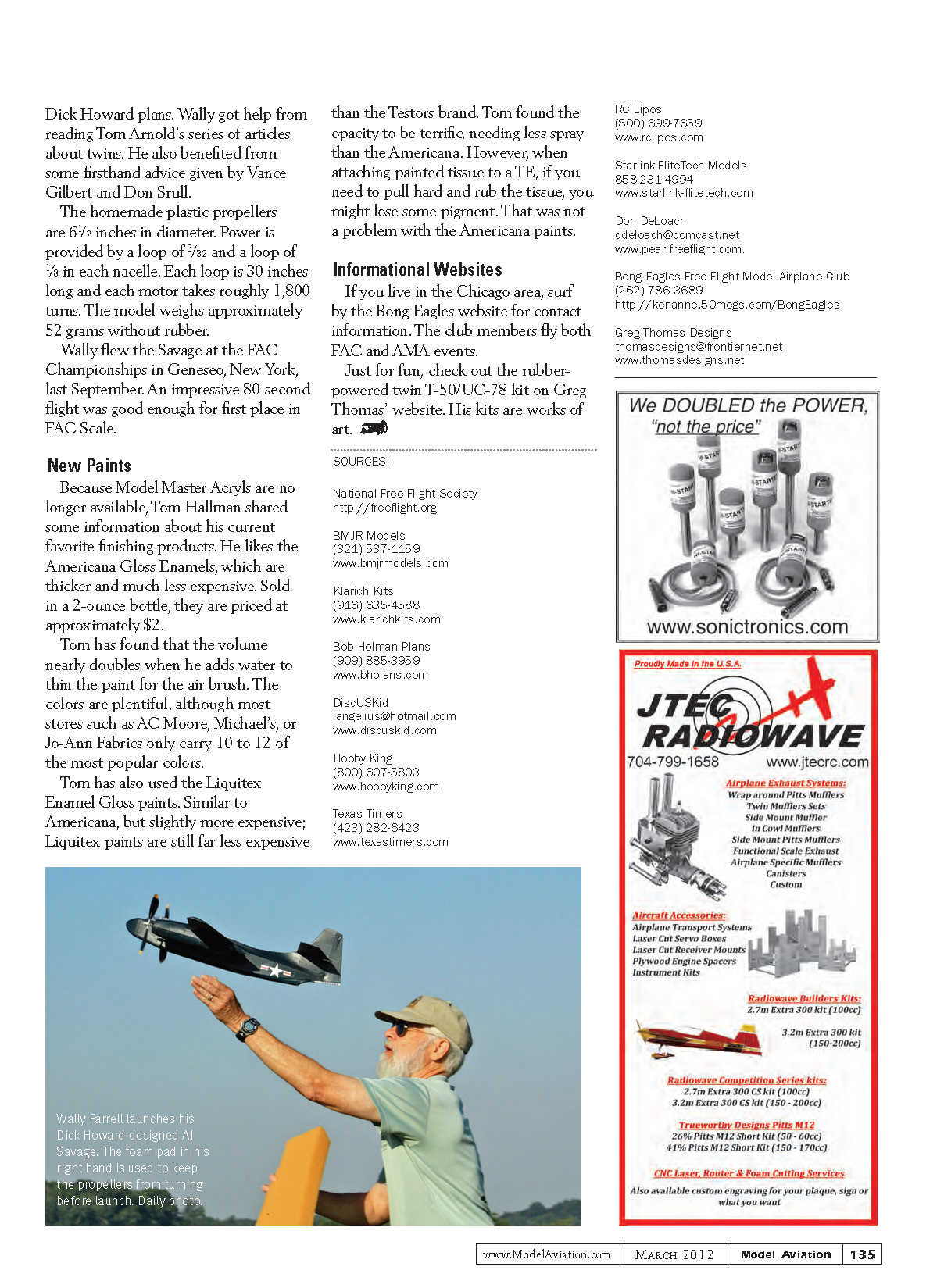
My Geef 513 needs roughly an hour of shop time to be ready for test flights. Get yours ready for the gas model One-Design contest at the Nats. See the “Sources” listing at the end of this column for plans, short kits, or a full kit.
Cleveland Models
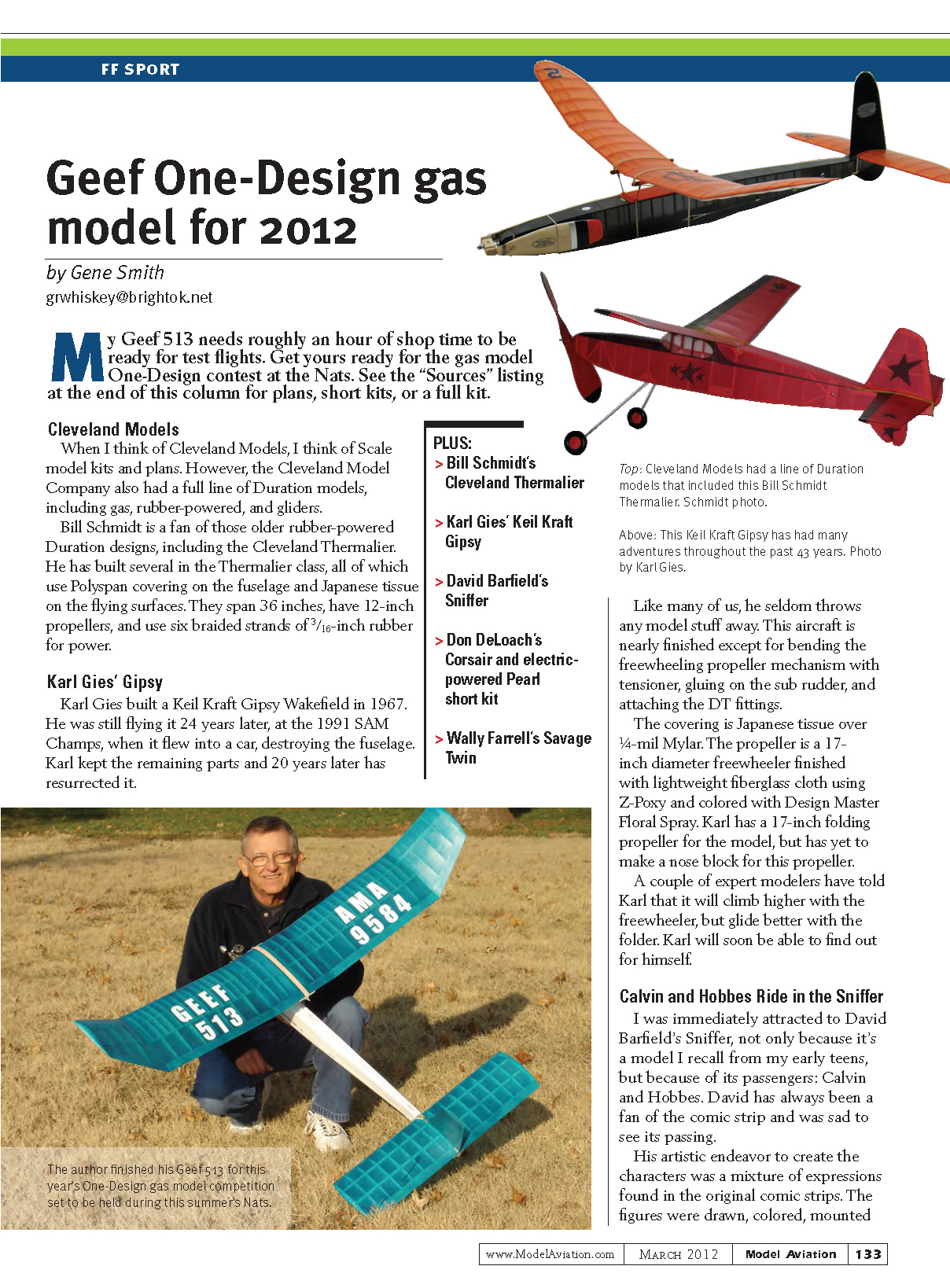
When I think of Cleveland Models, I think of scale model kits and plans. However, the Cleveland Model Company also had a full line of Duration models, including gas, rubber-powered, and gliders.
Bill Schmidt is a fan of those older rubber-powered Duration designs, including the Cleveland Thermalier. He has built several in the Thermalier class, all of which use Polyspan covering on the fuselage and Japanese tissue on the flying surfaces. They span 36 inches, have 12-inch propellers, and use six braided strands of 3/16-inch rubber for power.
Karl Gies’ Gipsy
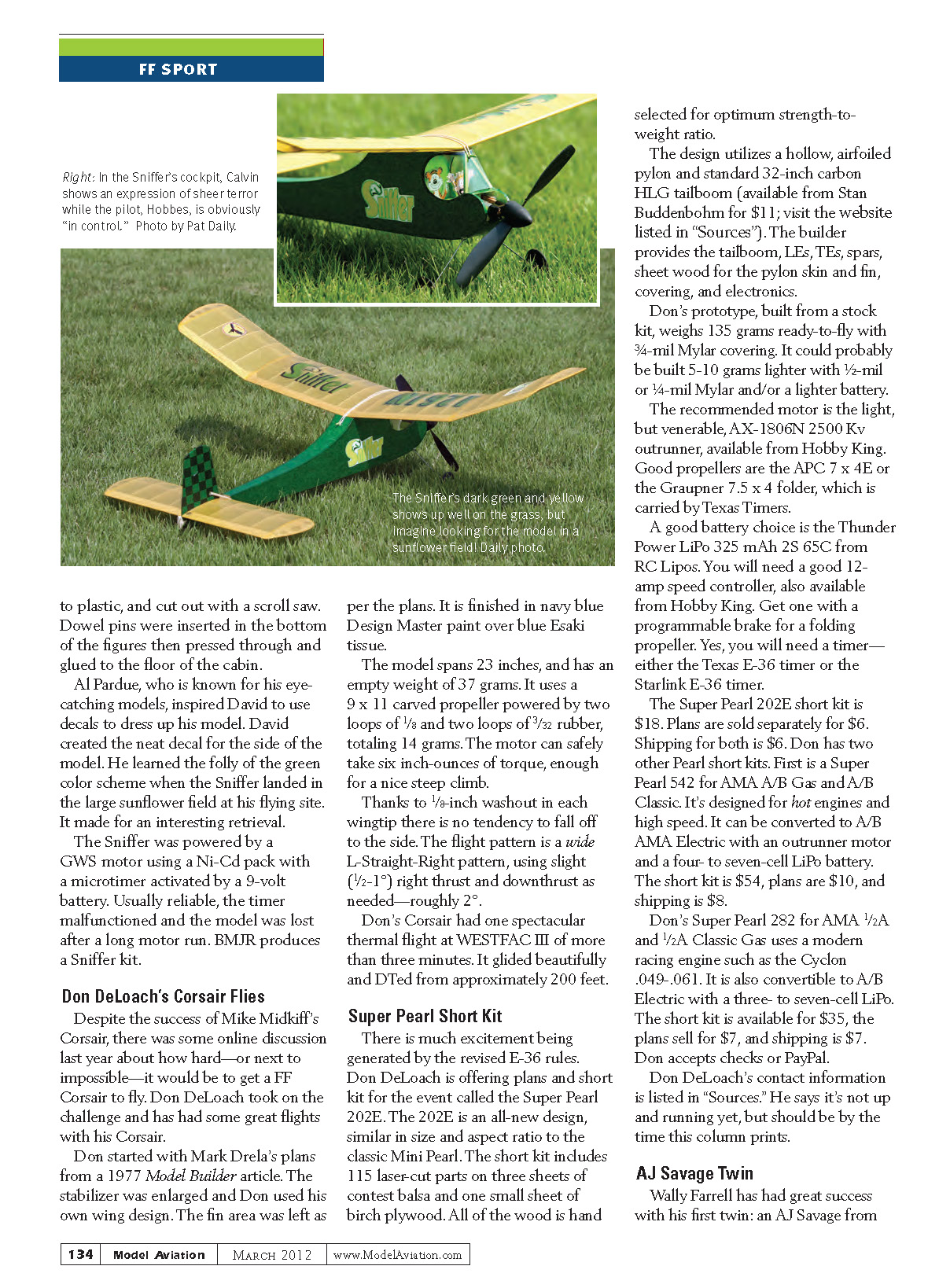
Karl Gies built a Keil Kraft Gipsy Wakefield in 1967. He was still flying it 24 years later, at the 1991 SAM Champs, when it flew into a car, destroying the fuselage. Karl kept the remaining parts and, 20 years later, has resurrected it.
Like many of us, he seldom throws any model stuff away. This aircraft is nearly finished except for bending the freewheeling propeller mechanism with tensioner, gluing on the sub-rudder, and attaching the D/T fittings.
The covering is Japanese tissue over 1/4-mil Mylar. The propeller is a 17-inch diameter freewheeler finished with lightweight fiberglass cloth using Z-Poxy and colored with Design Master Floral Spray. Karl has a 17-inch folding propeller for the model but has yet to make a nose block for this propeller.
A couple of expert modelers have told Karl that it will climb higher with the freewheeler, but glide better with the folder. Karl will soon be able to find out for himself.
Calvin and Hobbes Ride in the Sniffer
I was immediately attracted to David Barfield’s Sniffer, not only because it’s a model I recall from my early teens, but because of its passengers: Calvin and Hobbes. David has always been a fan of the comic strip and was sad to see its passing.
His artistic endeavor to create the characters was a mixture of expressions found in the original comic strips. The figures were drawn, colored, mounted to plastic, and cut out with a scroll saw. Dowel pins were inserted in the bottom of the figures, then pressed through and glued to the floor of the cabin. Al Pardue, who is known for his eye-catching models, inspired David to use decals to dress up his model. David created the neat decal for the side of the model.
He learned the folly of the green color scheme when the Sniffer landed in the large sunflower field at his flying site. It made for an interesting retrieval. The Sniffer was powered by a GWS motor using a Ni-Cd pack with a microtimer activated by a 9-volt battery. Usually reliable, the timer malfunctioned and the model was lost after a long motor run. BMJR produces a Sniffer kit.
Don DeLoach’s Corsair Flies
Despite the success of Mike Midkiff’s Corsair, there was some online discussion last year about how hard—or next to impossible—it would be to get a FF Corsair to fly. Don DeLoach took on the challenge and has had some great flights with his Corsair.
Don started with Mark Drela’s plans from a 1977 Model Builder article. The stabilizer was enlarged and Don used his own wing design. The fin area was left as per the plans. It is finished in navy blue Design Master paint over blue Esaki tissue.
The model spans 23 inches and has an empty weight of 37 grams. It uses a 9 x 11 carved propeller powered by two loops of 1/8 and two loops of 3/32 rubber, totaling 14 grams. The motor can safely take six inch-ounces of torque, enough for a nice steep climb.
Thanks to 1/8-inch washout in each wingtip there is no tendency to fall off to the side. The flight pattern is a wide L–Straight–Right pattern, using slight (1/2–1°) right thrust and downthrust as needed—roughly 2°.
Don’s Corsair had one spectacular thermal flight at WESTFAC III of more than three minutes. It glided beautifully and D/Ted from approximately 200 feet.
Super Pearl Short Kit
There is much excitement being generated by the revised E-36 rules. Don DeLoach is offering plans and a short kit for the event called the Super Pearl 202E. The 202E is an all-new design, similar in size and aspect ratio to the classic Mini Pearl. The short kit includes 15 laser-cut parts on three sheets of contest balsa and one sheet of birch plywood. All of the wood is hand-selected for optimum strength-to-weight ratio.
The design utilizes a hollow, airfoiled pylon and a standard 32-inch carbon HLG tailboom (available from Stan Buddenbohm). The builder provides the tailboom, leading edges (LEs), trailing edges (TEs), spars, sheet wood for the pylon skin and fin, covering, and electronics.
Don’s prototype, built from a stock kit, weighs 135 grams ready-to-fly with 3/4-mil Mylar covering. It could probably be built 5–10 grams lighter with 1/2-mil or 1/4-mil Mylar and/or a lighter battery.
Recommended components:
- Motor: AX-1806N 2500 kV outrunner (available from Hobby King)
- Propellers: APC 7 x 4E or Graupner 7.5 x 4 folding prop (carried by Texas Timers)
- Battery: Thunder Power LiPo 325 mAh 2S 65C (from RC Lipos)
- Speed controller: 12-amp ESC with programmable brake (available from Hobby King)
- Timer: Texas E-36 timer or Starlink E-36 timer
The Super Pearl 202E short kit is $18. Plans are sold separately for $6. Shipping for both is $6.
Don has two other Pearl short kits:
- Super Pearl 542 (for AMA A/B Gas and A/B Classic): designed for hot engines and high speed; convertible to A/B AMA Electric with an outrunner motor and a 4- to 7-cell LiPo battery. Short kit $54, plans $10, shipping $8.
- Super Pearl 282 (for AMA 1/2A and 1/4A Classic Gas): uses a modern racing engine such as the Cyclon .049–.061; also convertible to A/B Electric with a 3- to 7-cell LiPo. Short kit $35, plans $7, shipping $7.
Don accepts checks or PayPal. Don DeLoach’s contact information is listed in "Sources." He says his site is not up and running yet, but should be by the time this column prints.
AJ Savage Twin
Wally Farrell has had great success with his first twin: an AJ Savage from Dick Howard plans. Wally got help from reading Tom Arnold’s series of articles about twins. He also benefited from some firsthand advice given by Vance Gilbert and Don Srull.
The homemade plastic propellers are 6½ inches in diameter. Power is provided by a loop of 3/32 and a loop of 1/8 in each nacelle. Each loop is 30 inches long and each motor takes roughly 1,800 turns. The model weighs approximately 52 grams without rubber.
Wally flew the Savage at the FAC Championships in Geneseo, New York, last September. An impressive 80-second flight was good enough for first place in FAC Scale.
New Paints
Because Model Master Acryls are no longer available, Tom Hallman shared some information about his current favorite finishing products. He likes the Americana Gloss Enamels, which are thicker and much less expensive. Sold in a 2-ounce bottle, they are priced at approximately $2.
Tom has found that the volume nearly doubles when he adds water to thin the paint for the airbrush. The colors are plentiful, although most stores such as AC Moore, Michael’s, or Jo-Ann Fabrics only carry 10 to 12 of the most popular colors.
Tom has also used Liquitex Enamel Gloss paints. Similar to Americana, but slightly more expensive; Liquitex paints are still far less expensive than the Testors brand. Tom found the opacity to be terrific, needing less spray than the Americana. However, when attaching painted tissue to a trailing edge (TE), if you need to pull hard and rub the tissue, you might lose some pigment. That was not a problem with the Americana paints.
Informational Websites
If you live in the Chicago area, surf by the Bong Eagles website for contact information. The club members fly both FAC and AMA events.
Just for fun, check out the rubber-powered twin T-50/UC-78 kit on Greg Thomas’ website. His kits are works of art.
SOURCES:
- National Free Flight Society
- BMJR Models
(321) 537-1159 www.bmjmodels.com
- Klarich Kits
(916) 635-4588 www.klarichkits.com
- Bob Holman Plans
(909) 885-3959 www.bhplans.com
- DiscUSKid
[email protected] www.discuskid.com
- Hobby King
(800) 607-5803 www.hobbyking.com
- Texas Timers
(423) 282-6423 www.texastimers.com
- RC Lipos
(800) 699-7659 www.rclipos.com
- Starlink-FliteTech Models
858-231-4994 www.starlink-flitetech.com
- Don DeLoach
[email protected] www.pearlfreeflight.com
- Bong Eagles Free Flight Model Airplane Club
(262) 786-3689 http://kenanne.50megs.com/BongEagles
- Greg Thomas Designs
[email protected] www.thomasdesigns.net
Transcribed from original scans by AI. Minor OCR errors may remain.

