
Finishing tips and conversion details
by Gene Smith [email protected]
Mark your calendar for April 24-27 so you can attend the Western Region Flying Aces Club (WESTFAC) Mk-IV in Perris, California. This fourth iteration of WESTFAC promises to be bigger and better than ever with 23 events! Check the website, listed in "Sources," for details.
Mike Isermann's Danish Fighter and Finishing Tips
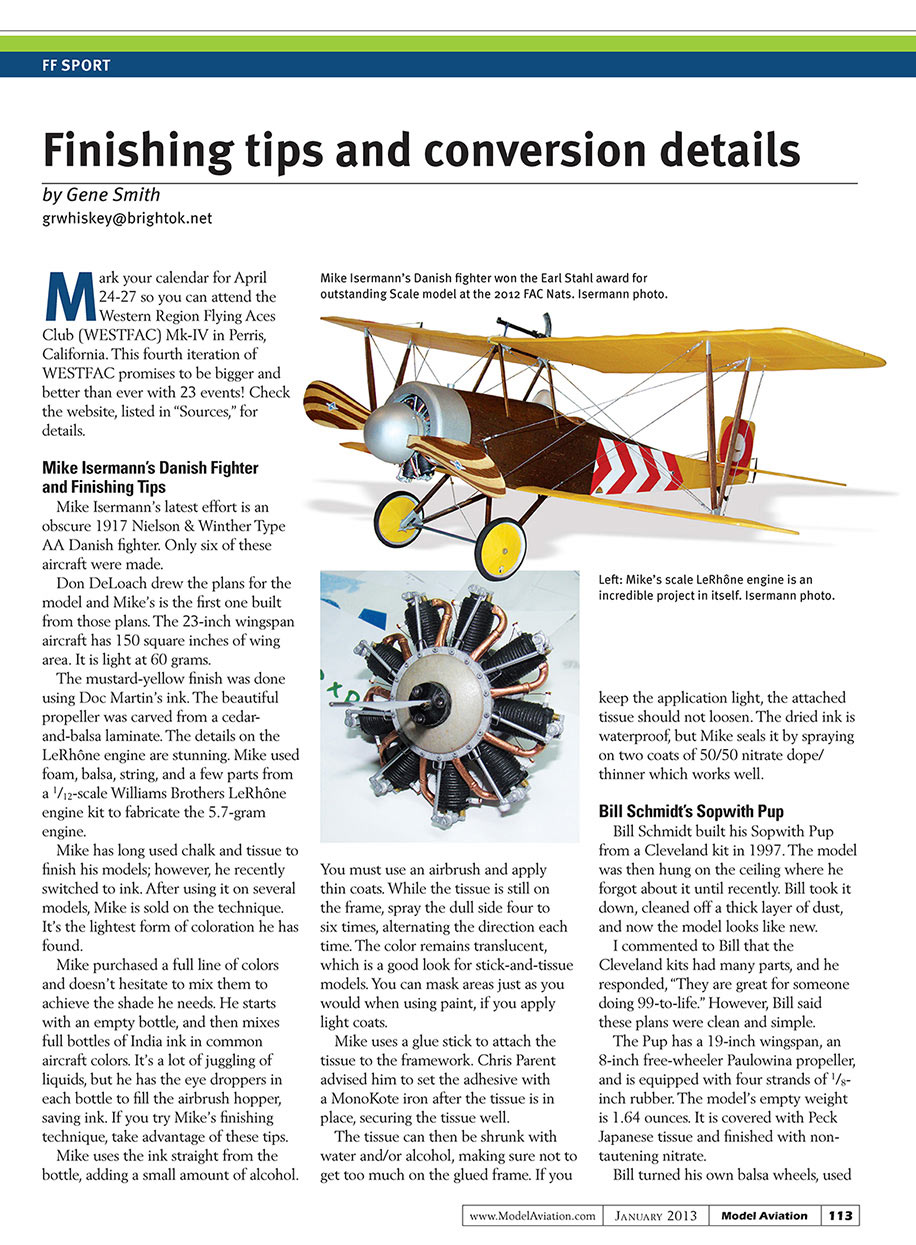
Mike Isermann's latest effort is an obscure 1917 Nielson & Winther Type AA Danish fighter. Only six of these aircraft were made.
Don DeLoach drew the plans for the model and Mike's is the first one built from those plans. The 23-inch wingspan aircraft has 150 square inches of wing area. It is light at 60 grams.
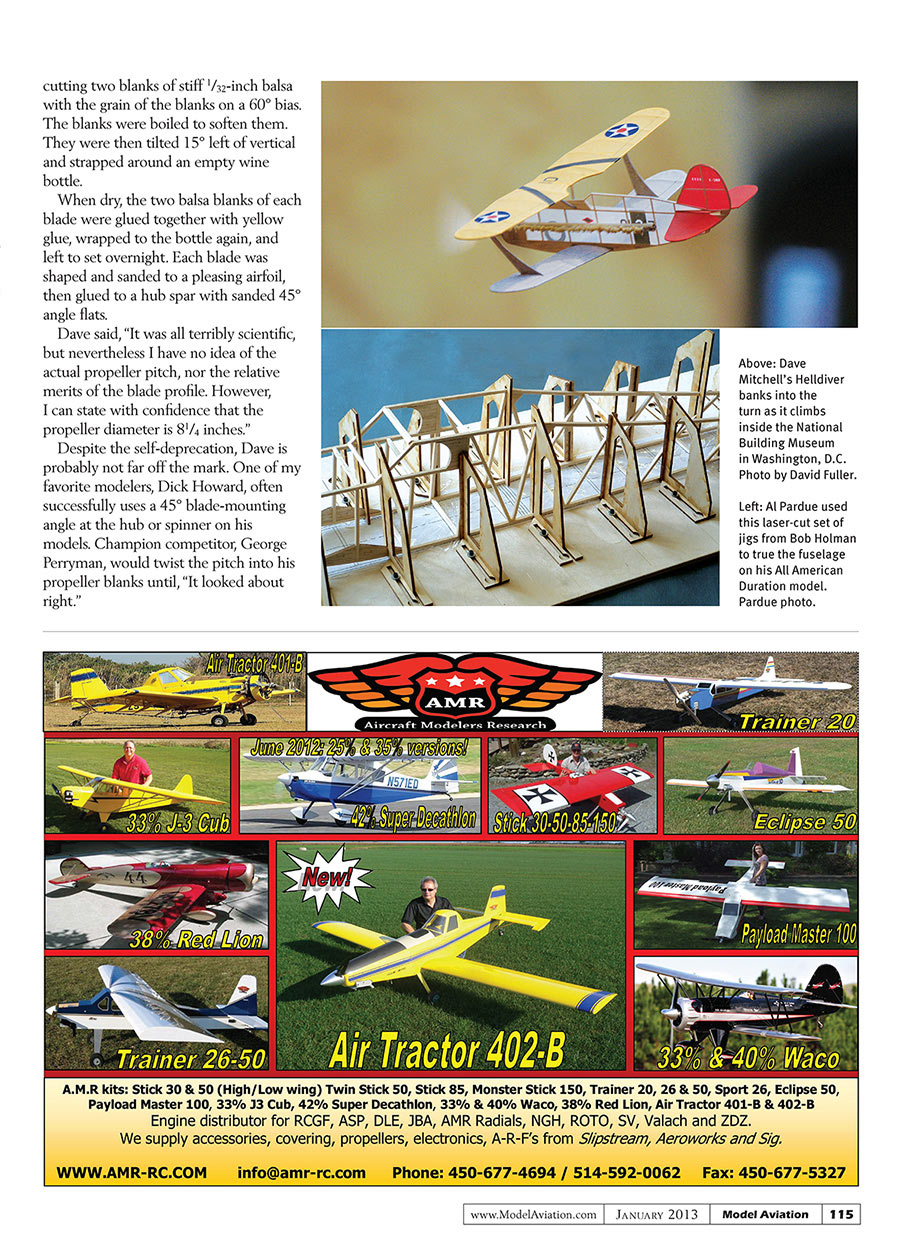
The mustard-yellow finish was done using Doc Martin's ink. The beautiful propeller was carved from a cedar-and-balsa laminate. The details on the LeRhône engine are stunning. Mike used foam, balsa, string, and a few parts from a 1/2-scale Williams Brothers LeRhône engine kit to fabricate the 5.7-gram engine.
Mike has long used chalk and tissue to finish his models; however, he recently switched to ink. After using it on several models, Mike is sold on the technique. It's the lightest form of coloration he has found.
Mike purchased a full line of colors and doesn't hesitate to mix them to achieve the shade he needs. He starts with an empty bottle, and then mixes full bottles of India ink in common aircraft colors. It's a lot of juggling of liquids, but he has the eye droppers in each bottle to fill the airbrush hopper, saving ink. If you try Mike's finishing technique, take advantage of these tips.
Mike uses the ink straight from the bottle, adding a small amount of alcohol.
You must use an airbrush and apply thin coats. While the tissue is still on the frame, spray the dull side four to six times, alternating the direction each time. The color remains translucent, which is a good look for stick-and-tissue models. You can mask areas just as you would when using paint, if you apply light coats.
Mike uses a glue stick to attach the tissue to the framework. Chris Parent advised him to set the adhesive with a MonoKote iron after the tissue is in place, securing the tissue well.
The tissue can then be shrunk with water and/or alcohol, making sure not to get too much on the glued frame. If you keep the application light, the attached tissue should not loosen. The dried ink is waterproof, but Mike seals it by spraying on two coats of 50/50 nitrate dope/thinner which works well.
Bill Schmidt's Sopwith Pup
Bill Schmidt built his Sopwith Pup from a Cleveland kit in 1997. The model was then hung on the ceiling where he forgot about it until recently. Bill took it down, cleaned off a thick layer of dust, and now the model looks like new.
I commented to Bill that the Cleveland kits had many parts, and he responded, "They are great for someone doing 99-to-life." However, Bill said these were clean and simple.
The Pup has a 19-inch wingspan, an 8-inch free-wheeler Paulownia propeller, and is equipped with four strands of 1/8-inch rubber. The model's empty weight is 1.64 ounces. It is covered with Peel Japanese tissue and finished with non-tautening nitrate.
Bill turned his own balsa wheels, used
Outdoors, the model needs extra power to gain altitude, and you want the motor to completely unwind at altitude. Indoors, you want the last winds to come out as the model lands. Moving the CG forward gives the model additional longitudinal stability which is needed in the more turbulent outdoor air.
FAI Model Supply
For those of you who might not be aware, FAI Model Supply is the primary source of rubber for our rubber-powered models. The company also has a wide variety of specialty items.
The business has recently changed hands, but the website address is the same. Not all of the company’s products are listed on the website, so contact FAI Model Supply directly for a more comprehensive paper catalog.
Campbell’s Custom Kits
Don’t forget Campbell’s Custom Kits. Lee Campbell carries most of the items we need as well as many excellent FF kits and FAI rubber.
Bob Holman Jigs
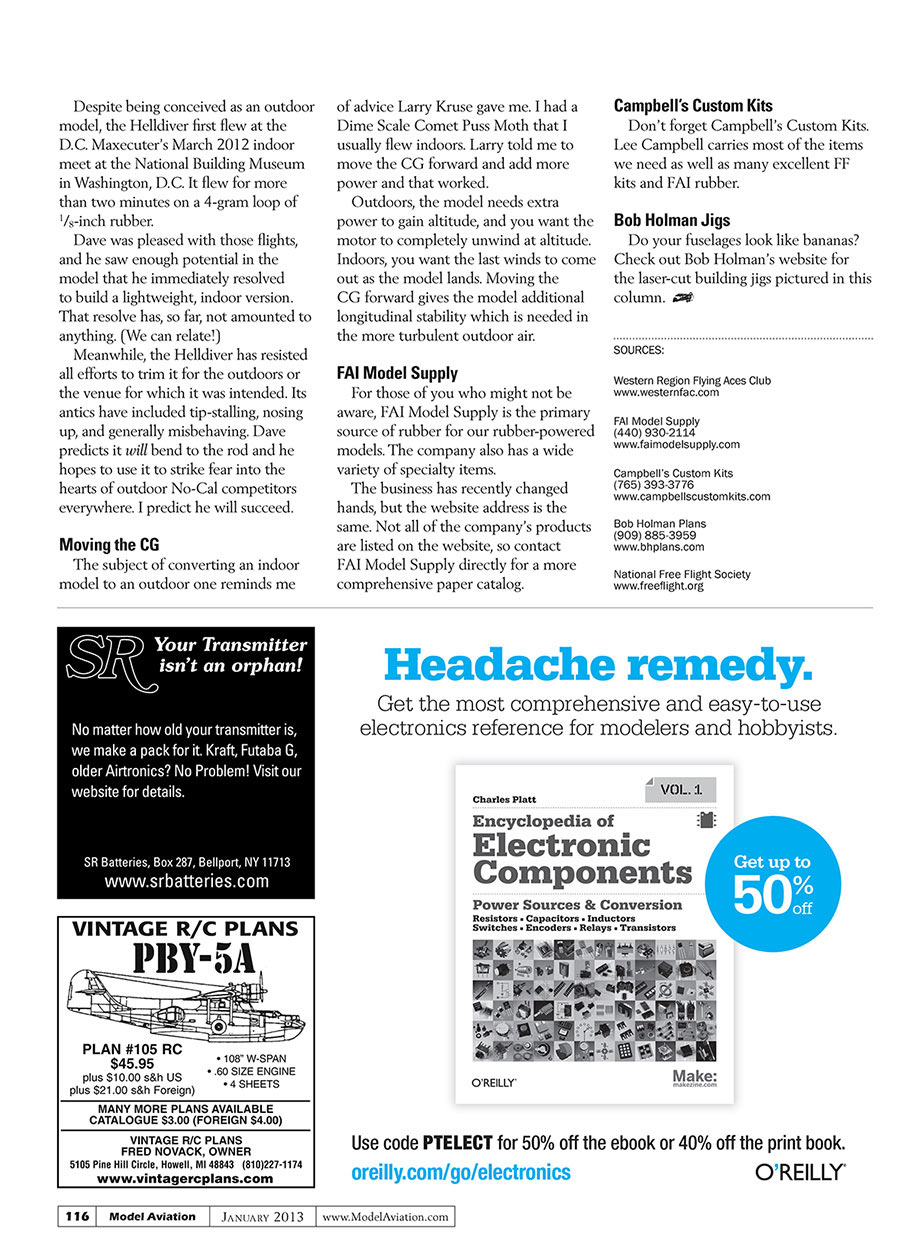
Do your fuselages look like bananas? Check out Bob Holman’s website for the laser-cut building jigs pictured in this column.
SOURCES:
- Western Region Flying Aces Club
- FAI Model Supply
(440) 930-2114 www.faimodelsupply.com
- Campbell’s Custom Kits
(765) 393-3776 www.campbellscustomkits.com
- Bob Holman Plans
(909) 885-3959 www.bhplans.com
- National Free Flight Society
Transcribed from original scans by AI. Minor OCR errors may remain.

