
FF Sport and Scale
Fernando Ramos, 19361 Mesa Dr., Villa Park CA 92861; E-mail: [email protected]
WHAT DO YOU call a modeler who starts building one model, gets it framed, then starts another? Before that one is completed, he/she starts another, until many frameworks are calling to be completed.
Is this being compulsive, neurotic, unstable? I don't fall into any of these particular categories; I just have real zeal for model building and flying.
Haven't you reached a hurdle that has stymied you, and a solution was not in sight? I have, and when I do I start another model until the solution comes to mind. Eventually I go back to that model, cross the hurdle, and go on to finish it.
One of the biggest problems I face is that there are so many airplanes. When one is calling to be built, I drop what I am doing and whale along with the new one.
I have never been one to start a model and go to completion before starting another one. That's boring! When I do get around to finishing my models, I end up having four or five new aircraft to test. It sure beats one!
Then another issue arises: a person's taste changes. I have been a Radio Control (RC) sport flier since I was in high school, but RC is no longer satisfying to me as a modeling interest. It has been more than a year since I have flown RC.
I admit that I have some interest in micro-RC and have acquired some of the smallest units available. However, I am trying to overcome the fact that the batteries that power the electric motor and the RC weigh more than the radio and model put together.
I have several RC models that will probably never be finished—at least by me. As one gets older (and maybe wiser), one's tastes change.
I am presently enamored with my Scale models—Rubber and Power, but also with Old-Timer Rubber and ignition-powered Free Flight (FF). (I have every model engine I have purchased since I was in grade school, including a Brown Jr. I have had since I was 12.)
There is nothing more heart-rendering or adrenaline-inducing than launching a Scale FF or an Old-Timer for the first time. It's satisfying to see the model perform as it should.
I love modeling, and since my retirement six years ago I have an opportunity to fly each Wednesday with approximately 15 dedicated FF modelers. I was never able to do that during my working years.
Another reason why I don't get some models finished is that I often build something just to prove a point, so I can pass the information on to readers. Don't you wish you had an excuse like that?
Do any of you go about modeling as I do?
The September column included various material sources I use for documentation. However, I overlooked Bob Banka's Aircraft Documentation (formerly Scale Model Research).
He has a new, 256-page catalog that was ready to mail by the end of October. Listed are more than 8,000 color Foto Paaks and 35,000 three-view drawings. There are also nine Scale-related articles written by the top names in the Scale movement.
To order the 2002 Aircraft Documentation catalog, send $8 ppd ($10 in Alaska, Hawaii, Puerto Rico, Canada, and Mexico) to Bob's Aircraft Documentation, 3114 Yukon Ave., Costa Mesa CA 92626; Tel.: (714) 979-8058. It is $18 for all other countries, which includes air post.
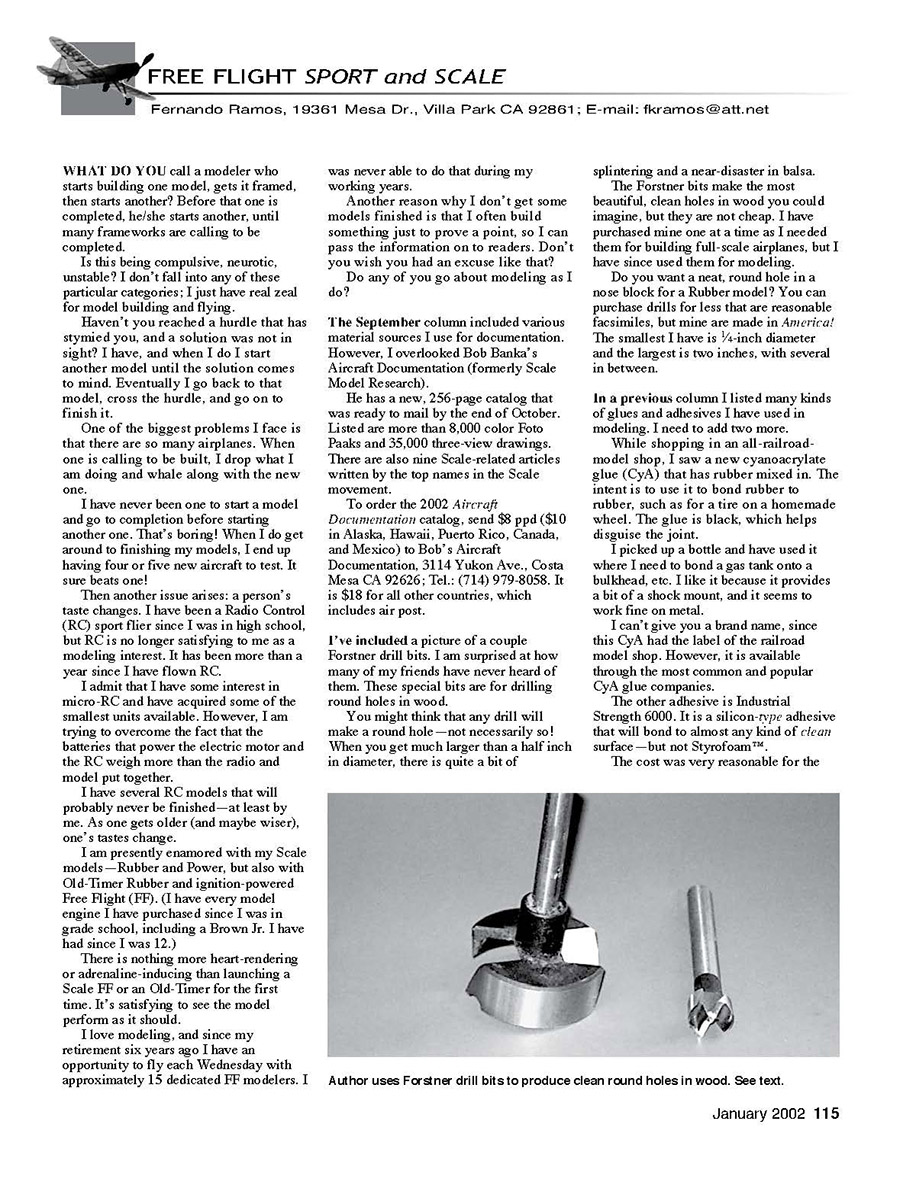
I've included a picture of a couple Forstner drill bits. I am surprised at how many of my friends have never heard of them. These special bits are for drilling round holes in wood.
You might think that any drill will make a round hole—not necessarily so! When you get much larger than a half inch in diameter, there is quite a bit of splintering and a near-disaster in balsa.
The Forstner bits make the most beautiful, clean holes in wood you could imagine, but they are not cheap. I have purchased mine one at a time as I needed them for building full-scale airplanes, but I have since used them for modeling.
Do you want a neat, round hole in a nose block for a Rubber model? You can purchase drills for less that are reasonable facsimiles, but mine are made in America. The smallest I have is 1/4-inch diameter and the largest is two inches, with several in between.
In a previous column I listed many kinds of glues and adhesives I have used in modeling. I need to add two more.
While shopping in an all-railroad-model shop, I saw a new cyanoacrylate glue (CyA) that has rubber mixed in. The intent is to use it to bond rubber to rubber, such as for a tire on a homemade wheel. The glue is black, which helps disguise the joint.
I picked up a bottle and have used it where I need to bond a gas tank onto a bulkhead, etc. I like it because it provides a bit of shock mount, and it seems to work fine on metal.
I can't give you a brand name, since this CyA had the label of the railroad model shop. However, it was available through the most common and popular CyA glue companies.
The other adhesive is Industrial Strength 6000. It is a silicon-type adhesive that will bond to almost any kind of clean surface—but not Styrofoam™.
The cost was very reasonable for the splintering and a near-disaster in balsa.
Transcribed from original scans by AI. Minor OCR errors may remain.

