
FF Sport & Scale
Fernando Ramos, <REDACTED>; E-mail: <REDACTED>
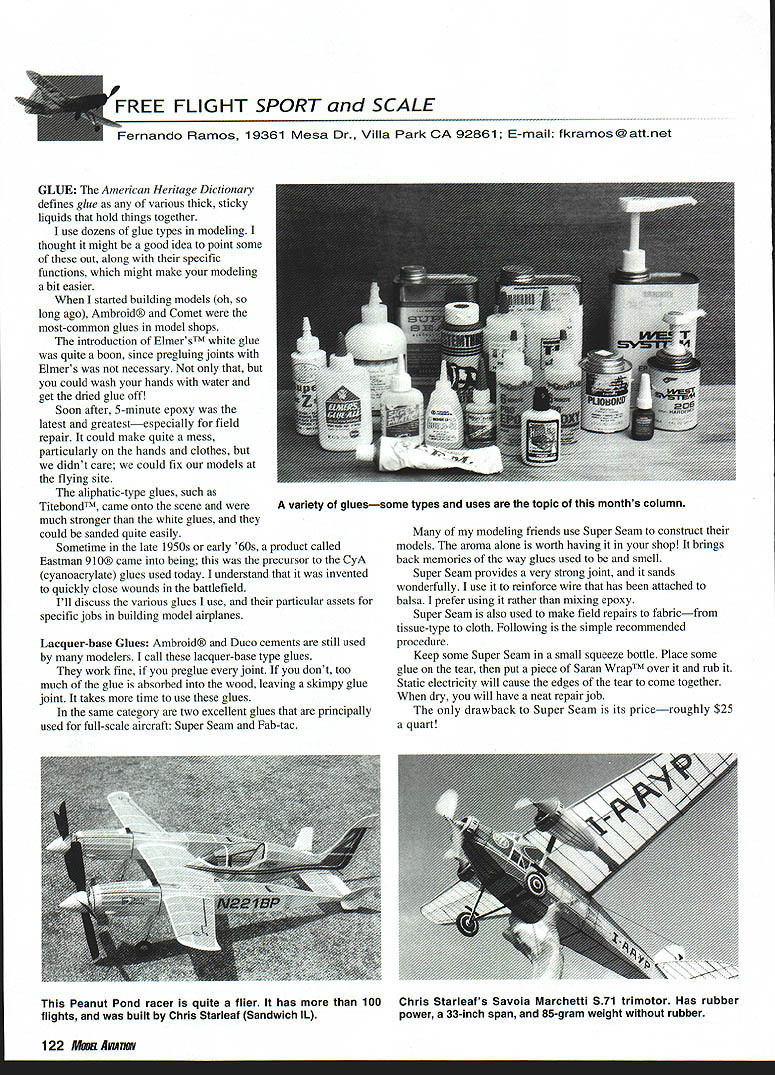
GLUE: The American Heritage Dictionary defines glue as any of various thick, sticky liquids that hold things together.
I use dozens of glue types in modeling. I thought it might be a good idea to point some of these out, along with their specific functions, which might make your modeling a bit easier.
When I started building models (oh, so long ago), Ambroid® and Comet were the most-common glues in model shops.
The introduction of Elmer’s™ white glue was quite a boon, since pregluing joints with Elmer’s was not necessary. Not only that, but you could wash your hands with water and get the dried glue off!
Soon after, 5-minute epoxy was the latest and greatest—especially for field repair. It could make quite a mess, particularly on the hands and clothes, but we didn’t care; we could fix our models at the flying site.
The aliphatic-type glues, such as Titebond™, came onto the scene and were much stronger than the white glues, and they could be sanded quite easily.
Sometime in the late 1950s or early ’60s, a product called Eastman 910® came into being; this was the precursor to the CyA (cyanoacrylate) glues used today. I understand that it was invented to quickly close wounds in the battlefield.
I’ll discuss the various glues I use, and their particular assets for specific jobs in building model airplanes.
Lacquer-base Glues
Ambroid® and Duco cements are still used by many modelers. I call these lacquer-base type glues.
They work fine, if you preglue every joint. If you don’t, too much of the glue is absorbed into the wood, leaving a skimpy glue joint. It takes more time to use these glues.
In the same category are two excellent glues that are principally used for full-scale aircraft: Super Seam and Fab-tac.
Many of my modeling friends use Super Seam to construct their models. The aroma alone is worth having in your shop! It brings back memories of the way glues used to be and smell.
Super Seam provides a very strong joint, and it sands wonderfully. I use it to reinforce wire that has been attached to balsa. I prefer using it rather than mixing epoxy.
Super Seam is also used to make field repairs to fabric—from tissue-type to cloth. Following is the simple recommended procedure.
- Keep some Super Seam in a small squeeze bottle.
- Place some glue on the tear, then put a piece of Saran Wrap™ over it and rub it.
- Static electricity will cause the edges of the tear to come together.
- When dry, you will have a neat repair job.
The only drawback to Super Seam is its price—roughly $25 a quart!
I mix Fab-Tac with nitrate dope to put over a structure before covering. I brush on three coats minimum of this mixture, and sand between coats. Any of the covering materials bond easily when acetone or MEK (methyl ethyl ketone) is brushed through them.
Fab-Tac is more reasonably priced, at less than $10 a quart.
Epoxies and Epoxy-like Adhesives
Epoxies are great where more strength is needed—usually around a firewall or landing gear.
I use a 5-minute epoxy where time is of the essence, and a super one called T-88. This is used for full-scale aircraft construction and is incredibly strong. It sets up in approximately 45 minutes, and it cures in roughly 24 hours. I use T-88 where strength is most important.
With epoxies, the longer the cure time, the stronger the joint.
West Systems is another epoxy I keep on hand. It is also used primarily for the full-scale market; however, it is advertised in magazines for radio-control fliers, where fiberglass and epoxy is used to finish a model.
I like using West Systems to coat the engine compartment of all my gas models. It is tough and durable. It will also bond metal to wood. I have pumps on the cans that give the exact proportions required, making it easy to mix.
Another epoxylike adhesive is Systems Three Grizzly Glue. It is a polyurethane one-part glue that is paintable and stainable. It can be used for wood, foam, concrete, marble, etc.
This glue is interesting because it tends to expand. I got it to repair balsa nose blocks when they have taken a hit, crack, and split. If used like regular glue or epoxy, clamping is in order—otherwise, expansion will take place.
If you aren't familiar with JB Weld or have never used it, hopefully this will give you reason to try it. Like epoxies, this is a two-parter of equal volume. The difference is that once it is dry, it can be machined!
JB Weld is dynamite for welding and for making a variety of repairs around the house.
A while back, I was in need of a needle-valve extension. However, I didn't want it to protrude outside the cowl.
I cut the head off an Allen-head screw, and attached it to the head of the needle valve with JB Weld. Now I can use a ball-driver for adjusting the needle valve.
Most of my scale free-flight models have plug-in wings. I like to have the tubing inside the fuselage, with the wires inside the wings. I use JB Weld to attach the tubing to the fuselage and attach the wires onto the wing structure. It doesn't weigh much more than regular epoxy, and is incredibly strong!
This adhesive also works great where an engine lug has been broken, or even where there's a crack in the crankcase. You can probably find many more uses than mentioned here.
Paul Harvey's radio program is sponsored by JB. He suggests that you keep some in your car, in case of an unexpected breakdown.
CyA (Cyanoacrylate) Glues
For some, this is the greatest invention since the wheel. For others, it has its place and can be used to advantage when the right situation comes along.
I fall into the latter category, but I know many modelers who use this type of glue from beginning to end.
There are many brands on the market, and they seem to work roughly the same. One thing many have in common is that the bottles' spouts will eventually plug up, and it's a continuous problem from that moment on.
I keep small bottles of thin and medium on hand for occasions where time and speed is crucial. I've tried thick, but it goes to pot long before I use much from the bottle. And sanding CyA is nearly impossible; the surrounding wood takes a beating.
One favorite use is to glue a wire into a tube. There is no way to separate the two, once the bond has been made!
White Glue
Even though I haven't made a model with this glue in many years, and I no longer use it thinned-out to attach tissue to structures, I still have a use for it.
Sometimes it is prudent to use foam for fairing, a scoop, etc., to keep the weight down, but dope will attack the foam and ruin your handiwork. I coat the foam part with white glue, and the part can be doped or painted after it dries.
Elmer's™ or Wilhold are the two most-popular types.
Aliphatic-type Glues
Aliphatic-type glues are those such as Franklin's Titebond™.
(In the world of chemistry, aliphatic refers to a straight chain of organic molecules, instead of the ring type.)
When Titebond first came out, I converted from using white glue. As time went on, it was more difficult to find some that was fresh; it was getting thick in the bottle.
When this happened, I thought it would be smart to buy a big jug and pour some into a small squeeze bottle. Was I wrong! I couldn't use the glue fast enough, and I ended up throwing away most of the big jug.
I went to the local True Value hardware store, and its brand was just as good and was always fresh. The hardware chain later decided not to carry its brand anymore. It still carries several aliphatic-type glues, but I learned of another one that I really like in the meantime—Rowood Glue.
It is strong, it dries reasonably quickly, and it sands easily. It is considered to have industrial strength, and is formulated to meet the needs of a professional craftsman. I buy Rowood Glue at a lumberyard that specializes in hardwoods. The cost is $2.50 for a 16-ounce bottle.
There is no address on the bottle, but there is a telephone number: (503) 981-5619. Try it; you will like it.
Another type of aliphatic glue I have is Super Phatic. This is really thin glue; it almost has the viscosity of water.
It is to be used like CyA glue, with wicking and capillary action at a joint. The good part is that it is water-soluble. I don't use CyA for this purpose; I find great use for it when I'm laminating wet strips of balsa or basswood or balsa.
After removing the strips of wood from the water (I use a piece of PVC [polyvinyl chloride] tubing with one end plugged filled with water to soak my wood), I wrap them around my template and pin them down. Then I use Super Phatic on the wet wood, to bond everything.
You can't do that with CyA glue, unless you work it dry!
I believe Super Phatic is manufactured in the UK and can be purchased from Hobby Lobby, which carries another dynamite glue—PFM™ Super Adhesive. It is a silicon-type glue that has a myriad of uses.
I make many of my own fuel tanks, using the largest-diameter brass tubing typically found in model shops. I solder flat brass sheet on either end, trim, then add the brass tubing for the fuel line and filling.
I use PFM™ to adhere the tank to the fuselage, usually on plywood or hardwood mounts. It is impervious to fuel.
For old-timer models that use ignition systems, I know of an electronics parts house that carries excellent metal battery boxes. They are attached to a piece of plywood with PFM™. I have never had one come loose.
Wilhöld R/C-56 glue is supposed to be good for attaching canopies and windshields onto models, but the results are a mixed bag. Sometimes it works great, and other times not so great. I know several modelers who have had the same results.
I don’t use R/C-56 for attaching canopies. I use it to attach the tails onto small rubber models. It dries clear, and it has a bit of give at the joint when thoroughly dry. I like using this glue because if the tail is bumped, it will give some without breaking anything.
If you want a good glue for attaching canopies and the like, try Pacer’s Hinge Glue.
I bought some to use on hinges, and it worked fine. One day the idea struck me that if it is good for all plastic hinges, why wouldn’t it work for canopies? I tried it, and it is excellent.
By inserting some Teflon™ tubing (used on CyA bottles as extensions, for smaller drops) into the bottle of the Hinge Glue, you can get a finer bead of glue. The Hinge Glue is thinner in viscosity than R/C-56, so a bit of care is in order.
The Hinge Glue dries fairly quick and clear. It's great stuff.
Contact Cement
The contact type of cements, such as Plibond and Goo, come in cans with a brush in the lid, in tubes, or even in spray cans.
There are times when only this type of glue will work, so I keep some on hand.
With contact cements, you have to coat each side of the surfaces to be bonded. Let the surfaces set for several minutes, then bring them together. Once you have done that, there is no separating them.
It is imperative to take care in alignment; otherwise, new parts have to be made.
I almost forgot Loctite®. This product comes in a variety of colors, with each designating a particular strength.
I keep the blue Loctite® for a specific job. I had a diesel, in which the compression screw would unwind as the engine was running. My friend Dave Larkin suggested using the blue to remedy the situation. It worked fine.
You can find Loctite® in any hardware store.
I hope you find this information useful. I know how easily it is to be locked in on one product, and nothing else will do.
I try to make life as easy as I can when building model airplanes! MA
Transcribed from original scans by AI. Minor OCR errors may remain.

