
Field of Dreams
"IF YOU BUILD IT, they will come." And they have.
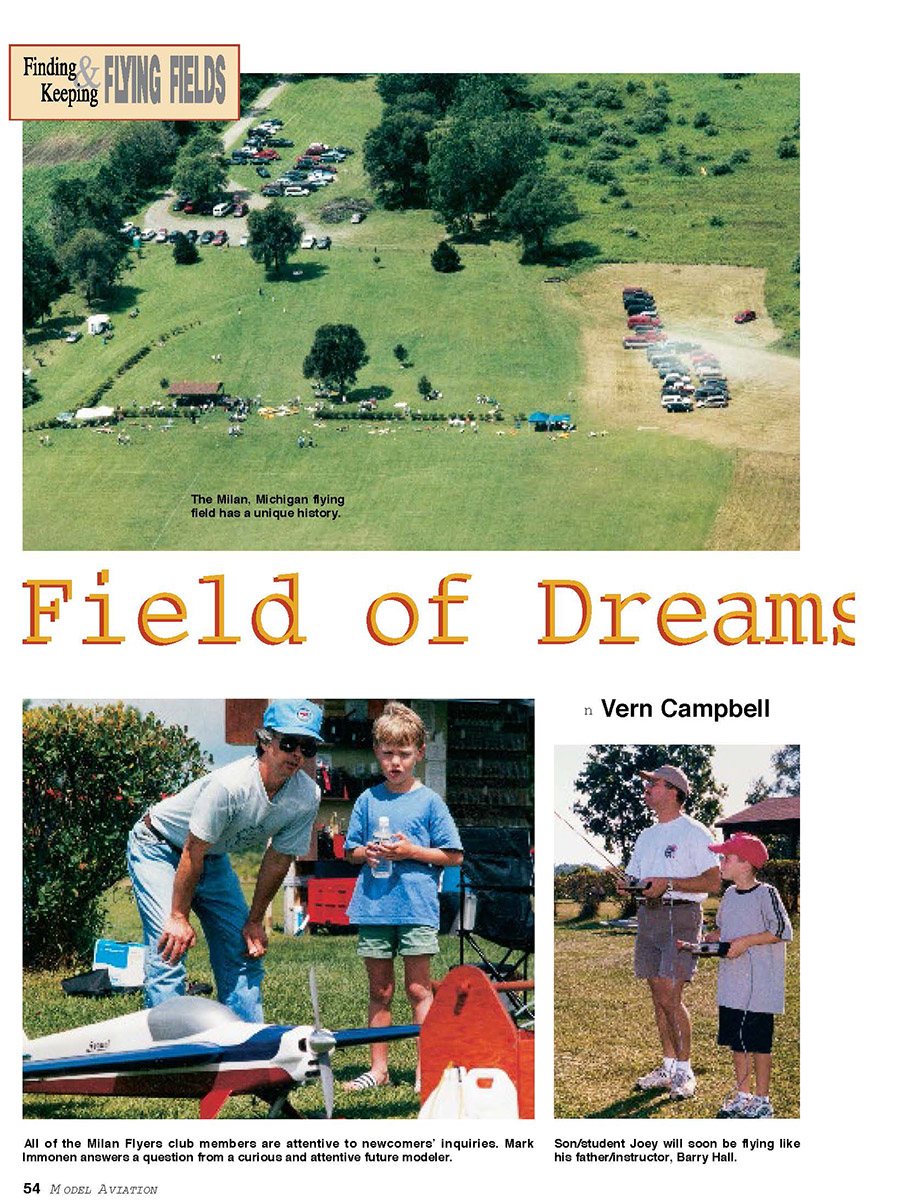
A unique feature of the Milan, Michigan flying field is that it came into being before there was anyone to fly off it. The site's life began when 139 acres became available as surplus government land. It had been the farm for the nearby Federal Correctional Institution.
At the time (1972), I was chair of the Milan Parks & Recreation Commission. As I walked into the post office one day, the postmaster shoved a piece of paper at me and asked, "Have you seen this?" It was a description of the surplus land.
A quick trip to the city office got a cool response to the idea of asking for it, but the Parks & Recreation people did not see it that way. To make a very long and complicated story short and simple, we applied for the land and got it!
The lesson here is that government—local and federal—can work in favor of such things as flying fields. It is a matter of being persistent and working the system.
Now that we had the property for recreational purposes, what would we do with it?
Many suggestions came forth, but a few action types moved the grass with hand mowers to get a strip mowed so one could fly off it. That primitive system went on for several years before there was an organized group of any kind.
We were actually trying to recruit pilots to come and fly so we could justify that use of the land. A key stipulation for the granting of the property was that it be used for recreation, and part of the evaluation of proper use is based on the number of people who use it.
Some who used the field one sunny afternoon did so while running engines with no mufflers. The next day we were notified that there would be no more flying at the site! The complaints were justified. Fields are easier to lose than to get, and this was the case in the reasons for losing ours.
However, by meeting with the proper officials, we got it back by agreeing to an enforced muffler rule.
We have since modified that with a 95 dB (decibel)-at-three-meters rule. We have an area laid out for checking static, and there are always sound meters at the field. The purpose is not to keep anyone from flying but to keep us in compliance so we can all fly.
Then a group of citizens came along who thought the field would be much better by home-riding area. They won.
There were several meetings that generated more heat than light, but the area was building the flying field had been. At that point we had lost the field twice.
Then a trade-off was proposed. There was some open space on the same old farm on the other side of the railroad tracks. It meant starting over again, but the resources came together to do it.
When a farmer friend heard what had happened, he volunteered to plow the site. A few pilots staked out the four corners of an eight-acre area, and the farmer came in with a five-bottom plow on one tractor and a disc and another tractor that his son drove.
The overgrown grass and brush had been transformed by the end of one evening, and our field of dreams began to take shape.
Between the time the land had been given and this point, the federal government had allowed part of the acreage to be leased for farm crops, so long as the revenue was used for development of the site.
This generated approximately $8,000 that the city approved to be used to further develop the flying field itself.
A contractor was hired, who came in with a huge earth-moving drag, and he quickly put all the high spots into the low spots, and there was a level flying field.
That good contractor loaned the city his grader, and by the next year there was a green grass.
The site ended up better than it was in the former location. The field is flat, smooth, and green, with good drainage and shade trees. There is ample parking on three sides of the field, but the only other area is a farmer's field at one end of the runway. He has been cooperative, and we talk with him about any problems. Yes, there have been some, but fortunately there are no houses adjacent to the field.
The politics of the city-owned site are complicated. The old farm is divided by the township line, with the parking area in one township and the flying area in another.
The solution has been to get the two townships and the city to adopt the same ordinances for the site, and there have been problems with the arrangement.
It has been a genuine friend. Not only was the site provided, but the city purchased a five- or six-acre roll mower from a sod farm. The fliers service the machinery and use it to cut the grass. That wonderful piece of equipment has been pulled by a variety of tractors, pickups, and vans.
Since the site is officially a park site, there are some special benefits. The city crews cut the grass outside the flying area, and the city provides portable toilets, maintenance on the road, and trash pickup. (Most of us have made a contribution of two to the trash barrel.)
The pilots have not only maintained the site, but have constructed the flight board and a fine shelter. These things were done with contributions of money and labor, and we all know that anything put on the site becomes city property.
This, as it should be, and the city and the fliers have been happy with the arrangements.
The first club to reserve and use the field was SAM (Society of Antique Modelers) 40. The members volunteered labor and planted many bushes to mark off the field and the flightline.
Many of the pilots have banded together to form the Milan Flyers since those days, so we have two primary clubs that use the facility, some fliers who belong to other clubs, and others who are AMA members but have no club affiliation.
The site is a public park administered by the Parks & Recreation Department of the City of Milan. That means anyone who adheres to the rules can fly there.
This has caused some conflict and is difficult for some to understand, because there are those who want private ownership and control.
This arrangement is based on cooperation. The city has allowed us to develop our own rules beyond the park ordinances, and they are similar to those found at any flying field.
When this project began, several radio ideas would never work. We have been flying there for roughly 20 years!
It is a first-class facility, and it seems that the problems we encounter are not much different from those that come up no matter what the legal arrangements are.
One of the original pilots at the field owned the local hobby store and needed a field where people who bought radio control airplanes and supplies could learn to fly. This field of dreams was built for that!
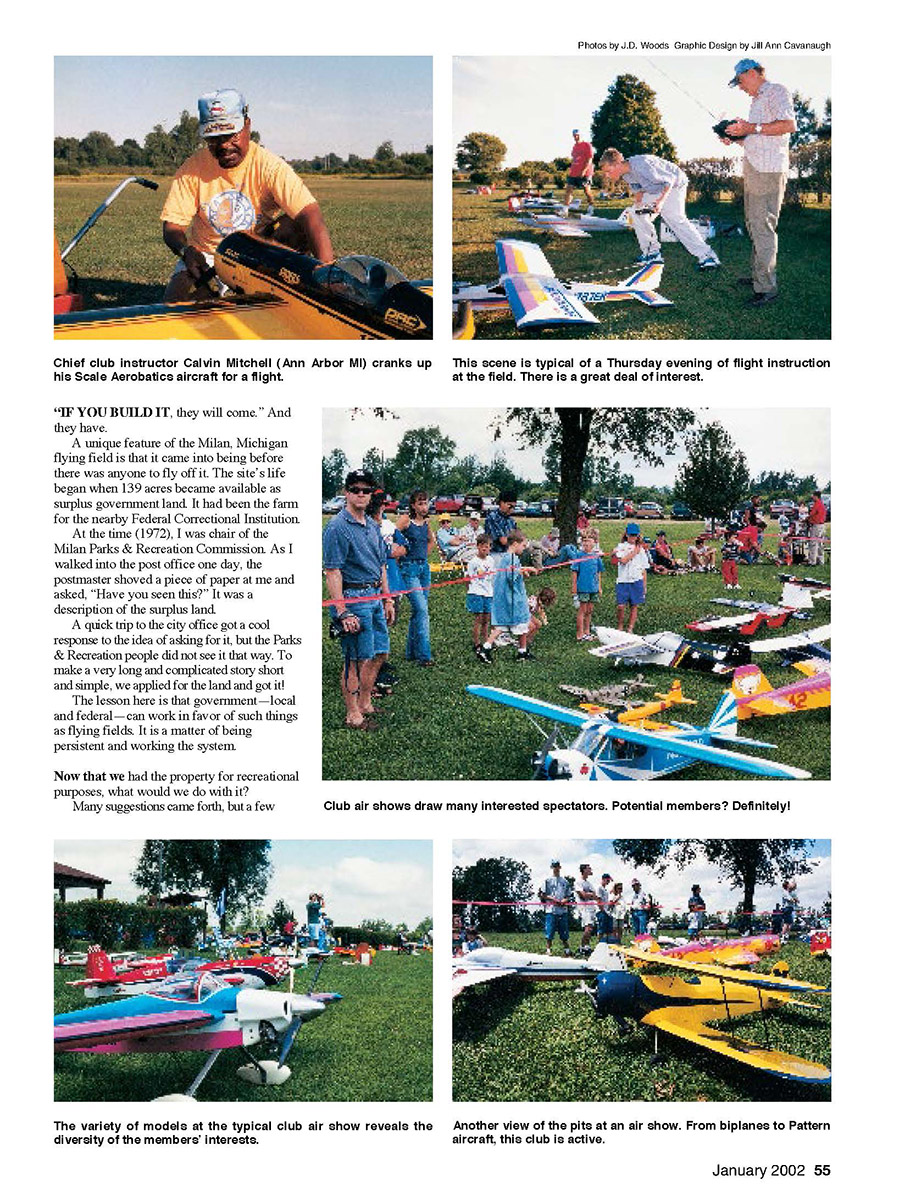
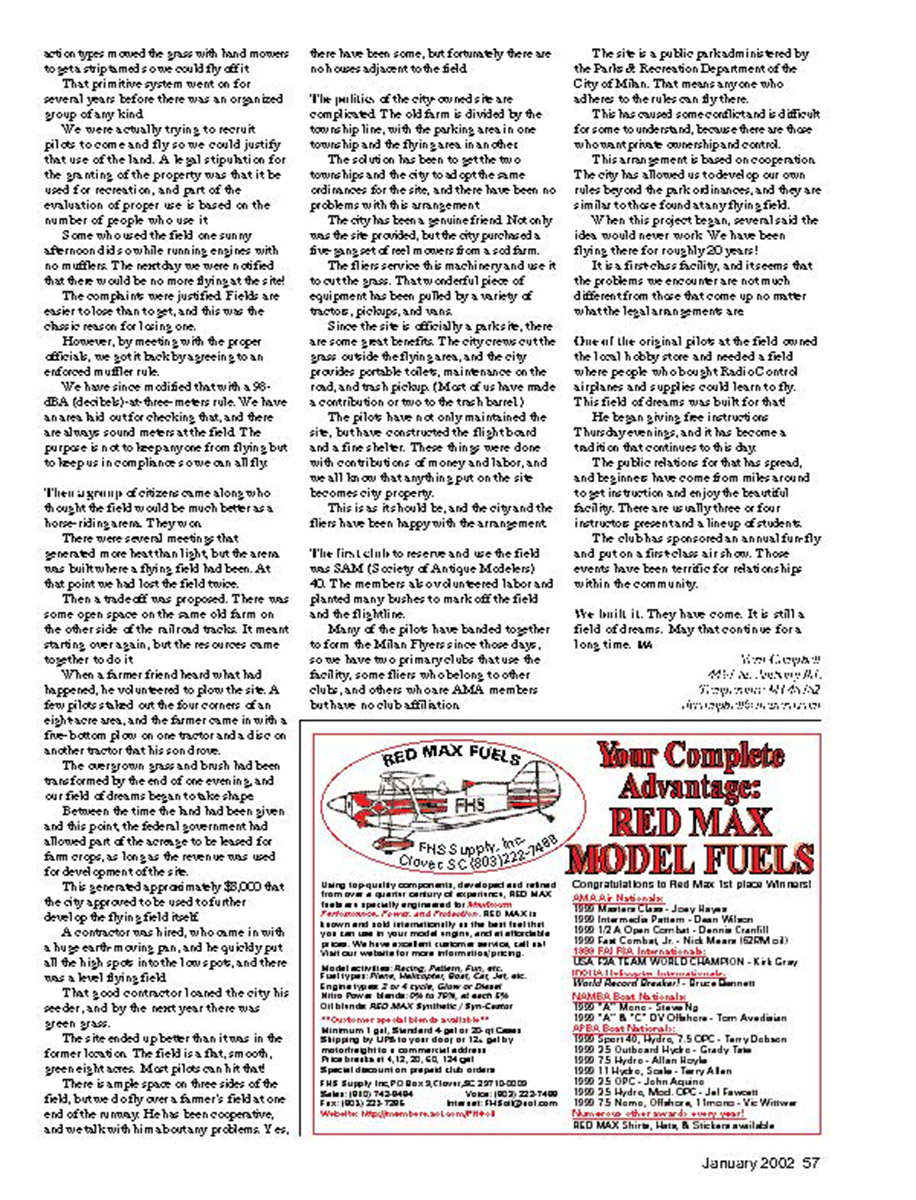
He began giving free instruction on Thursday evenings, and it has become a tradition that continues to this day.
The public relations for that has spread, and beginners have come from miles around to get instruction and enjoy the beautiful facility. There are usually three or four instructors present and a lineup of students.
The club has sponsored an annual fly and put on a first-class air show. Those events have been terrific for relationship within the community.
We built it. They have come. It is still a field of dreams. May that continue for a long time.
Milt Galy, Milan, Michigan, Councilman
Transcribed from original scans by AI. Minor OCR errors may remain.

