

Understanding Spins
Scott Stoops [email protected]
Spins
“Death spiral,” “unrecoverable,” and the “controls wouldn’t work right” are but a few of the words and terms that I have heard used to describe what modelers thought was happening to their airplanes right before they hit the ground. In most of those cases, if the pilot had been familiar with spin theory and recovery procedures, the model could have been saved.
Unfortunately, many modelers approach spins and stalls in the same manner that much of the full-scale general aviation world did in the past. Historically, general aviation has mentioned spin theory in passing and not required any spin training.
In the late 1980s and ’90s, there was a push to teach spin theory and train spin recovery. As a result of that change in spin-training philosophy, there has been a large reduction in spin accidents. I find that if you can understand and practice a spin as a maneuver rather than view it as an accident, your awareness will allow you to avoid unintentional ones.
So, what is a spin? It is a stall that has been aggravated with a yawing force, either purposely as a maneuver or by accident.
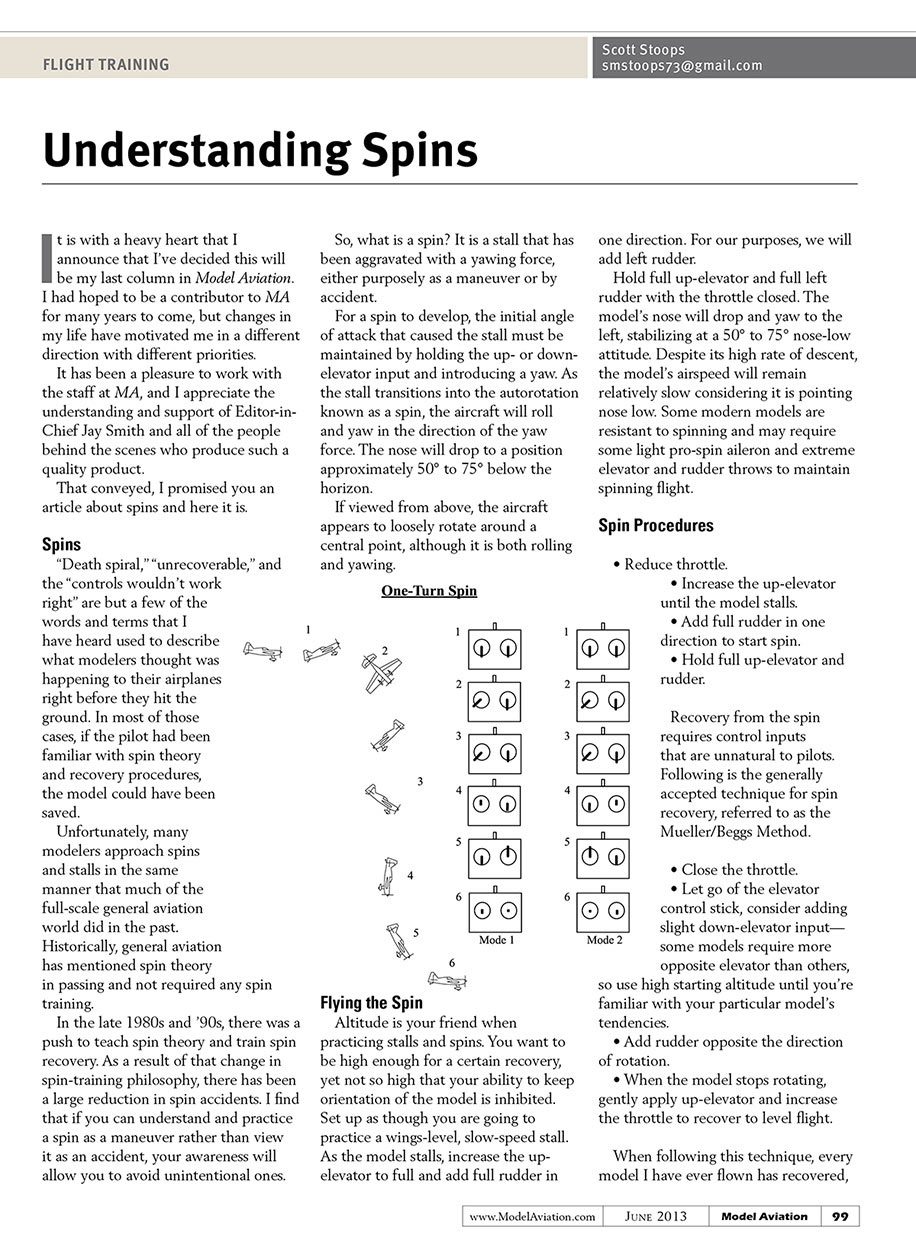
For a spin to develop, the initial angle of attack that caused the stall must be maintained by holding the up- or down-elevator input and introducing a yaw. As the stall transitions into the autorotation known as a spin, the aircraft will roll and yaw in the direction of the yaw force. The nose will drop to a position approximately 50° to 75° below the horizon.
If viewed from above, the aircraft appears to loosely rotate around a central point, although it is both rolling and yawing.
Flying the Spin
Altitude is your friend when practicing stalls and spins. You want to be high enough for a certain recovery, yet not so high that your ability to keep orientation of the model is inhibited. Set up as though you are going to practice a wings-level, slow-speed stall. As the model stalls, increase the up-elevator to full and add full rudder in one direction. For our purposes, we will add left rudder.
Hold full up-elevator and full left rudder with the throttle closed. The model’s nose will drop and yaw to the left, stabilizing at a 50° to 75° nose-low attitude. Despite its high rate of descent, the model’s airspeed will remain relatively slow considering it is pointing nose low. Some modern models are resistant to spinning and may require some light pro-spin aileron and extreme elevator and rudder throws to maintain spinning flight.
Spin Procedures
- Reduce throttle.
- Increase the up-elevator until the model stalls.
- Add full rudder in one direction to start spin.
- Hold full up-elevator and rudder.
Recovery from the spin requires control inputs that are unnatural to pilots. Following is the generally accepted technique for spin recovery, referred to as the Mueller/Beggs Method.
- Close the throttle.
- Let go of the elevator control stick, consider adding slight down-elevator input—some models require more opposite elevator than others, so use high starting altitude until you’re familiar with your particular model’s tendencies.
- Add rudder opposite the direction of rotation.
- When the model stops rotating, gently apply up-elevator and increase the throttle to recover to level flight.
When following this technique, every model I have ever flown has recovered, including some high-performance aircraft. With an extremely aft CG, it is possible that you will need to apply significant opposite elevator, for example, not neutral but down-elevator in an upright spin.
Although this is focused on an R/E/T (rudder, elevator, throttle) model with no ailerons, the recovery is identical for a model with ailerons. Notice that at no time did you use ailerons to recover from the spin.
There is a reason for this. Using ailerons causes adverse yaw. In our left spin scenario, if we were to use right aileron input to recover, adverse yaw from the aileron input yaws the nose left. This is not good when we are trying to reduce the left yaw.
Unplanned Spins
Here is the scenario: Approaching the field for an impressive high-speed fly-by with his new warbird, "Joe" has his model in a high, bank-angle left turn. Noticing that he overshot the turn onto his intended fly-by course, Joe pulls back on the stick harder than he intended to "pull it around the corner."
Suddenly, the model rolls hard to the left and the nose starts to drop. In response, Joe pulls up harder on the elevator and adds right aileron to bring the bank angle back to the intended one. Instead, the model rolls harder to the left and the nose drops further. The model hits the ground in a nearly vertical attitude after rolling several times while descending to the ground.
During the walk of shame to retrieve the pieces, Joe mutters to himself about how he must have been shot down or had a glitch. So, what happened?
As a result of that high-banked turn, the model was already at a high angle of attack. The increased pitch command for his course correction put the model's angle of attack beyond the critical angle of attack. The model stalled, and because of the existing bank angle and yaw condition, rolled slightly to the left. The adverse yaw from the pilot's aileron input caused a further left yaw, worsening the spin. Finally, the increased elevator input sealed the model's fate by fully developing the spin.
What could Joe have done differently? If he had recognized the stalled condition, he could have used the Mueller/Beggs recovery technique and saved the model.
Remember that, as with a stall, spins can start from any attitude and any airspeed. They are an angle of attack-triggered maneuver, not an airspeed- or attitude-triggered one. By closing the throttle, reducing the angle of attack, and adding opposite rudder, the spin would have never developed and the model would have been saved.
Take-Away
By understanding spin theory and actually practicing spins as maneuvers, you will develop spin awareness that will prevent an accidental spin from happening to you and your model. The next time you hear someone describe a "death spiral," you can casually say, "Oh, that is just a spin."
Thanks again to Model Aviation, the AMA, and you, the readers, for the gracious welcome into the fold that I received. I'll be around, and I will continue to be an avid AMA member and supporter.
As always, remember that learning is fun and fun is what this great hobby and the AMA are all about.
Transcribed from original scans by AI. Minor OCR errors may remain.

