
Florida Jets
History of the Event
Frank Tiano is the Ed Sullivan of model aviation. He has the organizational skills to stage a "really big show."
After countless meetings with Flagler County officials, in 1997 Frank launched the first Florida Jets event. The county agreed to rent an unused 5,000-foot runway at its airport located at Bunnell, between Daytona and St. Augustine.
The location is easily accessible by car (it's just off I-95) or airplane (the area is served by Orlando, Daytona Beach, and Jacksonville International Airports).
The event was scheduled for early March, assuring delightful Florida spring weather.
Frank had built a strong infrastructure of employees and volunteers from the Top Gun tournament, and he channeled their experience to Florida Jets. As a result, from the outset Florida Jets ran smoothly and safely, attracting prominent jet modelers and manufacturers from around the world. It has grown to become the Paris Airshow of jet-model aviation.
The 2001 edition of Florida Jets, held March 1–4, featured 180 pilots with more than 300 aircraft. An excess of 600 flights were logged before the flightline closed Sunday to make way for some serious weather.
Approximately 2,500 people attended the event—a number that might have doubled had the biggest spectator day, Sunday, not been a washout.
In typical Tiano fashion, the event was organized in a pilot- and spectator-friendly manner. The pit area provided easy access to the flightline. The local club—the Flagler County RAMS (Radio Aero Modelers)—ran the transmitter impound efficiently, and overnight model storage was available in a huge 40 x 80-foot tent, complete with a security guard.
Spectators had convenient parking and a clear view of the entire flightline, allowing a perfect vantage point for photography. Each day the flightline secured at noon to allow the spectators to inspect the models on the runway.
In five years Florida Jets has become a big business. Flagler County sees an estimated economic impact of 1.25 million dollars from the event.
Overview of the Models
Radio control (RC) jet modeling has evolved into three power-plant categories (gas turbines, glow-engine ducted fans, and electric-motor ducted fans) and two airframe categories (sport aircraft and scale aircraft).
Turbines clearly dominated this year's gathering; more than 90% of the models were turbine-powered. Glow-engine ducted fans are becoming scarce; it is almost a curiosity to hear the high-pitch two-stroke shriek on the flightline.
Electric fans are showing a growth in popularity; however, there was only one at this year's event.
Because of the ease of construction, lower cost, and higher performance, sport airframes were more numerous than scale airframes. The Kangaroo/Hot Spot delta wings were present in large numbers. Those are highly prefabricated models with simple exposed engine installations.
More refined sport jets with enclosed turbine systems, such as the Bob Violett Models (BVM) Bandit and the Crow Aviation Inc. (CAI) Raptor, were also present in large volume.
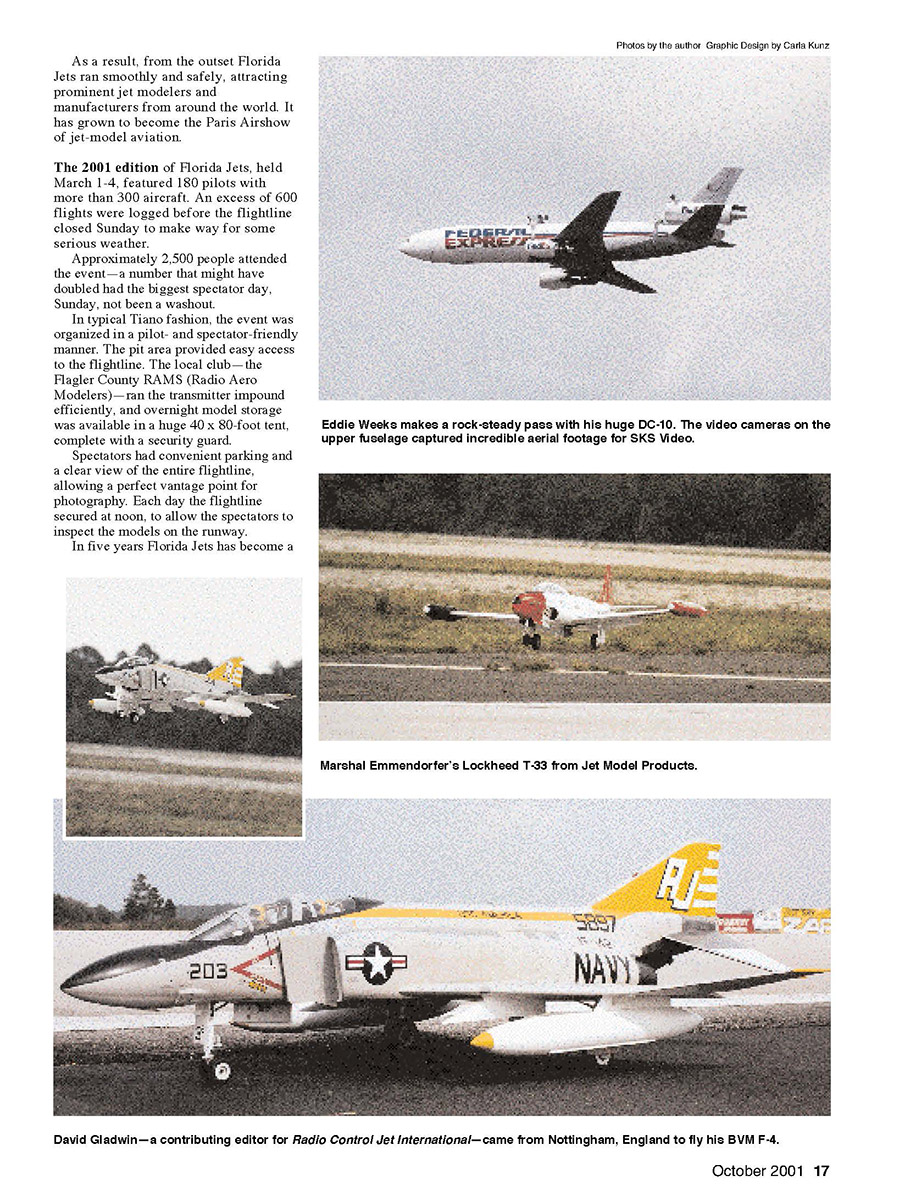
Among the high-performance sport jets, Tom Cook's Jet Model Products Firebird is an exceptional model. Powered by an AMT Olympus turbine, this elegant design flew with breathtaking speed without breaking a sweat. Tom told me he held the engine at 40% throttle or less for most of the flights. The true potential of this model is yet to be seen.
Another sport jet that is capable of astonishing performance is the BVM Bandit. I saw at least 10 fly during the event. Pete Malchione painted his AMT Mercury-powered Bandit in the colors of the Italian demonstration team, Frecce Tricolori. This is a very effective paint choice, since the Bandit's lines are similar to those of the Aermacchi MB 339 PAN jets the team flies.
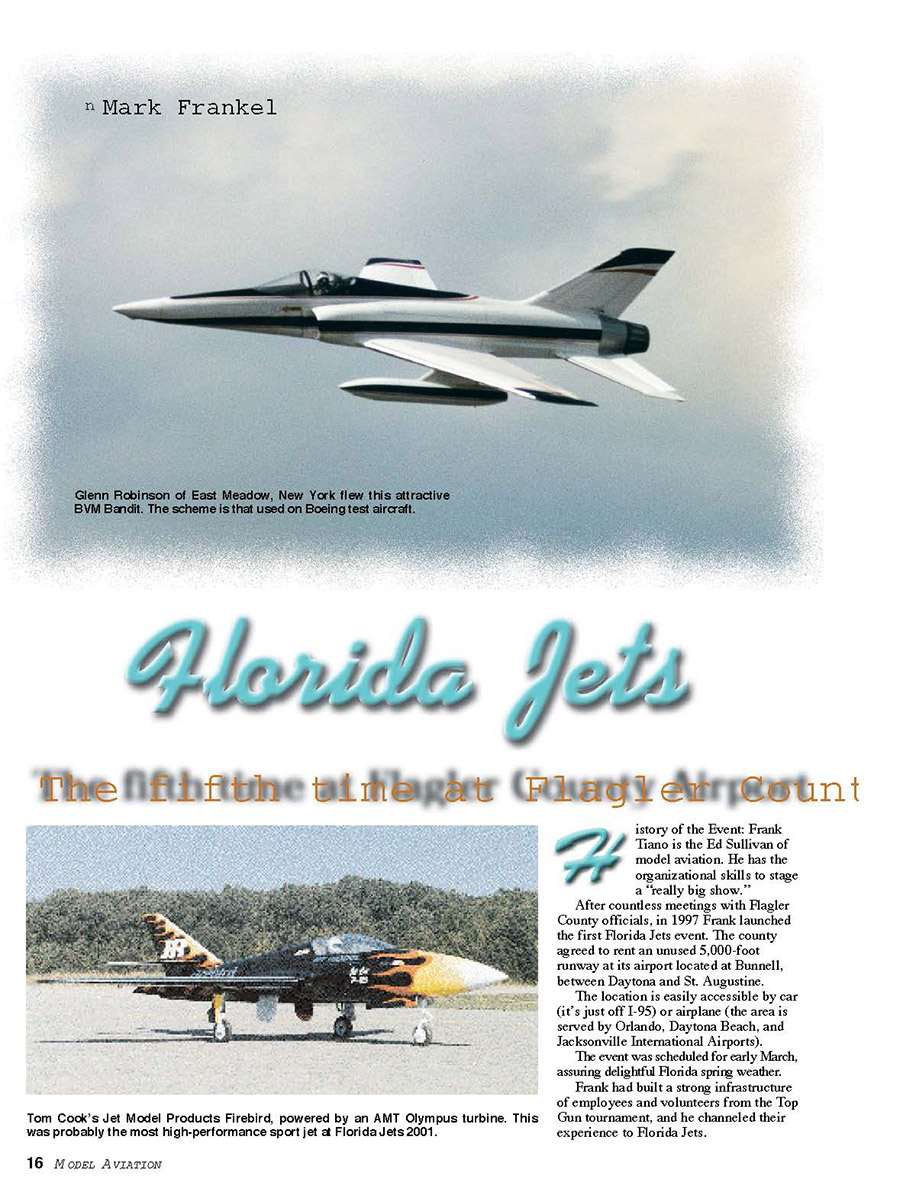
Glenn Robinson flew an immaculate white Bandit with red and blue trim—a scheme Boeing uses on test aircraft.
Scale models represented a diverse selection of designs from early military trainers to modern airliners. There were many notable scale displays during the event, but the most memorable was Bob Violett's F-100 Super Sabre.
When a perfectly sized airframe is matched with high thrust from a reliable turbine and well-executed scale detail is incorporated with interesting mechanical features, the result is a landmark scale project. Colonel Bob Thacker—a noted Air Force pilot and highly respected modeler—turned to me after a Violett demo, as the F-100 taxied in, and said, "You have just seen the difference between a model airplane and a miniature aircraft."
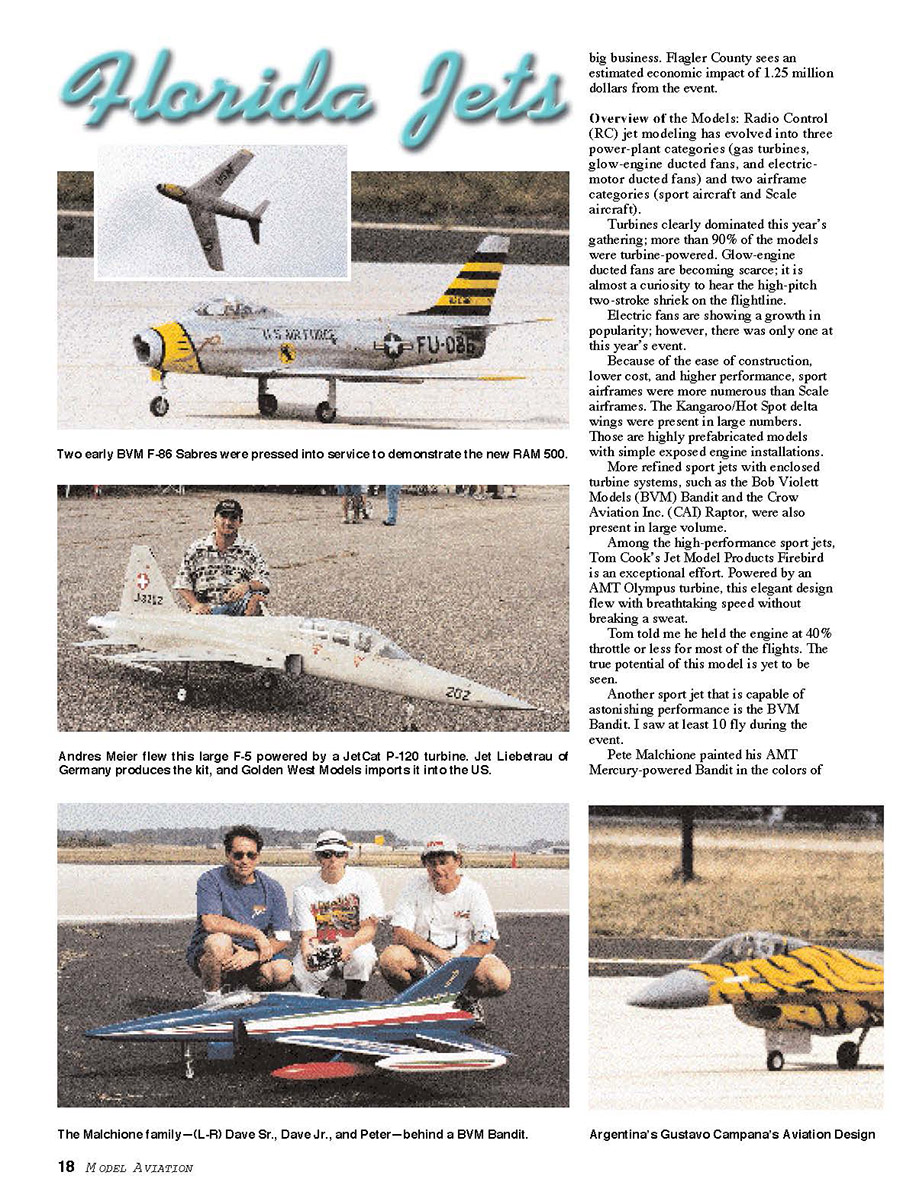
The BVM F-4 Phantom was designed in the early 1990s for twin ducted fans. The advent of turbine power has given that kit a new lease on life. A bifurcated tail pipe permits the use of a single engine, which emits its exhaust through two nozzles.
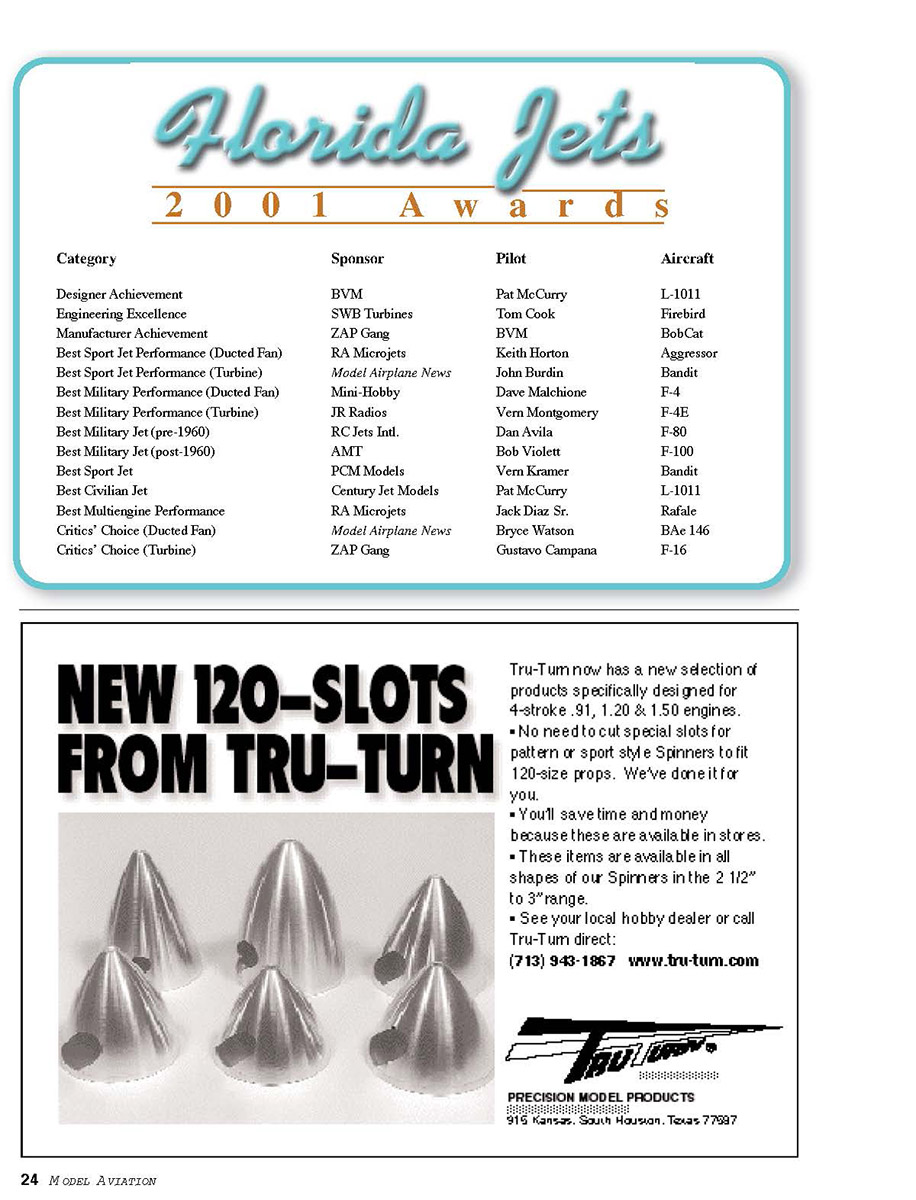
When powered by one of the high-powered turbines, such as the RA Microjets (RAM) 1000 or the AMT Pegasus, the Phantom's performance is superb. The Violett-Factory Phantom carries the Blue Angels colors and features a very effective smoke system.
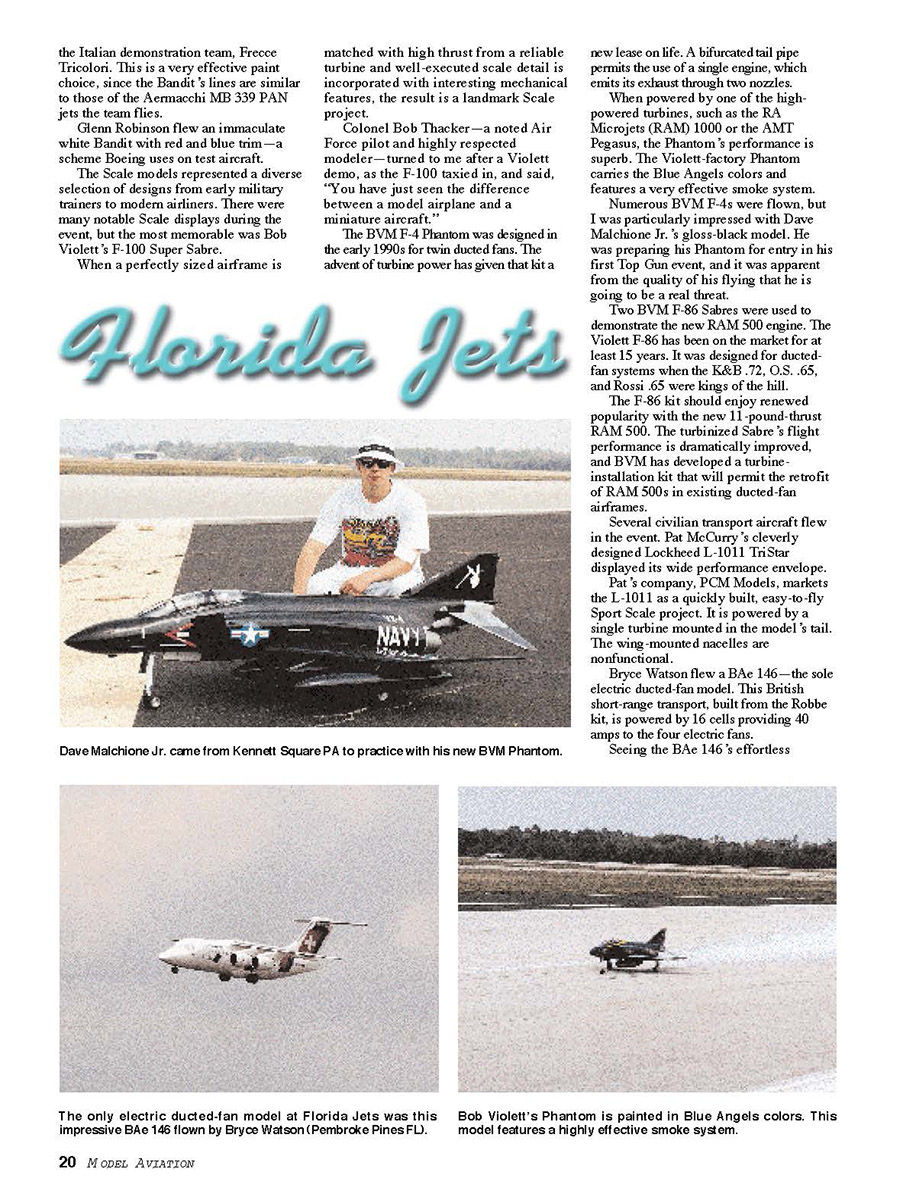
Numerous BVM F-4s were flown, but I was particularly impressed with Dave Malchione Jr.'s gloss-black model. He was preparing his Phantom for entry in his first Top Gun event, and it was apparent from the quality of his flying that he is going to be a real threat.
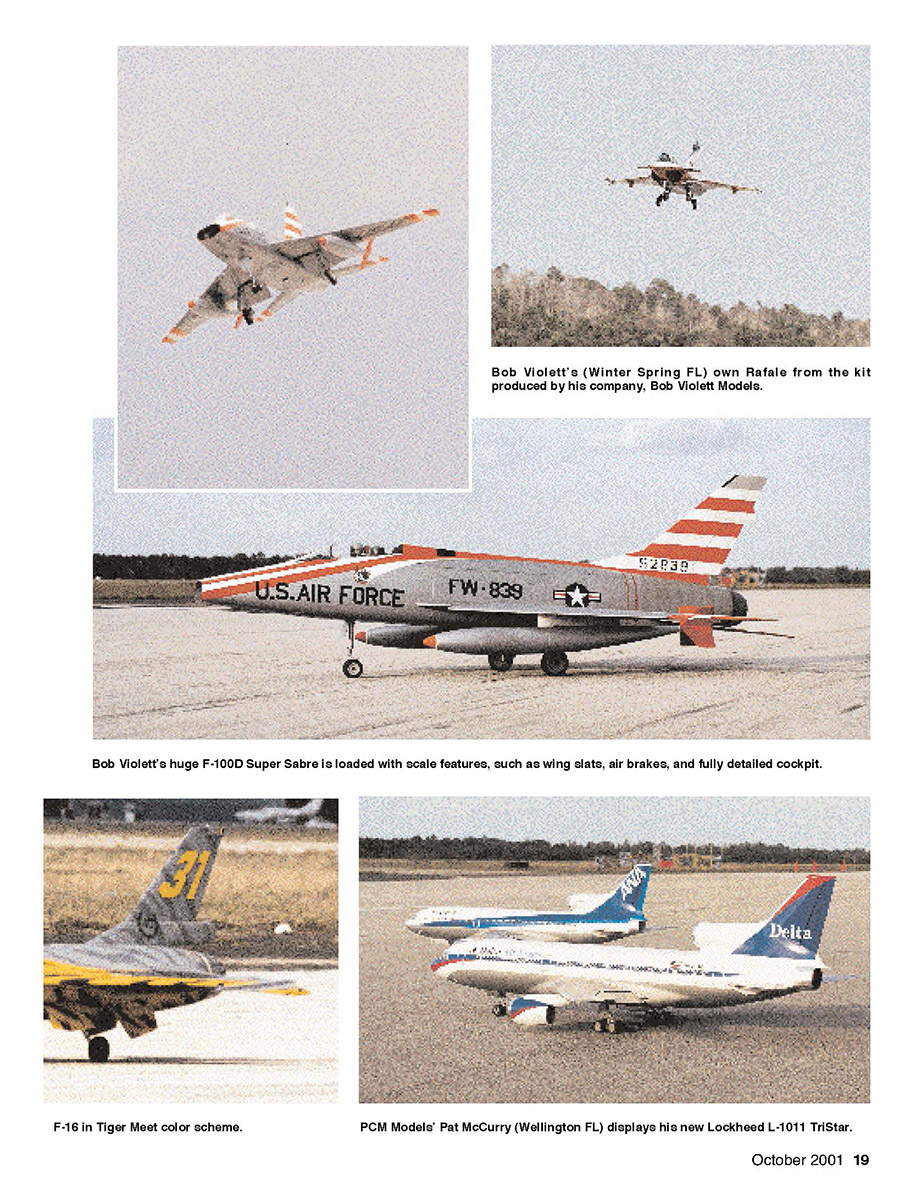
Two BVM F-86 Sabres were used to demonstrate the new RAM 500 engine. The Violett F-86 has been on the market for at least 15 years. It was designed for ducted-fan systems when the K&B .72, OS .65, and Rossi .65 were kings of the hill.
The F-86 kit should enjoy renewed popularity with the new 11-pound-thrust RAM 500. The turbinized Sabre's flight performance is dramatically improved, and BVM has developed a turbine-installation kit that will permit the retrofit of RAM 500s in existing ducted-fan airframes.
Several civilian transport aircraft flew in the event. Pat McCurry's cleverly designed Lockheed L-1011 TriStar displayed its wide performance envelope. Pat's company, PCM Models, markets the L-1011 as a quickly built, easy-to-fly sport scale project. It is powered by a single turbine mounted in the model's tail. The wing-mounted nacelles are nonfunctional.
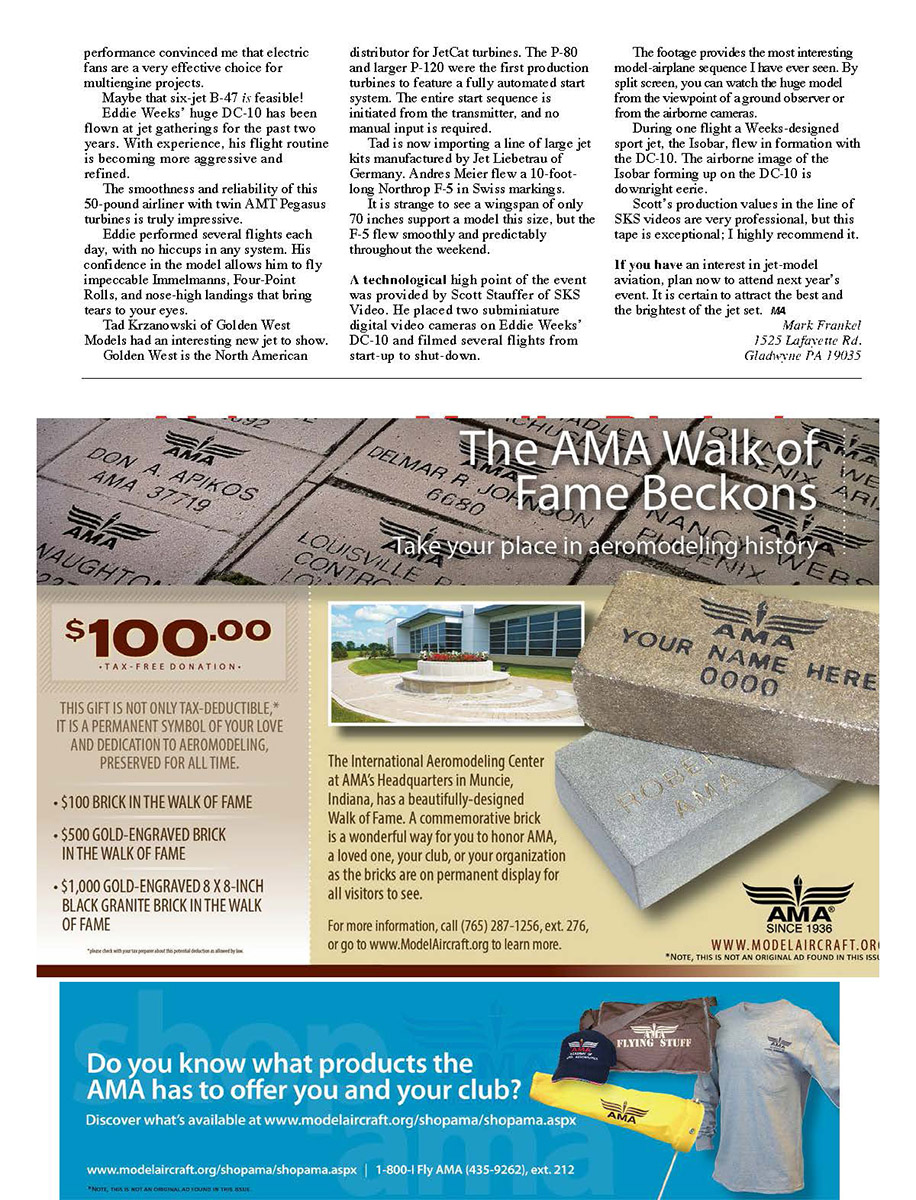
Bryce Watson flew a BAe 146—the sole electric ducted-fan model. This British short-range transport, built from the Robbe kit, is powered by 16 cells providing 40 amps to the four electric fans. Seeing the BAe 146's effortless performance convinced me that electric fans are a very effective choice for multiengine projects.
Maybe that six-jet B-47 is feasible!
Eddie Weeks' huge DC-10 has been flown at jet gatherings for the past two years. With experience, his flight routine is becoming more aggressive and refined. The smoothness and reliability of this 50-pound airliner with twin AMT Pegasus turbines is truly impressive.
Eddie performed several flights each day, with no hiccups in any system. His confidence in the model allows him to fly impeccable Immelmanns, four-point rolls, and nose-high landings that bring tears to your eyes.
Tad Krzanowski of Golden West Models had an interesting new jet to show. Golden West is the North American distributor for JetCat turbines. The P-80 and larger P-120 were the first production turbines to feature a fully automated start system. The entire start sequence is initiated from the transmitter, and no manual input is required.
Tad is now importing a line of large jet kits manufactured by Jet Liebetrout of Germany. Andres Meier flew a 10-foot-long Northrop F-5 in Swiss markings. It is strange to see a wingspan of only 70 inches support a model this size, but the F-5 flew smoothly and predictably throughout the weekend.
A technological high point of the event was provided by Scott Stauffer of SKS Video. He placed two subminiature digital video cameras on Eddie Weeks' DC-10 and filmed several flights from start-up to shut-down. The footage provides the most interesting model-airplane sequence I have ever seen. By split screen, you can watch the huge model from the viewpoint of a ground observer or from the airborne cameras.
During one flight a Weeks-designed sport jet, the Isobar, flew in formation with the DC-10. The airborne image of the Isobar forming up on the DC-10 is downright eerie.
Scott's production values in the line of SKS videos are very professional, but this tape is exceptional; I highly recommend it.
If you have an interest in jet-model aviation, plan now to attend next year's event. It is certain to attract the best and the brightest of the jet set.
Mark Frankel 1525 Lafayette Rd. Gladwyne PA 19035
Florida Jets
2001 Awards
- Designer Achievement - BVM - Pat McCurry - L-1011
- Engineering Excellence - SWB Turbines - Tom Cook - Firebird
- Manufacturer Achievement - ZAP Gang - BVM - BobCat
- Best Sport Jet Performance (Ducted Fan) - RA Microjets - Keith Horton - Aggressor
- Best Sport Jet Performance (Turbine) - Model Airplane News - John Burdin - Bandit
- Best Military Performance (Ducted Fan) - Mini-Hobby - Dave Malchione - F-4
- Best Military Performance (Turbine) - JR Radios - Vern Montgomery - F-4E
- Best Military Jet (pre-1960) - RC Jets Intl. - Dan Avila - F-80
- Best Military Jet (post-1960) - AMT - Bob Violett - F-100
- Best Sport Jet - PCM Models - Vern Kramer - Bandit
- Best Civilian Jet - Century Jet Models - Pat McCurry - L-1011
- Best Multiengine Performance - RA Microjets - Jack Diaz Sr. - Rafale
- Critics' Choice (Ducted Fan) - Model Airplane News - Bryce Watson - BAe 146
- Critics' Choice (Turbine) - ZAP Gang - Gustavo Campana - F-16
Transcribed from original scans by AI. Minor OCR errors may remain.

