
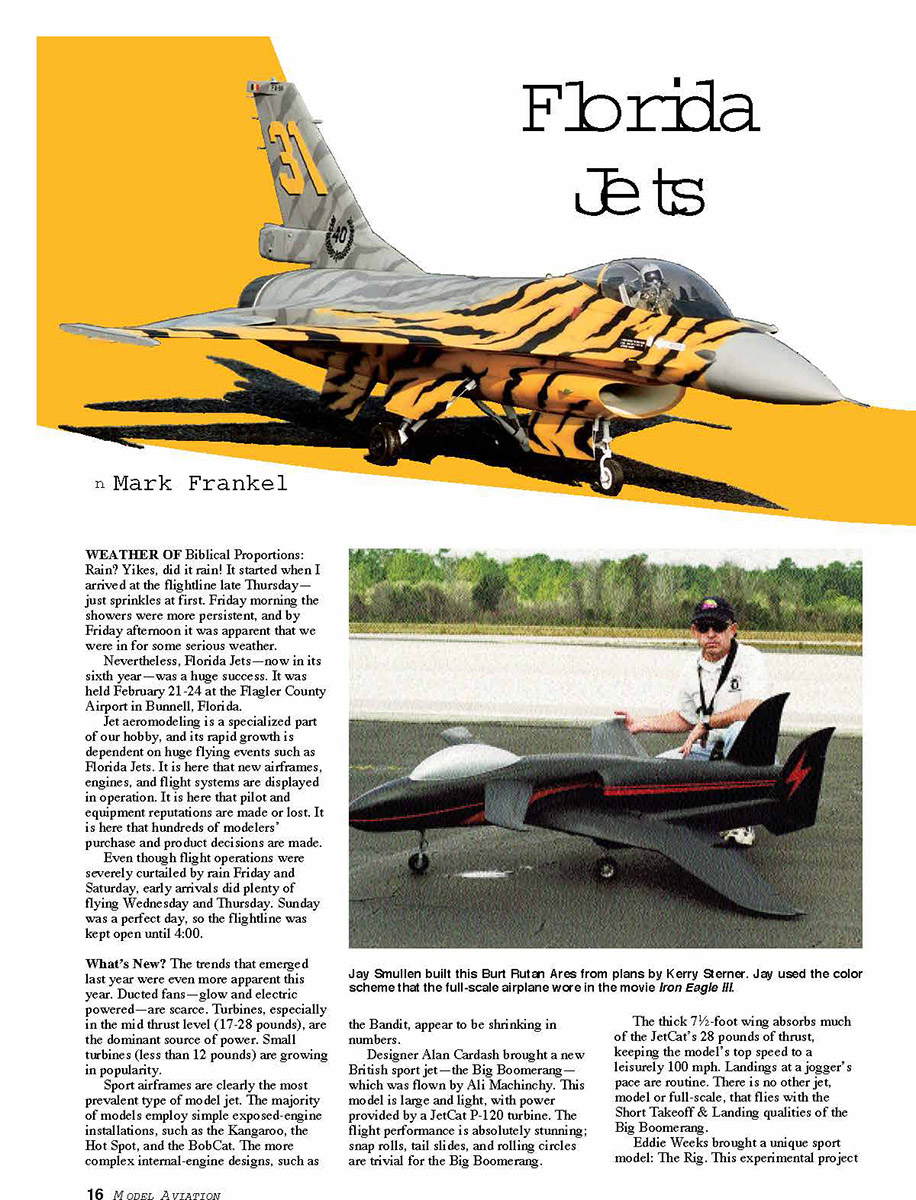
Florida Jets
by Mark Frankel
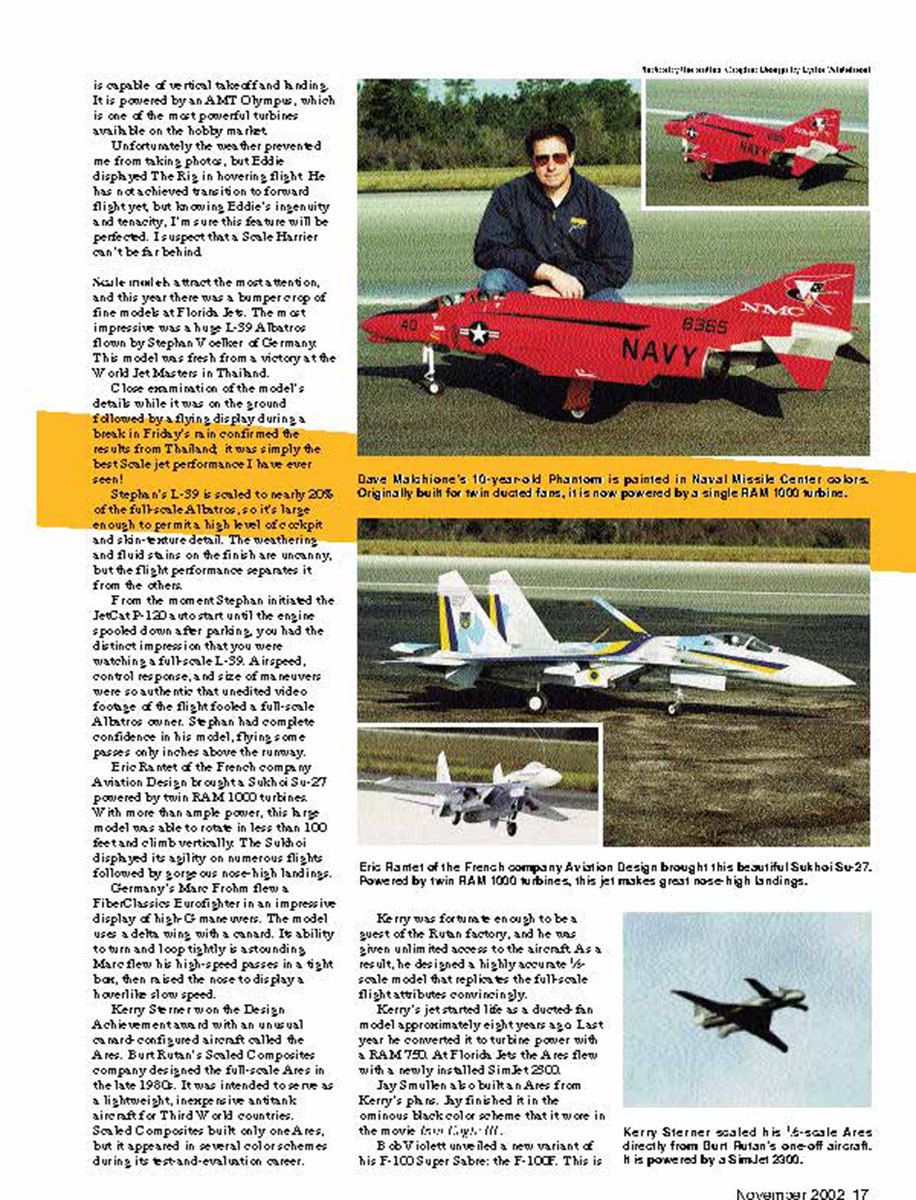
WEATHER OF Biblical Proportions: Rain? Yikes, did it rain! It started when I arrived at the flightline late Thursday—just sprinkles at first. Friday morning the showers were more persistent, and by Friday afternoon it was apparent that we were in for some serious weather.
Nevertheless, Florida Jets—now in its sixth year—was a huge success. It was held February 21-24 at the Flagler County Airport in Bunnell, Florida.
Jet aeromodeling is a specialized part of our hobby, and its rapid growth is dependent on huge flying events such as Florida Jets. It is here that new airframes, engines, and flight systems are displayed in operation. It is here that pilot and equipment reputations are made or lost. It is here that hundreds of modelers' purchase and product decisions are made.
Even though flight operations were severely curtailed by rain Friday and Saturday, early arrivals did plenty of flying Wednesday and Thursday. Sunday was a perfect day, so the flightline was kept open until 4:00.
What's New? The trends that emerged last year were even more apparent this year. Ducted fans—glow and electric powered—are scarce. Turbines, especially in the mid thrust level (17-28 pounds), are the dominant source of power. Small turbines (less than 12 pounds) are growing in popularity.
Sport airframes are clearly the most prevalent type of model jet. The majority of models employ simple exposed-engine installations, such as the Kangaroo, the Hot Spot, and the BobCat. The more complex internal-engine designs, such as the Bandit, appear to be shrinking in numbers.
Designer Alan Cardash brought a new British sport jet—the Big Boomerang—which was flown by Ali Machinchy. This model is large and light, with power provided by a JetCat P-120 turbine. The flight performance is absolutely stunning; snap rolls, tail slides, and rolling circles are trivial for the Big Boomerang.
The thick 7½-foot wing absorbs much of the JetCat's 28 pounds of thrust, keeping the model's top speed to a leisurely 100 mph. Landings at a jogger's pace are routine. There is no other jet, model or full-scale, that flies with the Short Takeoff & Landing qualities of the Big Boomerang.
Eddie Weeks brought a unique sport model: The Rig. This experimental project is capable of vertical takeoff and landing. It is powered by an AMT Olympus, which is one of the most powerful turbines available on the hobby market.
Unfortunately the weather prevented me from taking photos, but Eddie displayed The Rig in hovering flight. He has not achieved transition to forward flight yet, but owing to Eddie's ingenuity and tenacity, I'm sure this feature will be perfected. I suspect that a Scale Harrier can't be far behind.
Scale models attract the most attention, and this year there was a bumper crop of fine models at Florida Jets. The most impressive was a huge L-39 Albatros flown by Stephan Voelker of Germany. This model was fresh from a victory at the World Jet Masters in Thailand.
Close examination of the model's details while it was on the ground followed by a flying display during a break in Friday's rain confirmed the results from Thailand: it was simply the best Scale jet performance I have ever seen!
Stephan's L-39 is scaled to nearly 20% of the full-scale Albatros, so it's large enough to permit a high level of cockpit and skin-surface detail. The weathering and fluid stains on the finish are uncanny, but the flight performance separates it from the others.
From the moment Stephan initiated the JetCat P-120 auto start until the engine spooled down after parking, you had the distinct impression that you were watching a full-scale L-39. Airspeed, control response, and size of maneuvers were so authentic that unedited video footage of the flight looked a full-scale Albatros owner. Stephan had complete confidence in his model, flying some passes only inches above the runway.
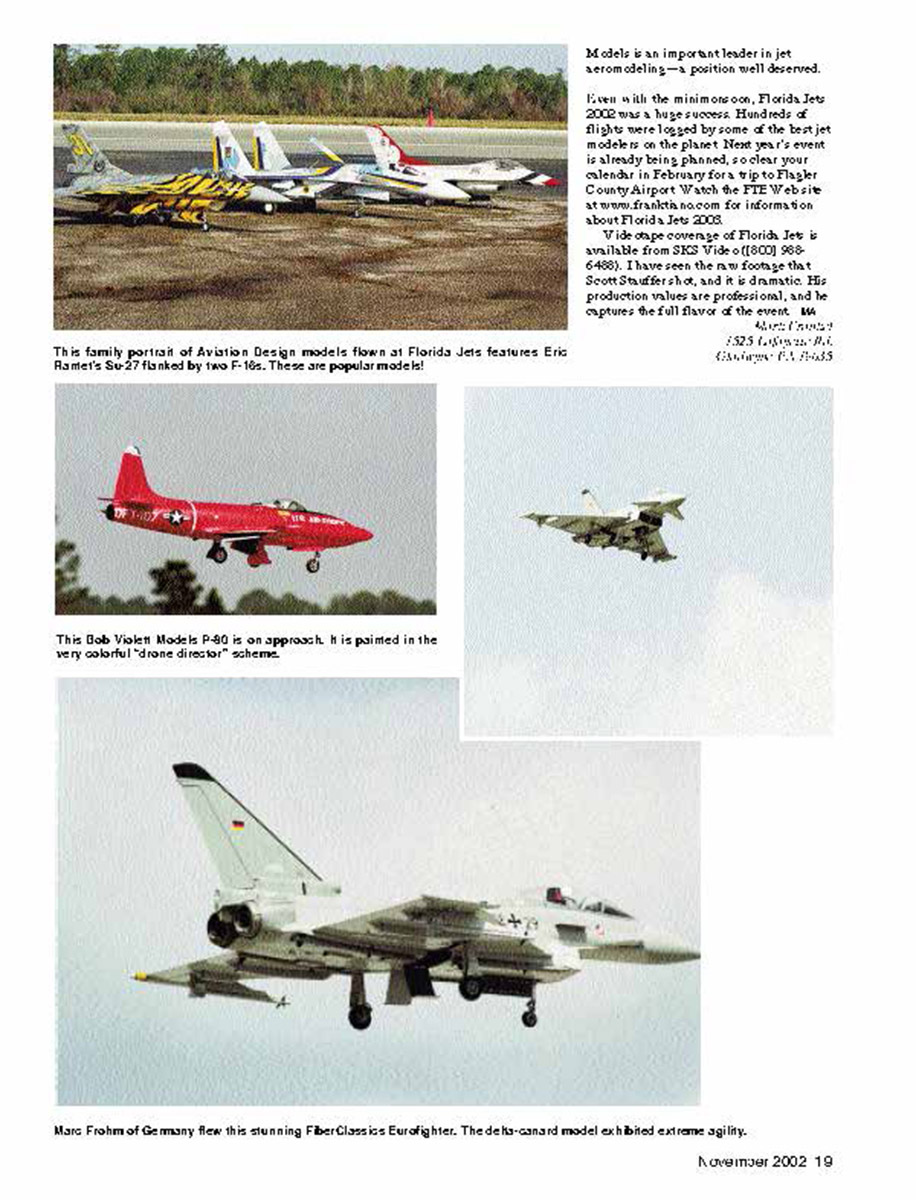
Eric Ramel of the French company Aviation Design brought a Sukhoi Su-27 powered by twin RAM 1000 turbines. With more than ample power, this large model was able to rotate in less than 100 feet and climb vertically. The Sukhoi displayed its agility on numerous high-alpha passes followed by gorgeously nose-high landings.
Germany's Marc Froehn flew a FiberClassics Eurofighter in an impressive display of high-G maneuvers. The model uses a delta wing with canard. Its ability to turn and loop tightly is astounding. Marc flew his high-speed passes in a tight box, then raised the nose to display a hover-like slow-speed.
Kerry Sterner won the Design Achievement award with an unusual canard-configured aircraft called the Aires. Built by Burt Rutan's Scaled Composites company, this one-of-a-kind specimen was the full-scale Aires in the late 1980s. The model is extremely lightweight, inexpensive and a characteristic of third world countries. Scaled Composites built only one Aires, but it appeared in several color schemes during its test-evaluation career.
Kerry was fortunate enough to be a guest of the Rutan factory, and he was given unlimited access to the aircraft. As a result, he designed a highly accurate 1/6-scale model that replicates the full-scale flight attributes convincingly.
Kerry's jet started life as a ducted-fan model approximately eight years ago. Last year he converted it to turbine power with a RAM 750 at Florida Jets; the Aires flew with a newly installed SimJet 2500.
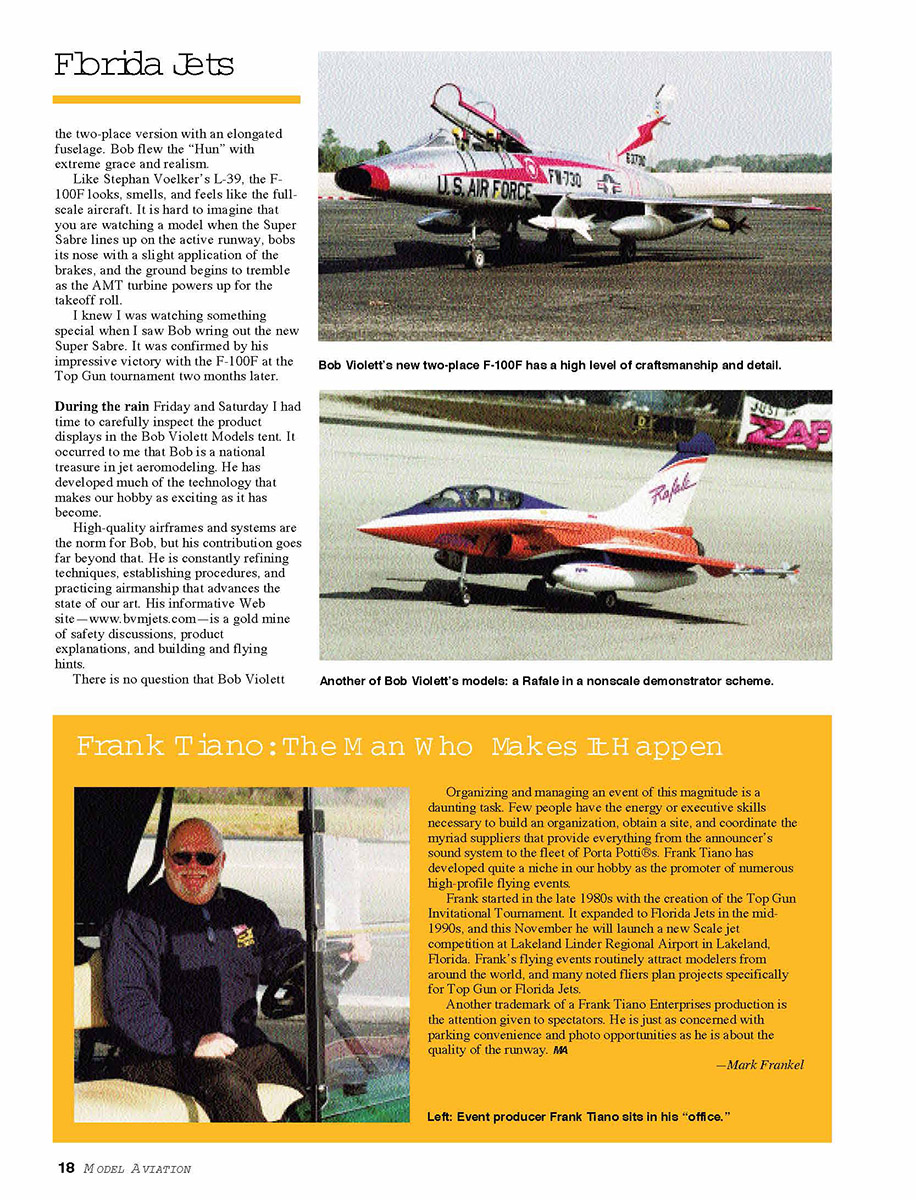
The two-place version with an elongated fuselage. Bob flew the "Hun" with extreme grace and realism.
Like Stephan Voelker's L-39, the F-100F looks, smells, and feels like the full-scale aircraft. It is hard to imagine that you are watching a model when the Super Sabre lines up on the active runway, bobs its nose with a slight application of the brakes, and the ground begins to tremble as the AMT turbine powers up for the takeoff roll.
I knew I was watching something special when I saw Bob wiring out the new Super Sabre. It was confirmed by his impressive victory with the F-100F at the Top Gun tournament two months later.
During the rain Friday and Saturday I had time to carefully inspect the product displays in the Bob Violett Models tent. It occurred to me that Bob is a national treasure in jet aeromodeling. He has developed much of the technology that makes our hobby as exciting as it has become.
High-quality airframes and systems are the norm for Bob, but his contribution goes far beyond that. He is constantly refining techniques, establishing procedures, and practicing airmanship that advances the state of our art. His informative Web site—www.bvmjets.com—is a gold mine of safety discussions, product explanations, and building and flying hints.
There is no question that Bob Violett is a major influence in the jet community. His work has inspired many modelers to push the envelope of performance and scale fidelity. At Florida Jets his booth was a magnet for both novice and experienced pilots seeking advice, parts, and the benefit of his experience.
Even with the mini-monsoon, Florida Jets 2002 was a huge success. Hundreds of flights were logged by some of the best jet modelers on the planet. Next year's event is already being planned, so clear your calendar in February for a trip to Flagler County Airport. Watch the FTE Web site at www.franklinna.com for information about Florida Jets 2003.
Videotape coverage of Florida Jets is available from SKS Video (1-800-968-6488). I have seen the raw footage that Scott Stauffer shot, and it is dramatic. His production values are professional, and he captures the full flavor of the event. — HM
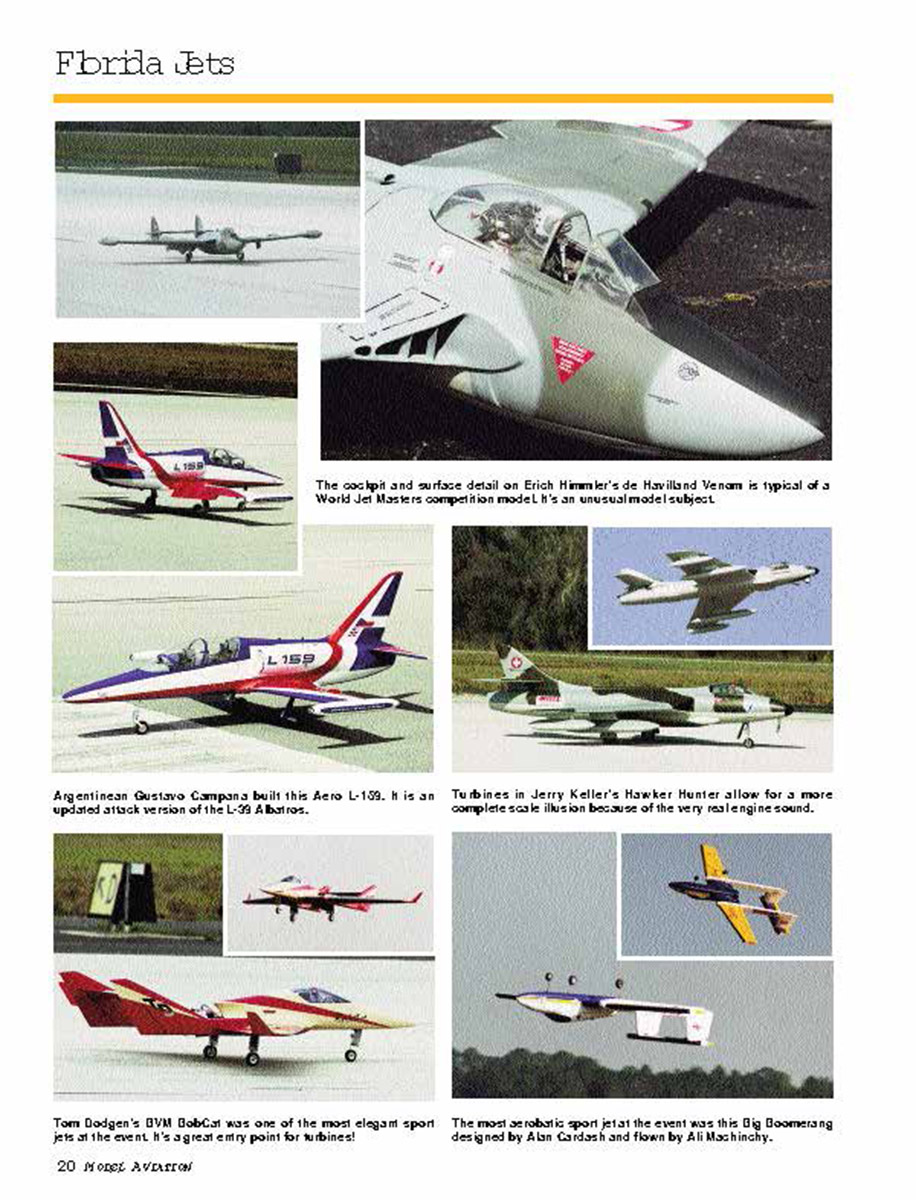
The cockpit and surface detail on Erich Himmer's de Havilland Venom is typical of a World Jet Masters competition model. It's an unusual model subject.
Argentinian Gustavo Campana built this Aero L-159. It is an updated attack version of the L-39 Albatros.
Turbines in Jerry Keller's Hawker Hunter allow for a more complete scale illusion because of the very real engine sound.
Tom Dodgen's BVM Goblin was one of the most elegant sport jets at the event. He's a great enemy point for turbines!
The most aerobatic sport jet at the event was this Big Boomerang designed by Alan Craddish and flown by Ali Mackinchy.
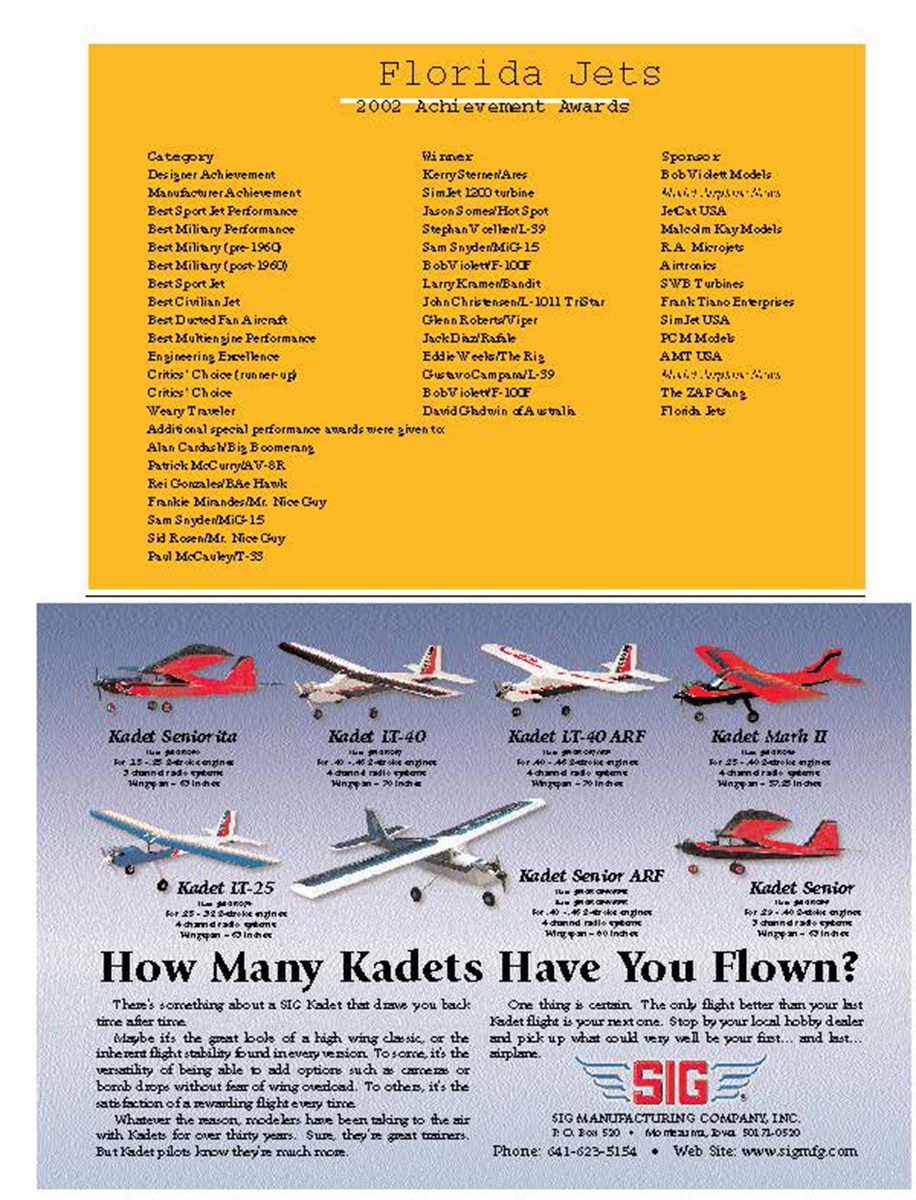
Florida Jets
2002 Achievement Awards
- Designer Achievement — Kerry Stern/Ares — Bob Violet Models
- Manufacturer Achievement — SimJet 1200 turbine — Allied/Impulse/?? (unclear)
- Best Sport Jet Performance — Jason Somes/Hot Spot — JC Cat USA
- Best Military Performance — Stephan Vetter/L-39 — Malcolm Kay Models
- Best Military (pre-1960) — Sam Snyder/MiG-15 — R.A. Microjets
- Best Military (post-1960) — Bob Violett/F-100F — Airtronics
- Best Sport Jet — Larry Kamen/Bandit — SWB Turbine
- Best Civilian Jet — John Christensen/L-1011 TriStar — Frank Tiano Enterprises
- Best Ducted Fan Aircraft — Glenn Roberts/Viper — SimJet USA
- Best Multiengine Performance — Jack Diaz/Raible? — PCM Model? (unclear)
- Engineering Excellence — Eddie Weck/The Pig — AMT USA
- Critics' Choice (runner-up) — Gustavo Campana/L-39 — Allied/Impulse/?? (unclear)
- Critics' Choice — Bob Violett/F-100F — The ZAP Gang
- Weary Traveler — David Chadwin/Australia — Florida Jets
Additional special performance awards were given to Alan Craddish/Big Boomerang Patrick McCurny/V-8R Rei Gonzalez/Blue Hawk Frankie Miranda/Mr. Nice Guy Sam Snyder/MiG-15 Sid Rosen/Mr. Nice Guy Paul McCauley/T-38
Note: A few sponsor or name entries on the scanned image were partially unclear; I have marked those as (unclear).
Transcribed from original scans by AI. Minor OCR errors may remain.

