
Fly the RC Adventure
by Joe Beshar
A grammar school program graduates from an elective to a mainstream science class
If you think aeromodeling should be a class in the local school system, read on carefully. This article describes one effort's success.
Imagine if every flying club in America followed the example you'll read about and made it possible for kids to fly model airplanes in their schools. Most of us who have been involved in aeromodeling for years might easily imagine getting an A+ in that class. What a confidence booster!
Because RC modeling, a wholesome pastime, has become so easy to learn, it's possible that the thrill of this activity could become widespread. The positive outcome could encourage students to use the valuable lessons of creativity that aeromodeling teaches and seek those same rewards in other scholastic disciplines. Kids doing better in school because of aeromodeling would be a huge boost to the AMA.
There is no better way to introduce someone to RC flight than with a hands-on experience. I find it satisfying to introduce model aviation to a friend or any interested individual this way because he or she is rewarded with a successful flying experience from the moment the lessons begin.
The thrill of flying a model aircraft might translate into a student's enthusiasm to learn more and get better at doing something as thrilling as piloting an airplane. Moreover, the positive experience may encourage a student to focus harder on academic subjects and strive to excel in those areas as well.
Describing the activity can be interesting, but the first experience of controlling a model aircraft is the best kickoff to get someone to join the modeling community. A new program called "Fly the RC Adventure" provides that hands-on exposure, and a trial of the program brought major sponsorship from one business to support a public-school program in its area.
Fly the RC Adventure is designed to encourage clubs and enable them to reach out to their communities with a suitable package that is hassle free regarding the equipment used. This is an asset that will bring more members into the club and, of course, the AMA.
Slow-flying and RTF electric-powered model packages are becoming more popular every day. The fact that they fly slowly not only gives a student pilot time to correct, but it also gives the instructor time to react. The overall flight-training experience has little "fear factor" and confidence is built quickly.
How Your Club Can Participate in Fly the RC Adventure
- Describe the program’s public-relations benefits at a club meeting.
- Explain to the club members how they need to sponsor this program as a benefit to the school and the community.
Because there is time for mistakes, many instructors have felt comfortable training without the use of a buddy box. An uncomplicated model that needs little experience to assemble, maintain, and train with contributes to how Fly the RC Adventure works.
The basic program is simple. Have the electric slow flyer ready at demo functions and spectator activities. It is great for community club promotions and can increase club membership. The model will be battery powered, so a couple of charged batteries on standby are the only field equipment needed.
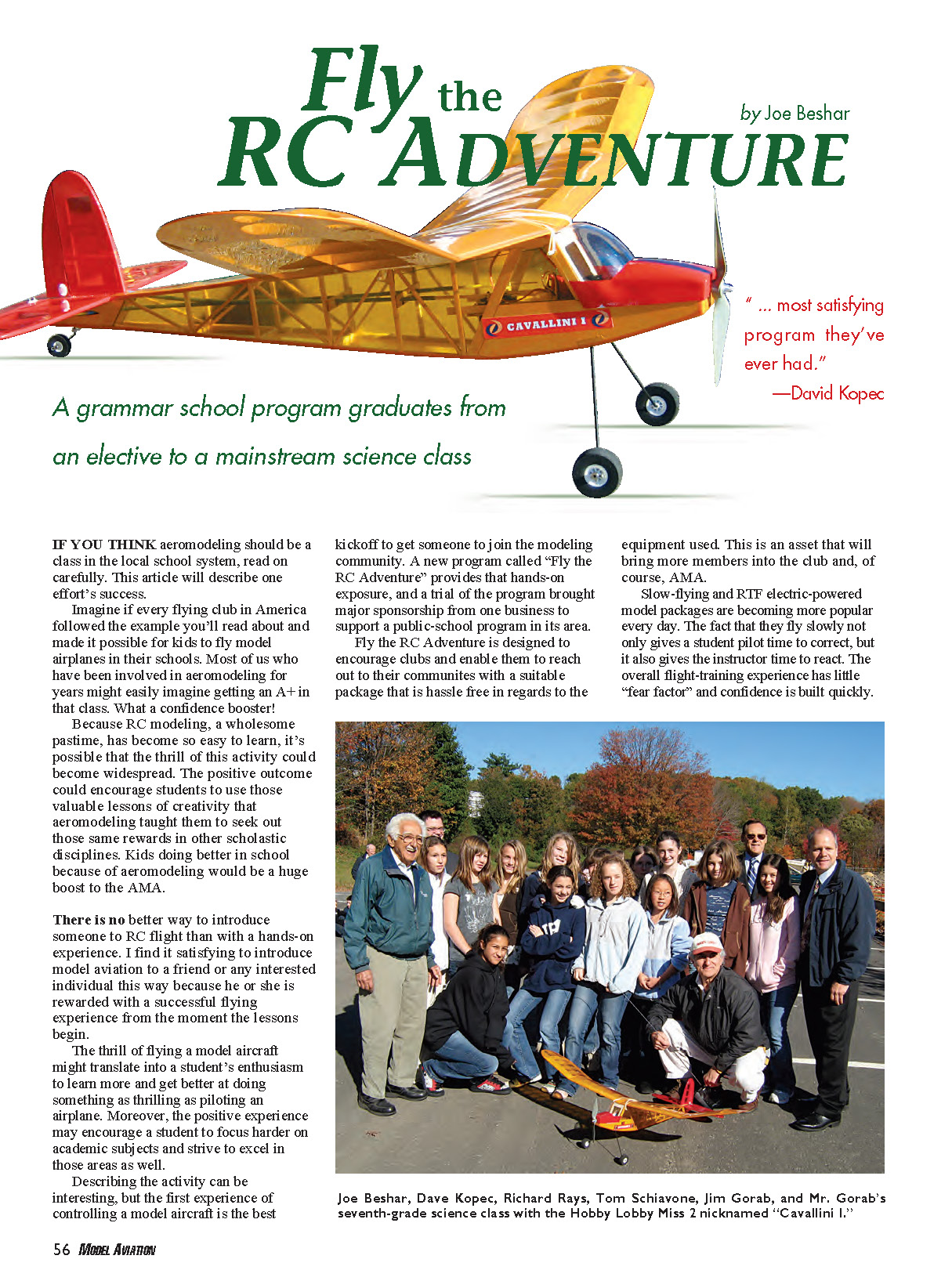
Most test outings have been with the Hobby Lobby Miss 2. I use a 2.4 GHz radio-control system, which works well because there is no chance of interference with any other flying that may take place.
Richard Rays, president and CEO of Paragon Federal Credit Union located in Montvale, New Jersey, is a model-building enthusiast. He is gracious and dedicated to serving the community around Montvale.
Richard recognized the value of Fly the RC Adventure and contacted me because I initiated the program. He expressed interest in adapting the program for use in the Montvale schools as an introduction to model-airplane flying.
The contact was timely because I had been using the Miss 2 at model gatherings to promote Fly the RC Adventure. I had spectators try to fly the model on the spot. The result was that it gained their interest in joining the modeling community and the Academy.
During my meeting with Mr. Rays, we discussed and developed the program structure for the Emil A. Cavallini Middle School in Upper Saddle River, New Jersey. David Kopec, a representative of Paragon Federal Development, arranged to visit Jim Gorab — a science teacher at Cavallini Middle School — who had shown interest in getting involved in the program.
Upon approval of the school administrator, a notice was posted for Fly the RC Adventure. It announced to the students that they could fly a radio-controlled model airplane with instructor assistance. The response was enormous!
Interested students attended a meeting that featured a lecture about building and flying model aircraft. It included a detailed review of the AMA, whose mission includes leadership, organization, education, and the scientific and technical development of modelers.
The students who showed continued interest at the meeting were asked to register for the next outing. They were signed into group squadrons of six, and an accomplished modeler paired with each squadron to be the leader at the appropriate local site.
Mr. Rays volunteered to supply the necessary materials for the school squadrons. The Miss 2 was selected as the trainer because its slow-flight characteristics and package completeness were the most encouraging. In addition, it could easily be flown at most football or soccer fields, which are the typical spaces around public schools.
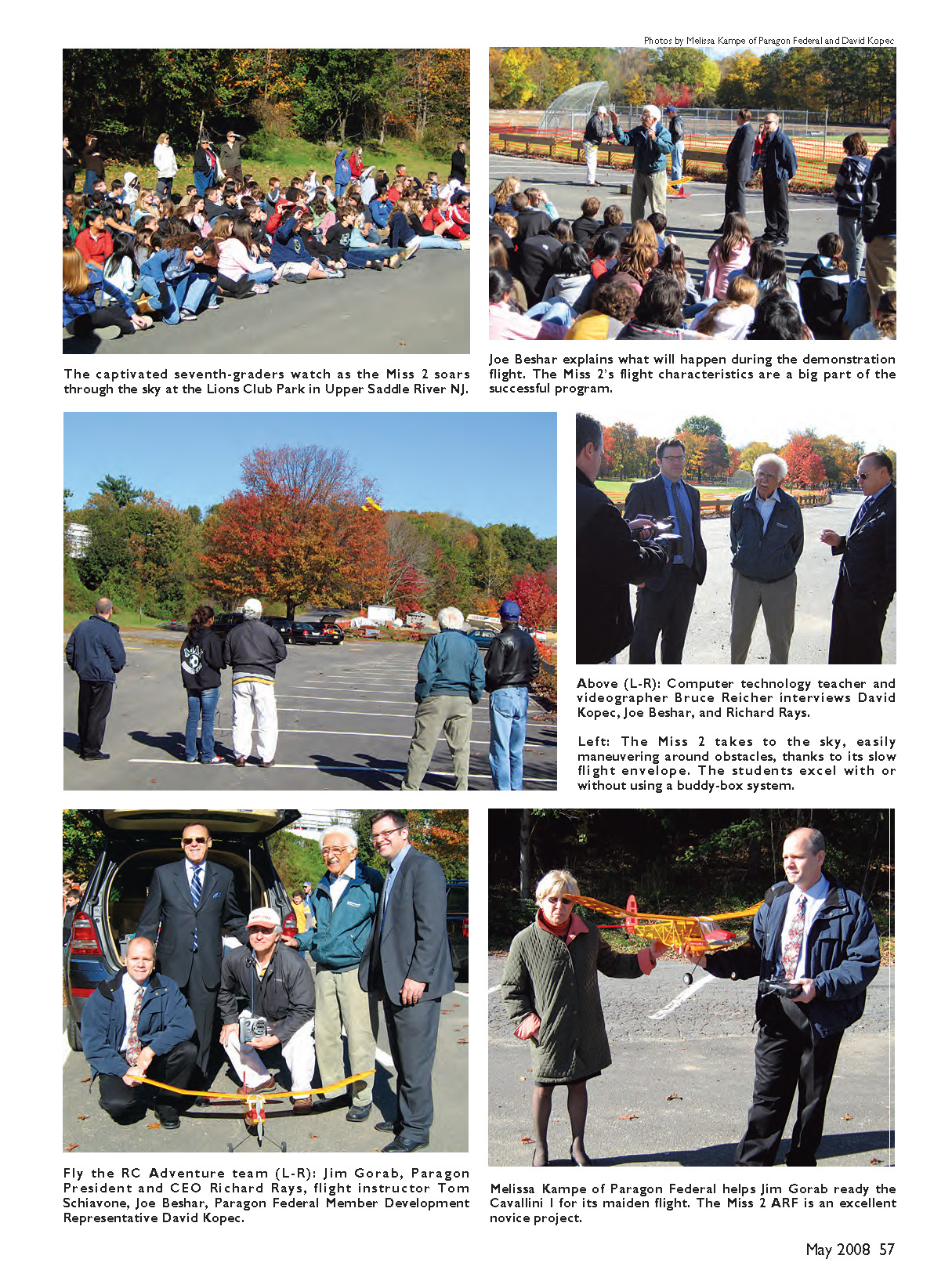
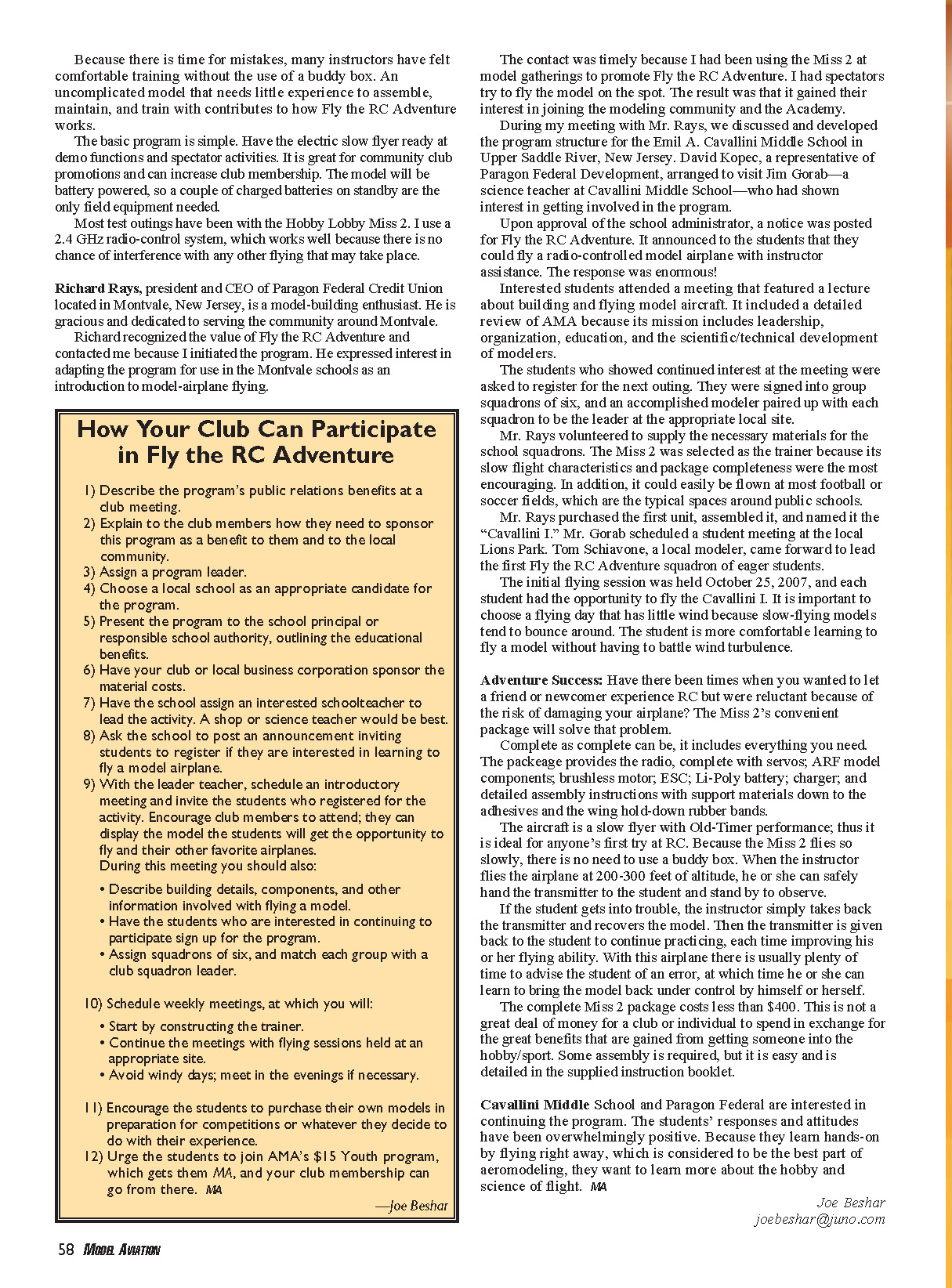
Mr. Rays purchased the first unit, assembled it, and named it the "Cavallini I." Mr. Gorab scheduled a student meeting at the local Lions Park. Tom Schiavone, a local modeler, came forward to lead the first Fly the RC Adventure squadron of eager students.
The initial flying session was held October 25, 2007, and each student had the opportunity to fly the Cavallini I. It is important to choose a flying day that has little wind because slow-flying models tend to bounce around. The student is more comfortable learning to fly a model without having to battle wind turbulence.
Adventure Success
Have there been times when you wanted to let a friend or newcomer experience RC but were reluctant because of the risk of damaging your airplane? The Miss 2’s convenient package will solve that problem.
Complete as complete can be, it includes everything you need. The package provides the radio, complete with servos; ARF model components; brushless motor; ESC; Li-Poly battery; charger; and detailed assembly instructions with support materials down to the adhesives and the wing hold-down rubber bands.
The aircraft is a slow flyer with Old-Timer performance; thus it is ideal for anyone’s first try at RC. Because the Miss 2 flies so slowly, there is no need to use a buddy box. When the instructor flies the airplane at 200–300 feet of altitude, he or she can safely hand the transmitter to the student and stand by to observe.
If the student gets into trouble, the instructor simply takes back the transmitter and recovers the model. Then the transmitter is given back to the student to continue practicing, each time improving his or her flying ability. With this airplane there is usually plenty of time to advise the student of an error, at which time he or she can learn to bring the model back under control independently.
The complete Miss 2 package costs less than $400. This is not a great deal of money for a club or individual to spend in exchange for the great benefits that are gained from getting someone into the hobby and sport. Some assembly is required, but it is easy and is detailed in the supplied instruction booklet.
Cavallini Middle School and Paragon Federal are interested in continuing the program. The students’ responses and attitudes have been overwhelmingly positive. Because they learn hands-on by flying right away, which is considered to be the best part of aeromodeling, they want to learn more about the hobby and the science of flight.
Joe Beshar [email protected]
Transcribed from original scans by AI. Minor OCR errors may remain.

