
Flying Aces Club Nats
Dennis Norman
FAC Nats Mk. XVIII, the 18th biennial Flying Aces Club (FAC) competition, was held in Geneseo, New York, July 18–21, 2012. An extra day was added to accommodate FAC Scale judging and vendors' displays at the FAC headquarters at the Geneseo Quality Inn.
One-hundred-and-forty-eight competitors took to the skies. This year, the FAC decreased the number of events to 30. Some thought it was a good idea, but others were disappointed in the change.
My pals, Russ Brown and Dell Balunek, drove with me to Geneseo on July 17. We made it to the flying field shortly after sunset. It was a beautiful evening and the light lasted nearly an hour after our arrival.
Usually the flightline is on the west side of the field near the 1941 Historical Aircraft Group (HAG) museum. For the first time in memory, it was on the east side of the field, far from its customary location. More puzzling still, it was near a huge field of 8-foot-high corn that was planted so densely as to make it nearly impossible to retrieve anything that landed in it.
Free Flight models fill the skies at Geneseo, New York
Weather forecasts projected occasional rain for the next few days, but winds were predicted to come mainly from the east. As it turned out, the prediction was accurate and the new flightline was positioned appropriately.
FAC members are a sociable group. They often gather at the flying field before and after the official flying to visit with friends from all parts of the US, Canada, England, and other countries.
On the evening of July 17, bursts of laughter and applause were heard as contestants unveiled new masterpieces and occasionally test-flew them for the crowd. England was well represented by Derek Knight, Andy Sephton, and Mike Stuart. The three flew in more than a dozen events. Mike gave everyone a thrill by winning Jumbo Scale with his Armstrong Whitworth Argosy. Andy placed second in the Aeronca Chief One Design event. Derek was third in the Russian Fly event.
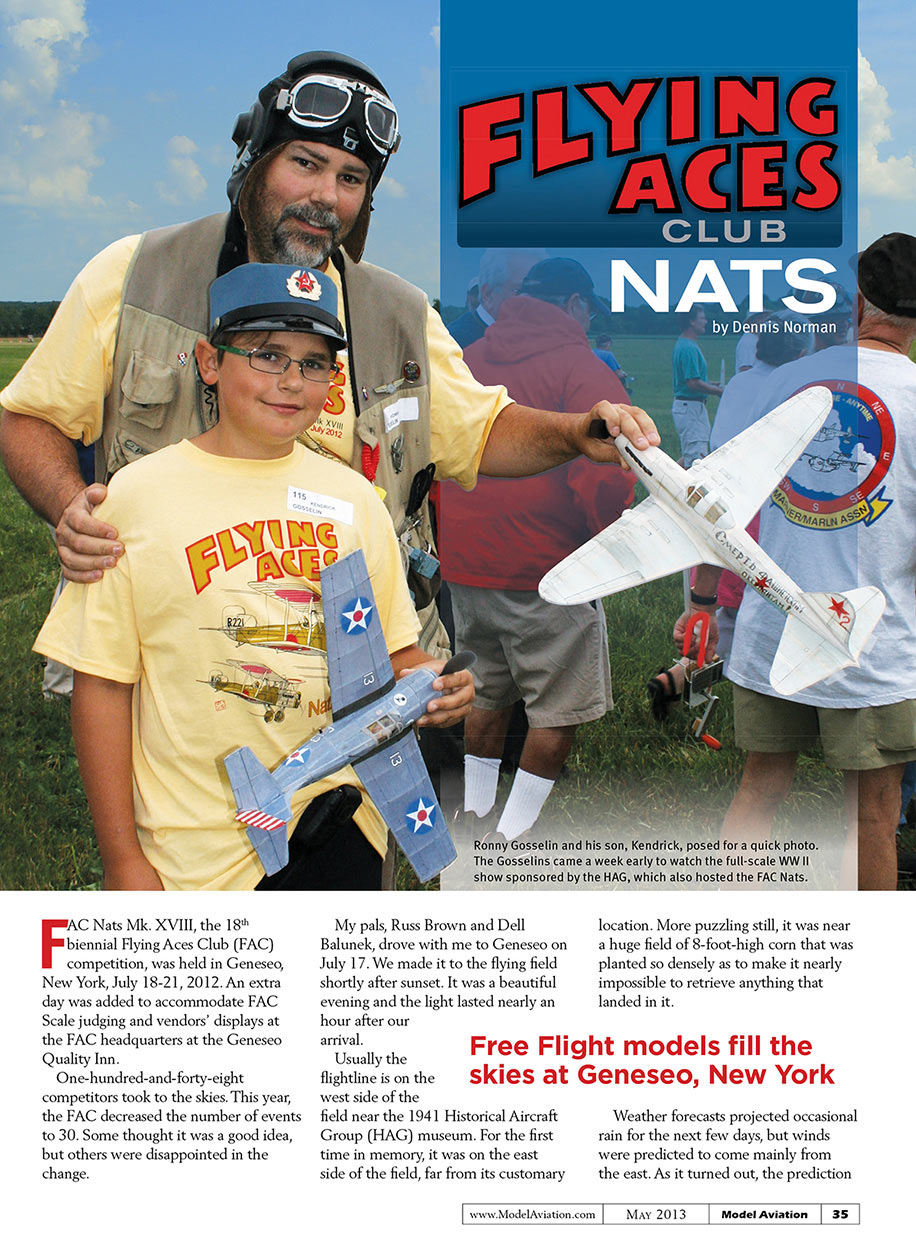
The colorful French-Canadian contingent, FAC Squadron #71, Escadrille Harfang Snow Owl, included Octavian Aldea, Bernard Dion, Bernard’s son Benedict, Ronny Gosselin, Ronny’s son Kendrick, and Luc Martin.
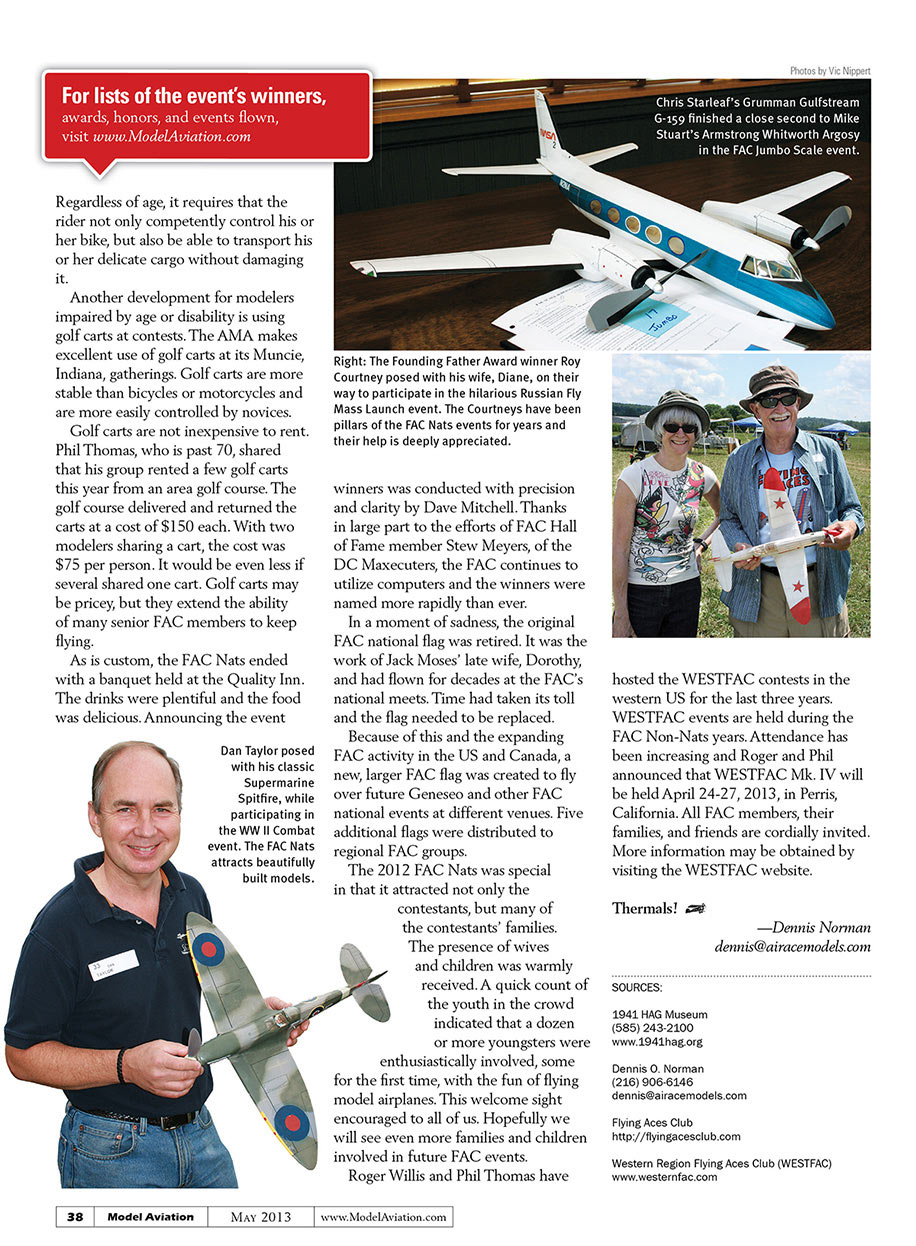
The Canadians rested their beloved French Design Mass Launch (FDML), replacing it with a Soviet substitute, the group’s Russian Fly Mass Launch. All participating aircraft were required to have Russian markings. Russian aircraft were preferred, but not mandated.
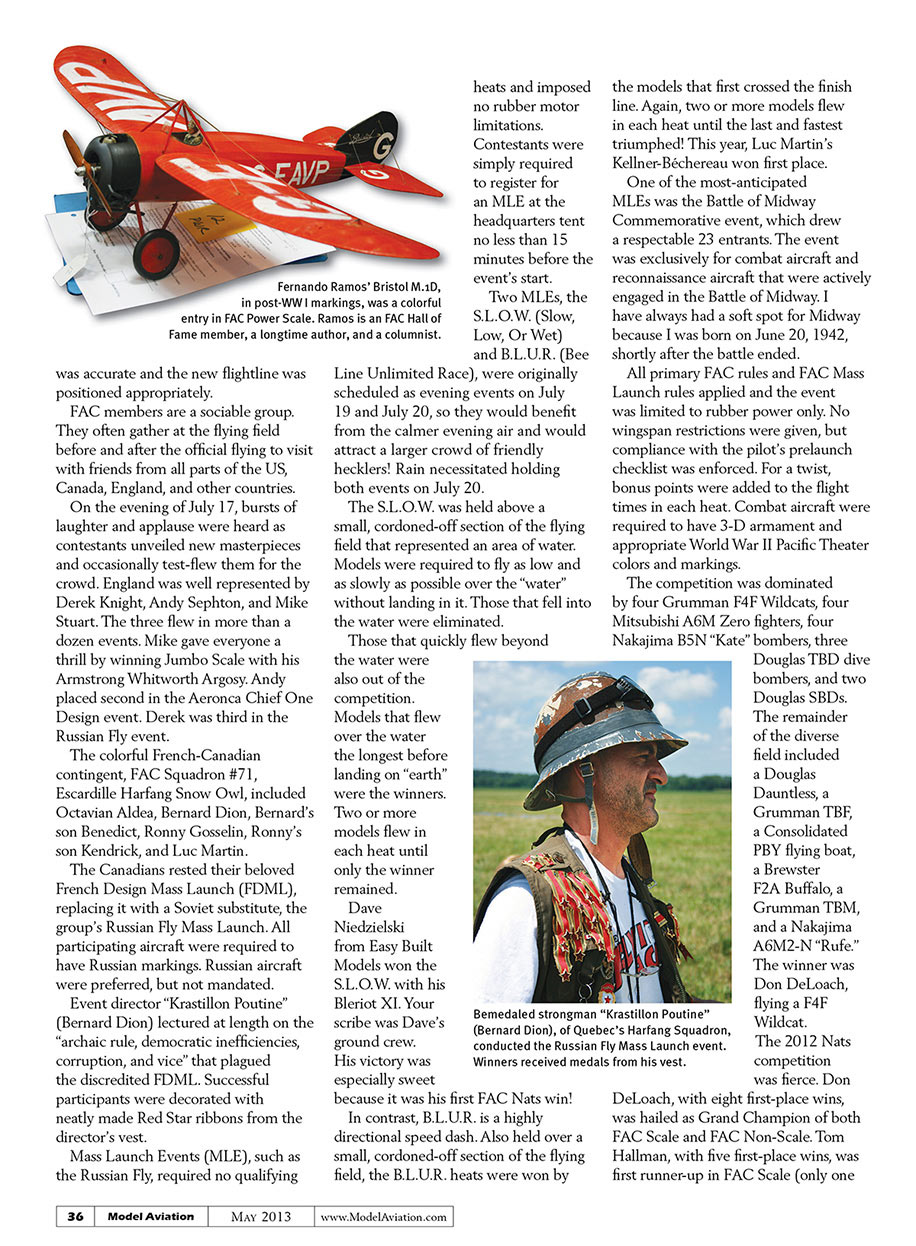
Event director “Krasitillon Poutine” (Bernard Dion) lectured at length on the “archaic rule, democratic inefficiencies, corruption, and vice” that plagued the discredited FDML. Successful participants were decorated with neatly made Red Star ribbons from the director’s vest.
Mass Launch Events (MLE), such as the Russian Fly, required no qualifying heats and imposed no rubber motor limitations. Contestants were simply required to register for an MLE at the headquarters tent no less than 15 minutes before the event’s start.
Two MLEs, the S.L.O.W. (Slow, Low, Or Wet) and B.L.U.R. (Bee Line Unlimited Race), were originally scheduled as evening events on July 19 and July 20, so they would benefit from the calmer evening air and would attract a larger crowd of friendly hecklers! Rain necessitated holding both events on July 20.
The S.L.O.W. was held above a small, cordoned-off section of the flying field that represented an area of water. Models were required to fly as low and as slowly as possible over the “water” without landing in it. Those that fell into the water were eliminated.
Those that quickly flew beyond the water were also out of the competition.
Models that flew over the water the longest before landing on “earth” were the winners. Two or more models flew in each heat until only the winner remained.
Dave Niedzielski from Easy Built Models won the S.L.O.W. with his Bleriot XI. Your scribe was Dave’s ground crew. His victory was especially sweet because it was his first FAC Nats win!
In contrast, B.L.U.R. is a highly directional speed dash. Also held over a small, cordoned-off section of the flying field, the B.L.U.R. heats were won by the models that first crossed the finish line. Again, two or more models flew in each heat until the last and fastest triumphed! This year, Luc Martin’s Kellner-Béchereau won first place.
One of the most-anticipated MLEs was the Battle of Midway Commemorative event, which drew a respectable 23 entrants. The event was exclusively for combat aircraft and reconnaissance aircraft that were actively engaged in the Battle of Midway. I have always had a soft spot for Midway because I was born on June 20, 1942, shortly after the battle ended.
All primary FAC rules and FAC Mass Launch rules applied and the event was limited to rubber power only. No wingspan restrictions were given, but compliance with the pilot’s prelaunch checklist was enforced. For a twist, bonus points were added to the flight times in each heat. Combat aircraft were required to have 3-D armament and appropriate World War II Pacific Theater colors and markings.
The competition was dominated by four Grumman F4F Wildcats, four Mitsubishi A6M Zero fighters, four Nakajima B5N “Kate” bombers, three Douglas TBD dive bombers, and two Douglas SBDs. The remainder of the diverse field included a Douglas Dauntless, a Grumman TBF, a Consolidated PBY flying boat, a Brewster F2A Buffalo, a Grumman TBM, and a Nakajima A6M2-N “Rufe.” The winner was Don DeLoach, flying a F4F Wildcat.
DeLoach, with eight first-place wins, was hailed as Grand Champion of both FAC Scale and FAC Non-Scale. Tom Hallman, with five first-place wins, was first runner-up in FAC Scale (only one point behind Don). The rest of the winners had one first-place win apiece. This spoke well for the quality of the competitors.
It is no secret that the average age of the FAC participants is increasing. Several of our members are past 70; some are even in their 80s. With age, there is often decreasing mobility and with it a significantly reduced ability to actively participate in FF events, which often demands hours of standing and miles of walking.
For years my family helped at contests. The children often retrieved models that flew well beyond my range. Now the kids have grown, moved away, and become busy with their own lives. They seldom attend model airplane contests. My grandchildren also have their time filled with school, sports, etc., and seldom have time to chase after Grandpa’s models.
As mentioned earlier, Russ Brown and Dell Balunek accompanied me to Geneseo. At 70, I am the “kid” in the group. Russ is past 80 and Dell is 79. We have difficulty participating in flying events, but each of us has found a solution that has kept us involved. Russ presides over our local contests and keeps meticulous records of them for the FAC and AMA. He is also the prime mover for the Cleveland Free Flight Society newsletter, Crosswinds, and has been for decades.
I report on the FAC and Free Flight Scale interests to the modeling community through my Model Aviation column. I also continue designing (and occasionally building) models as part of my “Air Ace” activities, and I occasionally contribute pieces to Crosswinds and to the FAC News.
Dell still builds great flying models, but has been forced to call upon others to launch and retrieve them. Two of his helpers, Greg Thorton and John Rodriguez, came to Geneseo this year almost exclusively for the purpose of helping Dell fly his models. Such selfless service is beyond the call of duty and we are fortunate to have men such as Greg and John as part of our fraternity.
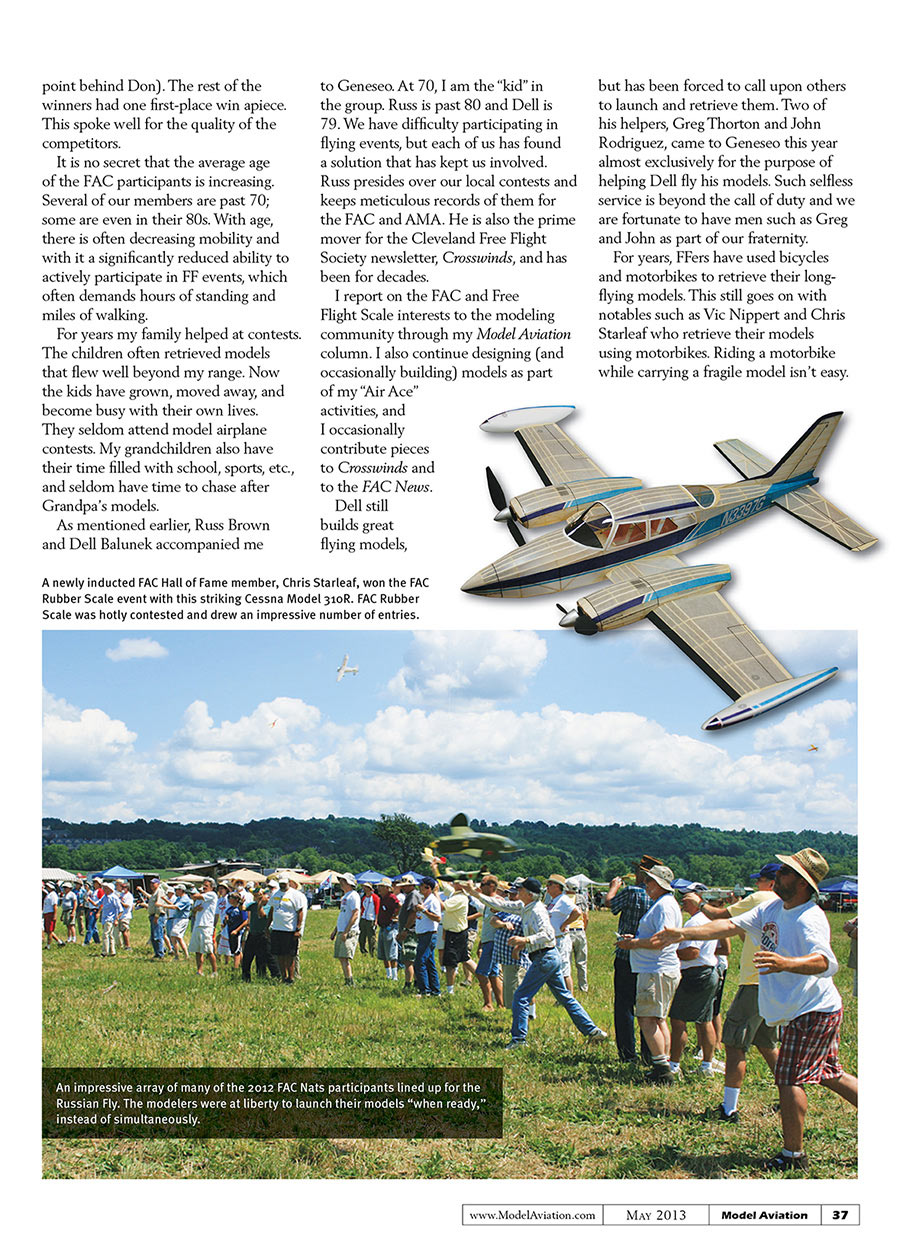
For years, FFers have used bicycles and motorbikes to retrieve their longflying models. This still goes on with notables such as Vic Nippert and Chris Starleaf who retrieve their models using motorbikes. Riding a motorbike while carrying a fragile model isn’t easy. Regardless of age, it requires that the rider not only competently control his or her bike, but also be able to transport his or her delicate cargo without damaging it.
Another development for modelers impaired by age or disability is using golf carts at contests. The AMA makes excellent use of golf carts at its Muncie, Indiana, gatherings. Golf carts are more stable than bicycles or motorcycles and are more easily controlled by novices.
Golf carts are not inexpensive to rent. Phil Thomas, who is past 70, shared that his group rented a few golf carts this year from an area golf course. The golf course delivered and returned the carts at a cost of $150 each. With two modelers sharing a cart, the cost was $75 per person. It would be even less if several shared one cart. Golf carts may be pricey, but they extend the ability of many senior FAC members to keep flying.
As is custom, the FAC Nats ended with a banquet held at the Quality Inn. The drinks were plentiful and the food was delicious. Announcing the event winners was conducted with precision and clarity by Dave Mitchell. Thanks in large part to the efforts of FAC Hall of Fame member Stew Meyers, of the DC Maxecuters, the FAC continues to utilize computers and the winners were named more rapidly than ever.
In a moment of sadness, the original FAC national flag was retired. It was the work of Jack Moses’ late wife, Dorothy, and had flown for decades at the FAC’s national meets. Time had taken its toll on the cloth and the flag needed to be replaced.
Because of this and the expanding FAC activity in the US and Canada, a new, larger FAC flag was created to fly over future Geneseo and other FAC national events at different venues. Five additional flags were distributed to regional FAC groups.
The 2012 FAC Nats was special in that it attracted not only the contestants, but many of the contestants’ families. The presence of wives and children was warmly received. A quick count of the youth in the crowd indicated that a dozen or more youngsters were enthusiastically involved, some for the first time, with the fun of flying model airplanes. This welcome sight encouraged us all. Hopefully we will see even more families and children involved in future FAC events.
Roger Willis and Phil Thomas have hosted the WESTFAC contests in the western US for the last three years. WESTFAC events are held during the FAC Non-Nats years. Attendance has been increasing and Roger and Phil announced that WESTFAC Mk. IV will be held April 24–27, 2013, in Perris, California. All FAC members, their families, and friends are cordially invited. More information may be obtained by visiting the WESTFAC website.
Thermals!
—Dennis Norman <REDACTED>
SOURCES: 1941 HAG Museum <REDACTED> www.1941hag.org
Dennis O. Norman <REDACTED> <REDACTED>
Flying Aces Club http://flyingacesclub.com
Western Region Flying Aces Club (WESTFAC) www.westernfac.com
Transcribed from original scans by AI. Minor OCR errors may remain.

