
Flying for Fun
D.B. Mathews
Another War Story
Many years ago I noticed that one of my dental patients was wearing a cap inscribed "Pearl Harbor Survivor." We chatted at length, and he related a story worth sharing. Not all of the U.S. Navy's fleet remained immobile and helpless the morning of December 7, 1941. Several ships got up enough steam to move away from Battleship Row—most notably the USS Nevada. Most of its crew was ashore that peacetime Sunday morning, but enough officers and ratings were aboard to get steam up and move the ship.
The gunnery crews of many of the docked warships manned the antiaircraft guns and shot down some Japanese bombers. The USS Arizona, the USS Oklahoma, and others were so badly damaged in the initial surprise attack that they were unable to defend themselves at all.
The Nevada had been hit by a torpedo that opened a large hole in its port side below the two forward turrets. This allowed a considerable amount of water to enter the ship through the innermost bulkheads. The damaged Nevada got underway at 8:40—approximately a half hour after it was torpedoed. Backing clear of its berth, it began to steam down the channel toward the navy yard.
The slow-moving battleship was an attractive target for Japanese dive bombers, which hit and nearly missed it repeatedly, opening up its forecastle deck, causing more leaks in its hull, and starting gasoline fires forward. In serious trouble and in danger of sinking and blocking the harbor channel, the Nevada's crew ran her aground on the navy-yard side of the channel, just south of Ford Island.
At the same moment, my patient's ship—the USS Avocet, a seaplane tender—was also underway and following the Nevada out of the harbor. While not heavily armed, the Avocet fired all of the antiaircraft arms she had and was strafed by the Japanese as she crawled toward open water.
After the Nevada went aground, she twisted in the shallow waters and ended up with her bow facing the harbor. With the help of tugs, the Nevada backed across the way and grounded, stern first, on the other side of the channel. There she settled into relatively shallow water, where she remained for more than two months. She was the subject of the first of Pearl Harbor's many demanding salvage projects.
While all of the preceding was happening, the Avocet managed to slip between the Nevada and Hospital Point on Ford Island. As they inched their way through the shallow water they observed a wet Army Air Forces pilot (presumably of a P-40) standing on a sandbar, waiting to be picked up by a small boat. My patient described his most vivid memory of that terrible day: that stranded pilot presented the Avocet's crew with a classic one-finger salute as she moved by him. He obviously felt that the Avocet's antiaircraft gunners had shot him down and was miffed at the proceedings.
Friend or Foe?
Although it has never been mentioned in the various movies made about the Pearl Harbor attack, friendly fire was bound to have been a problem that morning. Consider the flames, smoke, noise, surprise, gut-wrenching fear, and wild confusion. Can there be any doubt that some damage was self-inflicted? The gunners had to make split-second decisions.
To further complicate matters, the only identification-training materials that had been available were charts and manuals with three-view silhouettes printed on them. Those crews had never seen Japanese aircraft, and even silhouettes of some of the newer U.S. aircraft may not have been familiar. It instantly became apparent that a major defect existed in the U.S. methods of teaching aircraft identification to ground-to-air and air-to-air gunners.
The program to provide identification models to the armed forces started December 8, 1941. Navy Commander (later Admiral) Louis de Florez had just returned from England, where he had observed the British recognition program which included the use of 1/2-scale model airplanes. He had seen that when students handled these three-dimensional models, they could be placed at every possible angle. Because the models were painted black, features—not colors—were emphasized as the keys for identification between friend or foe.
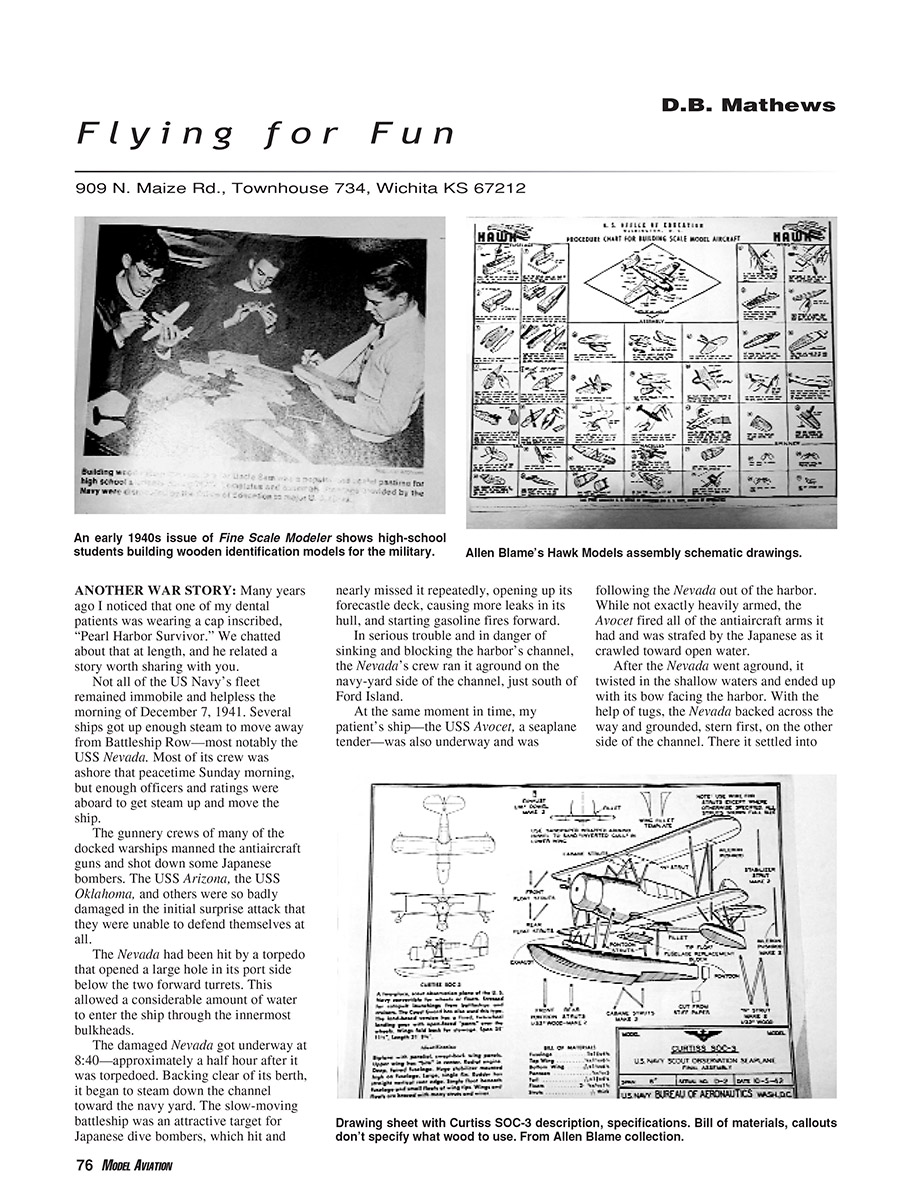
In this emergency the Navy Bureau of Aeronautics decided to call upon the nation's schools; they had instructors, student personnel, tools, and facilities needed for model-aircraft construction. For the first time in many shops, educational and production standards had to be combined. The Model Aircraft Project was launched.
In 22 months, 800,000 youth in 6,000 schools participated. The Navy (and later the Army) did not provide funding for the purchase of materials and supplies. It provided only the drawings and assembly instructions; the local schools, students, and teachers provided the materials.
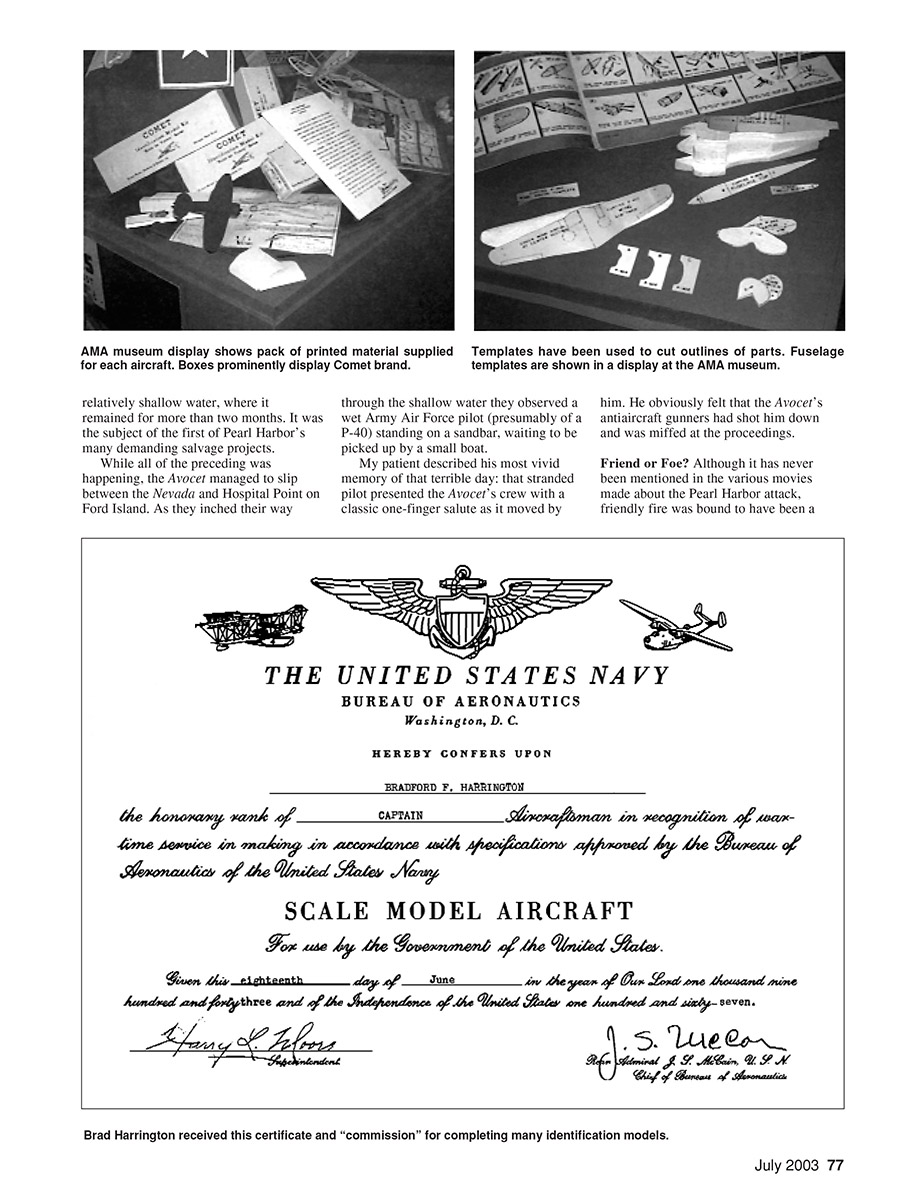
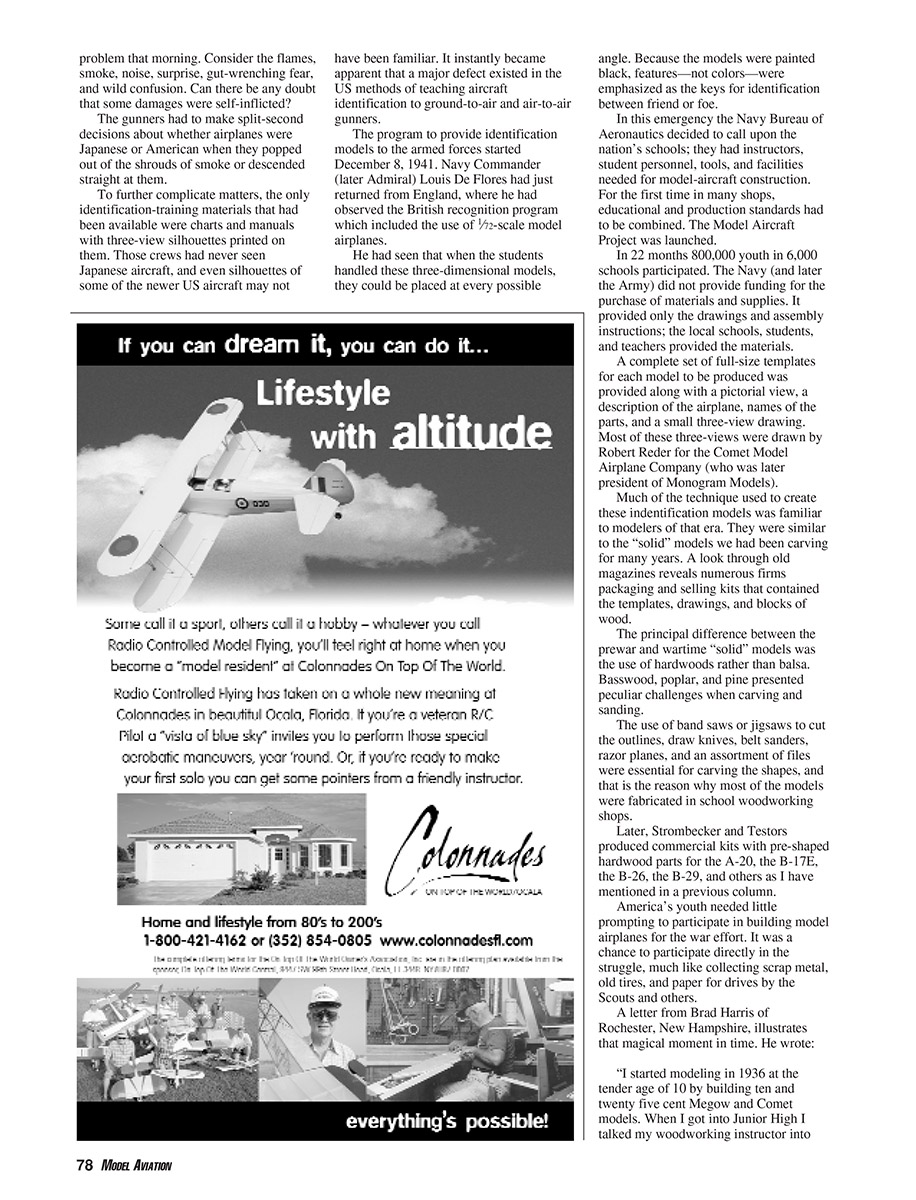
A complete set of full-size templates for each model to be produced was provided along with a pictorial view, a description of the airplane, names of the parts, and a small three-view drawing. Most of these three-views were drawn by Robert Reder for the Comet Model Airplane Company (he later became president of Monogram Models).
Much of the technique used to create these identification models was familiar to modelers of that era. They were similar to the "solid" models hobbyists had been carving for many years. A look through old magazines reveals numerous firms packaging and selling kits that contained templates, drawings, and blocks of wood.
The principal difference between the prewar and wartime "solid" models was the use of hardwoods rather than balsa. Basswood, poplar, and pine presented peculiar challenges when carving and sanding.
The use of band saws or jigsaws to cut the outlines, draw knives, belt sanders, razor planes, and an assortment of files were essential for carving the shapes, and that is the reason why most of the models were fabricated in school woodworking shops.
Later, Strombecker and Testors produced commercial kits with pre-shaped hardwood parts for the A-20, the B-17E, the B-26, the B-29, and others, as I have mentioned in a previous column.
America's youth needed little prompting to participate in building model airplanes for the war effort. It was a chance to participate directly in the struggle, much like collecting scrap metal, old tires, and paper for drives by the Scouts and others.
A letter from Brad Harris of Rochester, New Hampshire, illustrates that magical moment in time. He wrote:
"I started modeling in 1936 at the tender age of 10 by building ten- and twenty-five-cent Megow and Comet models. When I got into junior high I talked my woodworking instructor into letting me build my models while the other guys had to build shoe shine boxes and lamp holders.
"I was really in my glory when I got into high school and signed up in Woodworking to build aircraft-recognition models for the Armed Forces and Air Raid Wardens. I built so many of these models that I was awarded Honorary Captain in the Navy before I graduated. I am still an active modeler and an avid reader of Model Aviation.
"Several other modelers of that era responded with positive memories when I asked for material over the years. For the most part they remember successfully completing models which were delivered to the military. They also recall a feeling of great pride in being involved.
"My personal memories are those of a ten-year-old who was invited to observe the high schoolers carving these ID models. I seem to recall very slow going that required most of a semester to build one model, and also terrible problems encountered in gluing the parts together.
"Remember, the only adhesives back then were nitrocellulose glues (LePage's, Ambroid, Testors, etc.), which were not strong enough for hardwood models. The other adhesive was that furniture-glue stuff that was heated in a sticky can on top of the shop stove and seemingly never set. Paint would have had to be enamel that also dried terribly slowly."
A similar recollection came from Joe Wagner:
"When I started high school in New Castle, PA, I was put in charge of getting modelers to construct these planes. That was no doubt due to my being president of the local model club.
"The whole program was a fiasco. For one thing, hardly any U.S. modelers were used to working with hardwoods. For another, the degree of precision required was way beyond the ability of most of us youngsters. In the two years I worked in this program, only about three or four finished models were good enough to be accepted.
"I wonder who selected the airplanes to model. We had fictional aircraft like the 'Sento Ki-001,' 'Baku Geki K19,' and the 'Mitsubishi T.97 A.L.B.' On the other hand there was no Sunderland, Beaufighter, B-25, P-47, or P-51, yet we had the Saro Lerwick."
Perhaps some intermediate evaluation lies closer to the truth. The handmade-wooden-model project was developed as an emergency solution to the inability of the few plastic modelers around in 1942 to overcome the production problems they encountered in injection-molding these identification models.
Next month I will take a look at the origins of the plastic-model business as we know it today.
MA
Transcribed from original scans by AI. Minor OCR errors may remain.

