
Flying for Fun
D.B. Mathews 909 N. Maize Rd., Townhouse 734, Wichita, KS 67212
Leather Fillets
The April 2003 column mentioned some wing/fuselage fillet material that was included in the 1948 Madman, Sr. Control Line (CL) kit. I wrote: "…I have always wondered what exactly that material had been adapted from…" That brought forth a major pile of mail advising this farm boy that toolmakers use the fillet material in varying sizes to "round" the undercuts out of the corners of boxes for sand-casting patterns.
These toolmakers can't leave sharp corners in their tooling because the sand would not flow into a zero radius. They were installed using casein glue and were fairly durable. Each mold was made by packing in the sand, then pulling whatever cores were used to form the final part.
So a bunch of readers straightened me out on the normal use of these fillets. Since I have never seen a casting pattern made, or even been in a foundry, it's no wonder I didn't know.
The other question I have is why leather fillets were not used in other kits, or in other designs for that matter. One must presume that the technique became lost in antiquity or was unnoticed by others at the time. However, there appears to be a sudden renewal of interest in using these leather fillets for CL models at least.
"Wild Bill" Netzeband, who wrote the CL column for Model Airplane News for many years and designed a slew of highly regarded models, was one of the people who responded to my original question, and he provided a source for the leather material. Try Bill Sawyer at 165 Antioch Rd., New Bern, NC 28560. His e-mail address is [email protected].
In his May 2003 CL Aerobatics column in Flying Models magazine, Allen Brickhaus described installing leather fillets on his Hal deBolt Stunt Wagon. That was the first time I had seen the fillets mentioned in print in more than 50 years.
How Come?
In the midst of a conversation with my flying buddy George Sauer, we started remembering some of the more popular large radio-control scale kits of the 1950s and 1960s.
George mentioned that he'd always wanted to build the old Berkeley Navion. It occurred to us at the same time that there isn't a Giant Scale kit of that wonderful airplane or for many other neat civilian aircraft of the period, such as:
- Globe Swift
- Mooney Mite
- Lockheed Li'l Dipper
- Percival Mew Gull
- Luscombe Model 8A Silvaire
- Curtiss Junior
- Interstate Cadet
- Culver Cadet and V
To echo comments many others have made on the subject of choices for large scale kits: why all the P-51s and Extras?
Correction
Also in the April 2003 column I mistakenly identified the photo of the Kenhi kit ad as being published in the 1952 Model Airplane News magazine; it's actually from 1953. This is important to keep the Panther's second version in the proper time frame for CL Old Time Stunt events.
The Birth of Plastic Models
When I wrote my comments last month about the extreme likelihood of U.S. aircraft being shot at, and even downed, by friendly fire during the attack on Pearl Harbor, the calendar date was February 2003. The possibilities of those long-ago problems with friendly fire and the identification of friend or foe are still existent 70 years later, and they were encountered the following month in Iraq.
I somehow thought that all of the electronic gadgetry of modern combat aircraft (transponders, etc.) made identifying aircraft and armor foolproof. Obviously that conclusion was in error, and I apologize to any families affected by the friendly-fire accidents shown on the evening news.
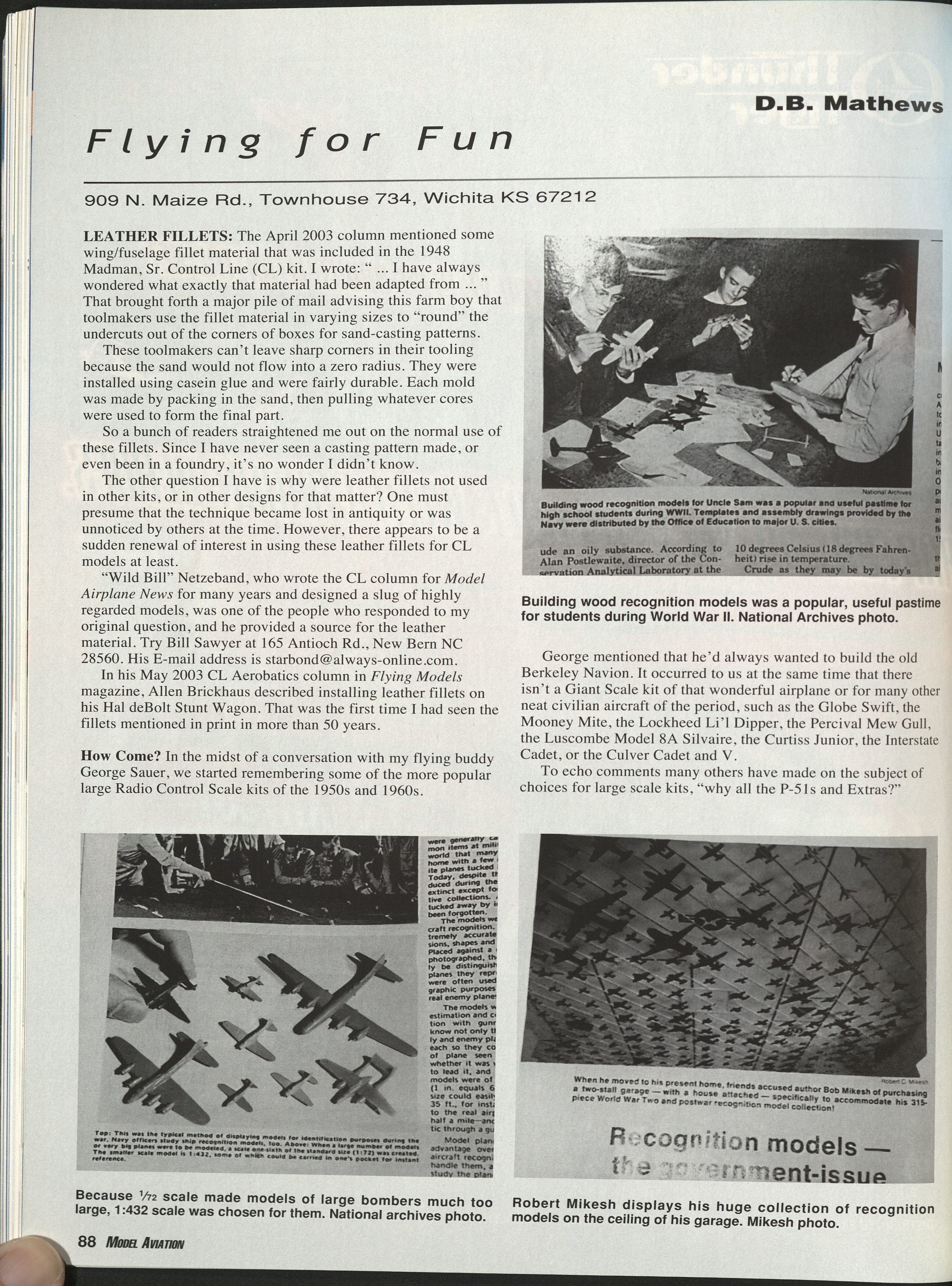
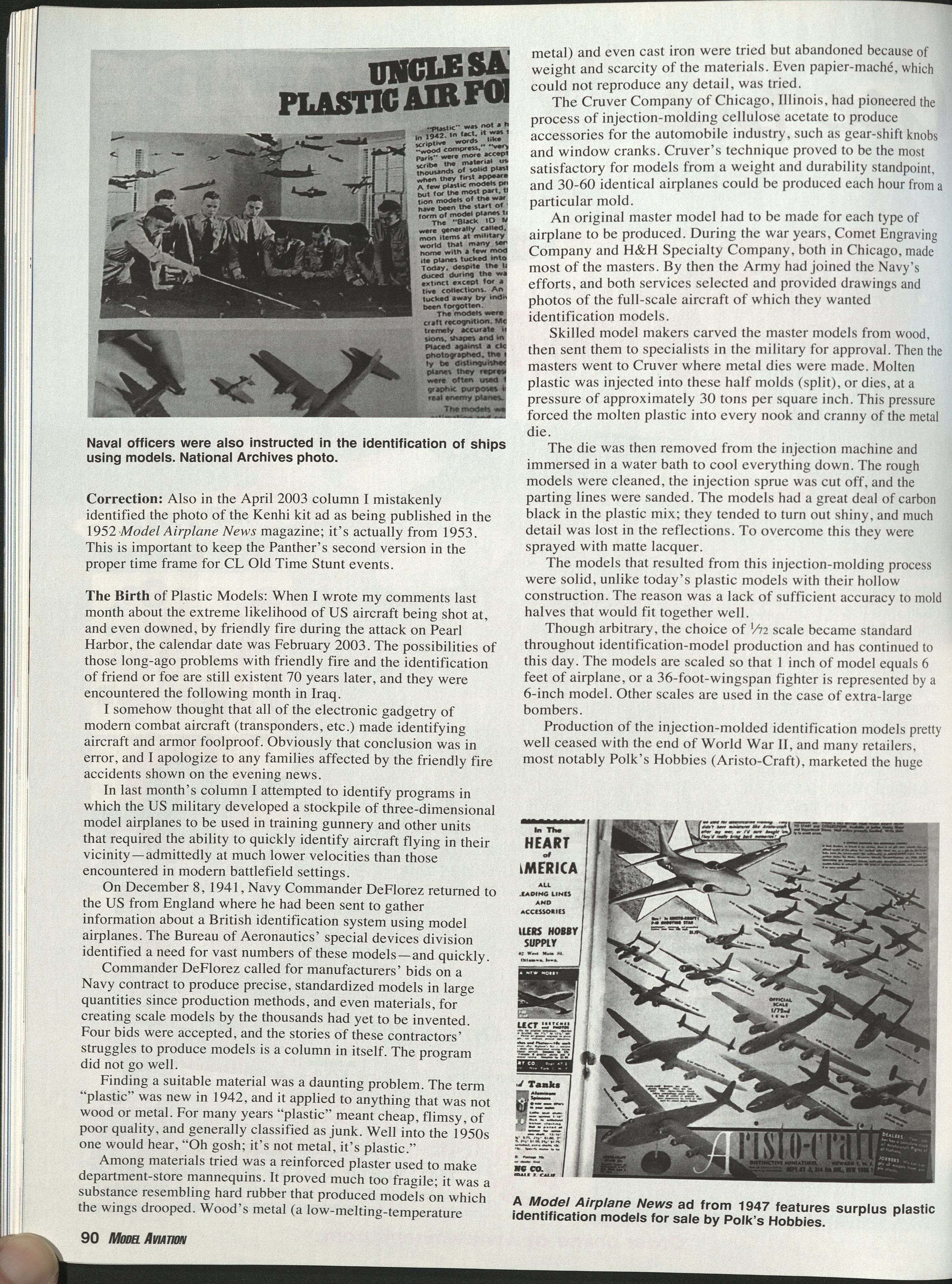
In last month's column I attempted to identify programs in which the U.S. military developed a stockpile of three-dimensional model airplanes to be used in training gunnery and other units that required the ability to quickly identify aircraft flying in their vicinity—admittedly at much lower velocities than those encountered in modern battlefield settings.
On December 8, 1941, Navy Commander DeFlorez returned to the U.S. from England where he had been sent to gather information about a British identification system using model airplanes. The Bureau of Aeronautics' special devices division identified a need for vast numbers of these models—and quickly. Commander DeFlorez called for manufacturers' bids on a Navy contract to produce precise, standardized models in large quantities since production methods, and even materials, for creating scale models by the thousands had yet to be invented. Four bids were accepted, and the stories of these contractors' struggles to produce models is a column in itself. The program did not go well.
Finding a suitable material was a daunting problem. The term "plastic" was new in 1942, and it applied to anything that was not wood or metal. For many years "plastic" meant cheap, flimsy, of poor quality, and generally classified as junk. Well into the 1950s one would hear, "Oh gosh; it's not metal, it's plastic."
Among materials tried was a reinforced plaster used to make department-store mannequins. It proved much too fragile; it was a substance resembling hard rubber that produced models on which the wings drooped. Wood's metal (a low-melting-temperature metal) and even cast iron were tried but abandoned because of weight and scarcity of the materials. Even papier-mâché, which could not reproduce any detail, was tried.
The Cruver Company of Chicago, Illinois, had pioneered the process of injection-molding cellulose acetate to produce accessories for the automobile industry, such as gear-shift knobs and window cranks. Cruver's technique proved to be the most satisfactory for models from a weight and durability standpoint, and 30–60 identical airplanes could be produced each hour from a particular mold.
An original master model had to be made for each type of airplane to be produced. During the war years, Comet Engraving Company and H&H Specialty Company, both in Chicago, made most of the masters. By then the Army had joined the Navy's efforts, and both services selected and provided drawings and photos of the full-scale aircraft of which they wanted identification models.
Skilled model makers carved the master models from wood, then sent them to specialists in the military for approval. Then the masters went to Cruver where metal dies were made. Molten plastic was injected into these half molds (split), or dies, at a pressure of approximately 30 tons per square inch. This pressure forced the molten plastic into every nook and cranny of the metal die.
The die was then removed from the injection machine and immersed in a water bath to cool everything down. The rough models were cleaned, the injection sprue was cut off, and the parting lines were sanded. The models had a great deal of carbon black in the plastic mix; they tended to turn out shiny, and much detail was lost in the reflections. To overcome this they were sprayed with matte lacquer.
The models that resulted from this injection-molding process were solid, unlike today's plastic models with their hollow construction. The reason was a lack of sufficient accuracy to mold halves that would fit together well.
Though arbitrary, the choice of 1/72 scale became standard throughout identification-model production and has continued to this day. The models are scaled so that 1 inch of model equals 6 feet of airplane, or a 36-foot-wingspan fighter is represented by a 6-inch model. Other scales are used in the case of extra-large bombers.
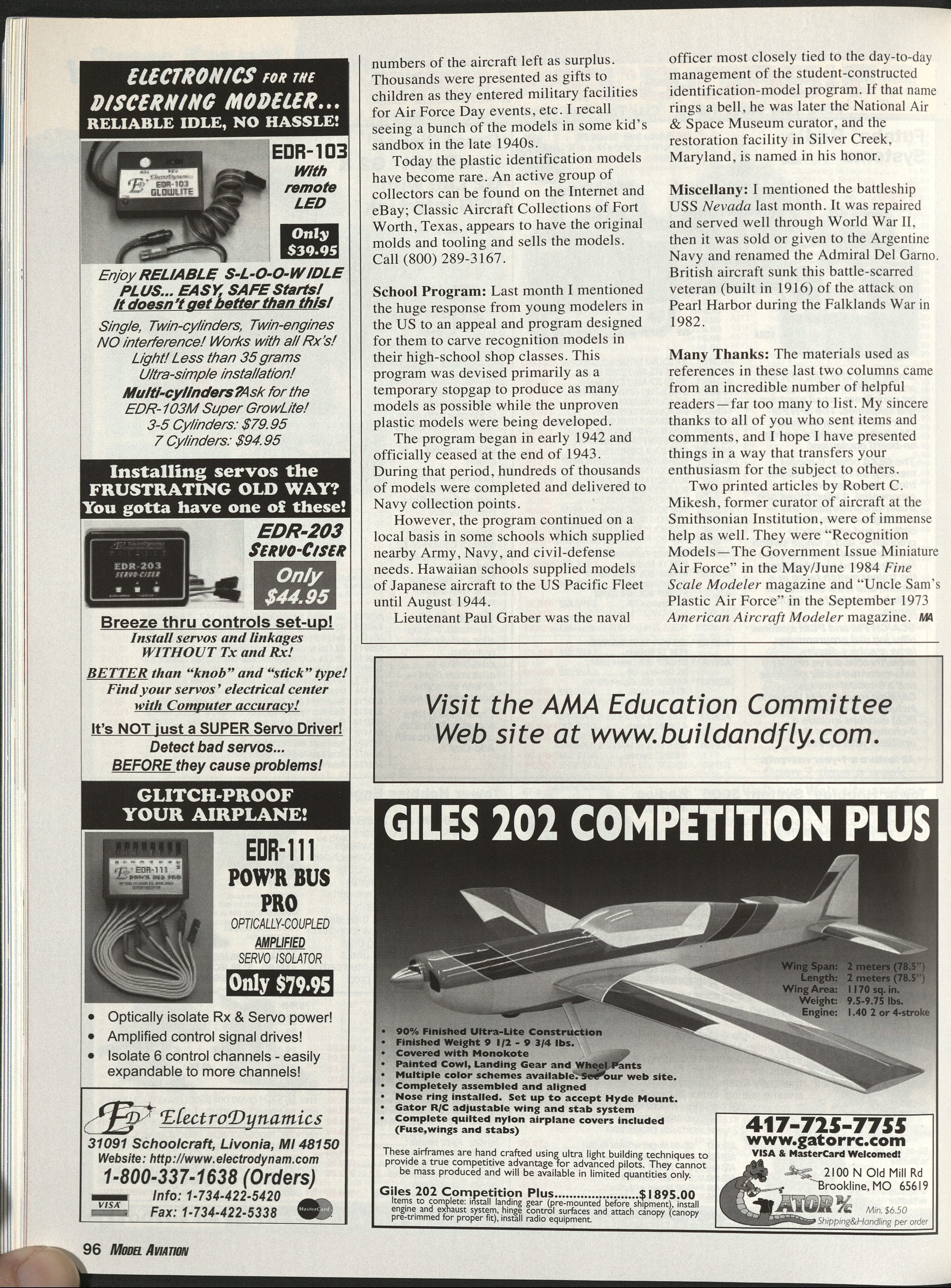
Production of the injection-molded identification models pretty well ceased with the end of World War II, and many retailers, most notably Polk's Hobbies (Aristo-Craft), marketed the huge numbers of the aircraft left as surplus. Thousands were presented as gifts to children as they entered military facilities for Air Force Day events, etc. I recall seeing a bunch of the models in some kid's sandbox in the late 1940s.
Today the plastic identification models have become rare. An active group of collectors can be found on the Internet and eBay; Classic Aircraft Collections of Fort Worth, Texas, appears to have the original molds and tooling and sells the models. Call (800) 289-3167.
School Program
Last month I mentioned the huge response from young modelers in the U.S. to an appeal and program designed for them to carve recognition models in their high-school shop classes. This program was devised primarily as a temporary stopgap to produce as many models as possible while the unproven plastic models were being developed.
The program began in early 1942 and officially ceased at the end of 1943. During that period, hundreds of thousands of models were completed and delivered to Navy collection points.
However, the program continued on a local basis in some schools which supplied nearby Army, Navy, and civil-defense needs. Hawaiian schools supplied models of Japanese aircraft to the U.S. Pacific Fleet until August 1944.
Lieutenant Paul Graber was the naval officer most closely tied to the day-to-day management of the student-constructed identification-model program. If that name rings a bell, he was later the National Air & Space Museum curator, and the restoration facility in Silver Creek, Maryland, is named in his honor.
Miscellany
I mentioned the battleship USS Nevada last month. It was repaired and served well through World War II, then it was sold or given to the Argentine Navy and renamed the Admiral Del Garno. British aircraft sunk this battle-scarred veteran (built in 1916) of the attack on Pearl Harbor during the Falklands War in 1982.
Many Thanks
The materials used as references in these last two columns came from an incredible number of helpful readers—far too many to list. My sincere thanks to all of you who sent items and comments, and I hope I have presented things in a way that transfers your enthusiasm for the subject to others.
Two printed articles by Robert C. Mikesh, former curator of aircraft at the Smithsonian Institution, were of immense help as well. They were "Recognition Models—The Government Issue Miniature Air Force" in the May/June 1984 Fine Scale Modeler magazine and "Uncle Sam's Plastic Air Force" in the September 1973 American Aircraft Modeler magazine.
MA
Transcribed from original scans by AI. Minor OCR errors may remain.

