
Flying for Fun
D.B. Mathews 909 N. Maize Rd., Townhouse 734, Wichita, KS 67212
MUCH OF THE following was excerpted from the article "Launch Count: 15,000 Drones, One Babe" by Stephen Joiner in the April/May 2003 Air & Space and the Web site http://www.ctie.monash.edu.au/hargrave/denny.html.
What We Didn't Know About Reginald Denny: As is true of almost any modeler interested in our hobby's history, I was aware of Reginald Denny's important contributions to the success of aeromodeling in the 1930s. In the previous two columns I have attempted to share information about those model-airplane contributions and his theatrical career. But as I explored the Monash University Web site, I learned that Reginald Denny is truly the father of remotely piloted model airplanes.
From the beginnings of aerial combat, anti-aircraft gunners practiced marksmanship by shooting at target sleeves, which were essentially large windsocks towed behind airplanes. Such flying duty was not highly prized; yet even though the target was towed in a straight line, few hits were ever recorded on the sleeve or tow airplane. Military thinkers doubted that enemy aircraft would oblige with such broad-sided targets. In 1935, Reginald Denny heard an anti-aircraft officer complaining about the inadequacy of the target sleeves. "I told him I saw no reason why a target plane couldn't be sent up by radio control," he later told a Los Angeles Herald-Express reporter. That was the defining moment for the development of what we refer to today as Remotely Piloted Vehicles, or RPVs.
Reginald's offhand remark was visionary and well ahead of the development curve. As far as can be determined, at that time no one had made repeatable radio-controlled flights—or at least not to the point of being commercially viable.
The AMA Nationals did not even have a radio-control event until 1937, and the few successful flights then were essentially controlled crashes. Clinton DeSoto won flying a radio-controlled (at least occasionally) glider.
On the other hand, the Good brothers, Chas. Siegfried, Chet Lanzo, Clinton DeSoto, Joe Raspante, Jim Walker, and a few others could see the potential for commercial and military applications for their pioneering radio-controlled model activities. But they lacked the financial backing of a movie star or the technical resources of a large body of unemployed technical people from the aircraft and movie industries. As a result, their radio-control developments were limited to single models and the available commercial engines.
Hobby Becomes Obsession
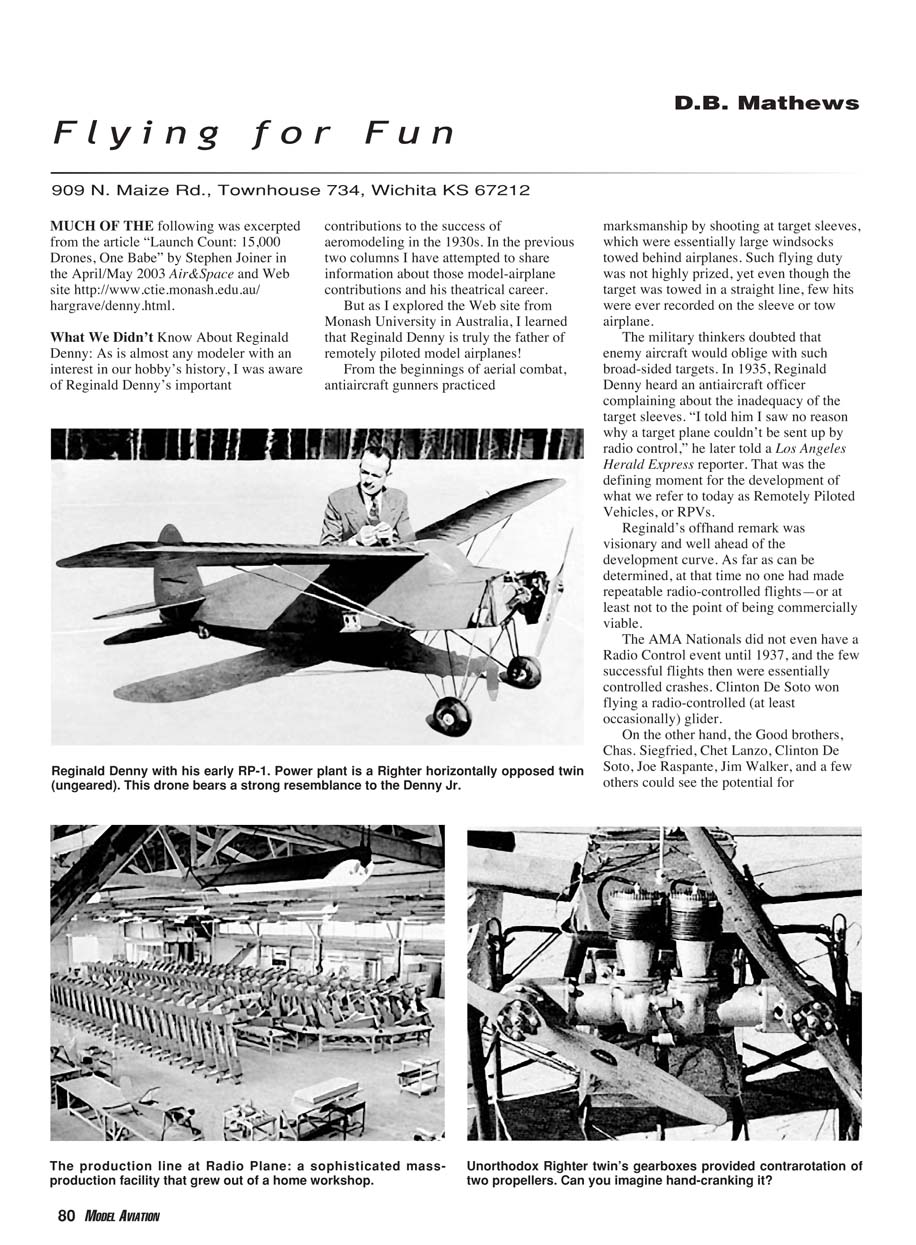
Reginald converted his home workshop into a remote-piloting lab. "My dad devoted most of his time to the development of radio control, and took acting jobs only to support his family and the drone project," said his son Reg Denny. With the help of several ham radio operators and Walter Righter, who built the two-cylinder engine, Reginald produced the first radio-controlled miniature target drone in 1936: the 9-foot-span RP-1. "RP" stood for "Radio Plane." (See photo.) The RP-1 used toy train motors to move the control surfaces and a rotary telephone dial to encode signals in the RC transmitter. Chas. Siegfried and Jim Walker also used a phone dial for this purpose, leading to the conclusion that there must have been a flow of information between these three pioneers. Chas. Siegfried worked for the telephone company here in Wichita, and I saw him in 1948 dialing for control, albeit rather sluggishly and inconsistently.
These primitive technologies did not produce acceptable results for several years. Undeterred by numerous early crashes, Reginald continued to finance prototypes by playing movie roles opposite such diverse talents as Greta Garbo and Abbott and Costello. Thus his late-night research and development continued on Vine Street.
Finally—Predictability!
Four years of hard work and frustration later, in 1939 the home-built servos were replaced with units from Bendix, and a joystick replaced the phone dial. When the 12-foot-span RP-4 finally auditioned for the military, its big break almost became a disaster.
"Unbeknownst to the military that day, the aircraft went completely out of control," wrote Reginald's son. "The brass was extremely impressed with the wild aerobatics, while my father and his group were terrified that the drone might dive into the reviewing stands."
The RP-4 spun into the ground, but Reginald returned to Hollywood with a government contract. The Army designated the improved RP-5 the OQ-2, and the Navy designated its drone the TDD-1, for "Target Drone Denny." The specifications were a one-hour flight to 5,000 feet, followed by parachute recovery with minimal damage.
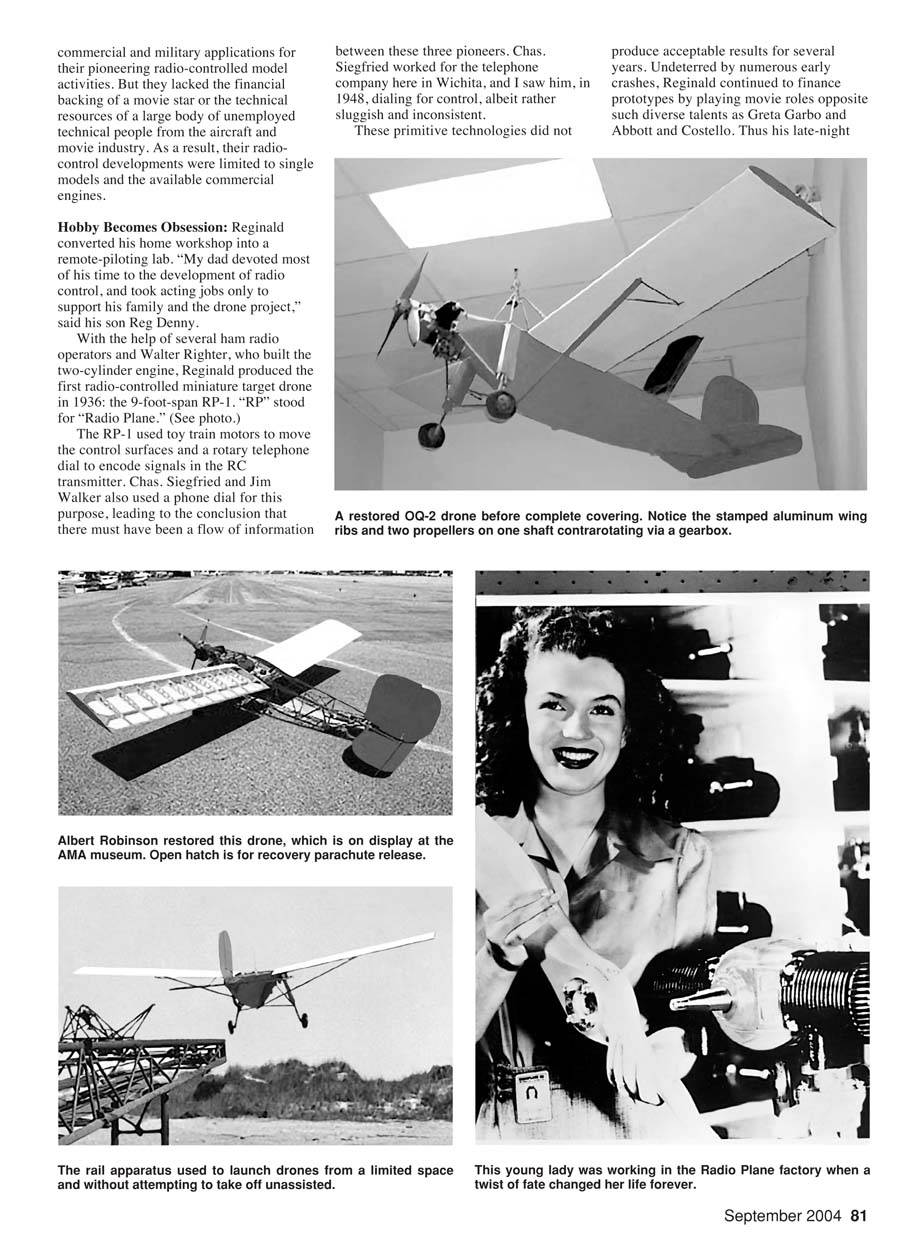
In June 1940, the Radio Plane Corporation moved from the Denny household to a Van Nuys, California, factory. Nearly 15,000 Denny drones were produced during World War II.
Reginald continued to refine the designs, adding aileron control, larger engines, and increasingly more reliable radio equipment. The last iteration was the long-lived KD-2R5, which reached a production run of more than 85,000, surpassing that of any full-scale aircraft ever manufactured.
Yet by the nature of their intended use, very few drones remain. That makes the OQ-2a on display in the AMA Museum in Muncie, Indiana, a unique exhibit.
Construction and Power
Early versions of the drones were constructed much like large model airplanes; that is, they were built mostly from wood and covered with lightweight muslin, which was sealed with nitrate dope. As the series evolved, a welded steel-tubing fuselage was combined with stamped aluminum wing ribs and a welded empennage.
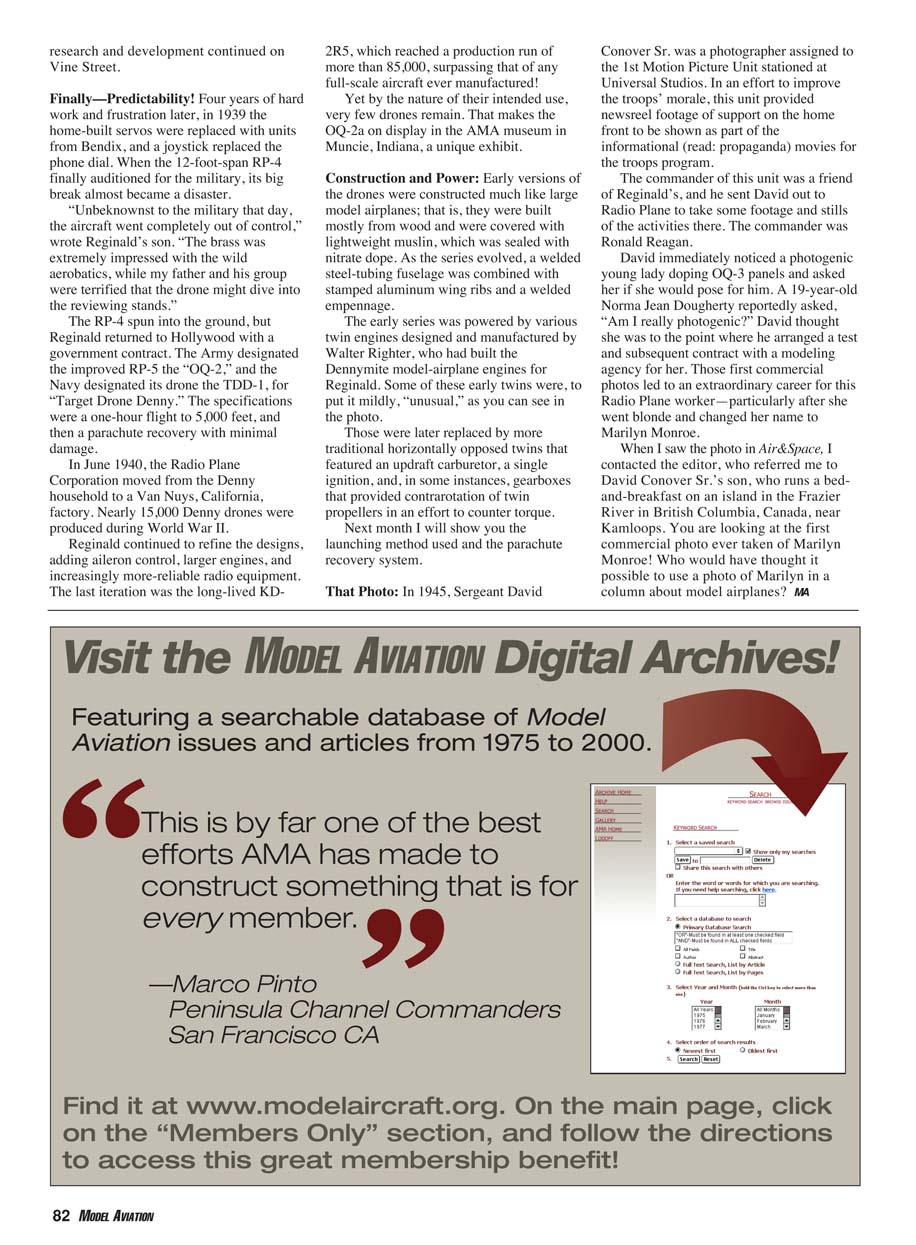
The early series was powered by various twin engines designed and manufactured by Walter Righter, who had built the Dennymite model-airplane engines for Reginald. Some of these early twins were, to put it mildly, unusual.
Those were later replaced by more traditional horizontally opposed twins that featured an updraft carburetor, a single ignition, and, in some instances, gearboxes that provided contrarotation of twin propellers in an effort to counter torque.
Next month I will show you the launching method used and the parachute recovery system.
That Photo
In 1945, Sergeant David Conover Sr. was a photographer assigned to the 1st Motion Picture Unit stationed at Universal Studios. In an effort to improve the troops' morale, this unit provided newsreel footage of support on the home front to be shown as part of the informational (read: propaganda) movies-for-the-troops program.
The commander of this unit was a friend of Reginald's, and he sent David out to Radio Plane to take some footage and stills of the activities there. The commander was Ronald Reagan.
David immediately noticed a photogenic young lady doping OQ-3 panels and asked her if she would pose for him. A 19-year-old Norma Jeane Dougherty reportedly asked, "Am I really photogenic?" David thought she was, arranged a test and a subsequent contract with a modeling agency for her. Those first commercial photos led to an extraordinary career for this Radio Plane worker—particularly after she went blonde and changed her name to Marilyn Monroe.
When I saw the photo in Air & Space, I contacted the editor, who referred me to David Conover Sr.'s son, who runs a bed-and-breakfast on an island in the Fraser River in British Columbia, Canada, near Kamloops. You are looking at the first commercial photo ever taken of Marilyn Monroe! Who would have thought it possible to use a photo of Marilyn in a column about model airplanes?
Transcribed from original scans by AI. Minor OCR errors may remain.

