
Flying for Fun
D.B. Mathews 909 N. Maize Rd., Townhouse 734, Wichita KS 67212
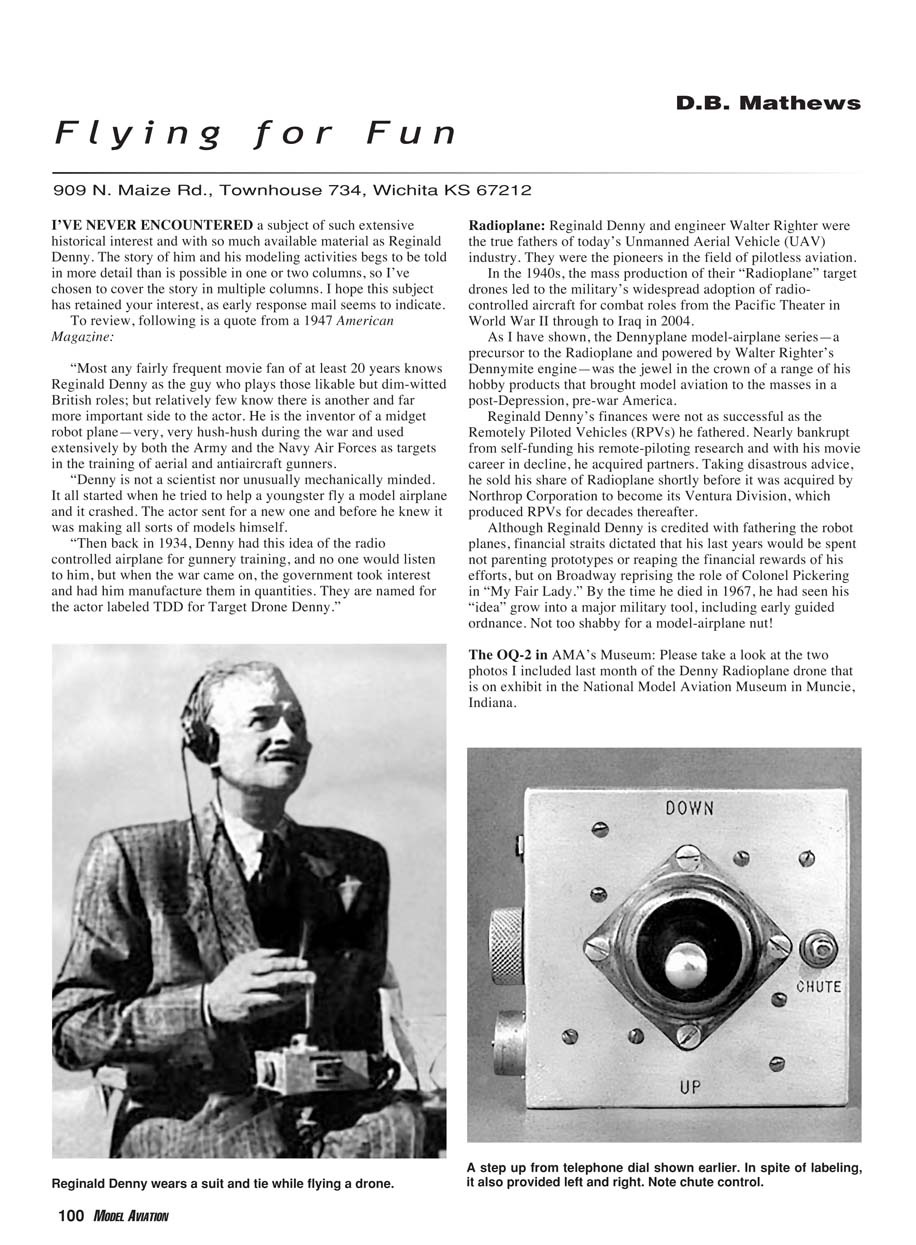
I've never encountered a subject of such extensive historical interest and with so much available material as Reginald Denny. The story of him and his modeling activities begs to be told in more detail than is possible in one or two columns, so I've chosen to cover the story in multiple columns. I hope this subject has retained your interest, as early response mail seems to indicate.
To review, following is a quote from a 1947 American Magazine:
"Most any fairly frequent movie fan of at least 20 years knows Reginald Denny as the guy who plays those likable but dim-witted British roles; but relatively few know there is another and far more important side to the actor. He is the inventor of a midget robot plane—very, very hush-hush during the war and used extensively by both the Army and the Navy Air Forces as targets in the training of aerial and antiaircraft gunners.
"Denny is not a scientist nor unusually mechanically minded. It all started when he tried to help a youngster fly a model airplane and it crashed. The actor sent for a new one and before he knew it was making all sorts of models himself.
"Then back in 1934, Denny had this idea of the radio controlled airplane for gunnery training, and no one would listen to him, but when the war came on, the government took interest and had him manufacture them in quantities. They are named for the actor labeled TDD for Target Drone Denny."
Radioplane
Reginald Denny and engineer Walter Righter were the true fathers of today's Unmanned Aerial Vehicle (UAV) industry. They were the pioneers in the field of pilotless aviation.
In the 1940s, the mass production of their "Radioplane" target drones led to the military's widespread adoption of radio-controlled aircraft for combat roles from the Pacific Theater in World War II through to Iraq in 2004.
As I have shown, the Dennyplane model-airplane series—a precursor to the Radioplane and powered by Walter Righter's Dennymite engine—was the jewel in the crown of a range of hobby products that brought model aviation to the masses in a post-Depression, pre-war America.
Reginald Denny's finances were not as successful as the Remotely Piloted Vehicles (RPVs) he fathered. Nearly bankrupt from self-funding his remote-piloting research and with his movie career in decline, he acquired partners. Taking disastrous advice, he sold his share of Radioplane shortly before it was acquired by Northrop Corporation to become its Ventura Division, which produced RPVs for decades thereafter.
Although Reginald Denny is credited with fathering the robot planes, financial straits dictated that his last years would be spent not parenting prototypes or reaping the financial rewards of his efforts, but on Broadway reprising the role of Colonel Pickering in My Fair Lady. By the time he died in 1967, he had seen his "idea" grow into a major military tool, including early guided ordnance. Not too shabby for a model-airplane nut!
The OQ-2 in AMA's Museum
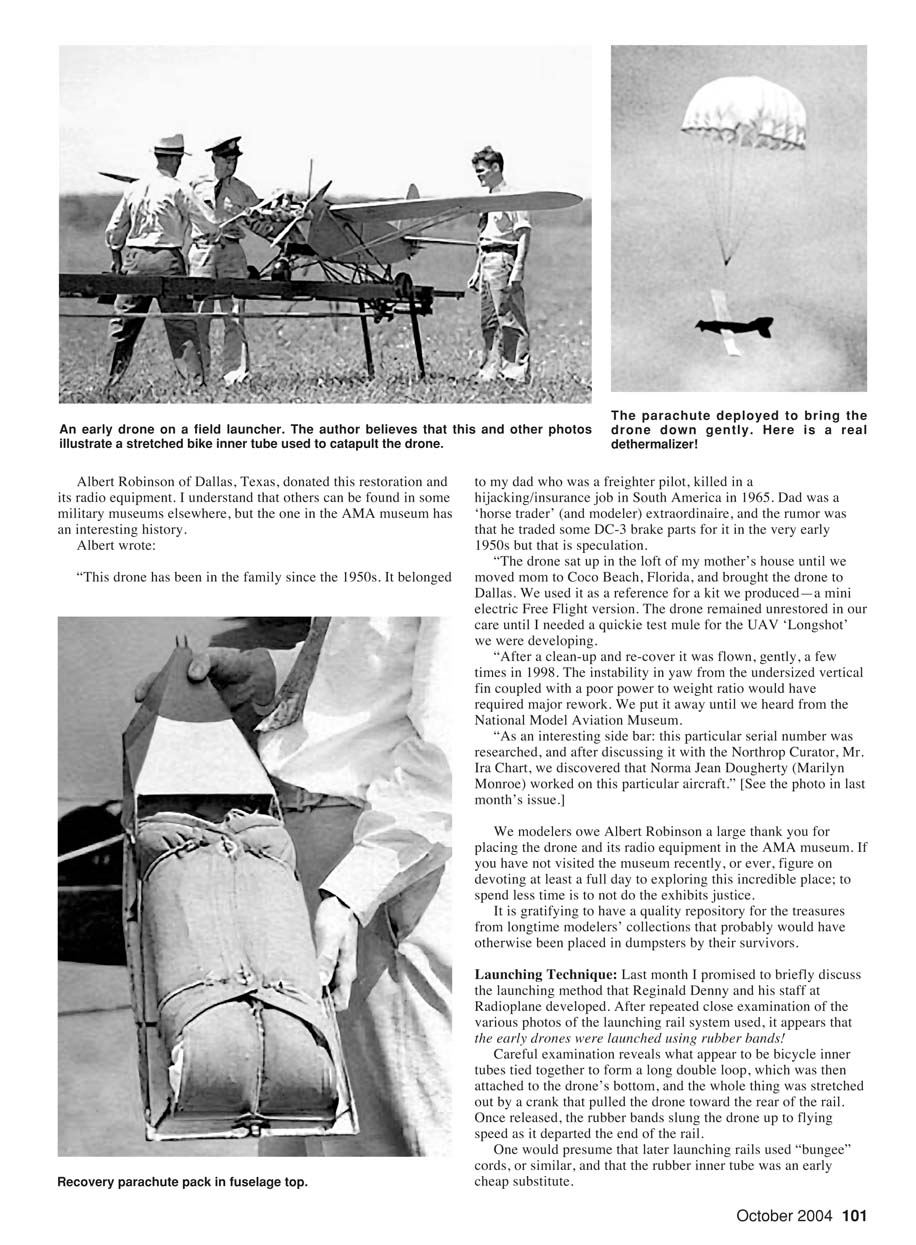
Please take a look at the two photos I included last month of the Denny Radioplane drone that is on exhibit in the National Model Aviation Museum in Muncie, Indiana. Albert Robinson of Dallas, Texas, donated this restoration and its radio equipment. I understand that others can be found in some military museums elsewhere, but the one in the AMA museum has an interesting history. Albert wrote:
"This drone has been in the family since the 1950s. It belonged to my dad who was a freighter pilot, killed in a hijacking/insurance job in South America in 1965. Dad was a 'horse trader' (and modeler) extraordinaire, and the rumor was that he traded some DC-3 brake parts for it in the very early 1950s but that is speculation.
"The drone sat up in the loft of my mother's house until we moved mom to Cocoa Beach, Florida, and brought the drone to Dallas. We used it as a reference for a kit we produced — a mini electric Free Flight version. The drone remained unrestored in our care until I needed a quickie test mule for the UAV 'Longshot' we were developing.
"After a clean-up and re-cover it was flown, gently, a few times in 1998. The instability in yaw from the undersized vertical fin coupled with a poor power-to-weight ratio would have required major rework. We put it away until we heard from the National Model Aviation Museum.
"As an interesting sidebar: this particular serial number was researched, and after discussing it with the Northrop Curator, Mr. Ira Chart, we discovered that Norma Jeane Dougherty (Marilyn Monroe) worked on this particular aircraft."
We modelers owe Albert Robinson a large thank you for placing the drone and its radio equipment in the AMA museum. If you have not visited the museum recently, or ever, figure on devoting at least a full day to exploring this incredible place; to spend less time is to not do the exhibits justice.
It is gratifying to have a quality repository for the treasures from longtime modelers' collections that probably would have otherwise been placed in dumpsters by their survivors.
Launching Technique
Last month I promised to briefly discuss the launching method that Reginald Denny and his staff at Radioplane developed. After repeated close examination of the various photos of the launching rail system used, it appears that the early drones were launched using rubber bands!
Careful examination reveals what appear to be bicycle inner tubes tied together to form a long double loop, which was then attached to the drone's bottom, and the whole thing was stretched out by a crank that pulled the drone toward the rear of the rail. Once released, the rubber bands slung the drone up to flying speed as it departed the end of the rail. One would presume that later launching rails used "bungee" cords, or similar, and that the rubber inner tube was an early cheap substitute.
This launching system was necessary because the target drones were flown on gunnery ranges — not air bases — so there were no prepared runways to use. This system also worked well when the Navy used it shipboard. I presume that the full-scale catapult system used on ships, involving either steam or gunpowder, would blow the wings off of the drones.
If there is any question of whether Denny and his group were modelers, this early launch device should prove that they were. This rubber-band launch technique has always been popular for launching models such as the Jim Walker Interceptor glider and many kits of the era.
Next month I will illustrate another launching system, also straight from modeling. If any reader knows for sure that this month's conclusion is incorrect, please advise me.
Recovery
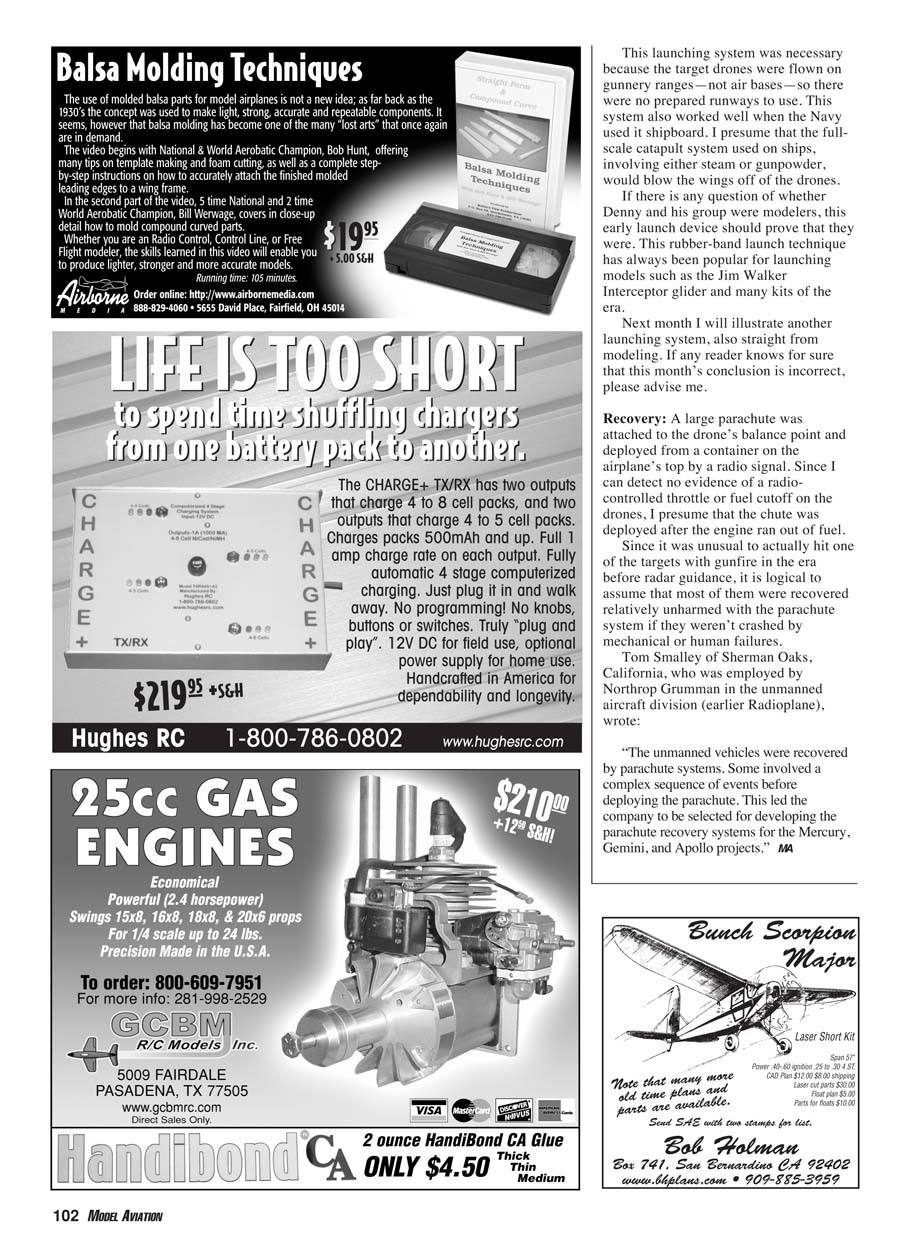
A large parachute was attached to the drone's balance point and deployed from a container on the airplane's top by a radio signal. Since I can detect no evidence of a radio-controlled throttle or fuel cutoff on the drones, I presume that the chute was deployed after the engine ran out of fuel.
Since it was unusual to actually hit one of the targets with gunfire in the era before radar guidance, it is logical to assume that most of them were recovered relatively unharmed with the parachute system if they weren't crashed by mechanical or human failures.
Tom Smalley of Sherman Oaks, California, who was employed by Northrop Grumman in the unmanned aircraft division (earlier Radioplane), wrote:
"The unmanned vehicles were recovered by parachute systems. Some involved a complex sequence of events before deploying the parachute. This led the company to be selected for developing the parachute recovery systems for the Mercury, Gemini, and Apollo projects."
MA
Transcribed from original scans by AI. Minor OCR errors may remain.

