
Flying for Fun
D.B. Mathews
909 N. Maize Rd., Townhouse 734, Wichita KS 67212
Problems
Before I get to the "meat and potatoes," a couple of mess-ups on my part need correction. Would the fellow who sent the video of Reginald Denny flying a Dennyplane please contact me? I have donated it to the AMA museum but need your name to place on it as the donor.
Someone wrote to inquire about the feasibility of enlarging a Cruiser 60 to fit a Moki 2.10 engine. I responded with a note and photos of the enlarged version I chose not to publish. It was all returned, marked "Insufficient Address." I no longer have the original letter.
A Champion
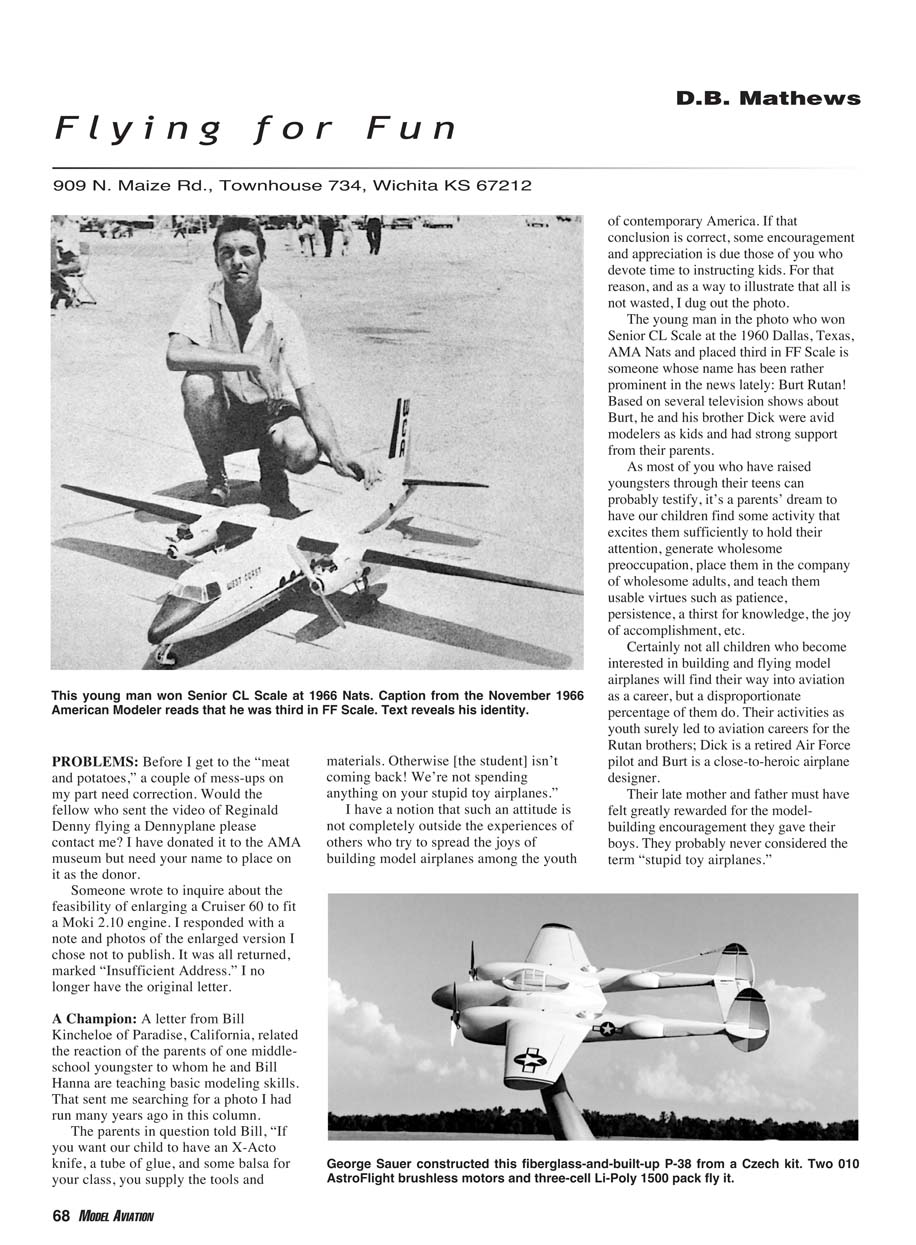
A letter from Bill Kincheloe of Paradise, California, related the reaction of the parents of one middle-school youngster to whom he and Bill Hanna are teaching basic modeling skills. That sent me searching for a photo I had run many years ago in this column. The parents in question told Bill, "If you want our child to have an X-Acto knife, a tube of glue, and some balsa for your class, you supply the tools and materials. Otherwise [the student] isn't coming back! We're not spending anything on your stupid toy airplanes." I have a notion that such an attitude is not completely outside the experiences of others who try to spread the joys of building model airplanes among the youth of contemporary America. If that conclusion is correct, some encouragement and appreciation is due those of you who devote time to instructing kids. For that reason, and as a way to illustrate that all is not wasted, I dug out the photo.
The young man in the photo who won Senior CL Scale at the 1960 Dallas, Texas, AMA Nats and placed third in FF Scale is someone whose name has been rather prominent in the news lately: Burt Rutan! Based on several television shows about Burt, he and his brother Dick were avid modelers as kids and had strong support from their parents.
As most of you who have raised youngsters through their teens can probably testify, it's a parents' dream to have our children find some activity that excites them sufficiently to hold their attention, generate wholesome preoccupation, place them in the company of wholesome adults, and teach them usable virtues such as patience, persistence, a thirst for knowledge, the joy of accomplishment, etc.
Certainly not all children who become interested in building and flying model airplanes will find their way into aviation as a career, but a disproportionate percentage of them do. Their activities as youth surely led to aviation careers for the Rutan brothers; Dick is a retired Air Force pilot and Burt is a close-to-heroic airplane designer.
Their late mother and father must have felt greatly rewarded for the model-building encouragement they gave their boys. They probably never considered the term "stupid toy airplanes."
"She confessed that the work of building a model, testing it, repairing it, and improving it kept me away from 'less wholesome' activities, so she would scrimp to make sure I had the materials, time, and a place to pursue what almost became an obsession." I'll bet those words brought a lump to many older readers' throats. They tell my story well, and although I didn't pursue a career in aviation, I did use the skills acquired to practice dentistry. I learned that more than two-thirds of my dental-school classmates were also modelers.
Nice In Any Language
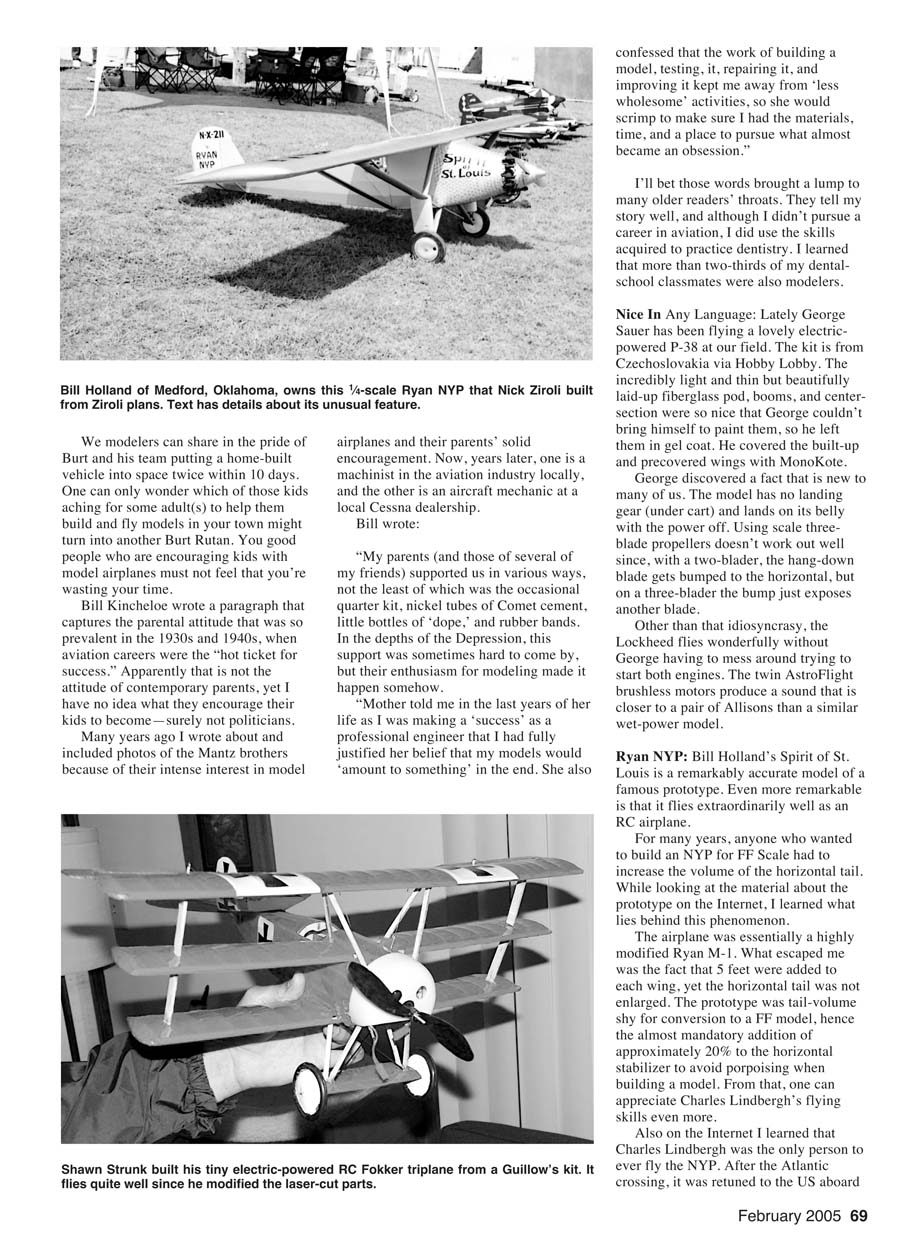
Lately George Sauer has been flying a lovely electric-powered P-38 at our field. The kit is from Czechoslovakia via Hobby Lobby. The incredibly light and thin but beautifully laid-up fiberglass pod, booms, and center section were so nice that George couldn't bring himself to paint them, so he left them in gel coat. He covered the built-up and precovered wings with MonoKote.
George discovered a fact that is new to many of us. The model has no landing gear (no undercarriage) and lands on its belly with the power off. Using scale three-blade propellers doesn't work out well since, with a two-blader, the hang-down blade gets bumped to the horizontal, but on a three-blader the bump just exposes another blade.
Other than that idiosyncrasy, the Lockheed flies wonderfully without George having to mess around trying to start both engines. The twin AstroFlight brushless motors produce a sound that is closer to a pair of Allisons than a similar wet-power model.
Ryan NYP
Bill Holland's Spirit of St. Louis is a remarkably accurate model of a famous prototype. Even more remarkable is that it flies extraordinarily well as an RC airplane.
For many years, anyone who wanted to build an NYP for FF Scale had to increase the volume of the horizontal tail. While looking at the material about the prototype on the Internet, I learned what lies behind this phenomenon.
The airplane was essentially a highly modified Ryan M-1. What escaped me was the fact that 5 feet were added to each wing, yet the horizontal tail was not enlarged. The prototype was tail-volume shy for conversion to a FF model, hence the almost mandatory addition of approximately 20% to the horizontal stabilizer to avoid porpoising when building a model. From that, one can appreciate Charles Lindbergh's flying skills even more.
Also on the Internet I learned that Charles Lindbergh was the only person to ever fly the NYP. After the Atlantic crossing, it was returned to the U.S. aboard the USS Memphis and then eventually flown to all 48 contiguous states, many cities in Central and Latin America, and finally to Washington, D.C., to be displayed at the Smithsonian Institution.
The NYP held 400 gallons of fuel, which represented half of the aircraft's total weight at takeoff!
The movie in which Jimmie Stewart played Charles Lindbergh used three reproductions; one is now in the Experimental Aircraft Association museum in Oshkosh, Wisconsin; one is (or was) in the San Diego Air & Space Museum; and a third resides in the Henry Ford Museum in Dearborn, Michigan.
Bill Holland slows the model Spirit in flight, makes a low pass over the runway, triggers a mini-cassette onboard, and Jimmie Stewart's voice can be heard shouting, "Which way to Ireland?" It's sort of spooky.
Triplane
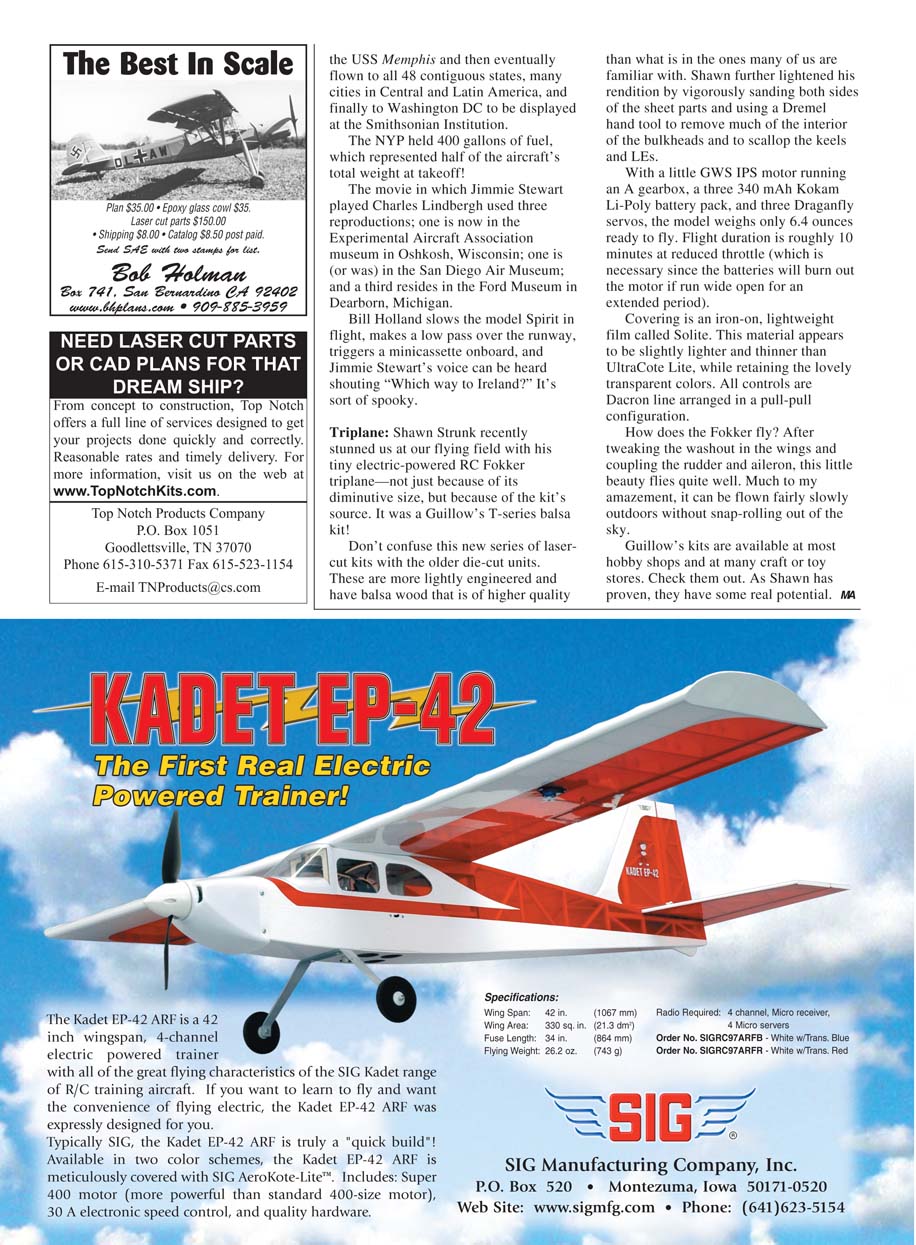
Shawn Strunk recently stunned us at our flying field with his tiny electric-powered RC Fokker triplane—not just because of its diminutive size, but because of the kit's source. It was a Guillow's T-series balsa kit!
Don't confuse this new series of laser-cut kits with the older die-cut units. These are more lightly engineered and have balsa wood that is of higher quality than what is in the ones many of us are familiar with. Shawn further lightened his rendition by vigorously sanding both sides of the sheet parts and using a Dremel hand tool to remove much of the interior of the bulkheads and to scallop the keels and leading edges.
With a little GWS IPS motor running an A-1 gearbox, a three-cell 340 mAh Kokam Li-Poly battery pack, and three Dragonfly servos, the model weighs only 6.4 ounces ready to fly. Flight duration is roughly 10 minutes at reduced throttle (which is necessary since the batteries will burn out the motor if run wide open for an extended period).
Covering is an iron-on, lightweight film called Solite. This material appears to be slightly lighter and thinner than UltraCote Lite, while retaining the lovely transparent colors. All controls are Dacron line arranged in a pull-pull configuration.
How does the Fokker fly? After tweaking the washout in the wings and coupling the rudder and aileron, this little beauty flies quite well. Much to my amazement, it can be flown fairly slowly outdoors without snap-rolling out of the sky.
Guillow's kits are available at most hobby shops and at many craft or toy stores. Check them out. As Shawn has proven, they have some real potential.
MA
Transcribed from original scans by AI. Minor OCR errors may remain.

