
Flying for Fun
D.B. Mathews
909 N. Maize Rd., Townhouse 734, Wichita, KS 67212
The January and February 2005 "Flying for Fun" columns have been not-so-subtly based on my continuing concern about the rapid decline in interest in building among contemporary modelers. Although there is absolutely no financial gain for me in encouraging modelers to branch out and get creative by building from plans or kits, I would like to share that joy.
Whatever reward one is seeking from involvement in model airplanes is obtainable; this is the basic explanation for the hobby's growth. Whether the participant wants to reproduce a scale model of a significant full-scale aircraft, fly maneuvers that cannot be duplicated in full-scale airplanes, fly indoors or in small spaces outdoors, build and fly delicate stick-and-tissue creations that are trimmed to fly well with no external control inputs, compete in closed-course racing, or even fly a model across the North Atlantic, modeling can make those dreams a reality.
Modeling activities are also great unifiers; they can mold diverse personalities into groups who speak a common language, share the same problems and solutions, enjoy helping each other through sharing acquired knowledge, and find happiness in the successes of others and sadness in their failures.
Model Airplanes is a classless society. Hardly anyone knows or cares about another modeler's occupation, wealth, or community status. All that seems to count is whether or not everyone is having fun.
Expanding Horizons
In the eyes of longtime modeling participants, many modelers are missing out on a rewarding part of the hobby. I have recently begun "hanging out" in a new neighborhood hobby shop, partly because I sense that I have been losing touch with the younger set. This experience has not only been educational, but it's been rather alarming.
This hobby shop has the most complete selection of hardware, engines, radio systems, materials, and ARFs I've ever seen. However, there is not a single kit in stock. The reason is simple: kits don't sell!
In the middle of a conversation I had roughly a year ago with one of the designers for a major U.S. manufacturer, I learned that the company was going to introduce a larger version of a design I had reviewed for a magazine. I immediately asked to be sampled so I could write a kit review of the new model, only to be advised that there would be no kit—only an ARF.
When I expressed surprise, I was told that the company had run the numbers and couldn't amortize the cost of developing a kit from projected sales.
In this new hobby shop, not only do the customers not buy kits, but many of them hire one of the store's employees to assemble and install the equipment in their new ARFs. In a tolerant mood I say that's fine, but my heart tells me that those modelers are missing a facet of the hobby that has been an immeasurable source of pleasure to many of us older guys: building.
Neither I nor anyone else is going to alter this new trend in modeling. At best, we can only encourage those who feel shortchanged after a few ARFs and are challenged to expand their skills and knowledge by constructing a model from a box of parts or even drawings.
Many of us wonder deep down if this art form we have learned to love during a lifetime of building is going the way of the whooping crane. We cannot convert the majority of ARF fliers into builders, but maybe by example we can interest a few of them enough that they will try building.
If they do, then we are obligated by the memory of those who came before us and taught us to help these neophyte builders anyway we can.
Most ARF fliers probably consider us builders an odd lot and remain bewildered by our interest, but a few (perhaps a precious few) are going to recognize an expanded side to modeling and try building. After all, there are still a few whooping cranes left. They are increasingly exposed to the public consciousness and may not be doomed to extinction after all.
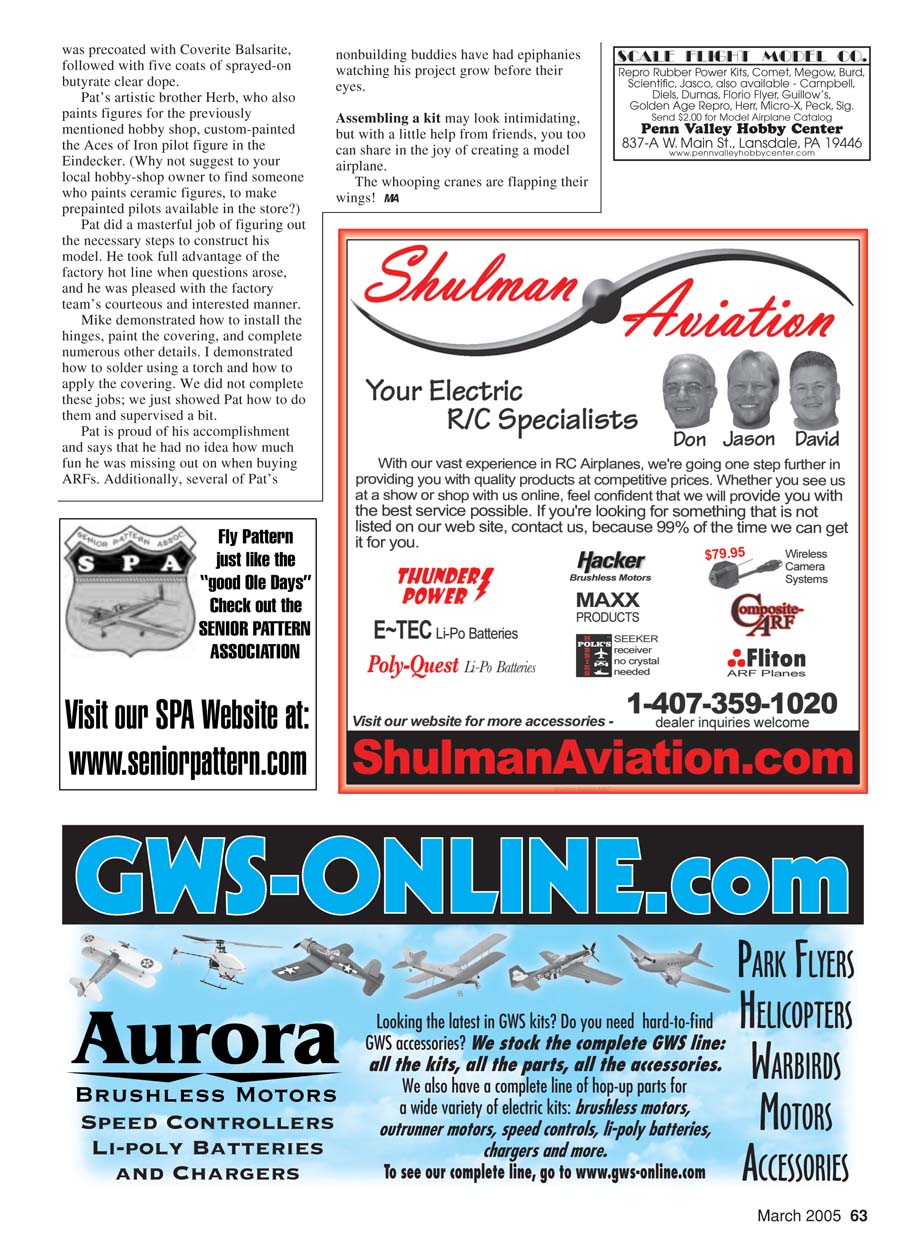
My neighbor Pat McGreevy developed an interest in RC models roughly a year ago. Starting with ARF trainers, he quickly progressed to lovely ARF scale models as his flying skills improved. The group he flies with is almost exclusively fliers—not builders.
Pat rents a business building in which he used to restore Cushman motor scooters. It makes a magnificent model-airplane workshop and has also evolved into a gathering place for fellow modelers who drop in during the day to socialize. Included in this group are Mike Tallman and me, and both of us truly love to build and fly.
Apparently some of our lifetime enthusiasm for the creative side of modeling led Pat to conclude that there might be another fascinating side to our hobby that is worth investigating. He decided that he wanted to construct an RC kit.
Pat had sort of built a few stick-and-tissue kits as a kid and had minimal success, so choosing to build a large-scale kit was indeed a bold move. We encouraged him to do it and offered to help him through the rough spots.
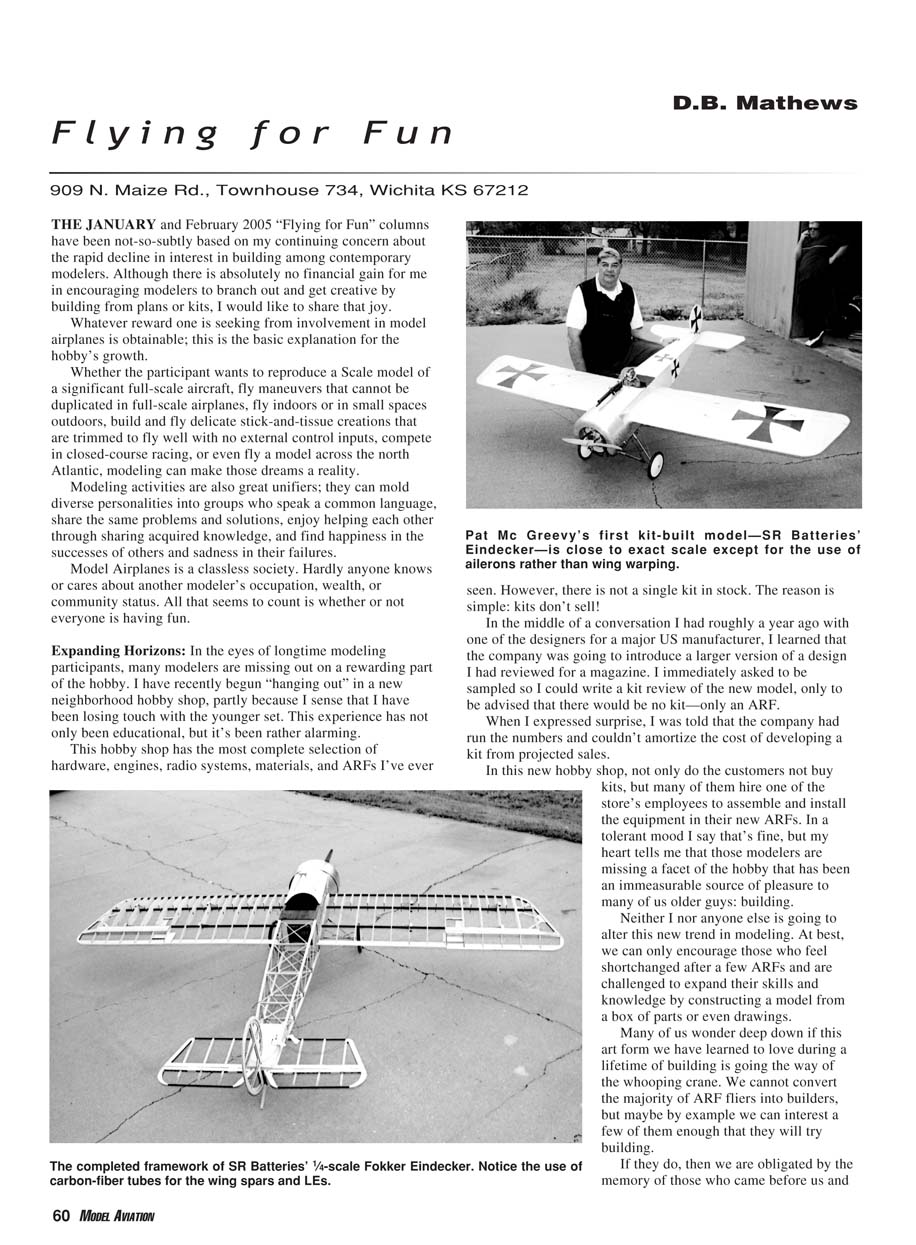
He investigated the ads in MA and checked out manufacturers' web sites to find a kit to suit his need for straightforward construction and a pleasing appearance. Through serendipity or dumb luck—or actually because of the prompt, courteous manner in which he was treated online by SR Batteries—Pat settled on a nearly perfect product for his needs: SR Batteries' 1/4-scale Eindecker.
I had reviewed SR Batteries' Cutie, SR X250, and Bantam kits, and I knew the quality to be top-notch. Many clever fixtures were included to assure straight construction, not to mention the top-rate engineering and instruction books. I was pleased to learn that Pat had chosen one of this company's products. Once Mike and I saw the kit, we felt confident that Pat would be able to construct this model with minimal problems.
The kit drawings were beautifully rendered on no less than four 72 x 24-inch sheets. The instruction manual was complete to the point of obsession, and a staffed helpline was available via the Internet or telephone.
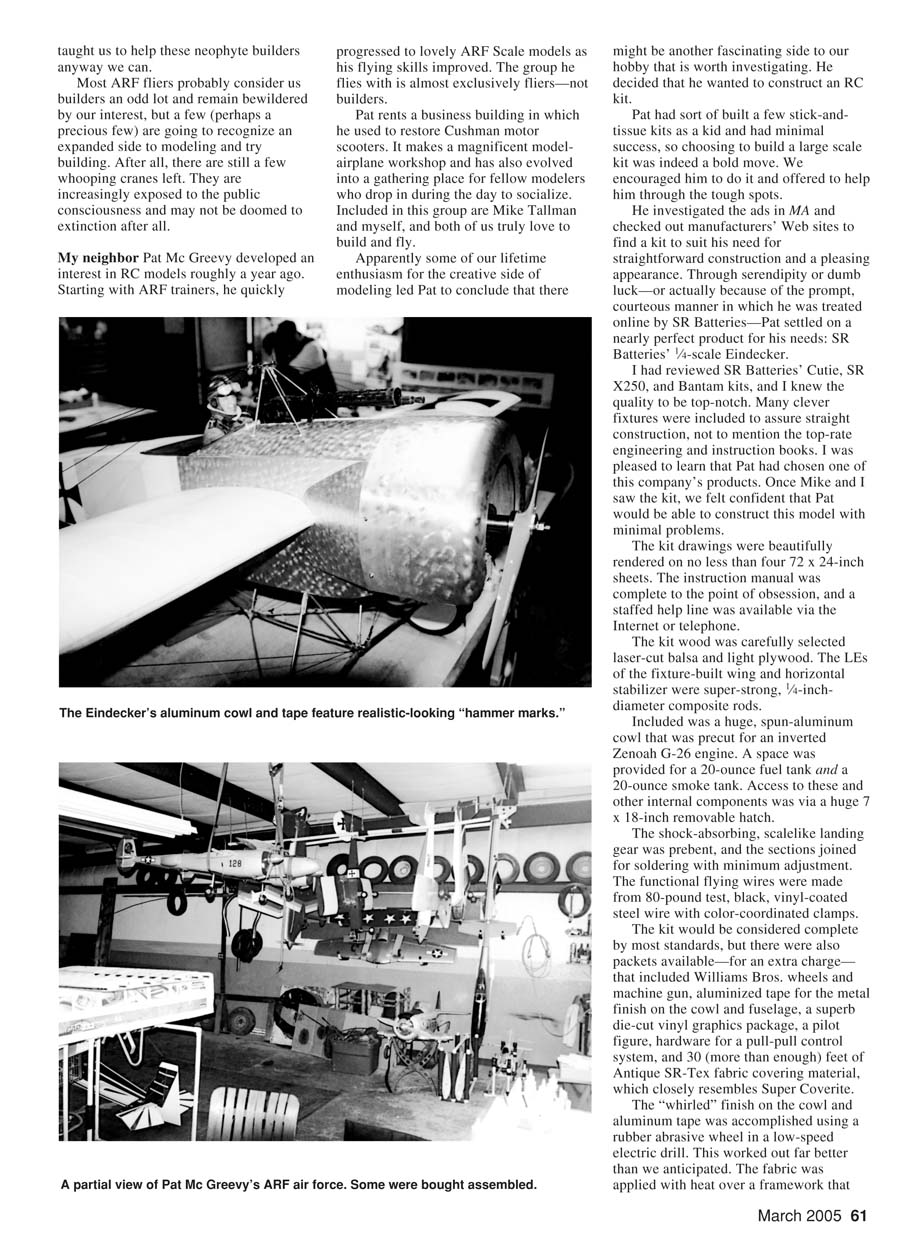
The kit wood was carefully selected laser-cut balsa and light plywood. The LEs (leading edges) of the fixture-built wing and horizontal stabilizer were super-strong, 1/4-inch-diameter composite rods.
Included was a huge, spun-aluminum cowl that was precut for an inverted Zenoah G-26 engine. A space was provided for a 20-ounce fuel tank and a 20-ounce smoke tank. Access to these and other internal components was via a huge 7 x 18-inch removable hatch.
The shock-absorbing, scale-like landing gear was prebent, and the sections joined for soldering with minimum adjustment. The functional flying wires were made from 80-pound-test, black, vinyl-coated steel wire with color-coordinated clamps.
The kit would be considered complete by most standards, but there were also packets available—for an extra charge—that included Williams Bros. wheels and machine gun, aluminized tape for the metal finish on the cowl and fuselage, a superb die-cut vinyl graphics package, a pilot figure, hardware for a pull-pull control system, and 30 (more than enough) feet of Antique SR-Tex fabric covering material, which closely resembles Super Coverite.
The "whirled" finish on the cowl and aluminum tape was accomplished using a rubber abrasive wheel in a low-speed electric drill. This worked out far better than we anticipated. The fabric was applied with heat over a framework that was precoated with Coverite Balsarite, followed with five coats of sprayed-on butyrate clear dope.
Pat's artistic brother Herb, who also paints figures for the previously mentioned hobby shop, custom-painted the Aces of Iron pilot figure in the Eindecker. (Why not suggest to your local hobby-shop owner to find someone who paints ceramic figures, to make prepainted pilots available in the store?)
Pat did a masterful job of figuring out the necessary steps to construct his model. He took full advantage of the factory hotline when questions arose, and he was pleased with the factory team's courteous and interested manner.
Mike demonstrated how to install the hinges, paint the covering, and complete numerous other details. I demonstrated how to solder using a torch and how to apply the covering. We did not complete these jobs; we just showed Pat how to do them and supervised a bit.
Pat is proud of his accomplishment and says that he had no idea how much fun he was missing out on when buying ARFs. Additionally, several of Pat's nonbuilding buddies have had epiphanies watching his project grow before their eyes.
Assembling a kit may look intimidating, but with a little help from friends, you too can share in the joy of creating a model airplane.
The whooping cranes are flapping their wings!
MA
Transcribed from original scans by AI. Minor OCR errors may remain.

