
PROOF OF THE PUDDING
I've used that phrase all my life and have no idea what it really means! Presumably, as used, it means tasting the cooked product to ascertain its quality. That being the case, flying a model-airplane construction project would fit the phrase, wouldn't it?
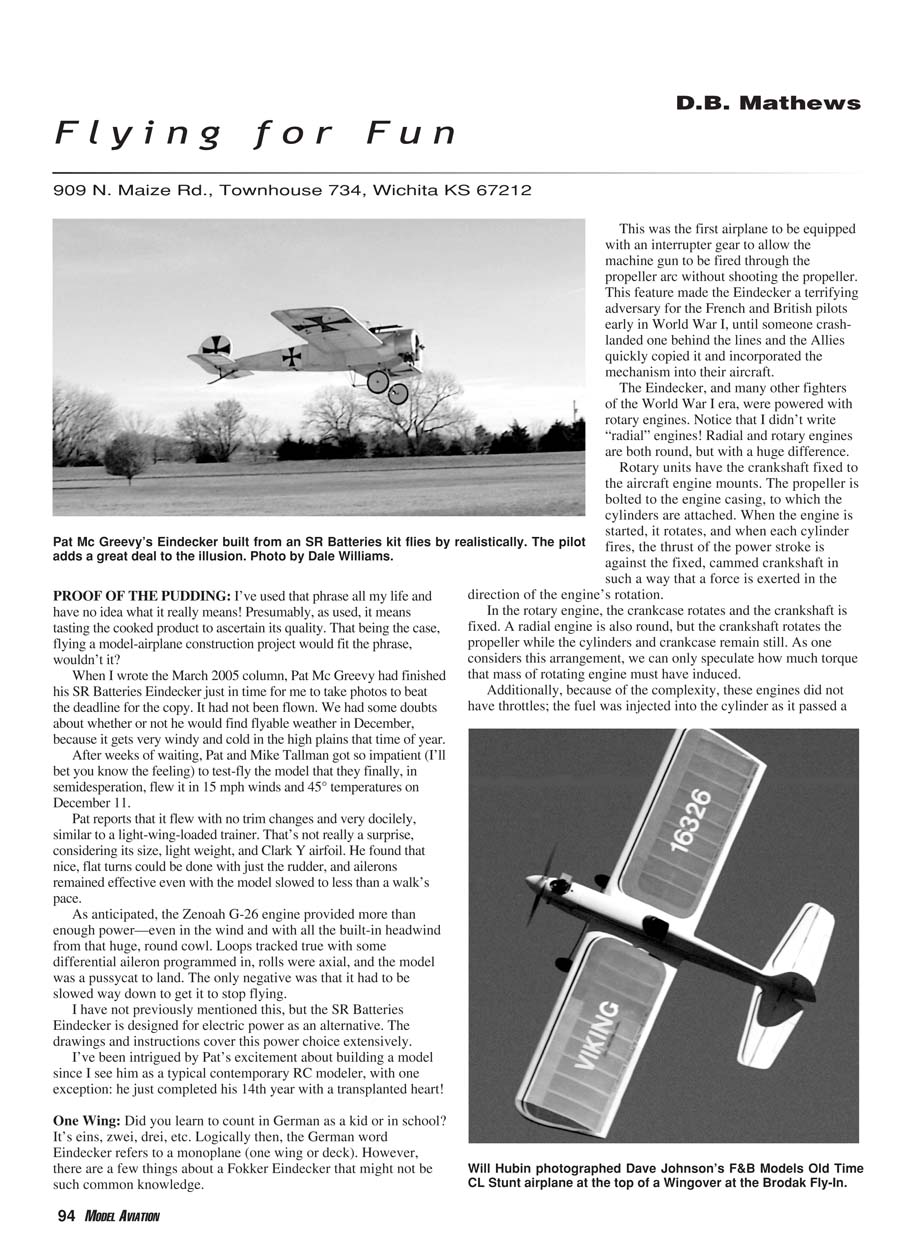
When I wrote the March 2005 column, Pat McGreevy had finished his SR Batteries Eindecker just in time for me to take photos to beat the deadline for the copy. It had not been flown. We had some doubts about whether he would find flyable weather in December, because it gets very windy and cold on the high plains that time of year.
After weeks of waiting, Pat and Mike Tallman got so impatient (I'll bet you know the feeling) to test-fly the model that they finally, in semi-desperation, flew it in 15 mph winds and 45°F temperatures on December 11.
Pat reports that it flew with no trim changes and very docilely, similar to a light-wing-loaded trainer. That's not really a surprise, considering its size, light weight, and Clark Y airfoil. He found that nice, flat turns could be done with just the rudder, and ailerons remained effective even with the model slowed to less than a walk's pace.
As anticipated, the Zenoah G-26 engine provided more than enough power—even in the wind and with all the built-in headwind caused by that huge, round cowl. Loops tracked true with some differential aileron programmed in, rolls were axial, and the model was a pussycat to land. The only negative was that it had to be slowed way down to get it to stop flying.
I have not previously mentioned this, but the SR Batteries Eindecker is designed for electric power as an alternative. The drawings and instructions cover this power choice extensively.
I've been intrigued by Pat's excitement about building a model since I see him as a typical contemporary RC modeler, with one exception: he just completed his 14th year with a transplanted heart!
One Wing
Did you learn to count in German as a kid or in school? It's eins, zwei, drei, etc. Logically then, the German word Eindecker refers to a monoplane (one wing or deck). However, there are a few things about a Fokker Eindecker that might not be common knowledge.
This was the first airplane to be equipped with an interrupter gear to allow the machine gun to be fired through the propeller arc without shooting the propeller. This feature made the Eindecker a terrifying adversary for the French and British pilots early in World War I, until someone crash-landed one behind the lines and the Allies quickly copied it and incorporated the mechanism into their aircraft.
The Eindecker, and many other fighters of the World War I era, were powered with rotary engines. Notice that I didn't write "radial" engines! Radial and rotary engines are both round, but with a huge difference.
Rotary units have the crankshaft fixed to the aircraft engine mounts. The propeller is bolted to the engine casing, to which the cylinders are attached. When the engine is started, the entire engine rotates, and when each cylinder fires, the thrust of the power stroke is against the fixed, cammed crankshaft in such a way that a force is exerted in the direction of the engine's rotation. In the rotary engine, the crankcase rotates and the crankshaft is fixed. A radial engine is also round, but the crankshaft rotates the propeller while the cylinders and crankcase remain still. As one considers this arrangement, we can only speculate how much torque that mass of rotating engine must have induced.
Additionally, because of the complexity, these engines did not have throttles; the fuel was injected into the cylinder as it passed a port. As a consequence, the pilot slowed the power plant by "blipping" the ignition switch on and off, hence the characteristic "burp, burp" sound one hears at Rhinebeck and in old movies as these airplanes are landed.
Another oddity of the Eindecker's Oberursel power plant is that it started life as a license-built French Gnome, but with the guns of August 1914 it was simply copied without royalties. Therefore, the power plants in the French Nieuport 11 and the British F.E.8 were nearly identical to the Eindecker's.
This information is from Fokker Eindecker in Action—a neat Squadron/Signal booklet that is included with the SR Batteries kit. It is packed with drawings, photos, and text.
A Rare One
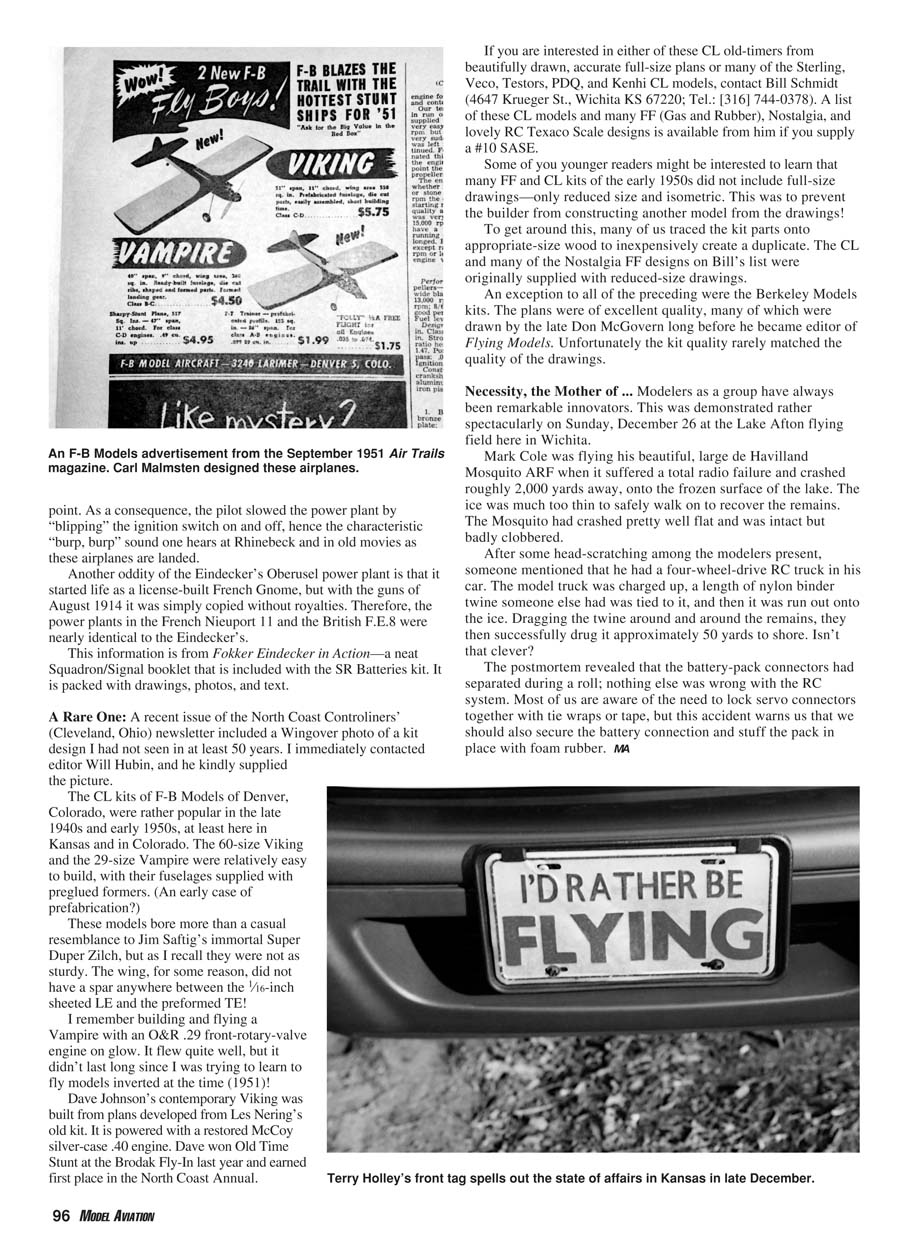
A recent issue of the North Coast Controllers' (Cleveland, Ohio) newsletter included a Wingover photo of a kit design I had not seen in at least 50 years. I immediately contacted editor Will Hubin, and he kindly supplied the picture.
The CL kits of F-B Models of Denver, Colorado, were rather popular in the late 1940s and early 1950s, at least here in Kansas and in Colorado. The 60-size Viking and the 29-size Vampire were relatively easy to build, with their fuselages supplied with pre-glued formers. (An early case of prefabrication?)
These models bore more than a casual resemblance to Jim Saftig's immortal Super Duper Zilch, but as I recall they were not as sturdy. The wing, for some reason, did not have a spar anywhere between the 1/16-inch sheeting at the leading edge and the preformed trailing edge!
I remember building and flying a Vampire with an O&R .29 front rotary-valve engine on glow. It flew quite well, but it didn't last long since I was trying to learn to fly models inverted at the time (1951!).
Dave Johnson's contemporary Viking was built from plans developed from Lees Nering's old kit. It is powered with a restored McCoy silver-case .40 engine. Dave won Old Time Stunt at the Brodak Fly-In last year and earned first place in the North Coast Annual.
If you are interested in either of these CL old-timers from beautifully drawn, accurate full-size plans, or many of the Sterling, Veco, Testors, PDQ, and Kenhi CL models, contact Bill Schmidt (4647 Krueger St., Wichita KS 67220; Tel.: [316] 744-0378). A list of these CL models and many FF (Gas and Rubber), Nostalgia, and lovely RC Texaco Scale designs is available from him if you supply a #10 SASE.
Some of you younger readers might be interested to learn that many FF and CL kits of the early 1950s did not include full-size drawings—only reduced-size and isometric. This was to prevent the builder from constructing another model from the drawings!
To get around this, many of us traced the kit parts onto appropriate-size wood to inexpensively create a duplicate. The CL and many of the Nostalgia FF designs on Bill's list were originally supplied with reduced-size drawings.
An exception to all of the preceding were the Berkeley Models kits. The plans were of excellent quality, many of which were drawn by the late Don McGovern long before he became editor of Flying Models. Unfortunately, the kit quality rarely matched the quality of the drawings.
Necessity, the Mother of ...
Modelers as a group have always been remarkable innovators. This was demonstrated rather spectacularly on Sunday, December 26 at the Lake Afton flying field here in Wichita.
Mark Cole was flying his beautiful, large de Havilland Mosquito ARF when it suffered a total radio failure and crashed roughly 2,000 yards away onto the frozen surface of the lake. The ice was much too thin to safely walk on to recover the remains. The Mosquito had crashed pretty well flat and was intact but badly clobbered.
After some head-scratching among the modelers present, someone mentioned that he had a four-wheel-drive RC truck in his car. The model truck was charged up, a length of nylon binder twine someone else had was tied to it, and then it was run out onto the ice. Dragging the twine around and around the wreckage, they then successfully dragged it approximately 50 yards to shore. Isn't that clever?
The postmortem revealed that the battery-pack connectors had separated during a roll; nothing else was wrong with the RC system. Most of us are aware of the need to lock servo connectors together with tie wraps or tape, but this accident warns us that we should also secure the battery connection and stuff the pack in place with foam rubber.
MA
Transcribed from original scans by AI. Minor OCR errors may remain.

