
Flying for Fun
D.B. Mathews 909 N. Maize Rd., Townhouse 734, Wichita KS 67212
Who Do You Trust?
Because of the deadlines associated mostly with the length of time required to prepare an issue’s text, photos, and ads for the printer, I actually wrote last month’s column in January 2005. I was aware of Hal deBolt’s serious medical problems at that time, but I did not anticipate his demise before the column was printed. I mention this since it looks as if I might have been unaware of Hal’s passing when I wrote the column and to point out the sad coincidence. I did not intend the May column to be a short tribute; it just worked out that way.
Once again I’ve been deceived by material on the Internet, and I’m growing weary of the inaccuracies and outright dishonesty found in that medium. Daniel Curtis of Cincinnati, Ohio, wrote the following:
“It’s said that you shouldn’t believe everything you read on the Internet. I read your column in the February 2005 issue of MA wherein you stated you had read on the Internet that Charles Lindbergh was the only person to fly the NYP.
“I have in my library a copy of The Spirit of St. Louis by Charles Lindbergh published by Charles Scribner and Sons. The Spirit’s log is included in this book as an appendix. Charles Lindbergh was not the only person to fly the ‘Spirit.’
“The log notes that on July 1, 1927 Major Lamphier, Commanding Officer of Selfridge Field, piloted the Spirit for ten minutes in the vicinity of the field. Another entry states that on August 8, 1927 Lt. Phillip R. Love piloted the Spirit for ten minutes in the vicinity of Louisville, Kentucky.
“What I found interesting was there were times when Col. Lindbergh flew the Spirit with passengers! I wonder how they sat (crouched). Some of those passengers were Donald A. Hall (designing engineer), Henry Ford, Edsel Ford, Lindbergh’s mother, and Harry F. Byrd (at that time governor of Virginia). There were others, but in the interest of brevity I am leaving them out.”
If one examines a cutaway drawing of the Spirit, there is a fuel tank just aft of the pilot’s seat that could be removed through the cabin door, providing space for at least a jump seat in that area. However, considering the cramped space available and the lack of windows, one would presume that such an arrangement would be unsuitable for people suffering from claustrophobia.
Later, Bill Hannah kindly sent a copy of the aforementioned log; it contains a fact that might be of interest. On July 2, 1927, Lindbergh flew the NYP from Selfridge Field (Michigan) to Ottawa, Canada. While in Ottawa he flew the Spirit over the funeral of Lieutenant Johnson (Royal Canadian Air Force), whose pursuit aircraft crashed as a result of having its tail cut off when flying in formation as part of a 12-airplane escort that had accompanied Lindbergh from Selfridge to Ottawa, Canada.
I quoted from a source I found on Google about The Spirit of St. Louis. That information was obviously untrue. I returned to the site to check for a byline, and the article is no longer there!
Why would someone place erroneous material on a site like this? The quandary then becomes: how can one determine what information on the Internet is honest and what is fraudulent? Apparently the only way to avoid this sort of embarrassment is to only use information that is confirmed on at least two other sites. Considering how time-consuming that would be, perhaps the better answer is to never quote the Internet!
All I can do is apologize to the readers.
To the best of my knowledge, the other facts concerning the NYP are true.
Incredible Engines
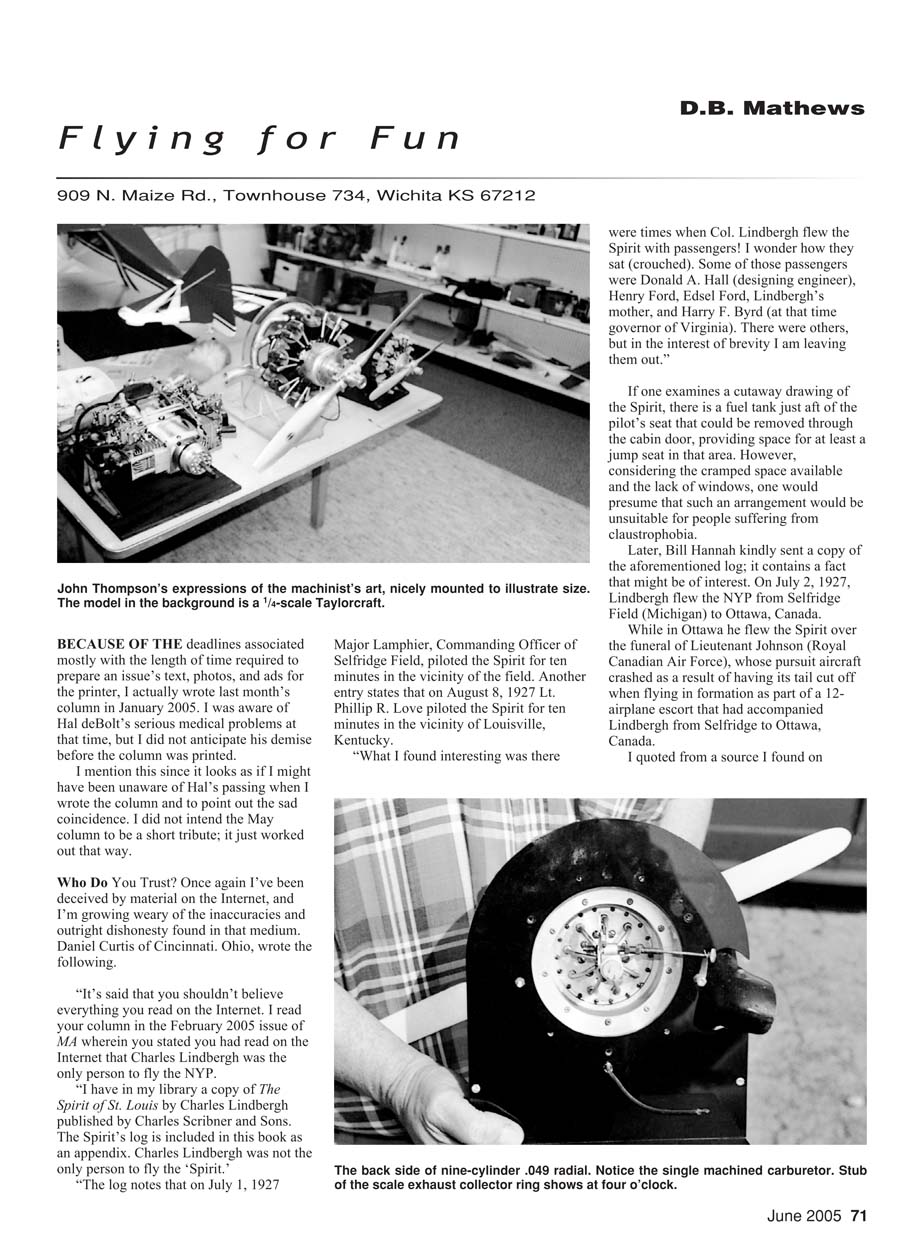
I continue to be amazed by the new dimensions a good hobby shop can add to one's modeling experiences. Recently George Knapple called from The Hangar to tell me I should grab my camera and get down there. The photos included with this and next month's column illustrate why.
Mitch Thompson had brought in his late father John's engines for appraisal. In the last few years of his life John fabricated some astonishing model engines in his home workshop, which was equipped with a metal lathe, milling machines, and other hobbyist machine tools. By vocation John was a machinist in the aircraft industry here in Wichita and in other cities.
The workmanship is first-class, and the design and engineering are exceptional. Mitch has for sale the machinist drawings of all three designs. His address is Box 513, Douglass KS 67039. All of the nonstock parts are machined; there are no castings.
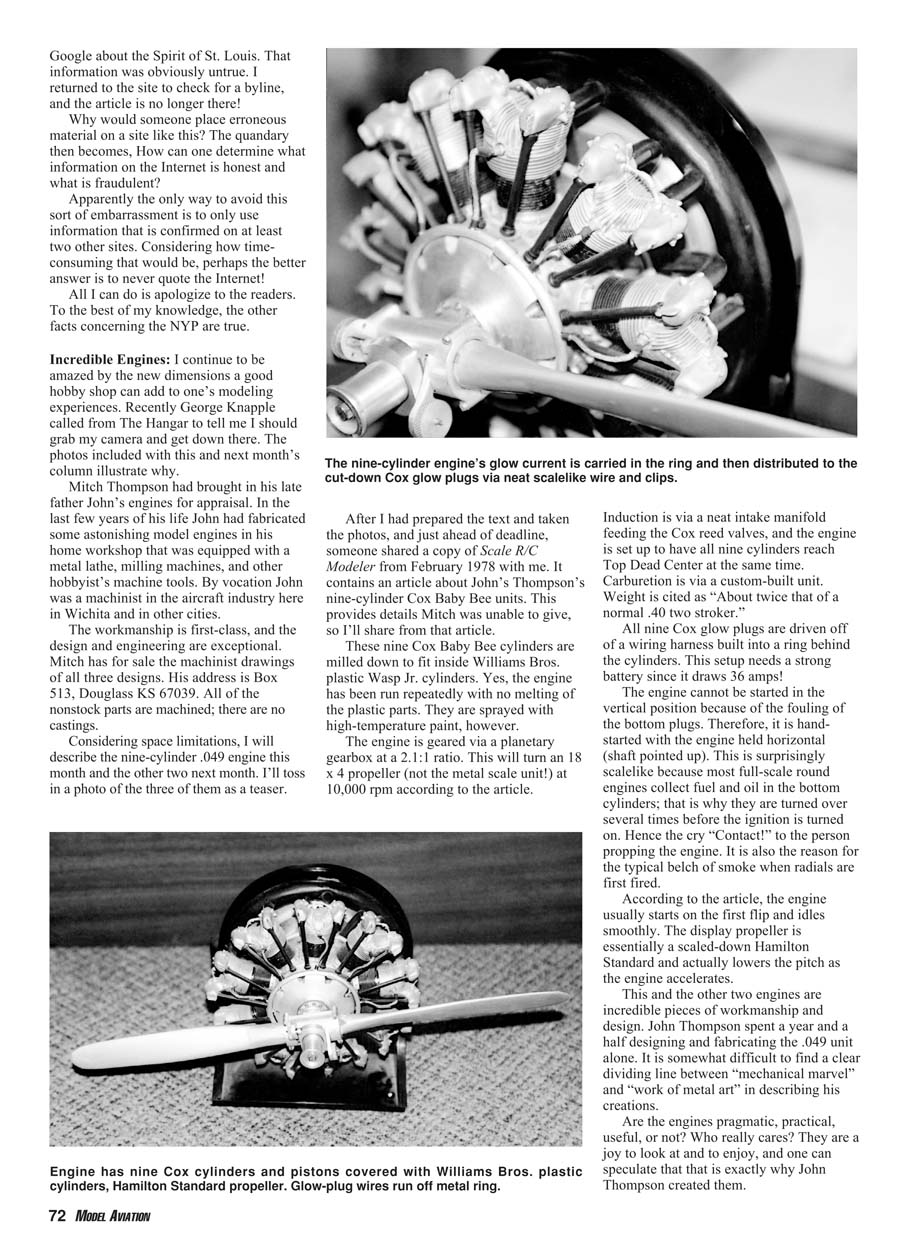
Considering space limitations, I will describe the nine-cylinder .049 engine here and the other two next month. I'll toss in a photo of the three of them as a teaser.
After I had prepared the text and taken the photos, and just ahead of deadline, someone shared a copy of Scale R/C Modeler from February 1978 with me. It contains an article about John Thompson's nine-cylinder Cox Baby Bee units. This provides details Mitch was unable to give, so I'll share from that article.
These nine Cox Baby Bee cylinders are milled down to fit inside Williams Bros. plastic Wasp Jr. cylinders. Yes, the engine has been run repeatedly with no melting of the plastic parts; they are sprayed with high-temperature paint, however.
The engine is geared via a planetary gearbox at a 2.1:1 ratio. This will turn an 18 x 4 propeller (not the metal scale unit) at 10,000 rpm according to the article.
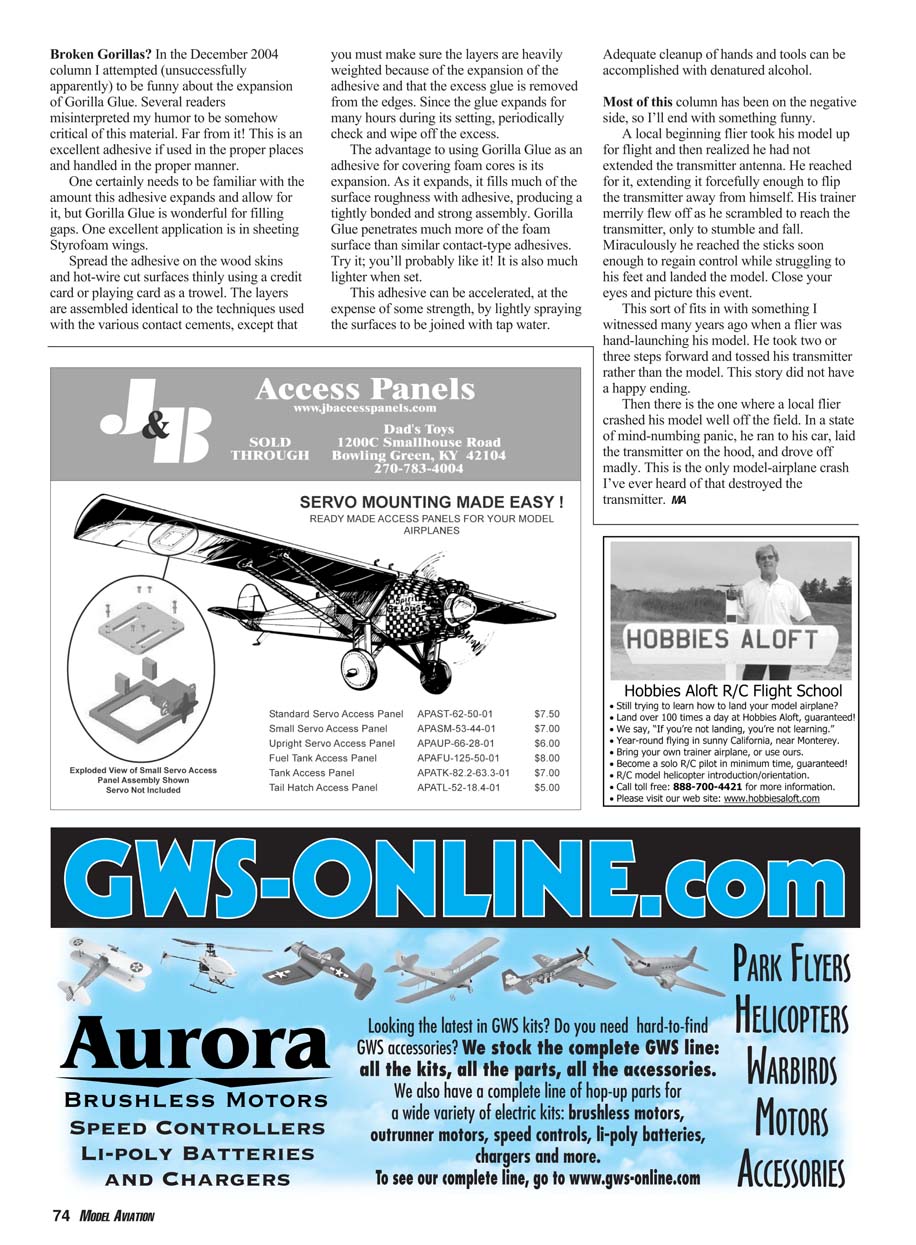
Induction is via a neat intake manifold feeding the Cox reed valves, and the engine is set up to have all nine cylinders reach Top Dead Center at the same time. Carburetion is via a custom-built unit. Weight is cited as “about twice that of a normal .40 two stroker.”
All nine Cox glow plugs are driven off a wiring harness built into a ring behind the cylinders. This setup needs a strong battery since it draws 36 amps!
The engine cannot be started in the vertical position because of fouling of the bottom plugs. Therefore, it is hand-started with the engine held horizontal (shaft pointed up). This is surprisingly scalelike because most full-scale radial engines collect fuel and oil in the bottom cylinders; that is why they are turned over several times before the ignition is turned on. Hence the cry “Contact!” to the person propping the engine. It is also the reason for the typical belch of smoke when radials are first fired.
According to the article, the engine usually starts on the first flip and idles smoothly. The display propeller is essentially a scaled-down Hamilton Standard and actually lowers the pitch as the engine accelerates.
This and the other two engines are incredible pieces of workmanship and design. John Thompson spent a year and a half designing and fabricating the .049 unit alone. It is somewhat difficult to find a clear dividing line between “mechanical marvel” and “work of metal art” in describing his creations.
Are the engines pragmatic, practical, useful, or not? Who really cares? They are a joy to look at and to enjoy, and one can speculate that that is exactly why John Thompson created them.
Broken Gorillas?
In the December 2004 column I attempted (unsuccessfully apparently) to be funny about the expansion of Gorilla Glue. Several readers misinterpreted my humor to be somehow critical of this material. Far from it! This is an excellent adhesive if used in the proper places and handled in the proper manner.
One certainly needs to be familiar with the amount that this adhesive expands and allow for it, but Gorilla Glue is wonderful for filling gaps. One excellent application is in sheeting Styrofoam wings.
- Spread the adhesive on the wood skins and hot-wire cut surfaces thinly using a credit card or playing card as a trowel.
- Assemble the layers identical to techniques used with contact cements, except be sure the layers are heavily weighted because of the adhesive’s expansion.
- Remove excess glue from the edges periodically, since the glue expands for many hours while setting.
The advantage to using Gorilla Glue as an adhesive for covering foam cores is its expansion. As it expands, it fills much of the surface roughness with adhesive, producing a tightly bonded and strong assembly. Gorilla Glue penetrates much more of the foam surface than similar contact-type adhesives. Try it; you'll probably like it! It is also much lighter when set.
This adhesive can be accelerated, at the expense of some strength, by lightly spraying the surfaces to be joined with tap water. Adequate cleanup of hands and tools can be accomplished with denatured alcohol.
Most of this column has been on the negative side, so I'll end with something funny.
A local beginning flier took his model up for flight and then realized he had not extended the transmitter antenna. He reached for it, extending it forcefully enough to flip the transmitter away from himself. His trainer merely flew off as he scrambled to reach the transmitter, only to stumble and fall. Miraculously he reached the sticks soon enough to regain control while struggling to his feet and landed the model. Close your eyes and picture this event.
This sort of fits in with something I witnessed many years ago when a flier was hand-launching his model. He took two or three steps forward and tossed his transmitter rather than the model. This story did not have a happy ending.
Then there is the one where a local flier crashed his model well off the field. In a state of mind-numbing panic, he ran to his car, laid the transmitter on the hood, and drove off madly. This is the only model-airplane crash I've ever heard of that destroyed the transmitter.
MA
Transcribed from original scans by AI. Minor OCR errors may remain.

