
Electrifying the Senior Telemaster
D.B. Mathews | [email protected]
This month's column is the second part of what I wrote for the December 2005 issue; it will center on electric-powered RC models. I had originally intended to include text about and photos of George Sauer's electric-powered Senior Telemaster with material about the foamie 3-D models and comments on outrunners, but I ran out of space. This month I'll share some spectacular computer-graphic-generated flight shots and general information about a delightful large electric conversion.
Telemaster History
The first Hobby Lobby Senior Telemaster advertisement I can find was published in the October 1972 Model Airplane News, and it claimed "Change of Pace kits from Germany." The ad mentioned that although the model could be flown with rudder only, for full effect fliers should use four channels, including the supplied ailerons.
Although the Telemaster spanned 95 inches, the recommended engine was a .45–.60, "... which is plenty of engine for a plane with such huge lifting capability," the ad read. "This plane has been used in Germany to string cables over valleys, for aerial photography, and as an R/C glider tug."
The ad also read, "Sufficient nylon covering material is included to make the 'Senior Telemaster' as indestructible as an R/C model can be made."
This design has been in continuous production for 33 years, putting it in a class with Sig's 1/12-scale Cub as one of the longest-running production RC kits of all time. Originally designed by Alex Engle and drawn by Joe Bridi, the Senior Telemaster has undergone minor improvements during that time.
During those many years several manufacturers have produced the kit for Hobby Lobby in Germany and the U.S., but the airplane's basic aerodynamic and structural design has remained the same. Its popularity owes to the fact that nearly every older RC modeler probably has one in the shop, used to have one, or has at least flown one.
My remembrances of the Telemaster go back at least 30 years, to one a flying buddy used successfully as his initial trainer. He essentially learned to fly the Telemaster without an instructor's help; it was that stable.
As the years go by I see more and more of these super-stable, graceful, wonderfully gentle models with huge engines stuffed in their noses. Although a 120 four-stroke is more than enough, I have to wonder when I see heavy Zenoahs or Quadras hung on them. The considerable increase in overall weight leads to a much higher flying speed necessary to maintain flight, which, in turn, requires a larger engine. It's sort of a catch-22 with ugly results.
The Telemaster is not intended to be a fully aerobatic/hang-on-the-propeller design. It is meant to fly using its built-in lift and gently cruise around the patch in a manner that is reminiscent of a full-scale lightplane. Generally, if any kit's builder/flier will stick with the designer's recommended power plant, the resulting model will stay within its design parameters and be much more fun to fly. If you're the kind of full-scale flier who would stick a Merlin on the nose of a Beechcraft Bonanza, be prepared to spread aircraft parts across three counties just before you die.
George Sauer's Electric Telemaster
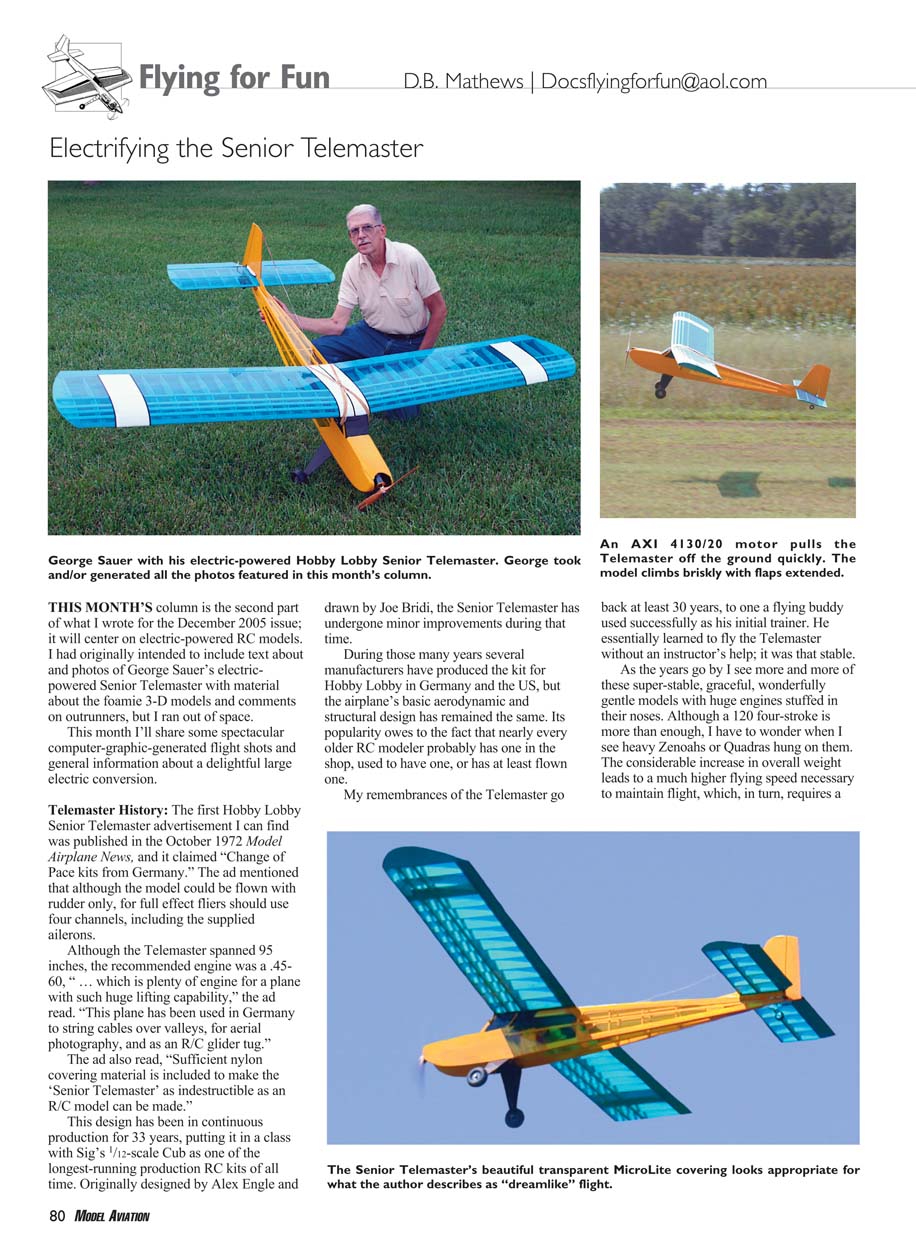
George Sauer's electric-powered Senior Telemaster illustrates my previous point. The model would weigh a ton with a big AXI 4130/20 outrunner motor driven by a pack of 14 Kokam Li-Poly cells of 2000 mAh (7S2P), right? Wrong! The complete ready-to-take-off model weighs an astonishing 8 pounds, 13 ounces. This gives it a wing loading of roughly 15 ounces per square foot, which is close to that of a sport free-flight model or an Old-Timer design converted to RC.
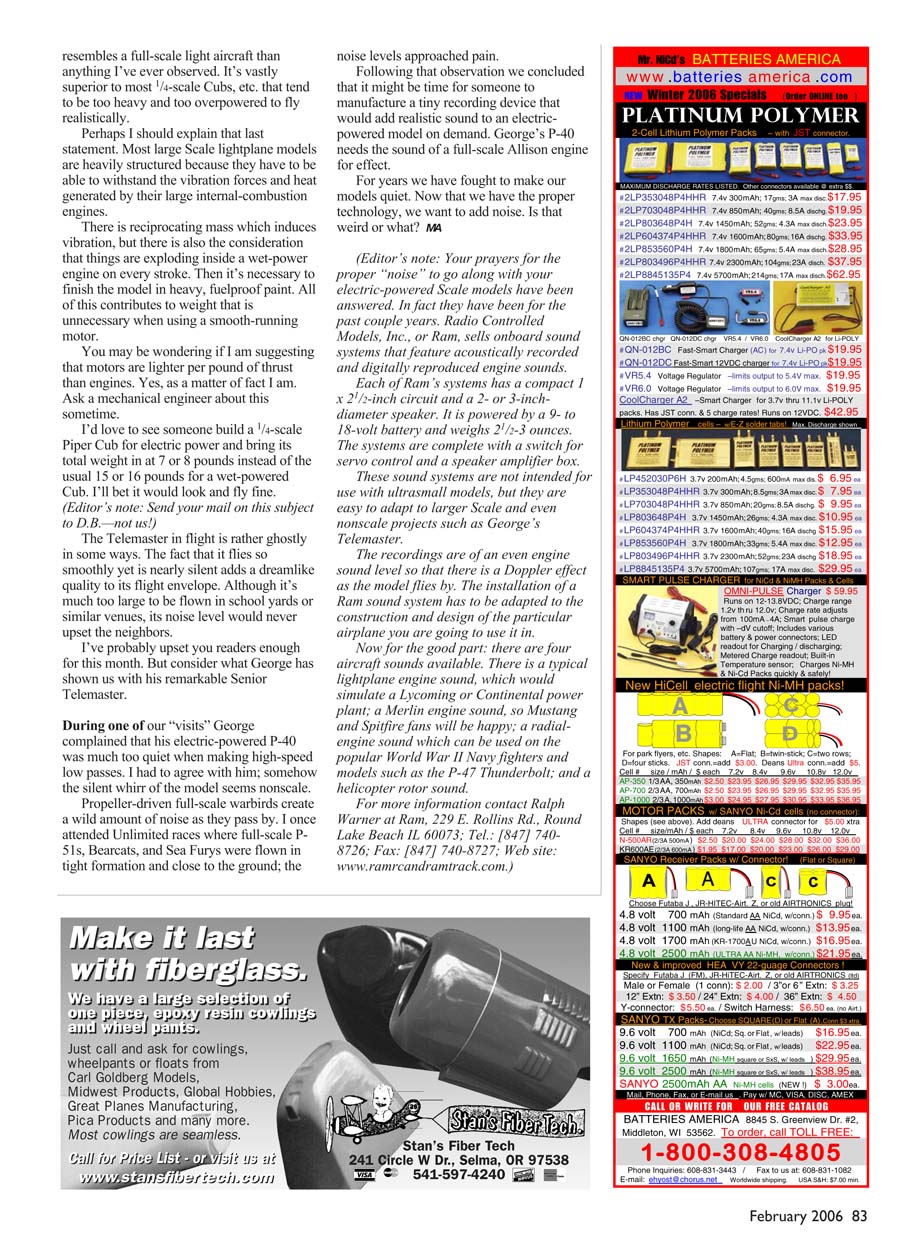
George’s Telemaster is covered with MicroLite by Coverite, which is a light but surprisingly brightly colored transparent material. He built the model stock but did vigorously sand all the sheet wood smooth and was judicious with adhesives.
Pull-pull controls are used on the rudder and elevator servos (which are Airtronics 9455s) using 1/2A Kevlar CL lines with supplied nylon horns and screw clevises on one end and home-bent soft-wire loops on the other end.
The speed controller is a Jeti Advance 77 opto. The motor is propped direct drive with a 15 x 6 Zinger. This setup pulls 20 amps at 25 volts wide open (7,500 rpm), but the model is flown at half throttle or less since it climbs excessively at full throttle. The batteries are charged with an AstroFlight 109 charger.
George and I fly together often—if you want to call it that. We spend nearly as much time at the flying field discussing modeling as we do flying, but what great fun it is!
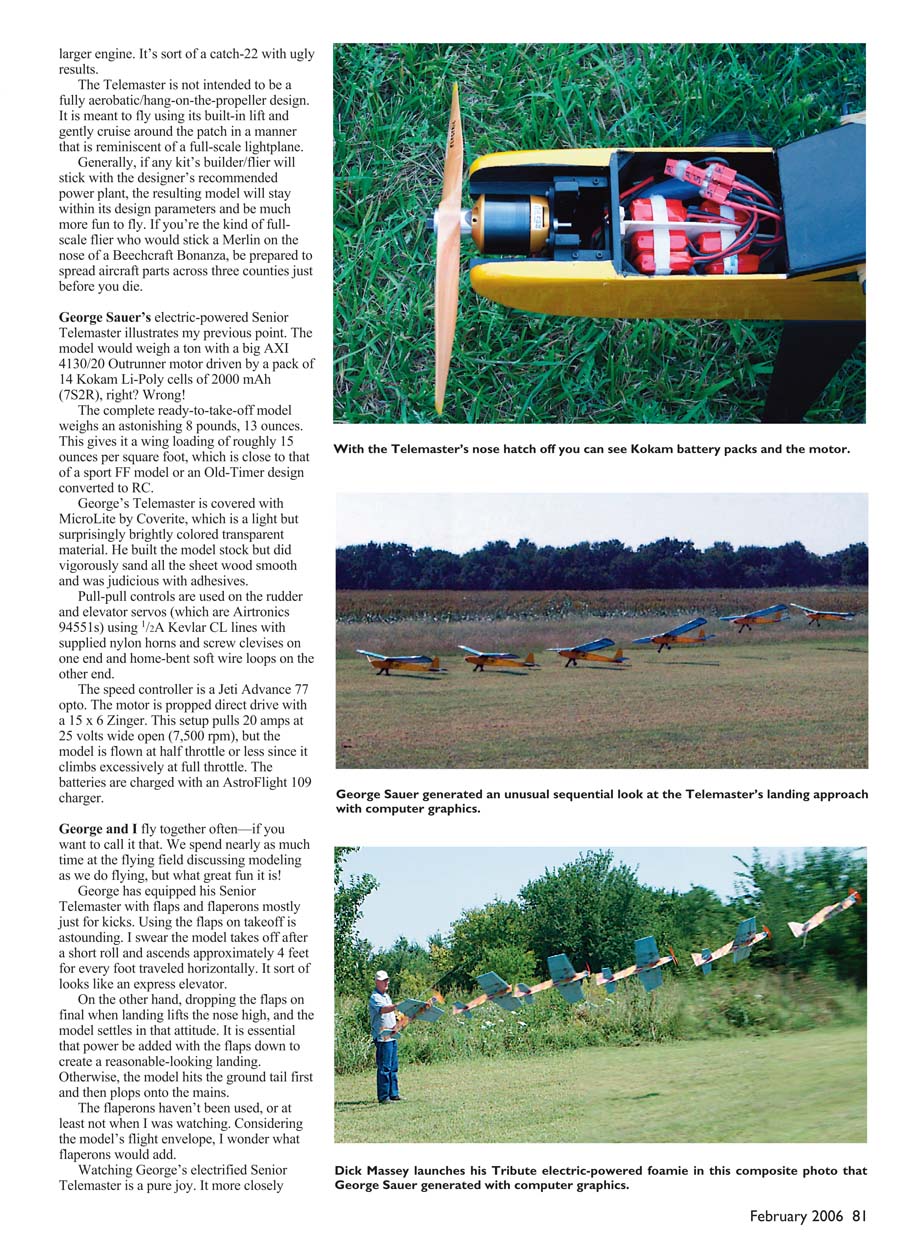
George has equipped his Senior Telemaster with flaps and flaperons mostly just for kicks. Using the flaps on takeoff is astounding. I swear the model takes off after a short roll and ascends approximately 4 feet for every foot traveled horizontally. It sort of looks like an express elevator.
On the other hand, dropping the flaps on final when landing lifts the nose high, and the model settles in that attitude. It is essential that power be added with the flaps down to create a reasonable-looking landing. Otherwise, the model hits the ground tail first and then plops onto the mains.
The flaperons haven't been used, or at least not when I was watching. Considering the model's flight envelope, I wonder what flaperons would add.
Watching George's electrified Senior Telemaster is a pure joy. It more closely resembles a full-scale light aircraft than anything I’ve ever observed. It’s vastly superior to most 1/4-scale Cubs, etc., that tend to be too heavy and too overpowered to fly realistically.
Perhaps I should explain that last statement. Most large scale lightplane models are heavily structured because they have to be able to withstand the vibration forces and heat generated by their large internal-combustion engines.
There is reciprocating mass which induces vibration, but there is also the consideration that things are exploding inside an internal-combustion engine on every stroke. Then it’s necessary to finish the model in heavy, fuelproof paint. All of this contributes to weight that is unnecessary when using a smooth-running motor.
You may be wondering if I am suggesting that motors are lighter per pound of thrust than engines. Yes, as a matter of fact I am. Ask a mechanical engineer about this sometime.
I’d love to see someone build a 1/4-scale Piper Cub for electric power and bring its total weight in at 7 or 8 pounds instead of the usual 15 or 16 pounds for a gas-powered Cub. It’ll look and fly fine. (Editor’s note: Send your mail on this subject to D.B.—not us!)
The Telemaster in flight is rather ghostly in some ways. The fact that it flies so smoothly yet is nearly silent adds a dreamlike quality to its flight envelope. Although it’s much too large to be flown in school yards or similar venues, its noise level would never upset the neighbors.
I’ve probably upset you readers enough for this month. But consider what George has shown us with his remarkable Senior Telemaster.
During one of our “visits” George complained that his electric-powered P-40 was much too quiet when making high-speed low passes. I had to agree with him; somehow the silent whirr of the model seems nonscale.
Propeller-driven full-scale warbirds create a wild amount of noise as they pass by. I once attended Unlimited races where full-scale P-51s, Bearcats, and Sea Furies were flown in tight formation and close to the ground; the noise levels approached pain.
Following that observation we concluded that it might be time for someone to manufacture a tiny recording device that would add realistic sound to an electric-powered model on demand. George’s P-40 needs the sound of a full-scale Allison engine for effect.
For years we have fought to make our models quiet. Now that we have the proper technology, we want to add noise. Is that weird or what? —MA
Editor’s note
Your prayers for the proper “noise” to go along with your electric-powered Scale models have been answered. In fact they have been for the past couple years. Radio Controlled Models, Inc., or RAM, sells onboard sound systems that feature acoustically recorded and digitally reproduced engine sounds.
Each of RAM’s systems has a compact 1 x 2-1/2-inch circuit card and a 2- or 3-inch-diameter speaker. It is powered by a 9- to 18-volt battery and weighs 2-1/2–3 ounces. The systems are complete with a switch for servo control and a speaker amplifier box. These sound systems are not intended for use with ultrasmall models, but they are easy to adapt to larger scale and non-scale projects such as George’s Telemaster.
The recordings are of an even engine sound level so that there is no Doppler effect as the model flies by. The installation of a RAM sound system has to be adapted to the construction and CG of the particular airplane you are going to use it in.
Now for the good part: there are four aircraft sounds available.
- Typical lightplane engine sound (simulates Lycoming or Continental)
- Merlin engine sound (for Mustang and Spitfire fans)
- Radial-engine sound (for WWII Navy fighters and models such as the P-47 Thunderbolt)
- Helicopter rotor sound
For more information contact Ralph Warner at RAM:
- Address: 229 E. Rollins Rd., Round Lake Beach, IL 60073
- Tel.: (847) 740-8726
- Fax: (847) 740-8727
- Web site: www.ramcrandramtrack.com
Transcribed from original scans by AI. Minor OCR errors may remain.

