
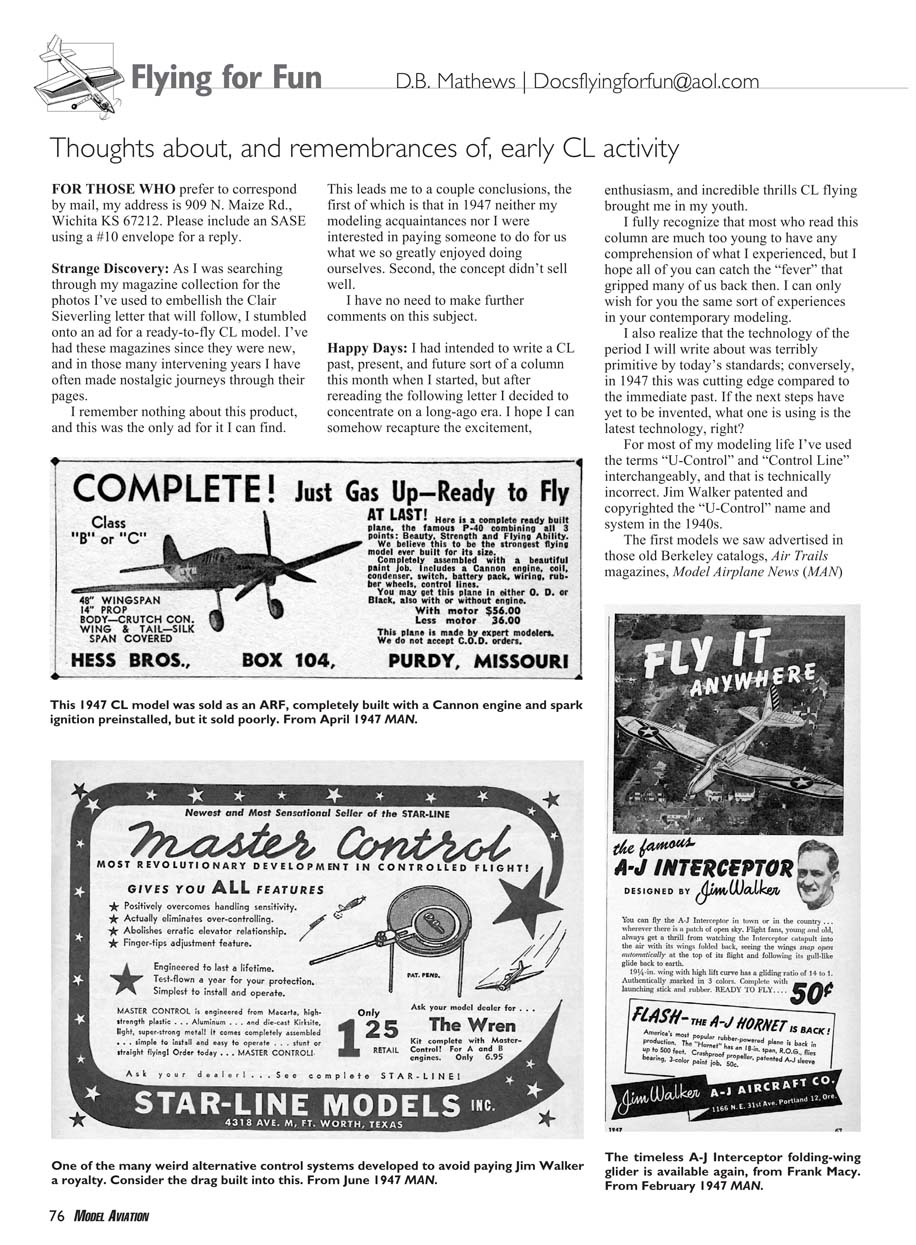
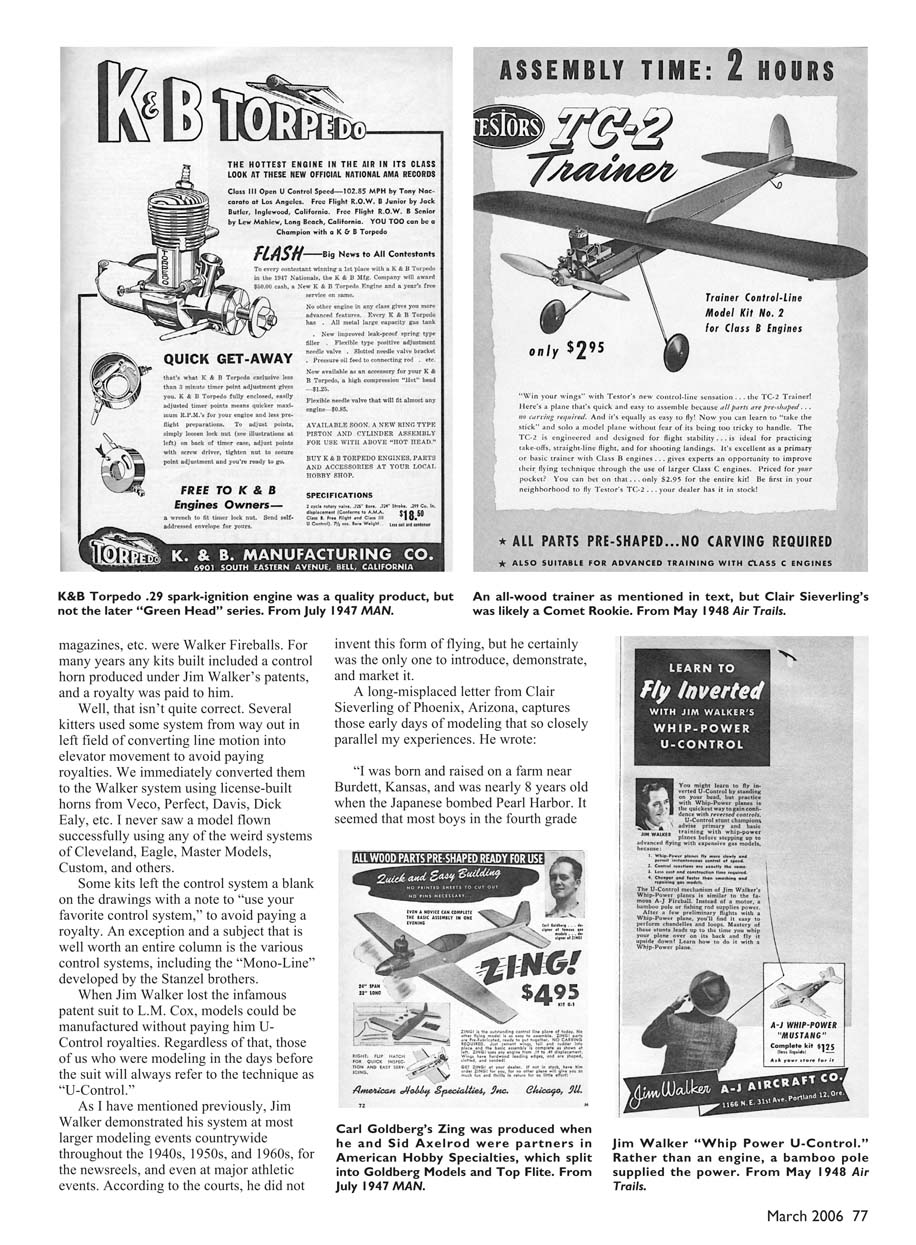
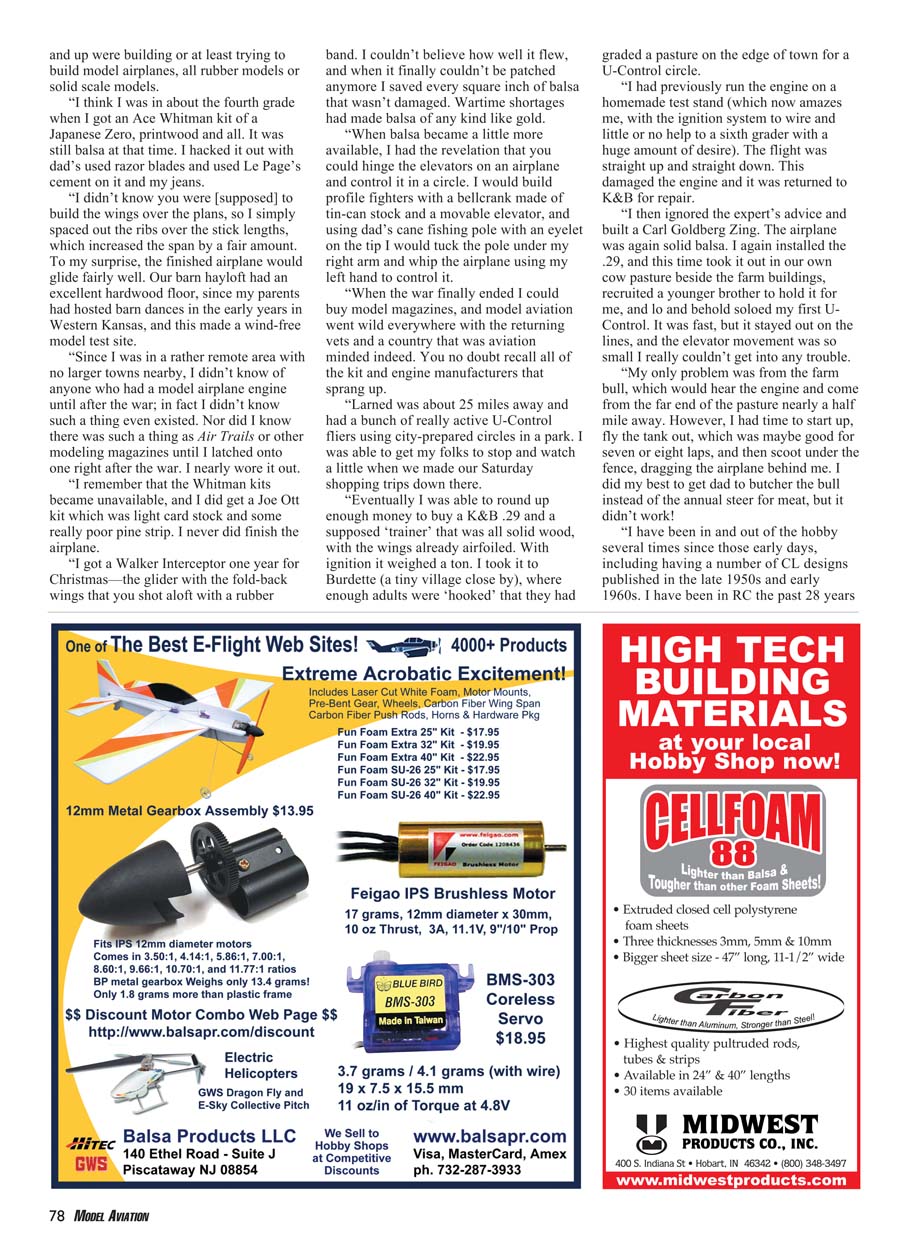
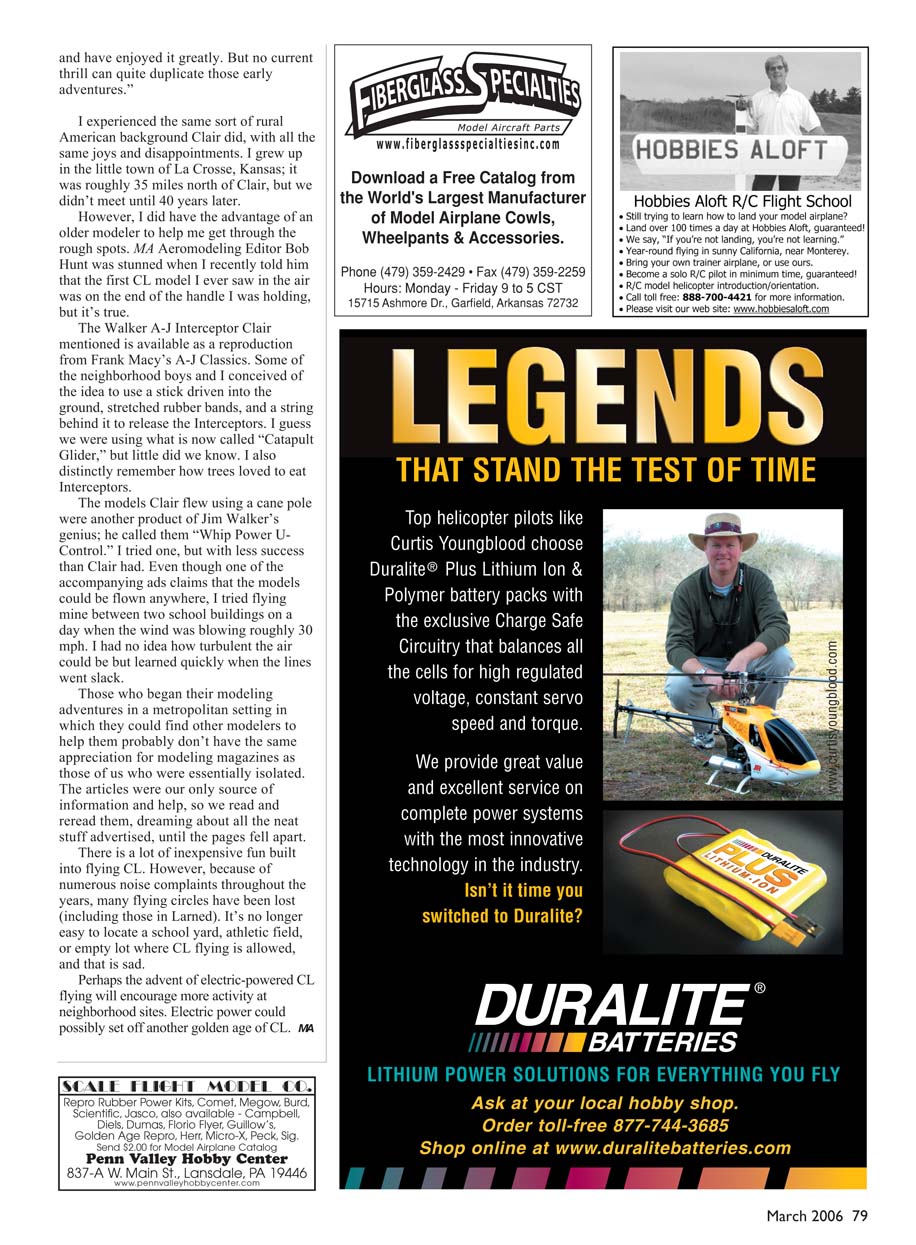
Flying for Fun
D.B. Mathews | [email protected]
Thoughts about, and remembrances of, early CL activity
For those who prefer to correspond by mail, my address is 909 N. Maize Rd., Wichita KS 67212. Please include an SASE using a #10 envelope for a reply.
Strange Discovery:
As I was searching through my magazine collection for the photos I’ve used to embellish the Clair Sieverling letter that will follow, I stumbled onto an ad for a ready-to-fly CL model. I’ve had these magazines since they were new, and in those many intervening years I have often made nostalgic journeys through their pages.
I remember nothing about this product, and this was the only ad for it I can find. This leads me to a couple conclusions, the first of which is that in 1947 neither my modeling acquaintances nor I were interested in paying someone to do for us what we so greatly enjoyed doing ourselves. Second, the concept didn’t sell well. I have no need to make further comments on this subject.
Happy Days:
I had intended to write a CL past, present, and future sort of column this month when I started, but after rereading the following letter I decided to concentrate on a long-ago era. I hope I can somehow recapture the excitement, enthusiasm, and incredible thrills CL flying brought me in my youth.
I fully recognize that most who read this column are much too young to have any comprehension of what I experienced, but I hope all of you can catch the “fever” that gripped many of us back then. I can only wish for you the same sort of experiences in your contemporary modeling.
I also realize that the technology of the period I will write about was terribly primitive by today’s standards; conversely, in 1947 this was cutting edge compared to the immediate past. If the next steps have yet to be invented, what one is using is the latest technology, right?
For most of my modeling life I’ve used the terms “U-Control” and “Control Line” interchangeably, and that is technically incorrect. Jim Walker patented and copyrighted the “U-Control” name and system in the 1940s.
The first models we saw advertised in those old Berkeley catalogs, Air Trails magazines, and Model Airplane News (MAN) were Walker Fireballs. For many years any kits built included a control horn produced under Jim Walker’s patents, and a royalty was paid to him. Well, that isn’t quite correct. Several kitters used some system from way out in left field of converting line motion into elevator movement to avoid paying royalties. We immediately converted them to the Walker system using license-built horns from Veco, Perfect, Davis, Dick Ealy, etc.
I never saw a model flown successfully using any of the weird systems from Cleveland, Eagle, Master Models, Custom, and others. Some kits left the control system a blank on the drawings with a note to “use your favorite control system,” to avoid paying a royalty. An exception — and a subject that is well worth an entire column — is the various control systems, including the “Mono-Line” developed by the Stanzel brothers.
When Jim Walker lost the infamous patent suit to L.M. Cox, models could be manufactured without paying him U-Control royalties. Regardless of that, those of us who were modeling in the days before the suit will always refer to the technique as “U-Control.”
As I have mentioned previously, Jim Walker demonstrated his system at most larger modeling events countrywide throughout the 1940s, 1950s, and 1960s, for the newsreels, and even at major athletic events. According to the courts, he did not invent this form of flying, but he certainly was the only one to introduce, demonstrate, and market it.
A long-misplaced letter from Clair Sieverling of Phoenix, Arizona, captures those early days of modeling that so closely parallel my experiences. He wrote:
"I was born and raised on a farm near Burdett, Kansas, and was nearly 8 years old when the Japanese bombed Pearl Harbor. It seemed that most boys in the fourth grade and up were building or at least trying to build model airplanes, all rubber models or solid scale models.
"I think I was in about the fourth grade when I got an Ace Whitman kit of a Japanese Zero, printwood and all. It was still balsa at that time. I hacked it out with dad's used razor blades and used Le Page's cement on it and my jeans.
"I didn't know you were supposed to build the wings over the plans, so I simply spaced out the ribs over the stick lengths, which increased the span by a fair amount. To my surprise, the finished airplane would glide fairly well. Our barny hayloft had an excellent hardwood floor, since my parents had hosted barn dances in the early years in western Kansas, and this made a wind-free model test site.
"Since I was in a rather remote area with no larger towns nearby, I didn't know of anyone who had a model airplane engine until after the war; in fact I didn't know such a thing even existed. Nor did I know there was such a thing as Air Trails or other modeling magazines until I latched onto one right after the war. I nearly wore it out.
"I remember that the Whitman kits became unavailable, and I did get a Joe Ott kit which was light card stock and some really poor pine strip. I never did finish the airplane.
"I got a Walker Interceptor one year for Christmas — the glider with the fold-back wings that you shot aloft with a rubber band. I couldn't believe how well it flew, and when it finally couldn't be patched anymore I saved every square inch of balsa that wasn't damaged. Wartime shortages had made balsa of any kind like gold.
"When balsa became a little more available, I had the revelation that you could hinge the elevators on an airplane and control it in a circle. I would build profile fighters with a bellcrank made of tin-can stock and a movable elevator, and using dad's cane fishing pole with an eyelet on the tip I would tuck the pole under my right arm and whip the airplane using my left hand to control it.
"When the war finally ended I could buy model magazines, and model aviation went wild everywhere with the returning vets and a country that was aviation minded indeed. You no doubt recall all of the kit and engine manufacturers that sprang up.
"Larned was about 25 miles away and had a bunch of really active U-Control fliers using city-prepared circles in a park. I was able to get my folks to stop and watch a little when we made our Saturday shopping trips down there.
"Eventually I was able to round up enough money to buy a K&B .29 and a supposed 'trainer' that was all solid wood, with the wings already airfoiled. With ignition it weighed a ton. I took it to Burdett (a tiny village close by), where enough adults were 'hooked' that they had graded a pasture on the edge of town for a U-Control circle.
"I had previously run the engine on a homemade test stand (which now amazes me, with the ignition system to wire and little or no help to a sixth grader with a huge amount of desire). The flight was straight up and straight down. This damaged the engine and it was returned to K&B for repair.
"I then ignored the expert's advice and built a Carl Goldberg Zing. The airplane was again solid balsa. I again installed the .29, and this time took it out in our own cow pasture beside the farm buildings, recruited a younger brother to hold it for me, and lo and behold soloed my first U-Control. It was fast, but it stayed out on the lines, and the elevator movement was so small I really couldn't get into any trouble.
"My only problem was from the farm bull, which would hear the engine and come from the far end of the pasture nearly a half mile away. However, I had time to start up, fly the tank out, which was maybe good for seven or eight laps, and then scoot under the fence, dragging the airplane behind me. I did my best to get dad to butcher the bull instead of the annual steer for meat, but it didn't work!
"I have been in and out of the hobby several times since those early days, including having a number of CL designs published in the late 1950s and early 1960s. I have been in RC the past 28 years and have enjoyed it greatly. But no current thrill can quite duplicate those early adventures."
I experienced the same sort of rural American background Clair did, with all the same joys and disappointments. I grew up in the little town of La Crosse, Kansas; it was roughly 35 miles north of Clair, but we didn't meet until 40 years later.
However, I did have the advantage of an older modeler to help me get through the rough spots. MA Aeromodeling Editor Bob Hunt was stunned when I recently told him that the first CL model I ever saw in the air was on the end of the handle I was holding, but it's true.
The Walker A-J Interceptor Clair mentioned is available as a reproduction from Frank Macy's A-J Classics. Some of the neighborhood boys and I conceived of the idea to use a stick driven into the ground, stretched rubber bands, and a string behind it to release the Interceptors. I guess we were using what is now called catapult glider, but little did we know. I also distinctly remember how trees loved to eat Interceptors.
The models Clair flew using a cane pole were another product of Jim Walker's genius; he called them "Whip Power U-Control." I tried one, but with less success than Clair had. Even though one of the accompanying ads claims that the models could be flown anywhere, I tried flying mine between two school buildings on a day when the wind was blowing roughly 30 mph. I had no idea how turbulent the air could be but learned quickly when the lines went slack.
Those who began their modeling adventures in a metropolitan setting in which they could find other modelers to help them probably don't have the same appreciation for modeling magazines as those of us who were essentially isolated. The articles were our only source of information and help, so we read and reread them, dreaming about all the neat stuff advertised, until the pages fell apart.
There is a lot of inexpensive fun built into flying CL. However, because of numerous noise complaints throughout the years, many flying circles have been lost (including those in Larned). It's no longer easy to locate a school yard, athletic field, or empty lot where CL flying is allowed, and that is sad.
Perhaps the advent of electric-powered CL flying will encourage more activity at neighborhood sites. Electric power could possibly set off another golden age of CL.
MA
Transcribed from original scans by AI. Minor OCR errors may remain.

