
Flying for Fun
D.B. Mathews | [email protected]
A few more odd prototypes that are worthy of modeling
I inadvertently omitted the address for Frank Macy, the source for A-J Interceptors and Hornets, from the March column. You can contact American Junior Classics at 1501 SW Baker St. #53, McMinnville, OR 97128; Web site: www.americanjuniorclassics.com.
Sharp-eyed readers will recognize McMinnville as the location of the Evergreen Aviation Museum. It displays the Hughes "Spruce Goose" and is where the Hughes H-1 racer reproduction was headed when it crashed in Yellowstone National Park.
Most of the designs I did for Ace were published in the various magazines, so those who want to duplicate these no-longer-in-production kits of the 4 series, the Bingos, and the biplanes can obtain construction drawings from the magazines. The glaring exception seems to be the 4-60 biplane. That is unfortunate since many say the best-flying size of all the bipes is the 60, which is often powered with a .90 four-stroke engine. I've seen several ads and notices seeking drawings of that model; apparently they are hard to find but desirable. I will make copies of mine and the illustrated building instructions available to those who are interested. E-mail me for prices.
I goofed on the caption for the K&B engine in the March 2006 issue. It was supposed to read that the ignition "Torp" shown was not the later, much-loved Green Head series. I did not mean to imply that the Green Head was anything less than a wonderful series of excellent engines; it just came off that way.
More Odd Prototypes
Last month I featured some single-place, civilian market-directed, full-scale aircraft for you to consider as subjects for scale models. This month I will dig out a few more from my collection of "someday projects" for your entertainment. Many of the full-scale prototypes I am showing would make excellent FF or CL scale subjects; I'm not limiting this discussion to RC. I'll jump to 1926 for this month's first single-place prototype.
Ford Flivver
The Ford Motor Company was totally owned by the family and there were no stockholders back then, providing Henry and his son Edsel with immense power. Decisions about products, marketing, and labor relations could be made quickly and forcefully. Ford had entered the aircraft-production market with the three-engine commercial AT series, with great success. Ford Tri-motors were becoming the standard airplane of most of the world's airlines.
Young Ford engineer Otto Koppen was assigned to design a small, single-place airplane that anyone could fly—basically a Model T of the air. Built in great secrecy behind locked doors, it was first flown on July 31, 1926, which was Henry Ford's 63rd birthday. The Flivver was flown by Harry Brooks—the son of one of Henry Ford's neighbors who was Henry's personal "fiddler"; he loved square dancing.
August 10, 1927, Detroit-born Charles A. Lindbergh arrived in Detroit on his tour of America following his epoch-making flight in May of that year. He viewed the Flivver and asked Mr. Ford if he could fly it. "Of course," replied Ford. "But you will be only the second person to do so."
In late 1927 Koppen designed a second, improved version of the Flivver. It was a bit larger, more appealing to the eye, and powered with a two-cylinder opposed engine of Ford design. This engine replaced the three-cylinder radial Anzani of the first prototype (serial number 268). For simplicity's sake I will refer to the Anzani-powered unit as "Flivver 1" and the flat-twin-powered aircraft as "Flivver 2."
The new 3218 was successful and was used to attempt a new class-record-distance nonstop flight along the eastern seaboard, ending in Miami, Florida. Harry Brooks crashed into the ocean and was killed during this flight. The loss of his fiddler's son's life so upset Henry that he had the project terminated.
A controversy exists concerning the Flivver 2 that is on display in the Ford Museum in Dearborn, Michigan. It is either an extensively repaired original that was recovered from the Atlantic Ocean (minus Brooks's body), or it was built from subassemblies that were already in existence.
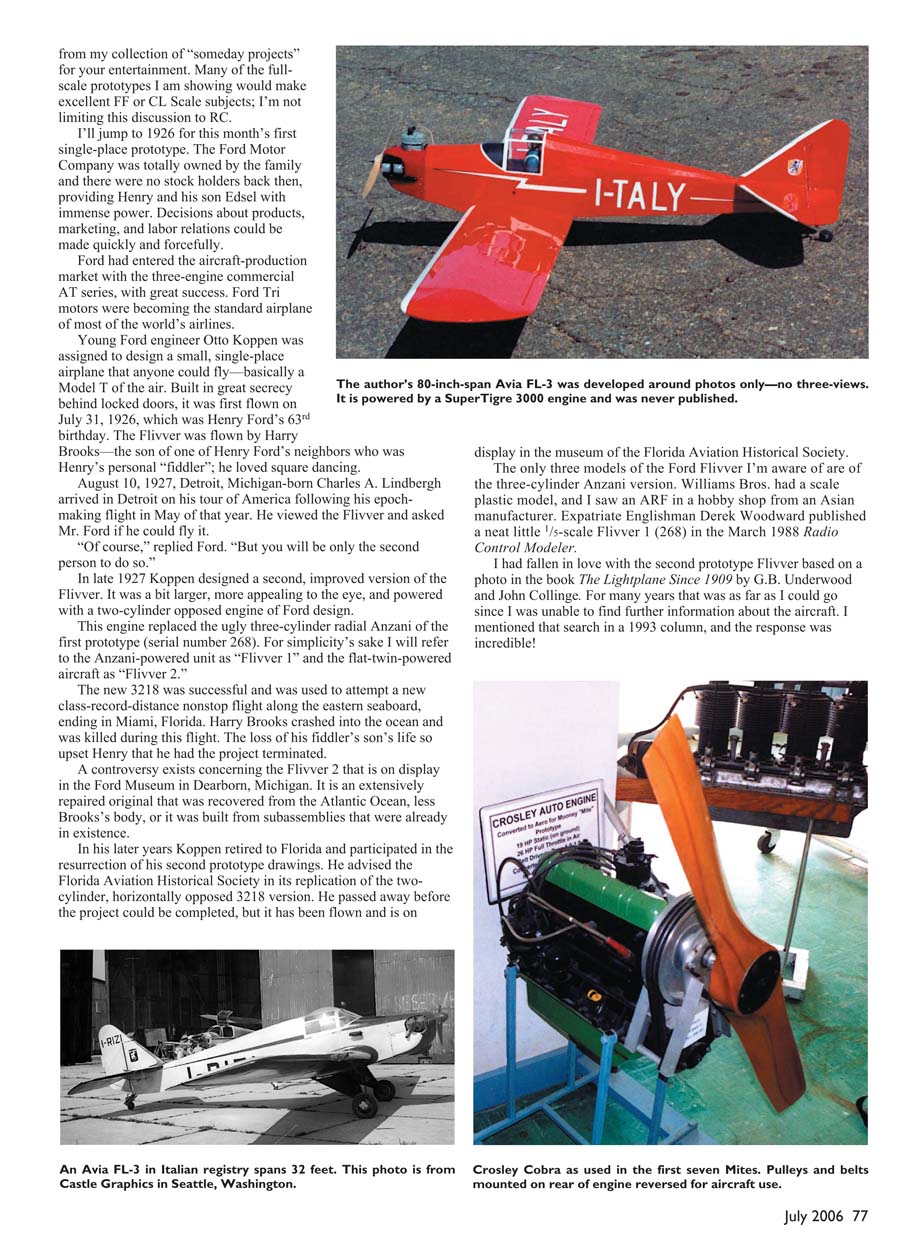
In his later years Koppen retired to Florida and participated in the resurrection of his second-prototype drawings. He advised the Florida Aviation Historical Society in its replication of the two-cylinder, horizontally opposed 3218 version. He passed away before the project could be completed, but it has been flown and is on display in the museum of the Florida Aviation Historical Society.
The only three models of the Ford Flivver I'm aware of are of the three-cylinder Anzani version. Williams Bros. had a scale plastic model, and I saw an ARF in a hobby shop from an Asian manufacturer. Expatriate Englishman Derek Woodward published a neat little 1/5-scale Flivver 1 (268) in the March 1988 Radio Control Modeler.
I had fallen in love with the second-prototype Flivver based on a photo in the book The Lightplane Since 1909 by G. B. Underwood and John Collinge. For many years that was as far as I could go since I was unable to find further information about the aircraft. I mentioned that search in a 1993 column, and the response was incredible!
Scale drawings for the much prettier twin-cylinder version were more difficult to locate, but, as I wrote in the June 1995 column, some detective work turned up superb three-views of the Flivver 2 (3218) from John Raymond (68 Gordon Pkwy. #2, Syracuse, NY 13219) that he prepared for an article in the October 1995 Skyways. Additional photos and details were provided by N.H. Haufrick (Box 232, Greensburg, OH 44232).
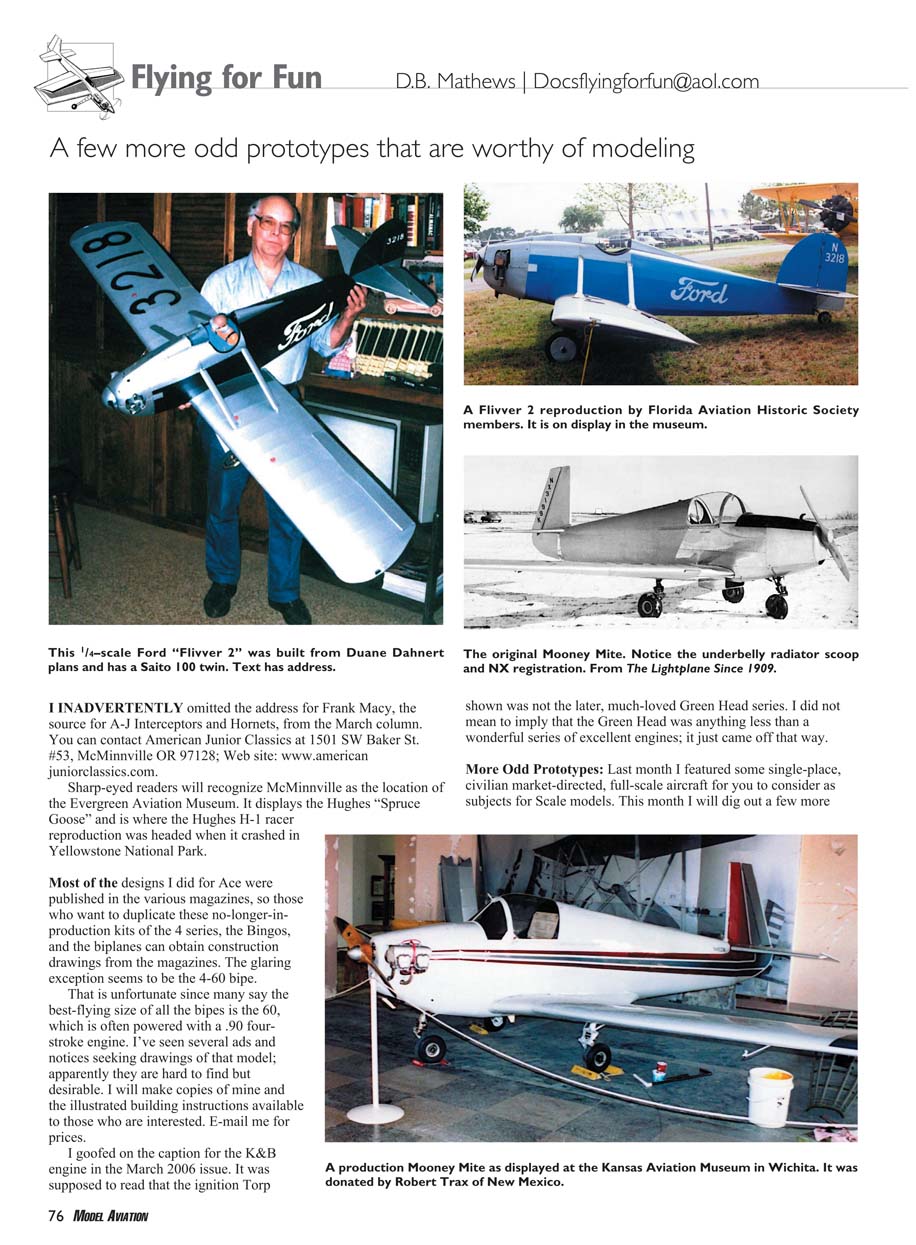
Duane Dahnert (7209 Bryant Ave. S., Richfield, MN 55423) used all that material to develop superb construction drawings for an 80-inch exact-scale Flivver 2 (3218) model that was suitable for a .90 or 1.00 four-stroke twin. Roughly 70 versions of the model have been built from Duane's plans throughout the years, and all are reported to be excellent fliers. Duane has the drawings for sale, John Raymond sells the three-views, and N.H. Haufrick sells the photos. All the components are in place to build your Flivver.
I have not been in contact with a couple of these men in several years. I hope all are still around. Duane Dahnert is; I just talked to him on the phone.
Avia FL-3
In the same book by Underwood and Collinge is a photo of a prototype I've spent many years trying to chase down information about. The Avia FL-3 is a single-place, low-wing, 60-horsepower cutey of Italian origin (not Czech as the name would imply).
I managed to obtain an 8 x 10-inch print of an FL-3 from Castle Graphics in Seattle, Washington, but nothing else. Finally I designed an 84-inch version based only on the photos, which produced a neat-looking, adequate-flying model that was semiscale at best. Because of that I chose not to publish plans.
So a delightful prototype sat unmodeled for a lack of material, much as the Flivver did for many years. Chasing down three-views and photos for an unusual subject can resemble a "cold-case file," but what fun it is to finally crack one like the Flivver.
I just cracked the Avia FL-3! In Bob Banka's (314 Yukon Ave., Costa Mesa, CA 92626) latest Aircraft Documentation catalog are three-views for this airplane.
Banka has photo packs, three-views, etc., for thousands of aircraft ranging from the mundane to the extraordinary. There are military, civilian, domestic, and foreign types. The list is amazing. If you have an interest in scale models, whether from a color-and-decoration standpoint or in three-views, you owe it to yourself to have his catalog.
I check my drawings against accurate three-views, and I might publish that Avia FL-3 yet.
Mooney M-18 Mite
The last single-place airplane I'll cover this month was reasonably successful, having sold 283 units in a production run that began in Wichita in 1946 and finished after Mooney moved to Kerrville, Texas, in 1953. This aircraft sort of vindicated the dreams of Lockheed, Piper, Ford, Luscombe, and others that a market for single-place civilian aircraft would develop post-war.
Mooney was one of the numerous manufacturers to set up in Wichita in the post-Lindbergh era. Al Mooney incorporated his own company after leaving Alexander Aircraft Company. As did the bulk of those startups, his company failed before it ever produced an airplane.
Al Mooney then worked as a designer for several companies—most notably Mono Aircraft, where he designed the Monosport, the rights for which were purchased by a wealthy sportsman named Culver. The name changed to "Dart," and the production was moved from Columbus, Ohio, to Wichita. During the war Culver produced a large number of PQ-8s and PQ-14s, which were all-wood, low-wing target aircraft.
In 1946 Beech Aircraft bought out Culver, and Mooney left to form his own company to produce a single-place, retract-gear, metal-and-fabric aircraft designated the M-18 Mite.
I attended the 1946 Nats with an older modeler when I was 14. The CL events were held on the concrete slab across the street from the Boeing plant and on the far west edge of the Wichita Municipal Airport (now McConnell Air Force Base). That slab had been the delivery hardstand for B-29s as they rolled off the production line. They were pulled across Oliver Street and finished out there.
The huge area was an ideal CL site for the Nats, with numerous circles in action at the same time. My friend wandered around on the hardstand and peeked into the small buildings scattered around the perimeter. We came to a little hangar with a large gap in the sliding doors, so we peered in.
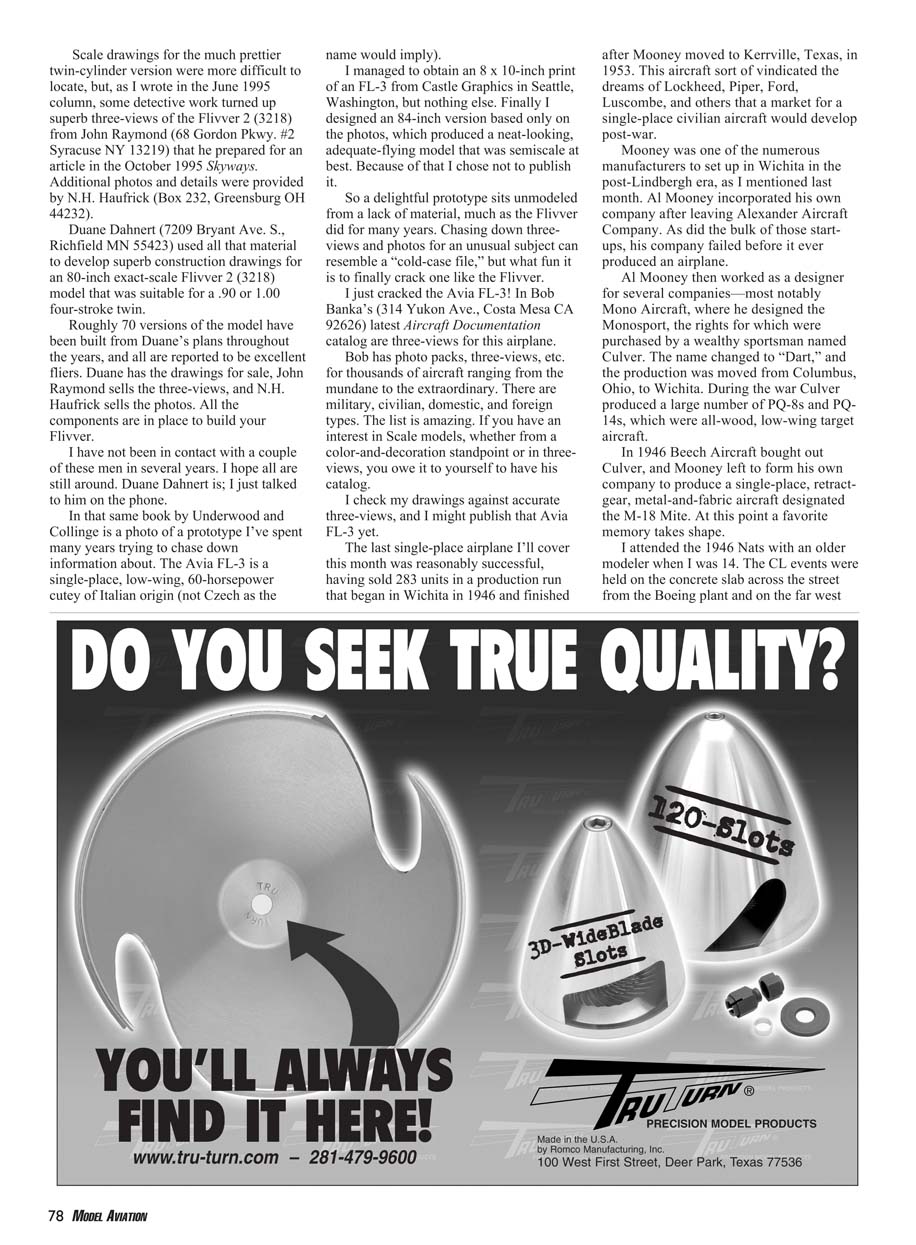
We saw a smallish, all-silver, low-wing airplane with a set of pulleys and belts running from the engine to the propeller. Unable to determine what power plant was being used, we did notice a belly scoop with a radiator in it and concluded that the design was water cooled. We were excited by our discovery and asked the adults around what the airplane might be. No one knew!
Several months later the aviation press identified what we had seen as the prototype for the Mooney Mite. The power plant was a four-cylinder Crosley automobile engine mounted in reverse, driving the propeller through reduction pulleys and belts. What an exciting discovery for two country boys!
This power plant proved to be underpowered and much too complex, and it was subsequently replaced with a 65-horsepower Lycoming horizontally opposed four-cylinder. Mooney recalled the seven aircraft he had produced with the Crosley and replaced them at no charge.
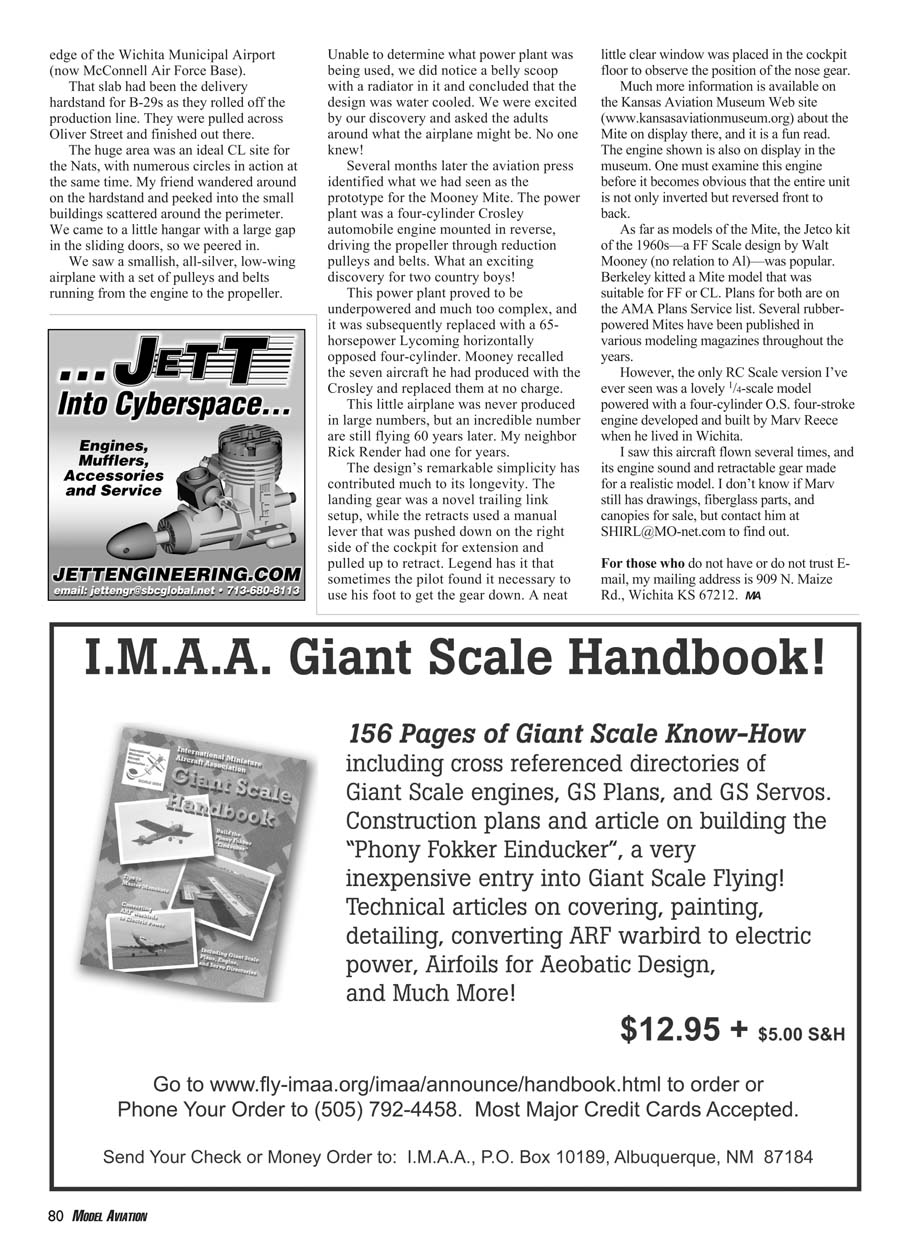
This little airplane was never produced in large numbers, but an incredible number are still flying 60 years later. My neighbor Rick Render had one for years. The design's remarkable simplicity has contributed much to its longevity. The landing gear was a novel trailing-link setup, while the retracts used a manual lever that was pushed down on the right side of the cockpit for extension and pulled up to retract. Legend has it that sometimes the pilot found it necessary to use his foot to get the gear down. A neat little clear window was placed in the cockpit floor to observe the position of the nose gear.
Much more information is available on the Kansas Aviation Museum Web site (www.kansasaviationmuseum.org) about the Mite on display there, and it is a fun read. The engine shown is also on display in the museum. One must examine this engine before it becomes obvious that the entire unit is not only inverted but reversed front to back.
As far as models of the Mite, the Jetco kit of the 1960s—a FF Scale design by Walt Mooney (no relation to Al)—was popular. Berkeley kitted a Mite model that was suitable for FF or CL. Plans for both are on the AMA Plans Service list. Several rubber-powered Mites have been published in various modeling magazines throughout the years.
However, the only RC scale version I've ever seen was a lovely 1/4-scale model powered with a four-cylinder O.S. four-stroke engine developed and built by Marv Reece when he lived in Wichita.
I saw this aircraft flown several times, and its engine sound and retractable gear made for a realistic model. I don't know if Marv still has drawings, fiberglass parts, and canopies for sale, but contact him at [email protected] to find out.
For those who do not have or do not trust e-mail, my mailing address is 909 N. Maize Rd., Wichita, KS 67212.
Transcribed from original scans by AI. Minor OCR errors may remain.

