
Flying for Fun - 2006/08
D.B. Mathews | [email protected]
Does your homeowner’s insurance cover your models if they are stolen?
The response to the report of the theft of my “modeling goodies” from a storage unit brought a surprising number of letters and e-mails. All were of the condolence variety, and many related stories of similar experiences.
Apparently model aircraft and associated support equipment are popular with thieves. One can only wonder why. Could it be the relative ease with which such merchandise can be sold illicitly? Frankly, who of us bothers to write down serial numbers?
A letter that deserves comment came from Rod Noll of Myerstown, Pennsylvania. He wrote:
“Several years ago on a Saturday evening I packed up my pickup truck with five airplanes and related field equipment so I could get an early start Sunday morning for our club fun-fly. When I came out of the house at daybreak, the lock on the door of the cab was broken. The inside of the truck looked like it had been steam cleaned, not even a speck of balsa dust!
“All the stuff I figured had a replacement value of over $4,000. When I tried to collect for my loss from my insurance company, they balked because my homeowner’s policy didn’t cover ‘losses due to incidents involving aircraft.’ If I would have had model trains or model cars in the truck they would have paid, but these were ‘airplanes.’
“Took me six months, two lawyers, one hearing, and nearly $1,000 in legal fees before the insurance company finally settled.”
Years ago I got curious about a similar rider in my homeowner’s policy and wrote the company (not the agent) for an interpretation of the “incidents involving aircraft.” I wanted to clearly understand that they would cover property damage and/or liability claims arising from my flying model airplanes away from home.
The answer was complex, as insurance language always is, but boiled down the answer was that I was not covered for accidents involving flying model airplanes under the aviation clause in my policy. I shopped around for a homeowner’s policy that did cover model airplanes.
I’ve related these experiences as a way to warn you to check your homeowner’s policy and get in writing from your underwriter that you and your model airplanes are covered for theft or liability. Otherwise, your AMA insurance will have to be primary rather than supplemental. Don’t presume anything unless you have it in writing! Additionally, don’t be comfortable flying with someone who is not an AMA member but is covered by his or her homeowner’s policy.
Design/Build/Fly Revisited
Several years ago I wrote a column about the American Institute of Aeronautics and Astronautics (AIAA) annual model-airplane event for university engineering students from around the world.
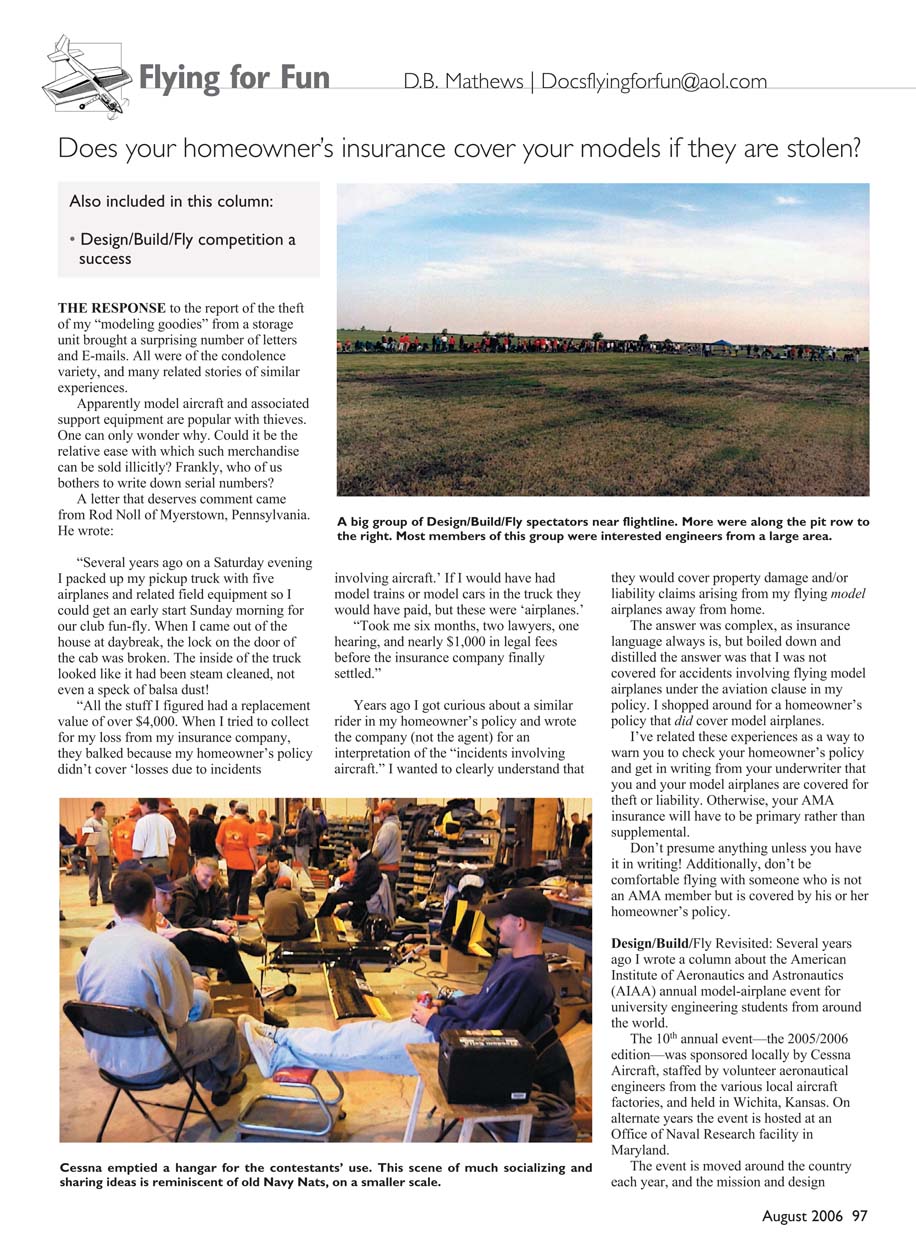
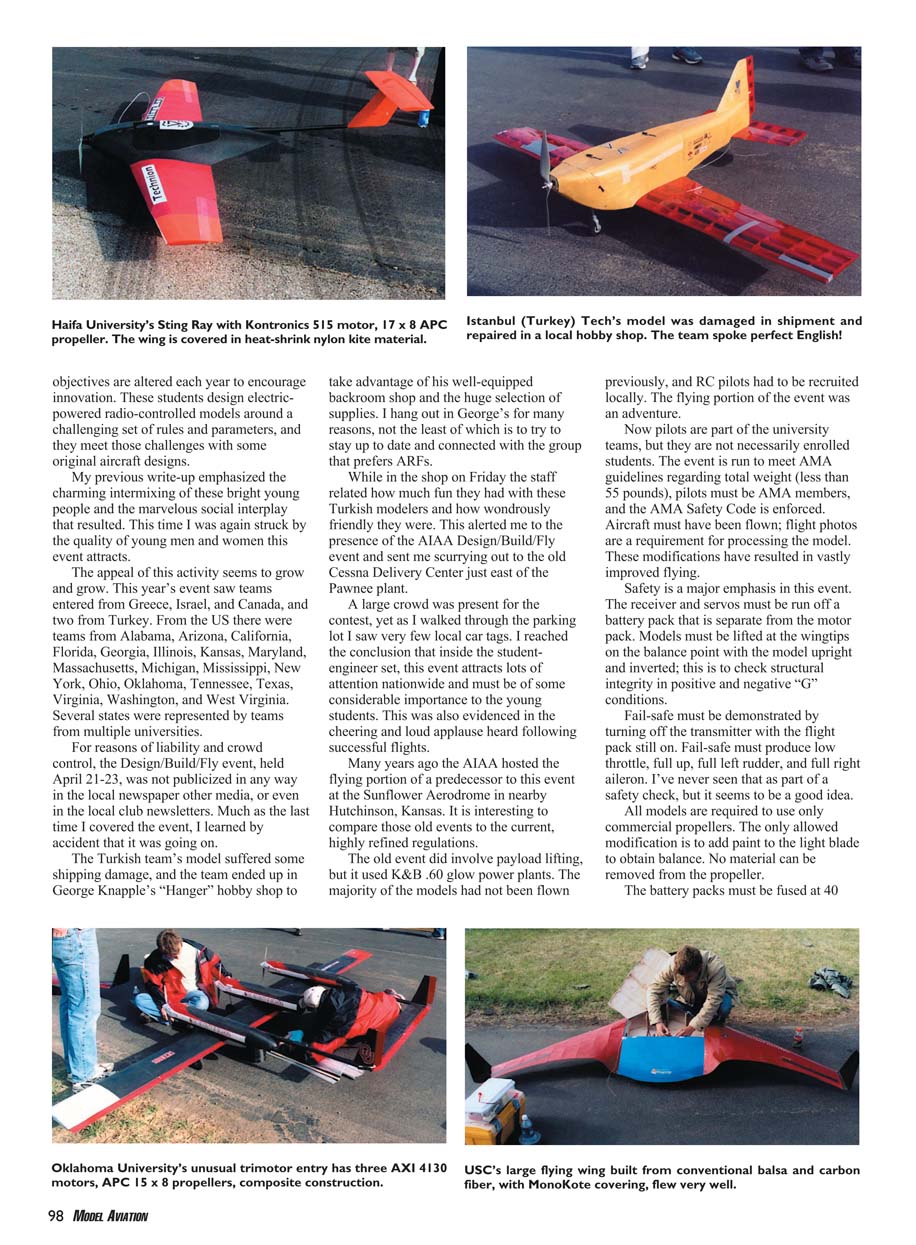
The 10th annual event—the 2005/2006 edition—was sponsored locally by Cessna Aircraft, staffed by volunteer aeronautical engineers from the various local aircraft factories, and held in Wichita, Kansas. On alternate years the event is hosted at an Office of Naval Research facility in Maryland. The event is moved around the country each year, and the mission and design objectives are altered annually to encourage innovation. These students design electric-powered radio-controlled models around a challenging set of rules and parameters, and they meet those challenges with some original aircraft designs.
My previous write-up emphasized the charming intermixing of these bright young people and the marvelous social interplay that resulted. This time I was again struck by the quality of young men and women this event attracts.
The appeal of this activity seems to grow and grow. This year’s event saw teams entered from:
- Greece
- Israel
- Canada
- Turkey (two teams)
From the United States there were teams from:
- Alabama
- Arizona
- California
- Florida
- Georgia
- Illinois
- Kansas
- Maryland
- Massachusetts
- Michigan
- Mississippi
- New York
- Ohio
- Oklahoma
- Tennessee
- Texas
- Virginia
- Washington
- West Virginia
Several states were represented by teams from multiple universities.
For reasons of liability and crowd control, the Design/Build/Fly event, held April 21–23, was not publicized in any way in the local newspaper, other media, or even in the local club newsletters. Much as the last time I covered the event, I learned by accident that it was going on.
The Turkish team’s model suffered some shipping damage, and the team ended up in George Knapp’s hangar hobby shop to take advantage of his well-equipped backroom shop and the huge selection of supplies. I hang out in George’s for many reasons, not the least of which is to try to stay up to date and connected with the group that prefers ARFs.
While in the shop on Friday the staff related how much fun they had with these Turkish modelers and how wondrously friendly they were. This alerted me to the presence of the AIAA Design/Build/Fly event and sent me scurrying out to the old Cessna Delivery Center just east of the Pawnee plant.
A large crowd was present for the contest, yet as I walked through the parking lot I saw very few local car tags. I reached the conclusion that inside the student-engineer set, this event attracts lots of attention nationwide and must be of some considerable importance to the young students. This was also evidenced in the cheering and loud applause heard following successful flights.
Many years ago the AIAA hosted the flying portion of a predecessor to this event at the Sunflower Aerodrome in nearby Hutchinson, Kansas. It is interesting to compare those old events to the current, highly refined regulations.
The old event did involve payload lifting, but it used K&B .60 glow power plants. The majority of the models had not been flown previously, and RC pilots had to be recruited locally. The flying portion of the event was an adventure.
Now pilots are part of the university teams, but they are not necessarily enrolled students. The event is run to meet AIAA guidelines regarding weight (less than 55 pounds), pilots must be AMA members, and the AMA Safety Code is enforced. Aircraft must have been flown; flight photos are a requirement for processing the model. These modifications have resulted in vastly improved flying.
Safety is a major emphasis in this event. Key safety and equipment rules include:
- The receiver and servos must be run off a battery pack that is separate from the motor pack.
- Models must be lifted at the wingtips on the balance point with the model upright and inverted; this checks structural integrity in positive and negative “G” conditions.
- Fail-safe must be demonstrated by turning off the transmitter with the flight pack still on. Fail-safe must produce low throttle, full up elevator, full left rudder, and full right aileron.
- All models are required to use only commercial propellers. The only allowed modification is to add paint to the light blade to obtain balance. No material can be removed from the propeller.
- Battery packs must be fused at a 40-amp maximum draw with an ATO or blade-type automobile fuse.
- Ni-Cd or NiMH battery packs must be over-the-counter units with all electrical connectors attached and the pack shrink-wrapped. No exposed battery posts.
- The arming fuse (switch) must be accessible from the rear of the model; no reaching over the propeller arc.
- Battery packs must not weigh more than 3 pounds.
Most packs I observed were apparently nickel-cadmium types. I have no idea why Li-Po packs are not allowed; perhaps the fact that teams already have Ni-Cds left over from previous years' projects is a factor, or perhaps the cost of components being part of the scoring process is significant.
To add to the challenges of this event, all models must be designed to fit inside a 4-foot by 2-foot by 15-inch box. Wing panels and fuselages must be sectional. Consider the challenge of stuffing a 96-inch-span model into such a small box. These bright youngsters came up with ways to do it.
Other rules include:
- No rotary-wing or lighter-than-air designs permitted.
- No parts dropping.
- No winches or hi-starts.
- Motors must be over-the-counter, unmodified units (geared or direct-drive, brushed or brushless).
Five flight attempts for the two best missions are permitted. Takeoff is from inside a 100-foot box marked on the runway. The course consists of a 500-foot upwind leg, a 90° turn, a 1,000-foot downwind leg with a 360° turn at two-thirds of its length, a 90° turn into the wind, and a landing inside the takeoff box. If the model lands outside the box or off the runway, the crew must retrieve it and return it to the start/finish line.
The cycle requires unloading the cargo, placing it off the runway in a designated pit area, and installing the next cargo to repeat the cycle. These young people running to retrieve their models, running the old cargo to the pits, and running back with the new cargo adds considerable excitement and athleticism to the whole proceeding. It’s little wonder the crowd gets involved in the excitement.
The cargo consists of a provided 4 x 4 x 24-inch wood block weighing 8 pounds, followed by as many as five 2-liter plastic bottles of water, and 48 loose tennis balls. Each cargo load must be flown from the previously described runway block, the model must complete the prescribed flight maneuvers, and it must stay in the air a minimum of two minutes.
Cargos must be secured structurally—not with tape or Velcro. No external pods can be used for the loads.
Judging is based on an engineering-design report, a rated aircraft-cost study, and the flight score. The number of pop bottles successfully flown has a great impact on the flight score, and everything else being equal, that makes a big difference.
The official results were unavailable at the time this was written, and I’m not too sure they had much impact on the levels of fun and fellowship these young aeronautical engineering students experienced. I do know that the University of Southern California flying wing successfully lifted five 2-liter bottles of water.
As I mentioned in previous columns about this event, it is a wonderful experience to be around these bright young men and women, to observe their creative minds at work, and to listen to them excitedly interact with students from around the world with whom they share a common bond in aeronautical engineering. The aviation industry is going to be in wonderful hands in the future.
MA
Transcribed from original scans by AI. Minor OCR errors may remain.

