
Flying for Fun - 2006/10
D.B. Mathews | [email protected]
FOR THOSE who do not have access to the Internet, my mailing address is 909 N. Maize Rd., Wichita, KS 67212.
Lockheed Little Dipper lovers are in luck
Do you remember the Lockheed Little Dipper I featured in the June column? I mentioned a short kit with cowl, canopy, etc., by P&W Models.
Frank Healey, at 189 Columbus Dr., Archbald, PA 18403, read the piece, which sent him on a search. He finally found his old kit, complete with construction drawings, among the Christmas decorations. He is willing to sell it if you're interested. His e-mail address is [email protected].
The telephone number I gave you in that column for the Radio Control Modeler plans service went out of service shortly after I wrote about it. The Web site—www.rcmmagazine.com—is still functional at this time.
Also included in this column:
- Cox history with Dale Kirn
- 1946–1953 Plymouth Internats
- The 47‑year‑old youth problem
Old Friends and Good Memories
I recently visited with Dale Kirn at the one‑day "Just Plane Fun" exhibit at the Smoky Hill Museum in Salina, Kansas. This marvelous and well‑done display centered around Dale, a local boy, and his lifetime activities and achievements with model aviation.
I enjoyed a wonderful visit with Dale. We reminisced about our modeling adventures in the long ago. He and I are contemporaries, and our paths crossed many times in the late 1940s at local contests.
I've always secretly envied Dale for managing to carve out a career in modeling, which many of us longtime modelers dreamed of doing in our youth. When he finished his tour with the Air Force (and he was on several Air Force national modeling teams), he went to work for Victor Stanzel demonstrating Mono‑Line (single‑line) flying across the country.
Dale would show up in cities and towns in a Chevy Bel Air station wagon. It had a large Stanzel sign on the roof, with all sorts of Stanzel and Mono‑Line graphics on it. Dale would then fly at the local CL circles.
Most memorable was his flying a .35‑size model on a 120‑foot line. No joke! I distinctly remember the lines actually dragging the ground. This was astonishing to us since slack lines were the nemesis of the two‑line‑system flier.
Later, after earning a degree from Kansas State, Dale went to work for Leroy Cox as an industrial engineer. Much of the Cox line of engines and ready‑to‑fly CL models bears his touch.
Dale and a gang of young boys would show up at important contests, particularly the Nats, to run a "fly a model" circle for the kids in attendance. They enclosed a circle with snow fence and would put any kid on the lines for a free introductory flight. The line often had 50 or more youngsters in it, waiting their turn.
My sons, who were young at that time, got a kick out of Dale’s method of handling the inevitable crashes. He and his crew would pick up the pieces and toss them into a 55‑gallon barrel! They salvaged the pieces and reassembled the good parts in the evenings, but my boys didn’t know that.
Dale and I were chatting about this activity when we met, and I asked for an estimate of how many young boys and girls got their first exposure to modeling at the Cox circles. Dale didn’t have an accurate count, but we estimated it to be in excess of 200,000.
That led to a question of how many of those kids went any further with the hobby. We concluded that there was no way to tell.
Was this promotion successful? Cox sold a ton of ready‑to‑fly PT trainers, etc., for sure. For years the things were included in the Sears Christmas catalog. But kids could fly CL on school playgrounds, parks, and baseball diamonds then.
Dale and his crew conducted a training session each year between Christmas and the new year for youngsters, and there were new CL ready‑to‑fly presents on the parking lot of the Anaheim stadium.
In later years Dale restored models and developed displays for the Stanzel Aircraft Museum in Schulenburg, Texas, which I’m told is excellent. For many years he manufactured and sold accessories for Cox engines—most notably a fine‑thread needle valve and body which greatly simplified setting a needle on the TD engine series—especially when using fuel pressure.
Plymouth Internats
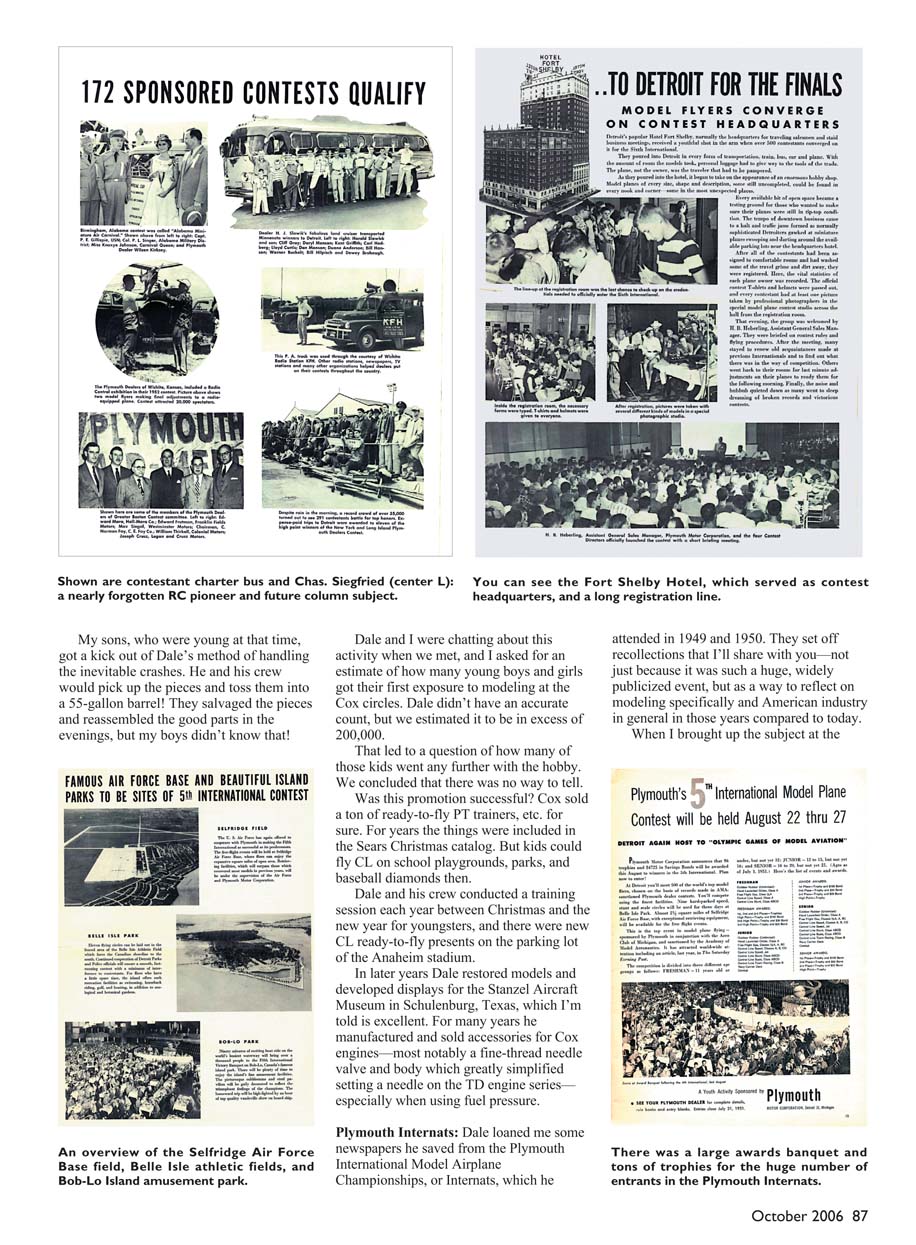
Dale loaned me some newspapers he saved from the Plymouth International Model Airplane Championships, or Internats, which he attended in 1949 and 1950. They set off recollections that I’ll share with you—not just because it was such a huge, widely publicized event, but as a way to reflect on modeling specifically and American industry in general in those years compared to today.
When I brought up the subject at the local hobby shop, I was astonished to find no modelers younger than 70 who were even aware of the Plymouth events or of their sponsorship. It seems that a significant part of our history has been forgotten, but it was full of successes.
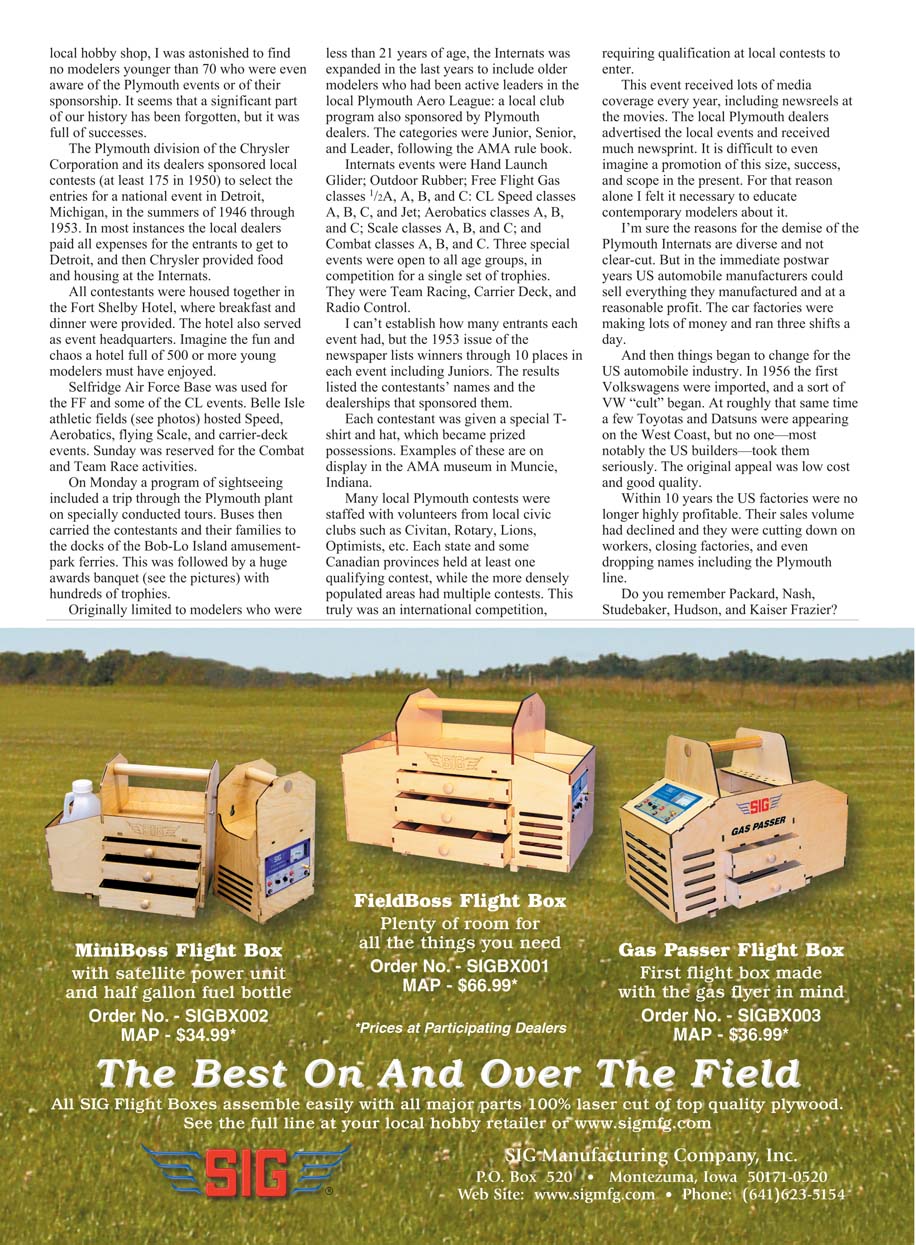
The Plymouth division of the Chrysler Corporation and its dealers sponsored local contests (at least 175 in 1950) to select the entries for a national event in Detroit, Michigan, in the summers of 1946 through 1953. In most instances the local dealers paid all expenses for the entrants to get to Detroit, and then Chrysler provided food and housing at the Internats.
All contestants were housed together in the Fort Shelby Hotel, where breakfast and dinner were provided. The hotel also served as event headquarters. Imagine the fun and chaos a hotel full of 500 or more young modelers must have enjoyed.
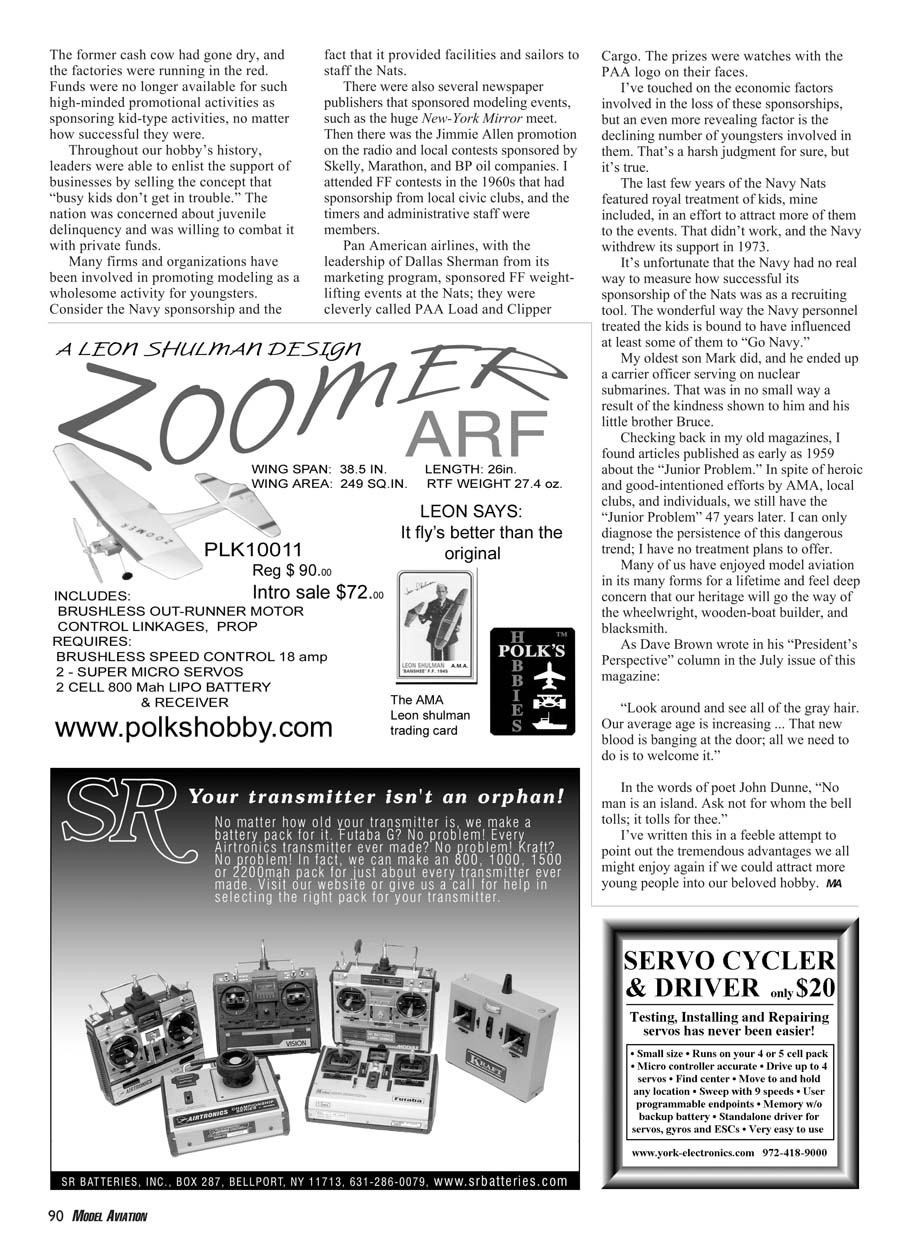
Selfridge Air Force Base was used for the FF and some of the CL events. Belle Isle athletic fields hosted Speed, Aerobatics, flying Scale, and carrier‑deck events. Sunday was reserved for the Combat and Team Race activities.
On Monday a program of sightseeing included a trip through the Plymouth plant on specially conducted tours. Buses then carried the contestants and their families to the docks of the Bob‑Lo Island amusement‑park ferries. This was followed by a huge awards banquet with hundreds of trophies.
Originally limited to modelers who were less than 21 years of age, the Internats was expanded in the last years to include older modelers who had been active leaders in the local Plymouth Aero League: a local club program also sponsored by Plymouth dealers. The categories were Junior, Senior, and Leader, following the AMA rule book.
Internats events included:
- Hand Launch Glider
- Outdoor Rubber
- Free Flight Gas classes 1/2A, A, B, and C
- CL Speed classes A, B, C, and Jet
- Aerobatics classes A, B, and C
- Scale classes A, B, and C
- Combat classes A, B, and C
Three special events were open to all age groups, in competition for a single set of trophies:
- Team Racing
- Carrier Deck
- Radio Control
I can't establish how many entrants each event had, but the 1953 issue of the newspaper lists winners through 10 places in each event including Juniors. The results listed the contestants' names and the dealerships that sponsored them.
Each contestant was given a special T‑shirt and hat, which became prized possessions. Examples of these are on display in the AMA museum in Muncie, Indiana.
Many local Plymouth contests were staffed with volunteers from civic clubs such as Civitan, Rotary, Lions, Optimists, etc. Each state and some Canadian provinces held at least one qualifying contest, while more densely populated areas had multiple contests. This truly was an international competition, requiring qualification at local contests to enter.
This event received lots of media coverage every year, including newsreels at the movies. The local Plymouth dealers advertised the local events and received much newsprint. It is difficult to even imagine a promotion of this size, success, and scope in the present. For that reason alone I felt it necessary to educate contemporary modelers about it.
I'm sure the reasons for the demise of the Plymouth Internats are diverse and not clear‑cut. But in the immediate postwar years US automobile manufacturers could sell everything they manufactured and at a reasonable profit. The car factories were making lots of money and ran three shifts a day.
And then things began to change for the US automobile industry. In 1956 the first Volkswagens were imported, and a sort of "VW" cult began. At roughly that same time a few Toyotas and Datsuns were appearing on the West Coast, but no one—most notably the US builders—took them seriously. The original appeal was low cost and good quality.
Within 10 years the US factories were no longer highly profitable. Their sales volume had declined and they were cutting down on workers, closing factories, and even dropping names including the Plymouth line.
Do you remember Packard, Nash, Studebaker, Hudson, and Kaiser‑Frazer? The former cash cow had gone dry, and the factories were running in the red. Funds were no longer available for such high‑minded promotional activities as sponsoring kid‑type events, no matter how successful they were.
Throughout our hobby’s history, leaders were able to enlist the support of businesses by selling the concept that "busy kids don’t get in trouble." The nation was concerned about juvenile delinquency and was willing to combat it with private funds.
Many firms and organizations have been involved in promoting modeling as a wholesome activity for youngsters. Consider the Navy sponsorship and the fact that it provided facilities and sailors to staff the Nats.
There were also several newspaper publishers that sponsored modeling events, such as the huge New York Mirror meet.
Then there was the Jimmie Allen promotion on the radio and local contests sponsored by Skelly, Marathon, and BP oil companies. I attended FF contests in the 1960s that had sponsorship from local civic clubs, and the timers and administrative staff were members.
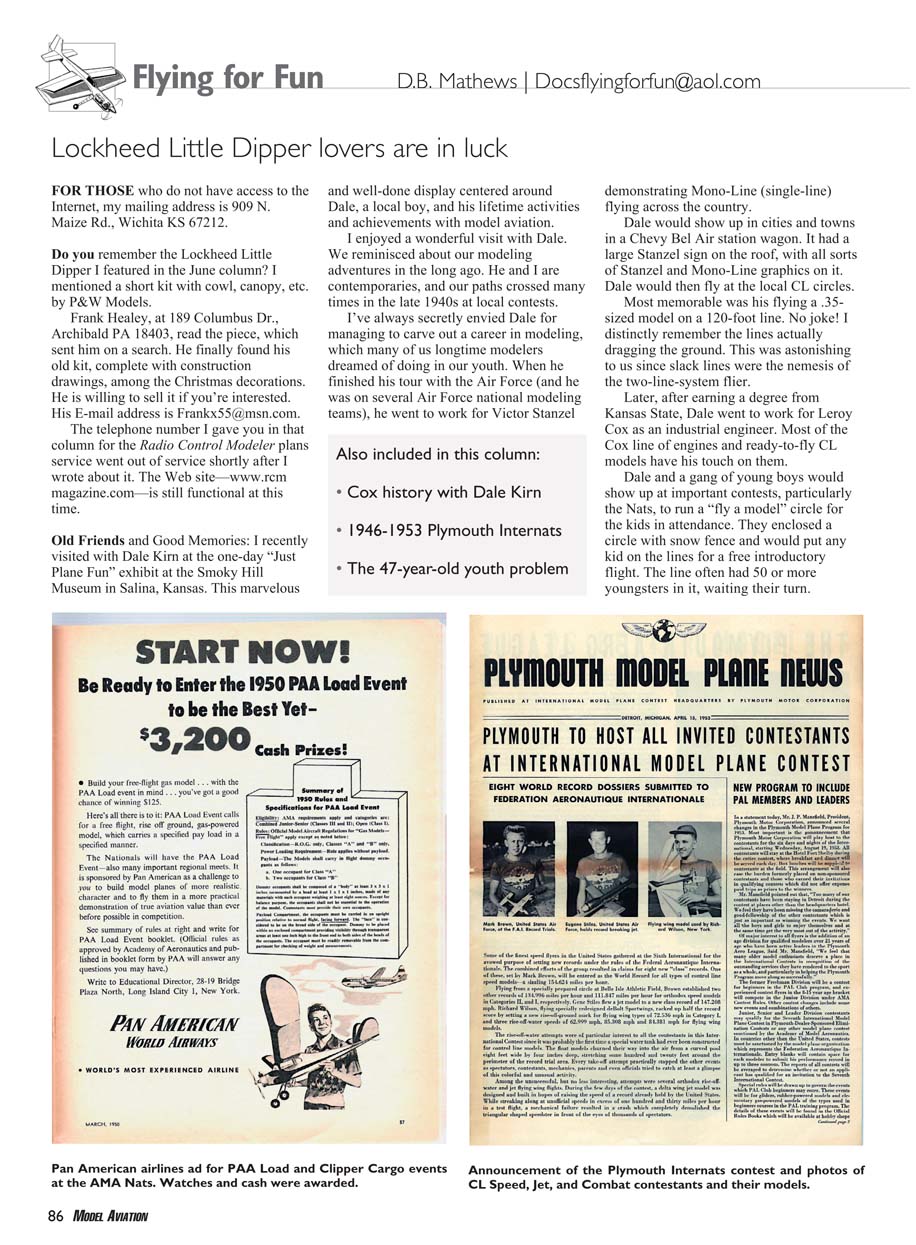
Pan American Airlines, with the leadership of Dallas Sherman from its marketing program, sponsored FF weight‑lifting events at the Nats; they were cleverly called PAA Load and Clipper Cargo. The prizes were watches with the PAA logo on their faces.
The 47‑year‑old youth problem
I’ve touched on the economic factors involved in the loss of these sponsorships, but an even more revealing factor is the declining number of youngsters involved in them. That’s a harsh judgment for sure, but it’s true.
The last few years of the Navy Nats featured royal treatment of kids, mine included, in an effort to attract more of them to the events. That didn’t work, and the Navy withdrew its support in 1973.
It’s unfortunate that the Navy had no real way to measure how successful its sponsorship of the Nats was as a recruiting tool. The wonderful way the Navy personnel treated the kids is bound to have influenced at least some of them to "Go Navy."
My oldest son Mark did, and he ended up a carrier officer serving on nuclear submarines. That was in no small way a result of the kindness shown to him and his little brother Bruce.
Checking back in my old magazines, I found articles published as early as 1959 about the "Junior Problem." In spite of heroic and good‑intentioned efforts by AMA, local clubs, and individuals, we still have the "Junior Problem" 47 years later. I can only diagnose the persistence of this dangerous trend; I have no treatment plans to offer.
Many of us have enjoyed model aviation in its many forms for a lifetime and feel deep concern that our heritage will go the way of the wheelwright, wooden‑boat builder, and blacksmith.
As Dave Brown wrote in his "President’s Perspective" column in the July issue of this magazine: "Look around and see all of the gray hair. Our average age is increasing ... That new blood is banging at the door; all we need to do is to welcome it."
In the words of poet John Donne, "No man is an island. Ask not for whom the bell tolls; it tolls for thee."
I’ve written this in a feeble attempt to point out the tremendous advantages we all might enjoy again if we could attract more young people into our beloved hobby.
MA
Transcribed from original scans by AI. Minor OCR errors may remain.

